OKR Tracking Software: From Planning to Achievement in 2026
Confused by OKR tracking software? This guide explains key features, how to choose the right tool, and how to turn your goals into daily achievements.
You probably already have goals written down somewhere.
They're in a planning doc, a Notion page, a spreadsheet tab, maybe a slide from the last quarterly meeting. Everyone agreed on them. Everyone nodded. Then real work resumed, deadlines piled up, and the goals slowly turned into background decoration.
That's the moment when teams typically start looking for okr tracking software. Not because they need prettier dashboards, but because they need a system that keeps goals connected to the work happening on Tuesday afternoon, not just to the strategy meeting from last month. If you manage a team, build a startup, or run your own projects, that distinction matters. A goal you can see is useful. A goal system that helps you act on it every day is much more valuable.
A lot of performance problems are really visibility problems mixed with follow-through problems. You can see a similar theme in AsanteBot's team insights, which focus on making performance measurable in ways teams can realistically use. OKRs work best in that same spirit. Clear direction, visible progress, and routines that make action easier.
Table of Contents
- What Is OKR Tracking Software and Why It Matters
- Understanding the Anatomy of an OKR System
- Essential Features of Modern OKR Tracking Software
- How to Choose the Right OKR Software for Your Needs
- A Practical Roadmap for Implementing Your OKR System
- Beyond Tracking The Future of Goal Achievement
What Is OKR Tracking Software and Why It Matters
OKR tracking software is a tool for setting objectives and key results, then keeping them visible, updated, and tied to actual work. At a basic level, it replaces scattered spreadsheets and static documents. At a better level, it becomes a shared system that shows what matters now, who owns what, and where progress is slipping.
That second version is why this category has become so important. The global OKR software market was estimated at USD 1.73 billion in 2026 and is projected to reach USD 5.15 billion by 2034, according to Fortune Business Insights on the OKR software market. That doesn't prove every tool is useful, but it does show that organizations increasingly treat goal tracking as core operating software, not a side utility.
The confusion starts when people think OKR software is just a scorecard.
It isn't, or at least it shouldn't be. A scorecard tells you whether the quarter went well. Good okr tracking software helps you adjust before the quarter goes badly. It closes the gap between strategic intent and daily execution.
Practical rule: If your tool only gets opened during review meetings, you don't have an execution system. You have a reporting system.
The easiest way to understand the value is to compare three common setups:
- Spreadsheet setup: Works for a very small team. Easy to start. Hard to keep current.
- Dashboard-only tool: Gives leadership visibility. Often weak at turning goals into weekly action.
- Execution-focused OKR system: Tracks goals, shows ownership, prompts updates, and helps people decide what to do next.
For founders, that means fewer goals drifting into wishful thinking. For managers, it means less chasing people for updates. For individuals, it means goals stop feeling abstract and start becoming schedulable work.
Understanding the Anatomy of an OKR System
A lot of people hear OKR jargon and tune out. The framework is much simpler than it sounds when you strip it down.
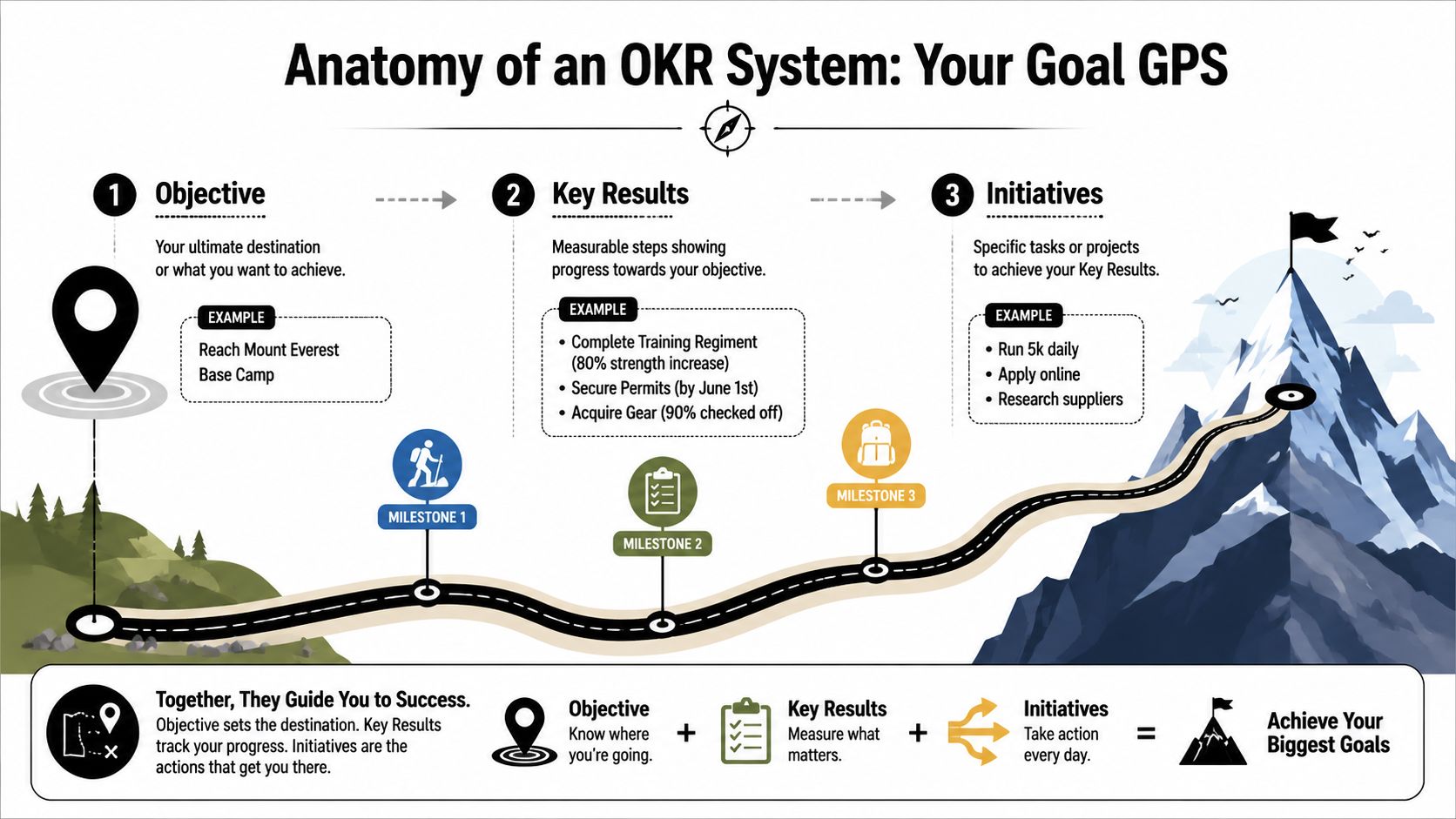
Think of an OKR system like a road trip plan. You need a destination, proof that you're getting closer, and the actions that move the car.
Objectives key results and initiatives
An objective is the destination. It should be directional and motivating.
Example: Launch a more reliable onboarding experience.
A key result is a measurable sign that tells you whether you're getting there.
Examples:
- Reduce onboarding drop-off
- Increase completion of first-time setup
- Cut support tickets related to onboarding confusion
An initiative is the work you do to influence those results.
Examples:
- Rewrite setup steps
- Add tooltips inside the product
- Fix the most common setup errors
- Run user interviews with new customers
The mistake many teams make is mixing these layers together. They write an objective that is a task, or a key result that's really an activity. When that happens, the software can't help much because the structure itself is blurry.
If you need help writing clean goals before you load them into a tool, this goal setup guide for structured planning is useful because it forces the distinction between the outcome you want and the actions that support it.
A healthy OKR has one clear destination, a handful of measurable signals, and work that obviously connects to those signals.
Why hierarchy matters
Things get more interesting when multiple people or teams are involved.
Good OKR systems don't store goals as isolated cards. They use a hierarchical data model so a lower-level key result can connect to a higher-level objective. Planview describes this as the ability to see how goals connect across levels in the organization through hierarchical OKR software structures.
That matters because alignment is not just a management slogan. It's a data problem.
Here's a simple example:
| Level | Example |
|---|---|
| Company objective | Improve customer retention |
| Product team key result | Reduce time to first value |
| Support team key result | Resolve onboarding blockers faster |
| Individual initiative | Publish weekly onboarding issue review |
When the software can map those relationships, a manager can see whether teams are contributing to the same strategic aim or just producing disconnected activity. When it can't, the system becomes a pile of goals with no visible logic.
For a founder with five people, hierarchy might be light. For a larger company, it's the difference between coordinated execution and polite chaos.
Essential Features of Modern OKR Tracking Software
The market has shifted away from static quarterly logging and toward systems that update more continuously. WorkBoard notes that modern platforms increasingly use structured trees, automated updates, predictive risk alerts, and AI nudges. It also points to trends such as AI in goal tracking (29%), mobile-first tools (26%), and smart alerts (21%) in its overview of modern OKR software trends.
That shift changes what you should look for in a tool. The goal isn't a prettier place to enter goals. The goal is a system that reduces lag between work, insight, and action.
Visibility that changes behavior
The first feature set is about seeing the state of execution clearly.
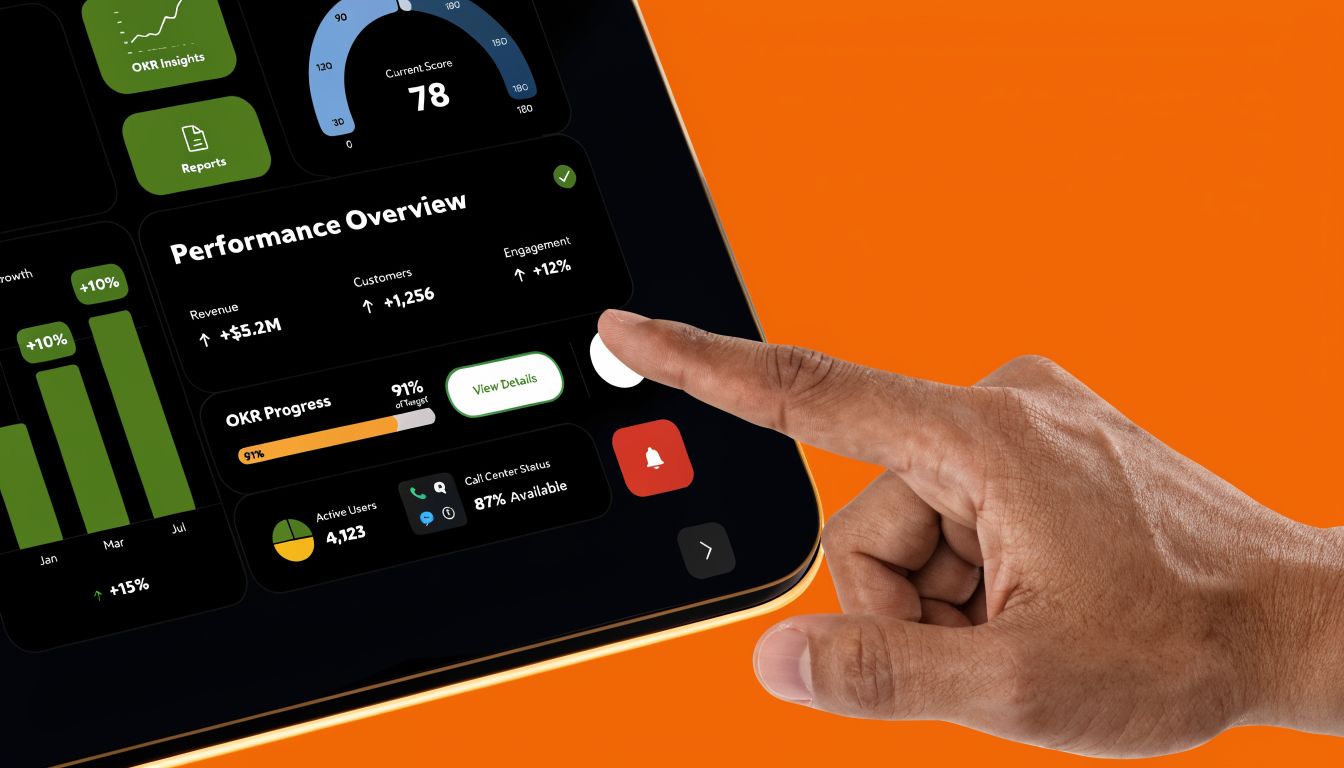
This includes dashboards, progress bars, status indicators, ownership fields, and drill-down views by team or time period. On paper, these sound ordinary. In practice, they change meetings. Instead of asking, “What's going on?” you start asking, “Why is this off track?” or “What do we need to change this week?”
Useful visibility features include:
- Progress views: People should be able to tell quickly whether a key result is advancing, stalled, or at risk.
- Ownership clarity: Every objective and key result needs a named owner, not “marketing” or “product.”
- Alignment views: Leaders need to inspect goals by team, department, or region.
- Trend history: A current score without movement over time is weak signal.
If you want one test, use this one: can a new manager open the tool and understand what matters in under a few minutes? If not, the interface may look polished while still being operationally confusing.
Automation that removes admin work
Manual check-ins create friction. Friction kills adoption.
The best okr tracking software reduces repeated status entry by pulling updates from tools teams already use, such as Slack, Google Workspace, Trello, project trackers, or BI systems. Craze and Teamflect highlight automated reminders, dashboards, analytics, exports, and predictive support in their discussion of core OKR software capabilities.
This matters for a very practical reason. Every manual process introduces delay:
- People forget to update.
- Managers review stale information.
- Risks surface late.
- Corrective action happens after the window to fix things has narrowed.
A good tool should also help turn goals into milestones. That's where something like a milestone generator for breaking goals into steps becomes relevant. The software shouldn't just ask, “How's the objective going?” It should help answer, “What are the next concrete steps that make progress likely?”
When people say their OKR process failed, they often mean the update process was too annoying to sustain.
Intelligence that helps you intervene earlier
The third feature set is where many buyers get distracted by marketing language. “AI-powered” can mean almost anything.
Focus on narrow, useful behaviors instead:
- Risk alerts that flag slipping goals
- Smart reminders based on inactivity or due dates
- Progress summaries that condense updates into readable form
- Suggested goal language when teams struggle to write measurable key results
- Exportable reporting for executive reviews or deeper analysis
Those features matter because managers don't need AI for decoration. They need help spotting problems sooner and reducing the effort required to maintain the system.
Leaders who are tightening their measurement discipline may also find this practical guide for leaders useful, especially when choosing metrics that reflect outcomes instead of just busyness.
Different users will value these capabilities differently:
| User type | Most useful feature pattern |
|---|---|
| Founder | Fast visibility across a small team, low admin overhead |
| Department manager | Alignment views, reminders, review workflows |
| Individual contributor | Clear ownership, simple updates, milestone-level clarity |
| Solo user or student | Daily-action support, minimal setup, habit-friendly structure |
The best tools make the complex parts invisible. You should feel more focused using them, not more supervised.
How to Choose the Right OKR Software for Your Needs
Most buyers compare OKR software the wrong way. They compare feature count.
That usually leads them toward a large platform with dashboards, permissions, reporting layers, templates, and a dozen integration logos. Then adoption stalls because the actual problem wasn't lack of features. It was lack of daily usability.
The more useful question is this: What job does the tool need to do in your environment?
Choose for the job not the feature list
People Managing People points to an important gap in the category. Many tools are strong at tracking and weak at translating goals into daily execution. Their coverage notes that the most effective options for individuals and small teams help decompose objectives into sequenced, actionable tasks in its guide to choosing OKR software for practical execution.
That's the contrarian filter worth using.
If you're a founder, your job-to-be-done may be: “Keep the company focused on a few priorities without creating process overhead.”
If you're a manager, it may be: “See where my team is drifting and run better weekly check-ins.”
If you're an individual, it may be: “Turn a big goal into something I can work on this week.”
A tool can be excellent for one of those jobs and clumsy for another.
Buy for the behavior you want to reinforce. Don't buy for the screenshot that looks most impressive in a demo.
A few practical examples:
- A startup founder often needs lightweight alignment and fast updates, not enterprise governance.
- A team manager usually needs hierarchy, ownership, reporting, and review cadence support.
- A student, creator, or solo professional often needs decomposition, routines, and momentum more than dashboards.
OKR software decision checklist
| Evaluation Criteria | Why It Matters for Founders | Why It Matters for Managers | Why It Matters for Individuals |
|---|---|---|---|
| Ease of setup | You need momentum fast and can't spend weeks configuring | Faster rollout means better team adoption | If setup feels heavy, you'll abandon it |
| Goal hierarchy | Helps connect company priorities to team work as you grow | Critical for tracing team output to department goals | Often less important than clarity and simplicity |
| Daily action support | Keeps strategy from staying too abstract | Helps teams translate goals into weekly tasks | This is often the deciding factor |
| Automation and reminders | Reduces manual follow-up from the founder | Keeps check-ins consistent without chasing people | Useful when motivation fluctuates |
| Reporting and review views | Helps you see whether priorities are moving | Supports one-on-ones and team reviews | Nice to have, but should stay simple |
| Integrations | Cuts duplicate entry across your stack | Creates a more reliable source of truth | Helpful if you already use task tools |
| Mobile usability | Useful when you work across meetings and travel | Helps managers update and review on the move | Important if you manage goals from your phone |
| Learning curve | High complexity creates rollout resistance | Complicated tools make teams fake compliance | Simplicity keeps you engaged longer |
This is also the point where it's fair to compare tool styles rather than just products. Some software behaves like a management platform. Some behaves like a planning assistant. Some behaves like a personal execution engine. They're not interchangeable, even if they all use OKR language.
A Practical Roadmap for Implementing Your OKR System
The software choice matters. The operating rhythm matters more.
Teams rarely fail with OKRs because the interface was missing a button. They fail because they load goals into a tool, announce the rollout, and never build the weekly habits that make the system real.
Start small and define the operating rhythm
Start with a narrow rollout. One team, one quarter, a small set of objectives.
That keeps the process learnable. It also gives you room to fix messy goal writing, weak ownership, or update fatigue before the system spreads. If you need a drafting starting point, a simple OKR generator for writing measurable goals can help teams get unstuck during setup.
A practical rollout often looks like this:
- Pick a small pilot group. Choose a team that already has a clear planning rhythm.
- Write fewer goals. If everything is a priority, nothing is.
- Define update cadence. Weekly usually works better than waiting for monthly reviews.
- Set ownership rules. Every key result needs one clear owner.
- Agree on review behavior. Decide what happens when a goal turns yellow or red.
For teams that struggle with first-draft language, an effective OKR planning tool can also help generate rough starting points that managers can refine.
Build habits around the tool
An OKR platform becomes useful when it attaches to routines people already keep.
That might mean:
- Calendar blocks: Schedule a short weekly review at the same time every week.
- Meeting templates: Use the OKR dashboard as the first screen in team check-ins.
- Task links: Connect initiatives to project or task systems so progress doesn't live in isolation.
- Personal planning: Turn each key result into a few concrete milestones for the week.
If you want a quick walkthrough of OKR basics and review rhythms, this short video is a helpful primer before you formalize your process.
One useful implementation test is simple: can a team member explain what they should do this week because the OKR system exists? If the answer is no, the process is still too abstract.
Use reviews to learn not to punish
Scorecards should support learning.
If teams treat every miss as failure, they'll game the numbers, lower ambition, and update less transparently. The better pattern is to treat reviews as structured diagnosis:
- What moved?
- What stalled?
- What assumption was wrong?
- What needs to change next week?
Category differences become apparent. Some tools mainly record progress. Others try to help users convert goals into milestones, routines, and next actions. This latter style is often more useful for people who don't have a dedicated operations layer around them.
One example in that execution-focused category is Beyond Time by Tribble Software Private Limited. It uses an OKR-based model to generate milestones, connect them to routines and habits, add short-interval time tracking in its iOS app, and provide a daily AI critique aimed at the most impactful focus for the day. That's a different shape of product from a classic executive dashboard, and for many users it's closer to what implementation genuinely needs.
Beyond Tracking The Future of Goal Achievement
Most okr tracking software still solves the visibility problem first. That's useful, but it's incomplete.
The harder problem is execution. People don't miss goals because they lacked one more dashboard. They miss goals because high-level plans don't automatically turn into prioritized actions, realistic routines, and honest feedback loops. The future of the category is moving in that direction. Less passive tracking. More active assistance.
That's why the most interesting tools aren't just asking users to enter goals and update percentages. They're helping users break goals into milestones, compare planned time with actual time spent, and reflect on what is or isn't moving the work forward. When software can support that loop, it starts behaving less like a reporting surface and more like a daily execution partner.
For founders, that means fewer strategy documents that drift away from reality. For managers, it means better coaching conversations because the data connects to actual work patterns. For students and self-directed professionals, it means the system doesn't stop at ambition. It reaches the calendar, the checklist, and the habit layer.
The next wave of goal software won't win by showing more data. It will win by making the next meaningful action easier to take.
If that's the standard you use, your evaluation changes. You stop asking whether a platform can display goals. You start asking whether it can help people finish them.
Keep going with Beyond Time
Beyond Time brings OKR thinking to your personal goals — not just your quarterly review deck.
- Goal Prioritization Matrix — Rank your objectives by impact before you start building key results.
- Best OKR Tools for Individuals — OKRs don't have to be a team sport — see solo-friendly options.
- Progress Tracking Software Guide — Understand how OKR tools fit into a broader tracking system.
- Beyond Time vs Notion for Goal Tracking — Compare two popular approaches to managing objectives.
If you want to try that more execution-focused approach, Tribble Software Private Limited offers Beyond Time as an AI-powered goal achievement system built around milestones, routines, time tracking, and daily coaching. It's a practical option for people who want their OKR workflow to extend beyond planning and into everyday follow-through.
Put this into practice
Free tools that match this article.
Goal Setting Worksheet
Turn a vague goal into milestones, habits, blockers, and a weekly review plan.
Try Goal WorksheetGoal SettingSMART Goal Validator
Instantly validate your goals against the SMART framework and get actionable improvement suggestions.
Try SMART ValidatorGoal SettingAI Milestone Generator
Turn your biggest goals into an actionable step-by-step plan in seconds with AI.
Try Milestone GeneratorGoal SettingOKR Generator
Transform any aspiration into a structured OKR with measurable key results in seconds.
Try OKR GeneratorKeep exploring this topic
Goal setting guide
Start with the fundamentals of setting goals that turn into action.
Goal frameworks compared
Choose between SMART goals, OKRs, BHAGs, and 12-week goals.
Time blocking guide
Turn priorities into protected calendar blocks.
Best goal tracking apps
Compare tools for goals, habits, and progress tracking.
Related Articles
A Goal Planning Template That Actually Works: OKR Method
Stop just setting goals. Use our OKR-based goal planning template to turn big ambitions into a daily action plan. Includes a free downloadable template.
AI Accountability Partner: Smarter Goal Setting
Tired of missed goals? An AI accountability partner provides the structure & feedback you need. Explore benefits, workflows, and tools.

Difference Between Short and Long Term Goals: A 2026 Guide
Learn the core difference between short and long term goals. This guide covers time horizons, purpose, and how to connect your vision to daily actions.
What Is the Difference Between Tactics and Strategy?
Learn what is the difference between tactics and strategy. This guide clarifies their scope and timeline, with examples, connecting vision to action for 2026

Weekly Goal Tracker: How to Plan and Achieve Your Goals
Design a weekly goal tracker that works. This guide shows you how to connect big objectives to daily tasks, build a tracker, and use AI to stay on course.
Master Your Estimated Completion Date in 2026
Calculate and manage an accurate, motivating estimated completion date. Our 2026 guide covers formulas, tracking, and common pitfalls to help you achieve goals.