
Goal Setting for Athletes: A Practical Framework for 2026
Unlock your potential with this guide to goal setting for athletes. Learn a practical framework to define, track, and achieve your sports goals with purpose.
You're probably here because your effort is real, but your progress feels uneven.
You train hard. You show up. You do the sessions your coach assigns, or you build your own plan and stick to it with uncommon dedication. Yet the result still feels slippery. Some weeks you feel close to a breakthrough. Other weeks you're busy, tired, and somehow no better than you were a month ago.
That's usually not a motivation problem. It's a system problem. Most athletes don't need more hype. They need a way to connect today's work to the result they care about, then adjust that plan as training demands change. Good goal setting for athletes does exactly that. It turns effort into direction, and direction into repeatable progress.
Table of Contents
- Why Your Hard Work Is Not Enough
- The Three-Tier Goal Pyramid for Athletes
- Translating Ambition into Actionable Milestones
- Aligning Your Goals with Training Periodization
- Your Weekly Blueprint for Goals and Habits
- Tracking Progress and Mastering Accountability
- Frequently Asked Questions About Athlete Goal Setting
Why Your Hard Work Is Not Enough
An athlete hits a plateau in a predictable way. Training volume stays high, effort stays high, but results flatten. A runner keeps stacking miles without changing race times. A lifter works hard every week but can't turn gym strength into meet-day execution. A team sport athlete trains constantly yet still drifts through sessions without a clear performance target.
The problem isn't usually laziness. It's that hard work without structure becomes noise.
I've seen athletes mistake intensity for progress. They leave practice exhausted, so they assume they're moving forward. But fatigue is not evidence of adaptation, and busyness is not evidence of direction. If the daily work isn't tied to a clear chain of goals, you can spend months being disciplined and still stay stuck.
A 2024 meta-analysis on athlete goal setting found that goal setting produced a statistically significant improvement in athletic performance with an effect size of d = 0.38, and that combined short- and long-term goals were more effective than long-term goals alone. That matters because it reframes goal setting from a motivational exercise into a performance tool.
Hard training works better when the athlete knows exactly what the session is supposed to move.
That's why athletes who seem mentally tough often look more composed than dramatic. They know what they're chasing this week, what they're measuring, and what counts as a win today. If you want a strong example of that practical mindset under extreme conditions, Luke Tyburski's endurance mindset is worth studying.
The hidden cost of vague ambition
“Get faster.” “Make varsity.” “Have a big season.” Those aren't useless thoughts, but they're weak operating instructions. They don't tell you what to do on Tuesday. They don't tell your coach what to emphasize. They don't tell you whether the last six weeks worked.
A real system does.
What separates organized athletes
The athletes who keep improving usually do three things better than everyone else:
- They narrow the target. They don't carry ten major priorities into one training block.
- They connect time scales. Today's habit supports this month's metric, which supports this season's result.
- They review objectively. They adjust the plan before frustration turns into drift.
The Three-Tier Goal Pyramid for Athletes
Most athletes don't fail because they chose the wrong dream. They fail because they put all their attention on the top of the pyramid and almost none on the base.
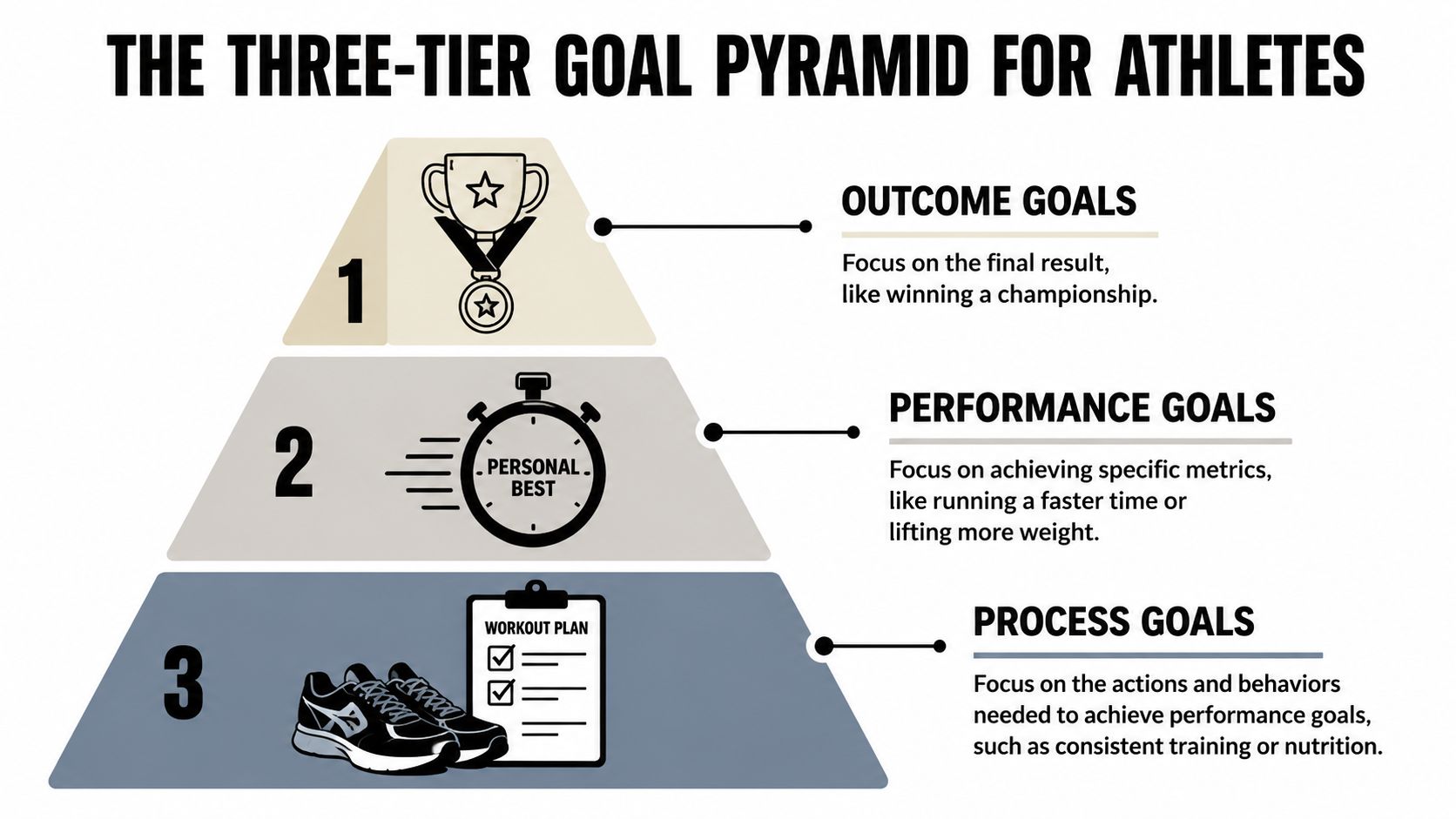
Sport-psychology guidance commonly organizes goals as a hierarchy with process goals at the base, performance goals in the middle, and outcome goals at the top. That structure reflects control. The closer a goal is to your daily actions, the more influence you have over it. The higher it sits, the more variables sit outside your control.
What each level is for
Outcome goals define the result you want in competition. Win the conference title. Make the starting lineup. Qualify for nationals. These goals matter because they create direction and emotional commitment.
But they're also unstable. Opponents improve. Selection decisions change. Race conditions shift. You can perform well and still miss an outcome goal.
Performance goals sit below that. These focus on the standard you want to reach, independent of whether someone else beats you. A swimmer might target a faster split. A basketball player might aim to improve free-throw consistency in competition. A striker might focus on shot quality and movement efficiency rather than just total goals scored.
Process goals are the daily behaviors that produce those performance changes. They include technical drills, sleep routines, recovery actions, session intent, video review habits, and nutrition behaviors.
If you only remember one thing, remember this: process goals drive the system.
How the tiers work together
A useful pyramid is connected, not decorative.
Here's what that looks like in practice:
| Goal type | Example | What it answers |
|---|---|---|
| Outcome | Earn a spot at the championship meet | What result am I aiming for |
| Performance | Hit the qualifying standard in competition | What level must I reach |
| Process | Execute pacing plan, complete key sessions, review splits weekly | What must I do repeatedly |
When athletes skip the middle, they usually create pressure without clarity. When they skip the bottom, they create ambition without traction.
Practical rule: Keep your eyes on the top of the pyramid, but spend most of your time coaching the bottom.
This is also where motivation gets steadier. Outcome goals create excitement. Process goals create momentum. If you want another lens on how athletes orient themselves around different motivational targets, Cartwright Fitness insights on motivation offer a useful complement to the pyramid model.
A strong pyramid also protects athletes from a common mental trap. If you lose a match, miss selection, or get beaten by someone better on the day, the whole identity of the plan doesn't collapse. You still have controllable behaviors to return to. That's what keeps the system alive.
Translating Ambition into Actionable Milestones
Big goals are easy to announce and hard to use. “Qualify for nationals” sounds serious, but it doesn't tell you what to do in the next training cycle. To make goal setting for athletes useful, you have to convert ambition into checkpoints that can steer real work.
Start with the outcome, then reverse-engineer it
Take an athlete with an outcome goal of qualifying for a major event. The first step isn't writing a longer motivational statement. It's asking what performance standard makes that outcome realistic.
That shift matters. Once the athlete identifies the relevant competition metric, the plan stops living in wishful thinking and starts living in training decisions.
Then work backward:
- Define the season result. Choose the one outcome that matters most.
- Identify the performance markers behind it. These are the numbers, standards, or technical benchmarks that signal readiness.
- List the repeatable behaviors that influence those markers. These become weekly process targets.
- Assign each behavior to a time and context. If a process goal has no place in the week, it's still just a thought.
A lot of athletes struggle at this stage because they treat milestones as motivational decorations. They aren't. Milestones are decision points. If you need a simple way to think about milestone structure, this guide to examples of milestones in project management is useful because the logic applies cleanly to sport as well.
Build milestones that you can actually hit
Applied sport-psychology guidance recommends making goals specific, measurable, and time-bound, and notes that immediate goals are often best set at no more than 5% above current performance in order to stay challenging but realistic, as outlined in the Association for Applied Sport Psychology guidance on effective goal setting.
That point is more practical than it sounds. Athletes often sabotage consistency by setting jumps that are emotionally exciting but operationally unrealistic. A target should stretch you without breaking trust in the process.
Here's the difference:
- Poor milestone: Drop race time dramatically by next month.
- Better milestone: Improve a specific split, pacing pattern, or technical marker within the current training block.
- Best milestone: Tie that performance marker to exact practice behaviors and a review date.
A milestone should be close enough to influence today's choices and meaningful enough to change the season.
Use this filter when you build each one:
- Can I observe it clearly? If not, it's too vague.
- Can I influence it through training behavior? If not, it belongs higher in the pyramid.
- Does it fit the current block? A strength milestone during a heavy competition phase may be poorly timed.
- Will I know when to review it? Every milestone needs a checkpoint.
Athletes get more out of a short chain of believable milestones than from an oversized plan full of fantasy leaps. If the target feels real, adherence improves. If adherence improves, the plan starts compounding.
Aligning Your Goals with Training Periodization
Most goal sheets fail for one simple reason. They stay frozen while training changes.
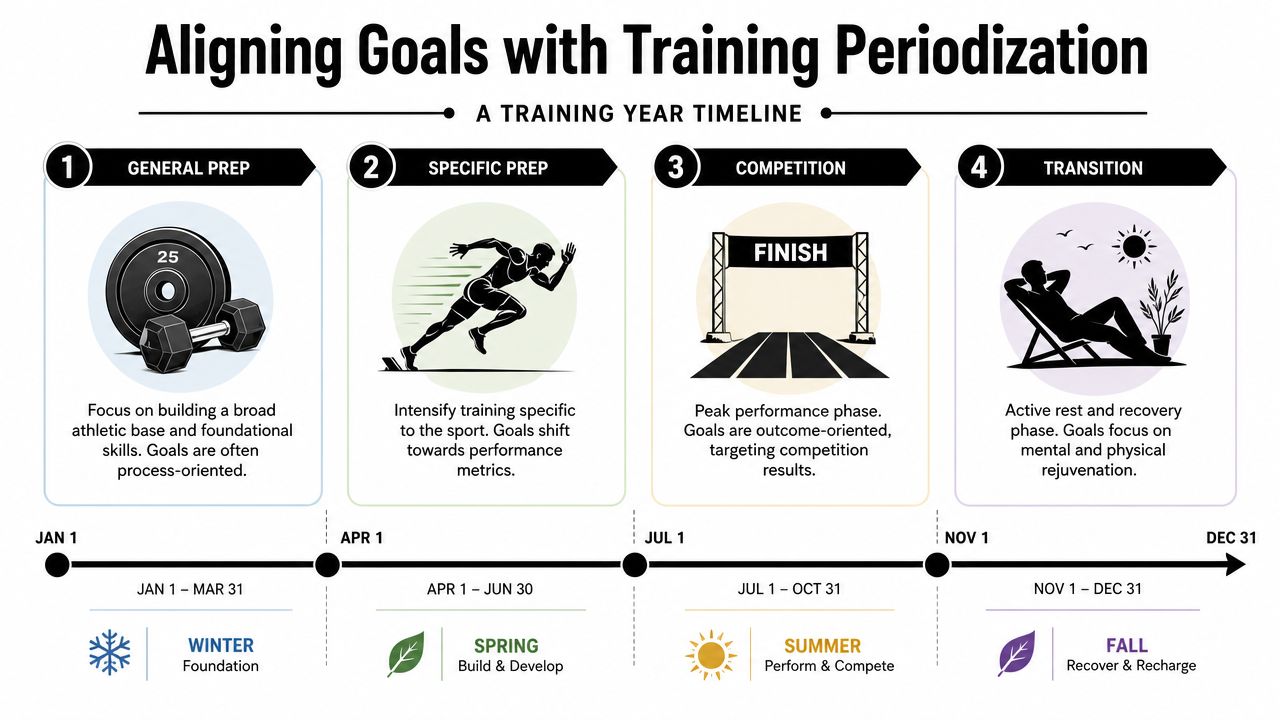
An athlete's year has different demands across preparation, competition, and recovery phases. A goal system has to move with those demands. If it doesn't, you end up pushing the wrong target at the wrong time. That creates frustration, poor focus, and unnecessary conflict between the mental plan and the physical plan.
General prep and specific prep
In general preparation, the athlete is usually building broad capacity. That may mean strength, aerobic base, movement quality, mobility, or technical foundation. During this phase, process goals should dominate. You want targets tied to consistency, training quality, and foundational habits.
A useful question in this phase is not “What do I want to win?” It's “What capacities must I build so later work matters?”
Examples of smart emphasis in general prep:
- Training consistency: Hit planned sessions with full intent.
- Movement quality: Clean up mechanics in low-pressure settings.
- Recovery habits: Stabilize sleep, fueling, and mobility routines.
In specific preparation, the focus narrows. Now the athlete starts converting broad fitness into sport-specific expression. Performance goals become more important here because they help sharpen training around the standards that matter in competition. Technical process goals still matter, but they should point more directly toward measurable performance outputs.
Often, athletes need to reduce clutter. Not every habit deserves equal attention once training intensifies.
Competition and transition
In the competition phase, outcome goals become more emotionally visible, but daily attention still belongs mostly on execution. Athletes perform better when they anchor themselves to a few tight process cues and only a small number of competition-relevant performance markers.
That usually means simplifying the plan:
| Phase | Main emphasis | Risk if you get it wrong |
|---|---|---|
| General prep | Process consistency and capacity building | Training without foundation |
| Specific prep | Performance benchmarks and sport transfer | Looking fit but not competition-ready |
| Competition | Execution, recovery, and composure | Chasing too many changes at once |
| Transition | Reset, reflection, and non-sport balance | Carrying fatigue into the next cycle |
The transition phase matters more than most athletes admit. This is when you review what worked, what drifted, what created stress, and what needs rebuilding before the next cycle. A living goal system doesn't treat transition as dead time. It treats it as reset time.
The right goal can become the wrong goal when the training phase changes.
If you compete year-round, periodization may be less clean on the calendar, but the principle still holds. Match the target to the phase. Don't run heavy rebuilding goals during a period that demands freshness. Don't obsess over outcome pressure during a block that should be technical and developmental.
The best athletes don't just set goals. They re-prioritize them as the season moves.
Your Weekly Blueprint for Goals and Habits
The plan becomes real at the weekly level. That's where most athletes either build traction or drift into good intentions.
A weekly blueprint should be simple enough to follow under fatigue and detailed enough to remove guesswork. If you need to think too hard about what to do each day, the system is already too loose.

What a usable week looks like
Start with a small set of process goals. Not ten. A few. Each one should support the current training block and connect clearly to a performance objective.
For example, an athlete in a return-to-performance phase might choose:
- Lower-leg resilience: Complete prescribed stability and calf work after warm-up on designated days.
- Technical sharpness: Film and review one key movement pattern during skill sessions.
- Recovery discipline: Follow a fixed post-session routine rather than improvising based on mood.
- Competition readiness: Rehearse one pre-performance routine before high-intensity sessions.
Now convert each process goal into a habit tied to a place in the week. “Improve ankle stability” is too broad. “Complete the stability series after warm-up on Monday, Wednesday, and Friday” is executable.
A practical weekly setup often includes:
| Weekly layer | What to define |
|---|---|
| Priority goal | The single process target that matters most this week |
| Session anchors | The workouts or practices where that target shows up |
| Habit trigger | The cue that tells you when the behavior starts |
| Review point | When you check whether the plan happened |
This is where tools can help if they reduce friction rather than create more admin. Athletes use notebooks, Notes, Google Sheets, coach dashboards, and training apps for this. One option is Beyond Time's habit-building approach, which connects goals to routines and daily execution. Tribble Software Private Limited also offers Beyond Time as a system for turning goals into milestones and linking them to recurring habits and reviews.
Keep the plan small enough to execute
A common mistake is writing a perfect week for your ideal self instead of your actual life. If you're balancing school, work, travel, treatment, or team demands, your weekly plan has to survive real constraints.
Use these filters before finalizing the week:
- What is essential? Protect the few behaviors with the highest training value.
- What is conditional? Mark habits that depend on travel, equipment, or coaching access.
- What will I do when the week gets messy? Pre-decide the minimum version of each habit.
Here's a simple example of a fallback structure:
- Full version when the week is stable.
- Reduced version when time is tight.
- Minimum version when energy is low but momentum must stay alive.
If your system only works on perfect weeks, you don't have a system yet.
The weekly blueprint shouldn't inspire you. It should guide you. That's a different standard, and it's the one that keeps progress moving when motivation dips.
Tracking Progress and Mastering Accountability
A goal only becomes useful once it meets a record. Until then, it's memory, emotion, and selective storytelling.
The athletes who improve steadily tend to track in a boring, consistent way. They don't rely on how the week felt. They compare what was planned with what was done, then decide whether the plan or the execution needs to change.
Track what you control first
One of the biggest mistakes in goal setting for athletes is treating an uncontrollable outcome as the daily scorecard. Premier Sport Psychology notes that common pitfalls include treating uncontrollable outcomes as daily prescriptions and setting vague goals, and stresses that effective goals are observable, measurable, time-bound, and internalized by the athlete in its guidance on successful goal setting for athletes.
That means your tracking system should start low in the pyramid.
Track things like:
- Process completion: Did the technical routine happen or not?
- Quality markers: Was the session executed with the intended standard?
- Performance checkpoints: Are the training metrics moving in the expected direction?
- Recovery adherence: Did sleep, fueling, and reset routines support the work?
For many athletes, the simplest method works best. A notebook. A shared document with a coach. A training log. An app that records planned versus actual execution. If you want a practical framework, this guide on how to track workout progress gives a clean starting point.
What to do when you miss the mark
Missing a goal doesn't automatically mean the goal was bad or that you lacked discipline. It means something in the chain needs review.
Ask four questions:
- Was the goal clear enough to measure?
- Did the week give me a chance to execute it?
- Did I choose too many priorities at once?
- Did I still own the goal, or was I just complying with someone else's plan?
Those questions usually reveal the issue faster than self-criticism does.
A short visual reminder can help when the process starts to drift:
Ownership matters here. Athletes follow through better when the goal feels internal, not borrowed. Coach input matters, but buy-in matters more. If the athlete doesn't believe the target fits their current reality, tracking becomes performative.
Don't use tracking to prove you're disciplined. Use it to make better decisions.
Accountability also works better when sport isn't your only identity. Athletes who set goals in areas like sleep, school, work, and communication often have a more stable base when performance gets messy. That doesn't reduce competitive drive. It protects it from becoming fragile.
Frequently Asked Questions About Athlete Goal Setting
What is the difference between a goal and a habit
A goal is the target. A habit is the repeated behavior that helps you reach it.
“Improve late-race execution” is a goal. “Review pacing notes after every quality session” is a habit. The goal gives direction. The habit gives repetition. If you only set goals, you'll feel ambitious. If you build habits that serve those goals, you'll make progress.
How do I stay motivated after missing a goal
Don't ask motivation to do the job of analysis. Review the chain instead.
Look at whether the goal was too vague, too large for the current block, poorly timed, or unsupported by the week you were living. Then tighten the target and restart with a smaller controllable action. Momentum usually returns when clarity returns.
Should I set goals alone or with a coach
The strongest setup is collaborative. Coaches often see technical and competitive realities more clearly. Athletes know what feels realistic, meaningful, and sustainable in day-to-day life.
If a coach sets everything and the athlete has no ownership, adherence weakens. If the athlete ignores coaching context, the plan can become detached from performance demands. The best system combines external structure with internal commitment.
Should athletes set goals outside sport
Yes. Guidance on athlete well-being suggests that non-sport goals for sleep, school or work, and personal identity can reduce unhealthy overreliance on sport and support long-term mental health, as discussed in the USEF guidance for parents and athletes.
That matters because performance fluctuates. Injury happens. Selection changes. Slumps happen. If sport is the only place you can feel competent or steady, every setback hits harder than it should. Non-sport goals don't distract from performance. They help stabilize the person doing the performing.
A good starting point is one goal inside sport, one recovery goal, and one life goal outside sport. That keeps the system competitive without becoming narrow.
If you want a structured way to turn athletic goals into milestones, routines, and weekly reviews, Tribble Software Private Limited offers Beyond Time as an AI-powered goal achievement system. It's designed to connect objectives with actionable roadmaps, habits, and accountability so your plan keeps moving after the initial motivation fades.
Put this into practice
Free tools that match this article.
Goal Setting Worksheet
Turn a vague goal into milestones, habits, blockers, and a weekly review plan.
Try Goal WorksheetGoal SettingSMART Goal Validator
Instantly validate your goals against the SMART framework and get actionable improvement suggestions.
Try SMART ValidatorGoal SettingAI Milestone Generator
Turn your biggest goals into an actionable step-by-step plan in seconds with AI.
Try Milestone GeneratorGoal SettingOKR Generator
Transform any aspiration into a structured OKR with measurable key results in seconds.
Try OKR GeneratorKeep exploring this topic
Goal setting guide
Start with the fundamentals of setting goals that turn into action.
Goal frameworks compared
Choose between SMART goals, OKRs, BHAGs, and 12-week goals.
Guide articles
Explore more guide articles from the Beyond Time blog.
goal setting for athletes
Read more articles tagged goal setting for athletes.
Related Articles

How to Track Multiple Goals Without Getting Overwhelmed
Learn a proven system for managing multiple goals simultaneously without losing focus or burning out. Practical frameworks for tracking 3-5 goals at once.
Accountability Partner Guide: Achieve Goals Faster
Learn how to find, structure, and get the most from an accountability partner. Research shows accountability can boost goal achievement by up to 95%.
5-Year Plan Template: Build Your Life Roadmap Step by Step
Build your life with this step-by-step 5 year plan template. Set goals across 5 key life domains and break them into year-by-year milestones you can act on.
How to Set Life Priorities: A Framework for What Matters Most
Learn how to set priorities in life with a proven values-based framework. Discover what matters most and start building goals aligned with your life today.
Life Audit: The Complete Guide to Redesign Your Life
A life audit helps you step back, evaluate every major area of your life, and redesign it with intention. Discover how to do yours in five clear steps.
How to Stay Motivated: Science-Backed Strategies That Work
Struggling with how to stay motivated on long-term goals? Discover science-backed systems and practical strategies to build lasting motivation that sticks.