How to Track Workout Progress: A System for Real Results
Learn how to track workout progress with a practical system. Go beyond simple logging to define goals, analyze trends, and achieve real fitness results.
You're probably doing one of two things right now. You either train hard and hope the mirror eventually confirms it, or you log so much data that tracking itself starts to feel like a second workout.
Neither approach works for busy people.
Founders, professionals, and students don't need a fitness system that looks impressive on paper. They need one that survives travel, deadlines, bad sleep, and weeks when life gets noisy. That's why the most useful way to think about workout tracking isn't as obsessive self-measurement. It's project management for your body.
A good system does three things. Track. Review. Iterate. You capture the right signals, look for trends, and make the next decision based on evidence instead of mood. That's how you learn what's moving you forward.
Table of Contents
- First Define Your Goal Then Your Metrics
- Choose Your Key Performance Indicators (KPIs)
- Establish Your Baseline and Logging System
- Create a Ritual for Reviewing Your Progress
- Iterate Your Plan When Progress Stalls
- Frequently Asked Tracking Questions
First Define Your Goal Then Your Metrics
Many individuals start backward. They download an app, buy a notebook, or open a spreadsheet before they've decided what success looks like.
That's how tracking turns into trivia.
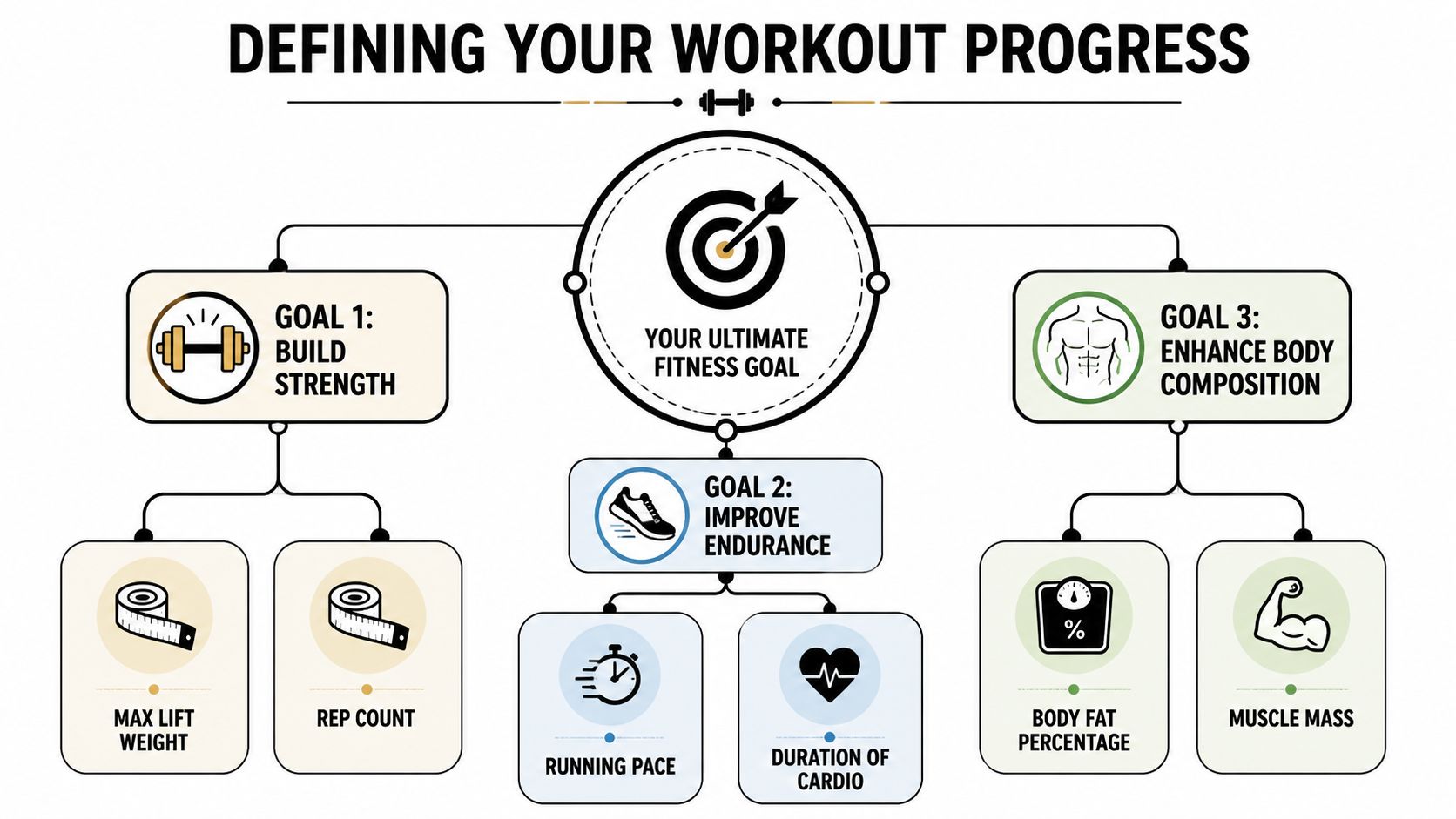
If your goal is vague, your data will be vague too. “Get fit” doesn't tell you what to measure. Strength, endurance, and body composition each require a different scoreboard. A roadmap only helps if you know the destination.
Goals decide what counts as progress
A person trying to build strength should care about performance in key lifts. A person training for endurance should care about pace, duration, and repeatability. Someone focused on body composition needs a broader view because scale weight alone can hide real change.
People lose months when they track everything except the one thing tied to the result they want.
Use this distinction:
| Goal type | What it means |
|---|---|
| Outcome goal | The result you want, such as getting stronger, improving conditioning, or changing body composition |
| Process goal | The repeatable actions that make that result more likely, such as completing planned sessions and progressing key workouts |
A useful outcome goal is concrete enough to drive choices. If you need help thinking through that step, BionicGym has a practical guide on achieving your personal fitness goals that fits well with a structured tracking approach.
Match process goals to the outcome
Once the outcome is clear, process tracking gets simpler. You stop asking, “What should I log?” and start asking, “What signals prove I'm moving toward the target?”
Practical rule: Don't build a tracking system until you can finish this sentence: “I'll know this plan is working if I see progress in these specific signs.”
For many busy people, I like a two-layer setup:
- Primary metric: The clearest sign of progress toward the main goal.
- Support metrics: A few process signals that explain why progress is happening or stalling.
That's the same logic used in work planning. You define the objective, then set the milestones. If you think this way naturally, a milestone framework like structured progress checkpoints can help you map training goals into smaller targets you can review regularly.
A good tracking system should narrow your focus, not widen it. If your log doesn't help you make the next training decision, it's clutter.
Choose Your Key Performance Indicators (KPIs)
Once the goal is set, you need a dashboard. Not a giant spreadsheet. A dashboard.
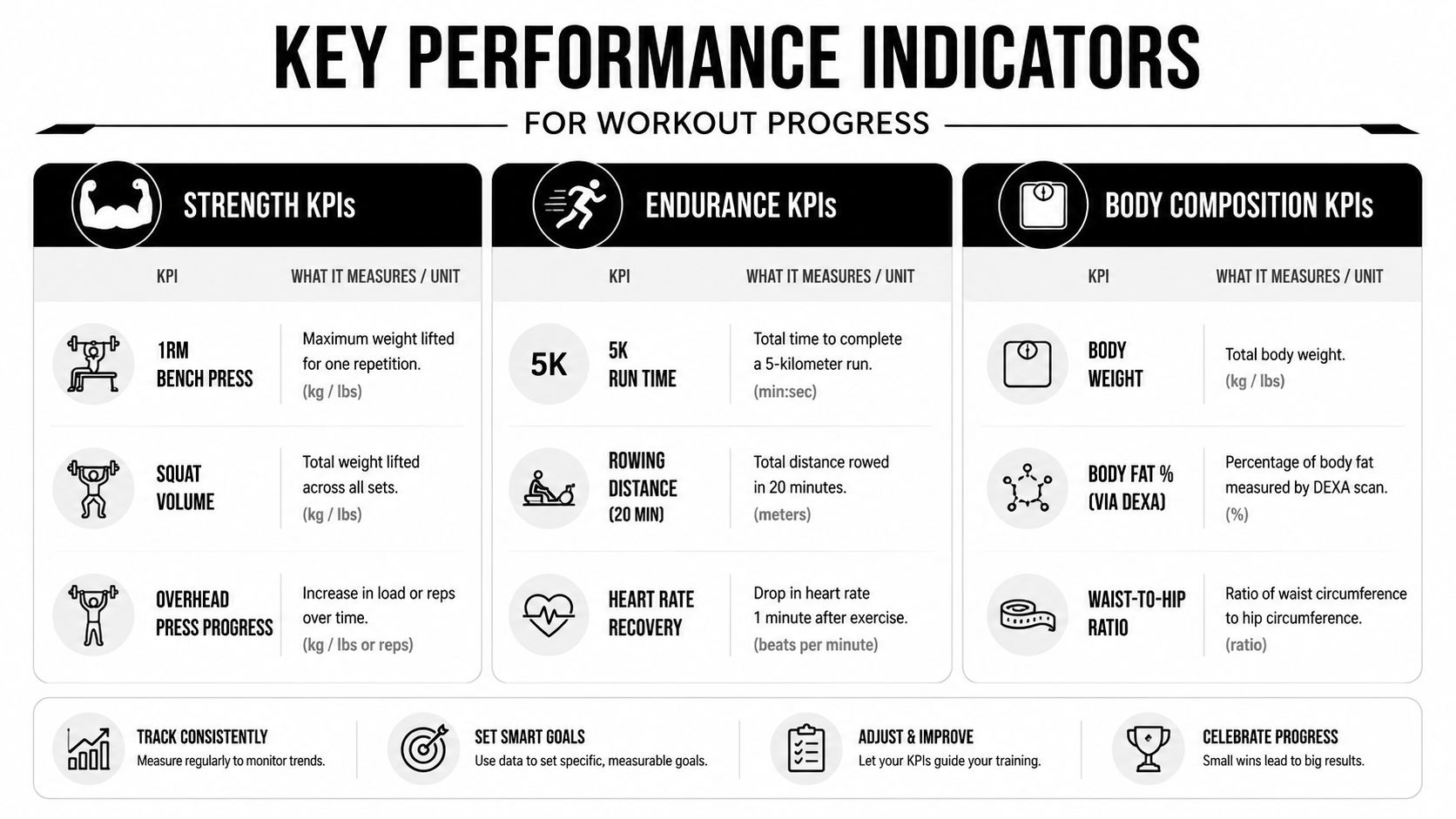
The point of KPIs is to reduce noise. You're identifying the few signals that tell you whether training is working. Practical guidance on tracking the same measurable variables every session recommends starting with 3 to 5 metrics, because that smaller set is easier to sustain and compare over time. For strength, that usually means sets, reps, weight, and RPE. For cardio, it's typically time, distance, and pace.
Use a small dashboard
People with demanding schedules often quit tracking for the same reason they quit overbuilt productivity systems. Too many fields, too much friction, too much guilt when they fall behind.
A smaller KPI set solves that. It gives you enough information to steer without turning every workout into admin work.
Track the smallest set of numbers that still helps you make a better next decision.
Here's a practical way to choose.
Pick KPIs by training focus
For strength
- Track your main lift performance with sets, reps, weight, and RPE.
- Keep one headline metric for each major lift you care about.
- If you can't answer “What did I do last time?” in a few seconds, the system is too messy.
For endurance
- Use time, distance, pace or splits, and either heart rate or perceived effort.
- Pick the format that matches your actual training. A runner might care about pace. A rower may care more about split consistency over a fixed duration.
For body composition
- Use a combination approach, not one single number.
- Your best dashboard often includes bodyweight trend, measurements, photos, and a simple performance benchmark.
A common mistake is mixing too many categories at once. Someone says they want fat loss, strength gain, better conditioning, and visible abs, then tries to create a log that treats every metric as equally important. That's how dashboards become junk drawers.
A better model is to give one category priority and let the others play supporting roles. If strength is the main goal, performance gets top billing. If body composition is the main goal, visual and measurement trends matter more than chasing random gym PRs.
Establish Your Baseline and Logging System
Progress is always relative. If you don't know your starting point, you won't know whether you're improving or just staying busy.
That's why every useful system starts with a baseline. Think of it as your day zero snapshot. Not perfect. Just consistent enough that future comparisons mean something.
Create a day zero record
Your baseline should reflect your actual goal.
If you care most about lifting performance, record your current working numbers in the key exercises you repeat regularly. If endurance matters most, log a benchmark session you can revisit under similar conditions. If body composition is part of the plan, take initial photos and measurements using the same setup you'll use later.
The exact method matters less than consistency. Same movements. Same format. Same conditions when possible.
A simple baseline checklist looks like this:
- Strength baseline: Current working sets for your main lifts
- Cardio baseline: A repeatable session such as a fixed run, ride, or row
- Physique baseline: Front, side, and back photos plus core measurements
- Context baseline: Any note that affects interpretation, such as schedule chaos, travel, or poor sleep
Choose the lowest friction tool
The best logging tool is the one you'll still use on a stressful Tuesday.
Best practice for a workout journal is to log the training date, bodyweight, exercise name, planned load, sets, reps, and rest intervals during the session, because that reduces recall bias and makes plateaus easier to spot. Common mistakes include changing the format every session and skipping rest interval tracking, as explained in James Clear's guide to a consistent workout journal.
You have three solid options:
| Tool | Works well for | Main trade-off |
|---|---|---|
| Notebook | Lifters who want speed and no distractions | Harder to review trends |
| Spreadsheet | People who like customization and analysis | More setup effort |
| Training app | Anyone who wants previous-session recall and easy charts | Can become feature-heavy |
If you want a more structured digital approach for tracking progress across different goals, progress tracking software options can help you compare systems before you commit to one.
One rule matters more than the tool itself. Use the same format every session. A messy log creates messy conclusions.
Create a Ritual for Reviewing Your Progress
Logging without review is like taking meeting notes and never acting on them.
The review is where workout tracking becomes useful. This is the point where you stop being a recorder of effort and start acting like a manager of performance.
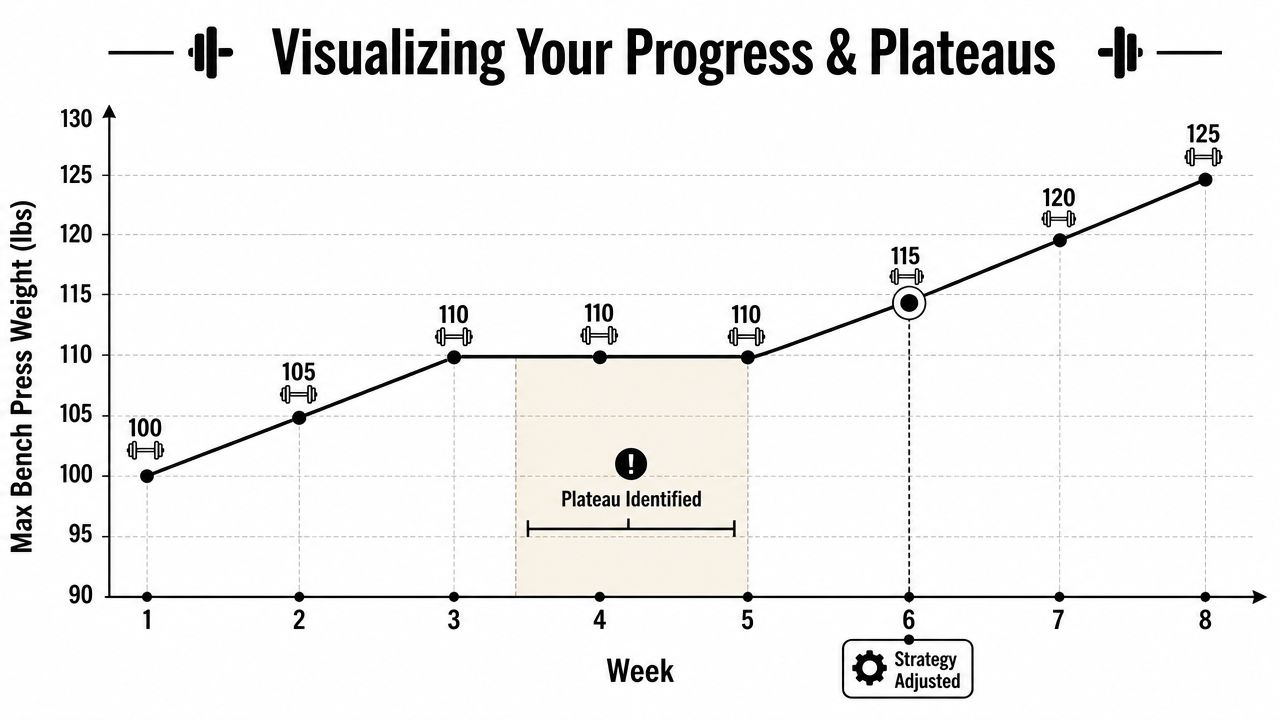
A visual trend makes this easier to see.
Turn logs into decisions
Busy people do well with a short weekly review. Not a long reflection session. Just enough time to check whether training happened as planned and whether the signals are moving.
Use a planned versus actual lens:
- Planned workouts: What sessions were supposed to happen
- Actual workouts: What you completed
- Performance change: Whether the key lift, pace, or benchmark moved
- Recovery pattern: Whether poor sleep, stress, or soreness seems to line up with misses or weak sessions
This is also where habit tracking helps. If you want a simple template for that side of the system, habit logs that show completion over time fit well with workout review because they make consistency visible.
Use trend lines not daily noise
A strong review process uses more than performance numbers alone. Guidance on tracking fitness progress with photos, measurements, and trend lines recommends combining output metrics with standardized visual checkpoints. Monthly progress photos and circumference measurements can reveal recomposition even when scale weight stays stable, and the bigger lesson is to focus on trend lines over time instead of reacting to daily noise.
That matters because daily bodyweight, single-session strength, and how you “feel” in the mirror can all mislead you.
A bad workout is not a failed plan. It's one data point.
Use your review to answer a few blunt questions:
- Did I do what I planned?
- Is the main metric improving, flat, or slipping?
- What pattern might explain that?
- What single adjustment should I make next week?
If you need a reset on what a review mindset looks like in practice, this video gives a useful example of how people learn to spot patterns instead of chasing isolated workouts.
The review ritual is what closes the gap between effort and learning. Without it, you're just collecting receipts.
Iterate Your Plan When Progress Stalls
Plateaus aren't a sign that tracking failed. They're the reason tracking exists.
If your log shows the same result repeating without improvement, that's useful information. It means your current setup has probably extracted what it can, at least for now. The next job is adjustment, not panic.

Treat plateaus like feedback
A smart response depends on the goal.
For physique goals, reliable home workout progress tracking combines daily weigh-ins using a weekly average, month-by-month measurements of areas like the waist, chest, and arms, and periodic performance benchmarks such as timed planks. That mix matters because body composition changes slowly, and weekly measurement checks can create false alarms.
For performance goals, the same principle applies. Don't overhaul the whole plan because one session felt flat. Look for sustained stall patterns, then respond with intention.
Adjust one lever at a time
When progress slows, change a variable you can observe. Don't make five changes and then pretend you know what worked.
Useful adjustments include:
- Increase the challenge: Add load, add a rep, or add a set if recovery looks solid.
- Change the exercise variation: If one movement has gone stale, a close variation can create a new stimulus while keeping the same goal.
- Modify rest periods: If workouts drift into random pacing, standardizing rest can make performance easier to compare.
- Reduce fatigue: Sometimes the problem isn't insufficient effort. It's accumulated fatigue and poor recovery.
Plateaus usually become manageable once you stop treating them as personal failure and start treating them as system feedback.
If you want another practical perspective on this decision-making process, Strive Workout Log has a useful walkthrough on how to track gym progress that lines up with the idea of using recorded data to guide changes rather than guessing.
One note for high-achievers. Don't confuse complexity with precision. The right adjustment is usually the smallest one that gives you a cleaner signal next week.
Frequently Asked Tracking Questions
Busy people rarely stop tracking because they do not care. They stop because the system becomes another job. A missed log turns into a missed week, and then the whole process feels broken.
The fix is to treat tracking like any other operating system. Keep it light enough to survive travel, deadline weeks, exam periods, and low-motivation days. The goal is not a perfect archive. The goal is a usable feedback loop for your body: track, review, iterate.
What if I miss workouts or forget to log
Log the next session accurately and keep going.
Trying to rebuild the week from memory usually creates bad data and unnecessary guilt. A clean restart gives you something you can trust. If missed sessions keep clustering around late meetings, poor sleep, or a certain day of the week, that pattern deserves attention. The miss is not just a lapse. It is a constraint in your schedule or recovery plan.
Useful reset: Your next honest entry matters more than a reconstructed week.
How long should I track before judging progress
Wait until you can see a pattern across several entries.
Strength and performance trends can show up fairly quickly if training is consistent. Body composition usually takes longer and is easier to misread week to week. That is why the best tracking system is usually the one you can maintain without resentment.
A simple setup works better than an ambitious one for founders, professionals, and students with uneven schedules. The practical standard is enough data to answer three questions: Did you do the planned session, did one key metric improve or hold steady, and did recovery look good enough to support the plan? Fitbod makes a similar point in its article on avoiding data fatigue in workout tracking.
Do I need an app or is a notebook enough
A notebook is enough. A notes app is enough. A spreadsheet is enough.
Use the tool that makes two things easy: capturing the session while details are fresh, and reviewing previous weeks without friction. Apps help when you want faster comparisons and reminders. Paper helps when screens already dominate your day. Spreadsheets help when you want tighter control over trends and formulas.
If you want a training-specific comparison point, RepStack has a practical guide on how to track your workouts.
The wrong tool has clear symptoms. You avoid opening it. You spend more time formatting than training. You feel behind after one missed day. Once that happens, simplify the system until it supports execution instead of interrupting it.
Keep going with Beyond Time
Beyond Time connects your fitness goals to the routines and reviews that make them stick.
- 30-Day Challenge Generator — Build a focused fitness challenge with daily milestones.
- How to Track Multiple Goals Without Overwhelm — Keep fitness alongside every other goal without losing focus.
- Beyond Time vs RescueTime — See which app actually connects effort to outcomes.
- AI-Native Goal Tracking Explained — Discover how AI turns raw logs into smarter next steps.
Put this into practice
Free tools that match this article.
Goal Setting Worksheet
Turn a vague goal into milestones, habits, blockers, and a weekly review plan.
Try Goal WorksheetAssessmentLife Audit Tool
Score your life in 6 key areas and get a personalized action plan to create balance and fulfillment.
Try Life AuditGoal SettingSMART Goal Validator
Instantly validate your goals against the SMART framework and get actionable improvement suggestions.
Try SMART ValidatorPersonal DevelopmentPersonal Development Plan Generator
Generate a personalized development plan with quarterly milestones, skill gaps, and daily habits tailored to your goals.
Try Development PlanKeep exploring this topic
Goal setting guide
Start with the fundamentals of setting goals that turn into action.
Life audit guide
Review the areas of life that need more attention and intention.
Goal frameworks compared
Choose between SMART goals, OKRs, BHAGs, and 12-week goals.
Personal development plan
Create a growth plan that connects identity, habits, and goals.
Related Articles

How to Track Multiple Goals Without Getting Overwhelmed
Learn a proven system for managing multiple goals simultaneously without losing focus or burning out. Practical frameworks for tracking 3-5 goals at once.
Accountability Partner Guide: Achieve Goals Faster
Learn how to find, structure, and get the most from an accountability partner. Research shows accountability can boost goal achievement by up to 95%.
5-Year Plan Template: Build Your Life Roadmap Step by Step
Build your life with this step-by-step 5 year plan template. Set goals across 5 key life domains and break them into year-by-year milestones you can act on.
How to Set Life Priorities: A Framework for What Matters Most
Learn how to set priorities in life with a proven values-based framework. Discover what matters most and start building goals aligned with your life today.
Life Audit: The Complete Guide to Redesign Your Life
A life audit helps you step back, evaluate every major area of your life, and redesign it with intention. Discover how to do yours in five clear steps.
How to Stay Motivated: Science-Backed Strategies That Work
Struggling with how to stay motivated on long-term goals? Discover science-backed systems and practical strategies to build lasting motivation that sticks.