How to Build Better Habits: A Science-Backed Playbook
Learn how to build better habits that last. Our guide provides a science-backed framework, tracking templates, and troubleshooting for real-world results.
The most popular habit advice breaks at the first collision with real life. “Do it for 21 days” sounds clean, motivating, and easy to remember. It's also a bad operating model for founders with travel, managers with calendar chaos, students in exam weeks, and anyone whose schedule changes faster than their intentions.
The better question isn't how to stay perfect. It's how to build habits that still function when your morning gets hijacked, your energy drops, or your environment changes. That shift matters because habit formation doesn't run on a universal countdown. A widely cited University College London study found an average of 66 days for a behavior to become automatic, with a range from 18 to 254 days, and a later systematic review and meta-analysis of 20 studies with 2,601 participants concluded that health-related habits typically take 2 to 5 months, with variation from 4 to 335 days. The same review also found that stable environments improved automaticity, and that morning practices and self-selected habits tended to be stronger, as reported in this habit formation evidence review.
That means missed days don't prove you're undisciplined. They usually prove your system was too fragile for the context you live in.
This guide takes a more useful approach to how to build better habits. Build for disruption. Measure outcomes, not streaks. Keep the habit small enough to survive bad weeks, then strong enough to support meaningful goals.
Table of Contents
- Why Most Habit-Building Advice Fails You
- The Science-Backed Principles of Lasting Habits
- Your Three-Phase Habit Implementation Playbook
- Designing Your Environment for Automatic Success
- Troubleshooting When Your Habits Break Down
- Conclusion From Planning Habits to Achieving Goals
Why Most Habit-Building Advice Fails You
Most habit advice assumes your life is stable. Same wake-up time, same desk, same energy, same evenings. That's why so many habit plans look good on Sunday and collapse by Wednesday.
The old “21-day” idea trained people to expect a short sprint. Real habit formation works more like system installation. It takes repetition, consistent cues, and an environment that doesn't force you to renegotiate the behavior every day.
The real problem isn't weak willpower
Busy people usually don't fail because they don't care. They fail because they chose a habit design that only works under ideal conditions. A routine built for a calm week won't survive conference travel, a product launch, a sick kid, or exam season.
That's why high-achievers often get trapped in a frustrating loop:
- They start too large. The habit demands energy, time, and attention they can't reliably spare.
- They over-rely on mood. If motivation is the trigger, the habit disappears on low-energy days.
- They confuse tracking with progress. A clean streak can hide a habit that isn't producing better work, better health, or better focus.
- They restart from zero after disruption. One break becomes an identity crisis instead of a normal adjustment.
Practical rule: If your habit only works on your best days, it isn't a habit yet. It's a performance.
Generic advice ignores chaotic schedules
A founder might want to write daily but spend half the week in reactive meetings. A manager wants to work out, but travel changes sleep and meal timing. A student plans to review notes nightly, then deadlines stack up and the plan disappears.
In each case, the person doesn't need more inspirational language. They need a habit with a base version, a fallback version, and a restart rule.
What works is less glamorous than most habit content suggests. Tie the action to a cue you encounter. Make the first version almost too easy. Reduce setup friction. Decide in advance what “good enough” looks like on disrupted days. Then evaluate whether the habit is changing an outcome you care about.
That's the difference between habit theater and a durable routine. One looks disciplined. The other survives real life.
The Science-Backed Principles of Lasting Habits
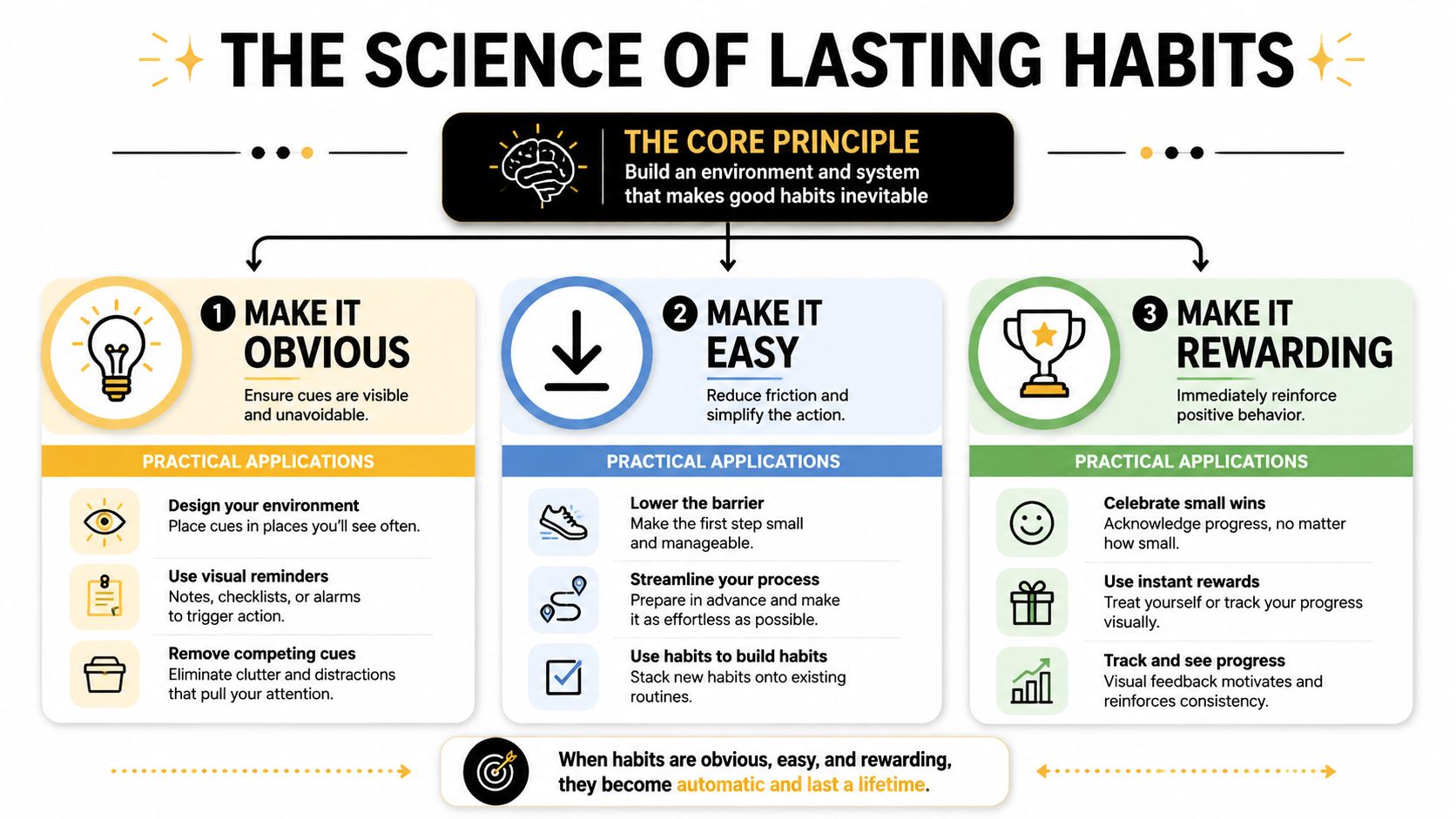
The mechanics of habit change are simpler than the advice industry makes them seem. A habit sticks when a cue is clear, the action is easy enough to repeat, and the result feels rewarding enough to do again.
Research summarized by the American Psychological Association notes that about 40 to 43% of everyday actions are performed habitually while people are thinking about something else, according to this APA summary on habits and automatic behavior. That's why habit design matters so much. You're not trying to win every decision with discipline. You're trying to reduce how many decisions need discipline in the first place.
Why habit loops matter
Think in three parts: cue, routine, reward.
The cue tells your brain when to start. The routine is the behavior itself. The reward closes the loop and makes repetition more likely. If one part is weak, the whole system wobbles.
A few practical examples make this obvious:
Reading more
- Cue: sit down with morning coffee
- Routine: read one page from the book already on the table
- Reward: a calmer start and visible progress through the book
Daily planning
- Cue: open laptop at work
- Routine: write the top three priorities before opening chat or email
- Reward: less drift and fewer reactive decisions later
Strength training
- Cue: get home and put keys in the bowl
- Routine: change into workout clothes immediately
- Reward: lower resistance to starting the session
The loop matters because vague intentions create vague behavior. “I should journal more” isn't a loop. “After I brush my teeth, I write three lines in my notebook” is.
A cue you can see beats a goal you can remember.
How stacking and environment do the heavy lifting
Habit stacking means attaching a new behavior to one that already happens. This works because the old routine provides the trigger. You don't need to remember the new habit from scratch.
Good stacks sound plain on purpose:
- After I make coffee, I review my calendar.
- After I sit at my desk, I put my phone in the drawer.
- After lunch, I walk for a few minutes before reopening Slack.
The second lever is environment design. If your desired behavior requires too many decisions, too much setup, or too much resistance to distraction, you'll lose more often than you should.
A few high-return adjustments:
- Make good cues visible. Keep the notebook open, not stored. Leave the guitar on a stand, not in a case.
- Reduce setup cost. Pre-fill the water bottle. Keep workout clothes where you change, not in a buried drawer.
- Raise friction on bad defaults. Log out of distracting apps. Move entertainment off your home screen. Keep snacks you don't want less accessible.
For professionals trying to support healthier work routines, these same principles show up in practical workplace design choices. This collection of expert advice on workplace well-being is useful because it ties daily behavior to concrete environmental shifts instead of motivation talk.
If you want to know how to build better habits, start here. Don't ask, “How do I become more disciplined?” Ask, “What cue starts this, what makes it easy, and what makes repeating it feel worth it?”
Your Three-Phase Habit Implementation Playbook
Trying to optimize a habit before it's stabilized is backwards. The sequence that works is simpler: start, scale, automate.
The point isn't to make the habit impressive. The point is to make it repeatable, then useful, then valuable enough to keep.
Phase one start
In the beginning, ambition is the enemy. The first version should feel almost too small.
If you want to write daily, open the document and write a few lines. If you want to meditate, sit down and take a few deliberate breaths. If you want to study, review one concept card. The exact size matters less than one rule: the habit must be easy to begin under normal resistance.
This phase is about protecting the launch from perfectionism.
Use these filters:
- Make the action tiny. Shrink it until you can do it on a tired day.
- Attach it to a stable cue. Breakfast, logging in, brushing teeth, shutting down work.
- Remove setup friction. Put the tools where the action happens.
- Define the minimum version. Know what counts even when the day goes sideways.
A common mistake is choosing a habit size that belongs in month three, then wondering why week one fails. Starting small isn't lowering standards. It's building reliability.
Phase two scale
Once the habit shows up consistently enough to feel normal, increase difficulty carefully. Don't scale by enthusiasm. Scale by evidence.
If reading one page happens smoothly, move to a short chapter. If a brief review session is stable, extend it when time allows. If your walking habit is anchored, add pace, route, or duration based on the constraint in your week.
This is also where habits need a job beyond repetition. They should support a meaningful goal.
Here's a useful distinction:
| Phase | Primary Goal | Key Actions | Success Metric |
|---|---|---|---|
| Start | Make the habit easy to begin | Shrink the action, choose one cue, reduce friction | You show up reliably |
| Scale | Increase usefulness without breaking consistency | Add challenge gradually, connect the habit to a real goal, keep a fallback version | The habit contributes to visible progress |
| Automate | Reduce decision load and evaluate value | Standardize timing, use tools or reminders, review outcome quality | The habit runs with less effort and earns its place |
A writing habit should improve output quality or idea clarity. A workout habit should support strength, energy, or recovery. A planning habit should reduce drift and improve execution. If you want a framework for tying routines more directly to work outcomes, this guide on how to improve work productivity is a useful companion.
Phase three automate
Automation isn't just about reminders. It's about reducing the number of choices between cue and action.
Standardize what you can:
- Time: same general window when possible
- Location: same chair, same desk, same gym corner
- Sequence: same order of actions before the habit starts
- Tools: same notebook, same app, same playlist, same checklist
Then measure whether the habit deserves to stay.
Most habit advice overweights streaks and underweights impact. A more useful lens, especially for knowledge work, is return on attention. This idea is captured well in this piece on measuring habits by outcomes, not just streaks. The question is simple: does this routine reduce decision fatigue, improve output, or move an important goal forward?
Use a short review:
- Is the habit still easy enough to sustain?
- Is it producing a result I can notice?
- Would I keep it if I stopped tracking the streak?
- Does it deserve expansion, simplification, or replacement?
The best habits earn time back. They don't just consume it neatly.
That's how to build better habits without collecting a bunch of routines that look productive and change nothing.
Designing Your Environment for Automatic Success
The fastest way to make a habit easier is to stop asking your future self to overcome a badly designed space. Most behavior follows the path with the fewest obstacles. If your environment points toward distraction, delay, or overeating, motivation won't rescue you for long.
The focused desk beats the motivated mind
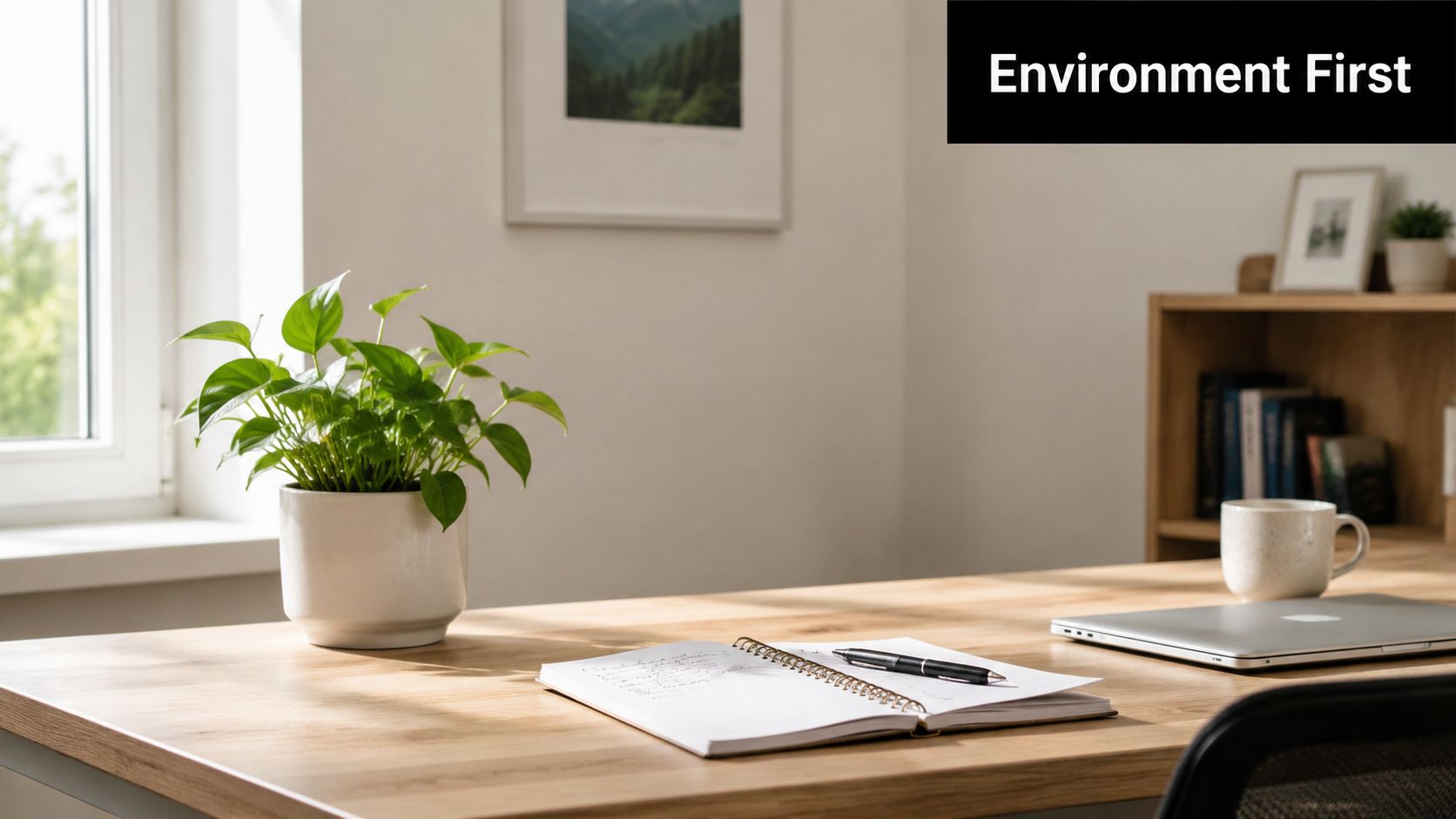
A cluttered desk asks you to make too many micro-decisions. Which notebook? Where's the charger? Why is yesterday's paperwork still here? A clean desk with one visible next action does something better. It narrows the options.
I've seen one simple shift work repeatedly for knowledge workers: turn the workspace into a single-purpose cue. If the desk is for deep work, don't let it become storage, snack staging, and random admin overflow.
A practical setup looks like this:
- Visible next tool: one notebook, one pen, laptop open to the task
- Phone friction: face down, across the room, or in a drawer
- Clear start signal: task list visible before inboxes and chat apps open
- Reduced clutter: remove objects that invite unrelated work
The same rule applies outside the office. If healthy eating matters, fruit should be visible and convenient. If guitar practice matters, the instrument should stay accessible. If sleep matters, chargers shouldn't live next to the bed where late-night scrolling starts.
Tools can help here too. A planner app, website blocker, or a structured routine builder can translate good intentions into repeatable defaults. For people who want a guided way to pair behaviors with existing routines, a habit stack builder can make those links more concrete.
Digital spaces train habits too
Physical clutter gets attention. Digital clutter often does more damage.
Individuals often sabotage focus through interface design without noticing it. The phone home screen is full of cues for low-value behavior. Notifications interrupt the exact moment a better habit should begin. Browser tabs keep unfinished loops open and attention fragmented.
A stronger digital environment usually includes:
- Intentional app placement: put learning, notes, calendar, or reading tools where you'll see them first
- Notification limits: keep only alerts that demand real response
- Default work screens: open the document or task board first, not the inbox
- Friction for distraction: log out, hide, or relocate the apps that trigger impulsive checking
A short visual walkthrough can help you rethink your setup:
The strongest habit environments don't feel dramatic. They feel obvious. You sit down, and the next right action is already easier than the wrong one.
Troubleshooting When Your Habits Break Down
When a habit breaks, people often make the wrong diagnosis. They call it laziness, inconsistency, or lack of discipline. More often, the habit failed because the context changed and the system didn't adapt.
That matters because disrupted routines are where generic advice becomes useless. Mainstream habit content still focuses on stable schedules, but a major gap is maintaining habits during travel, illness, shift work, and other disruptions. Stanford lifestyle medicine guidance highlights the importance of fallback plans and environment resets because habit failure is often contextual, not just motivational, as discussed in this guidance on making healthy habits stick.
The habit rescue protocol
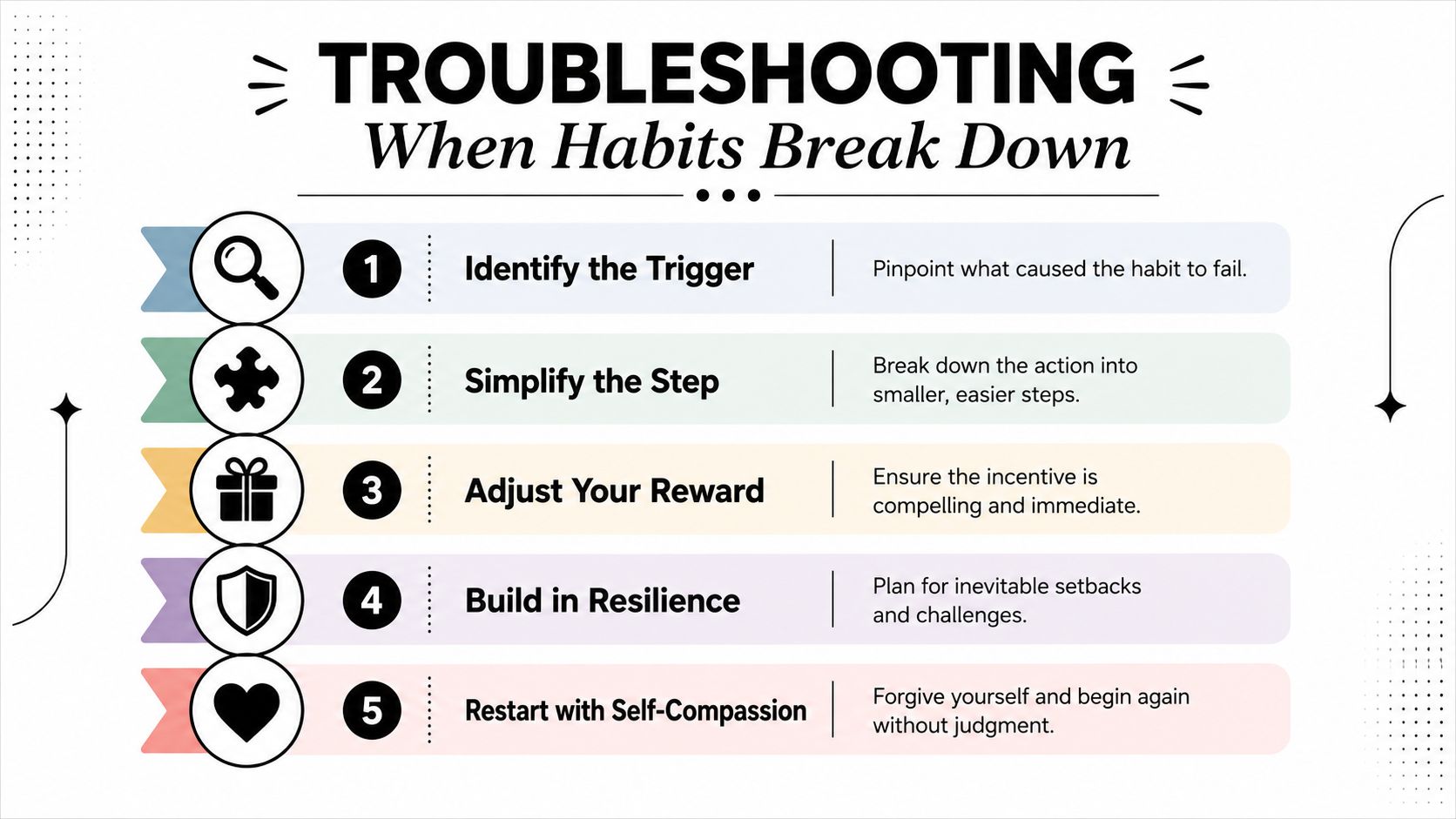
When a routine slips, don't ask, “Why am I like this?” Ask, “What changed in the system?”
Use this recovery sequence:
- Identify the break point. Did the cue disappear? Did the action become too large? Did the environment change?
- Shrink the habit immediately. Go back to the minimum version. Preserve continuity before intensity.
- Create an if-then fallback. If the normal routine fails, what smaller version still counts?
- Reset the environment. Recreate the visible cue in the new context.
- Restart without guilt. Judgment slows re-entry. Clear action speeds it up.
Missing the ideal version doesn't require abandoning the whole pattern.
Many people benefit from having examples of disciplined behavior that aren't built on perfection. These examples of self-discipline are helpful because they show consistency as a design choice, not a personality trait.
What to do in common disruption scenarios
Different disruptions break different parts of the loop. The fix should match the failure.
Travel
Your usual cue chain disappears. Meals shift, hotel layouts are unfamiliar, and time zones change. Keep one portable version of the habit.
- Reading: one page before sleep
- Exercise: short bodyweight sequence after waking
- Planning: review top priorities before opening messages
Illness or low energy
This is not the time for the full version. Protect identity through participation, not output.
- Workout habit: stretch or walk briefly instead of training hard
- Writing habit: capture one idea, not a polished draft
- Study habit: review one key concept, then stop
Deadline weeks
Pressure makes people cut the behaviors that keep them functional. Don't aim for balance. Aim for minimum viable continuity.
- Keep the planning habit.
- Keep the sleep-supporting habit.
- Keep one recovery habit.
- Pause anything decorative.
Caregiving or unpredictable schedules
Time-based cues often fail here. Switch to event-based cues instead.
- After the child falls asleep, do the short version.
- After the shift ends, reset for tomorrow.
- After dinner cleanup, complete the smallest meaningful action.
The strongest habit systems don't pretend disruption won't happen. They assume it will, and they build the fallback in before it's needed.
Conclusion From Planning Habits to Achieving Goals
The people who build lasting habits aren't usually the most motivated. They're the ones who stop treating habits like a test of character and start treating them like systems that need design, maintenance, and recovery.
That's the practical answer to how to build better habits. Start with a version so small you can do it under resistance. Scale only when the behavior is stable. Automate the cue, the setup, and the sequence. Then judge the habit by what it changes, not just how often you checked the box.
That last part is where many ambitious people finally get traction. A streak can feel satisfying while producing almost nothing. A useful habit lowers decision fatigue, protects focus, supports health, or creates visible progress toward a real goal. If it doesn't, it needs revision.
Resilient habits also assume interruption. Travel, stress, illness, and deadline pressure aren't edge cases. They are normal parts of a demanding life. The habit that survives those conditions is more valuable than the habit that looks clean on a perfect calendar.
For founders, professionals, students, and self-improvers, habits are not the end goal. They are the execution layer. Goals live at the strategic level. Habits are what make those goals move on ordinary days.
When your daily actions connect cleanly to meaningful milestones, consistency gets easier. You're no longer building routines for their own sake. You're building a system that turns intention into progress.
If you want a more connected way to link habits to actual goals, Tribble Software Private Limited offers Beyond Time, an AI-powered goal achievement system that turns objectives into milestones, routines, and measurable daily actions. It's built for people who don't just want to track habits, but want to connect those habits to planned work, time use, and outcome review in one operating system.
Put this into practice
Free tools that match this article.
Habit Tracker Template
Create a free printable habit tracker template — weekly or monthly. Customize your habits and download a clean PDF in seconds.
Try Habit TrackerHabit BuildingHabit Stack Builder
Use habit stacking to build new habits by attaching them to your existing routines.
Try Habit Stack BuilderHabit Building30-Day Challenge Generator
Build any habit with a personalized 30-day challenge featuring daily tasks and weekly milestones.
Try 30-Day ChallengeGoal SettingGoal Setting Worksheet
Turn a vague goal into milestones, habits, blockers, and a weekly review plan.
Try Goal WorksheetKeep exploring this topic
Atomic Habits summary
Apply the core behavior-change principles behind lasting habits.
Habit stacking guide
Attach new behaviors to routines you already do every day.
Goal setting guide
Start with the fundamentals of setting goals that turn into action.
Goal frameworks compared
Choose between SMART goals, OKRs, BHAGs, and 12-week goals.
Related Articles
The Force of Habit: Master Your Autopilot for Success
Learn what the force of habit is and how to use its power. This guide explains the neuroscience and gives you evidence-based strategies to build good habits.
A Goal Planning Template That Actually Works: OKR Method
Stop just setting goals. Use our OKR-based goal planning template to turn big ambitions into a daily action plan. Includes a free downloadable template.
Difference Between Short and Long Term Goals: A 2026 Guide
Learn the core difference between short and long term goals. This guide covers time horizons, purpose, and how to connect your vision to daily actions.
What Is the Difference Between Tactics and Strategy?
Learn what is the difference between tactics and strategy. This guide clarifies their scope and timeline, with examples, connecting vision to action for 2026
Weekly Goal Tracker: How to Plan and Achieve Your Goals
Design a weekly goal tracker that works. This guide shows you how to connect big objectives to daily tasks, build a tracker, and use AI to stay on course.

Master Your Estimated Completion Date in 2026
Calculate and manage an accurate, motivating estimated completion date. Our 2026 guide covers formulas, tracking, and common pitfalls to help you achieve goals.