Master Your Estimated Completion Date in 2026
Calculate and manage an accurate, motivating estimated completion date. Our 2026 guide covers formulas, tracking, and common pitfalls to help you achieve goals.
You set a date at kickoff. Everyone nodded. The plan looked clean in the project tool, the milestones felt reasonable, and the deadline sounded just ambitious enough to create urgency.
Then reality showed up.
A dependency slipped. Someone got pulled into a fire drill. A task that looked like two days turned into a week because the “easy part” depended on decisions nobody had made. Now the deadline is still sitting there like a monument to optimism, while the team stops believing it.
That's where most estimated completion dates fail. Not in the spreadsheet. In the gap between a number that looked motivating on day one and the actual work required on day twenty.
If that sounds familiar, you're not dealing with a scheduling problem alone. You're dealing with a blend of math, behavior, communication, and trust. The best estimated completion date isn't the one that sounds impressive in a meeting. It's the one people can use to plan, act on, and still believe after the first few surprises hit. If your team also needs stronger operating habits around calendars, priorities, and meeting load, these effective time management strategies are a useful companion to better forecasting.
Table of Contents
- The Familiar Pain of a Slipping Deadline
- What an Estimated Completion Date Really Means
- Why Vague Deadlines Are a Recipe for Failure
- How to Calculate Your Estimated Completion Date
- From Static Guess to Dynamic Forecast
- Common Estimation Pitfalls and How to Avoid Them
- Future-Proof Your Deadlines with AI Goal Systems
The Familiar Pain of a Slipping Deadline
The pattern is easy to recognize. A founder promises a launch window to customers. A manager tells leadership the migration should be done by month-end. A student blocks out six weeks for a thesis chapter and assumes weekends will absorb whatever goes wrong.
At first, the date feels helpful. It creates shape. People move.
Then the deadline starts drifting in ways nobody wants to say out loud. Work piles up near the end because the early estimates were rough. Reviews take longer than expected. Stakeholders ask for “small changes” that aren't small. The date remains unchanged, but everyone's internal model changes. The team no longer asks, “How do we hit it?” They ask, “How late will we be?”
That shift matters more than many realize.
A weak estimated completion date creates two kinds of damage at once. The obvious damage is operational. Plans break, resources get reallocated badly, and other work gets delayed downstream. The less visible damage is psychological. People stop trusting the plan, then stop trusting the planning process, then start protecting themselves with hedged language and hidden buffers.
Good execution needs tension, but it also needs credibility. A date that nobody believes won't motivate anyone for long.
Experienced project managers learn this early. Missing a deadline isn't usually the original problem. The original problem is that the team treated a rough target as if it were a tested forecast.
That's why mastering the estimated completion date is worth the effort. Done well, it reduces drama, improves decisions, and keeps pressure productive instead of corrosive.
What an Estimated Completion Date Really Means
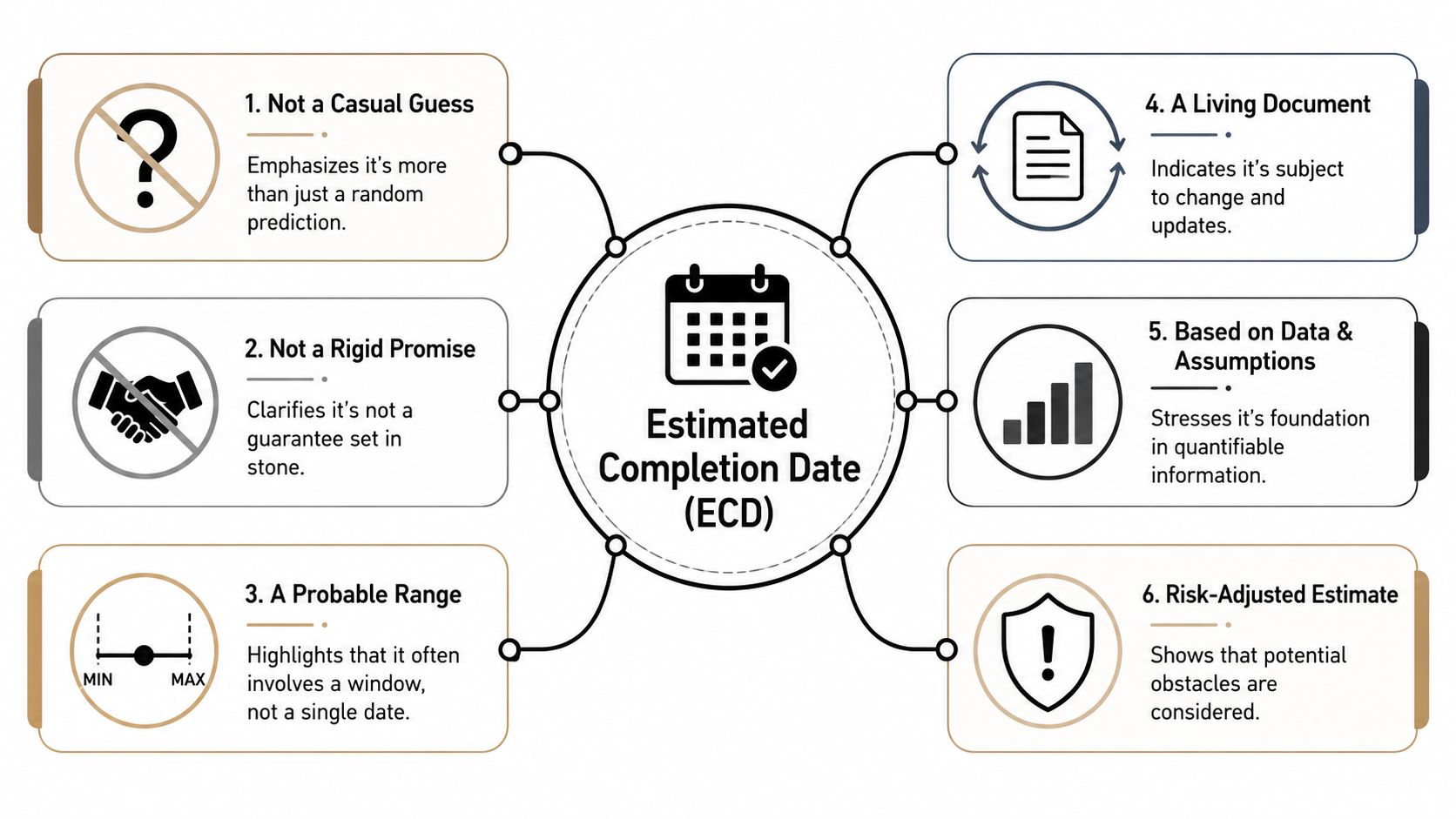
An estimated completion date is best treated like a weather forecast. It's built from evidence, assumptions, and current conditions. It helps people decide what to do next. But it isn't a magical promise that reality must obey.
The mistake many teams make is swinging between two extremes. One group treats the date casually, almost like a placeholder. Another treats it like a contract even when the underlying estimate is flimsy. Both approaches create avoidable trouble.
Forecast, not fortune telling
A useful estimated completion date has a few core qualities:
- It's based on defined work. If the scope is blurry, the date is blurry too.
- It reflects assumptions. Team capacity, approvals, dependencies, and handoffs all shape the forecast.
- It needs revision. New information should change the estimate when the facts change.
- It includes risk thinking. Mature teams don't schedule as if nothing will go wrong.
That's why I prefer language like “current forecast” over “final date” during active execution. It keeps everyone honest. It also keeps the conversation practical. If the estimate changes, the question becomes what changed in the work, not who failed to defend a number.
Three jobs one date has to do
A solid estimated completion date serves three functions at once.
| Function | What it does | What goes wrong when it fails |
|---|---|---|
| Forecasting | Helps sequence work, staff the effort, and coordinate dependencies | Other plans rest on fiction |
| Communication | Gives stakeholders a shared reference point | Teams hear different versions of reality |
| Commitment | Creates healthy pressure and focus | Motivation turns into cynicism |
These functions can pull against each other. The most aggressive date may inspire action in the short term, but if it ignores uncertainty, it destroys forecasting quality. The safest date may reduce risk, but it can also invite drift if nobody feels urgency.
Practical rule: The best estimated completion date is believable enough to guide action and firm enough to create focus.
That balance is the true craft. You aren't just predicting when work ends. You're designing a date people can plan around without inwardly dismissing it.
Why Vague Deadlines Are a Recipe for Failure
A team leaves kickoff with a deadline like “end of quarter.” It sounds specific enough to calm stakeholders and loose enough to keep options open. Three weeks later, design thinks that means final files delivered, engineering thinks it means code complete, and the executive sponsor assumes launch.
That is how slippage starts before the work is even hard.
Vague deadlines fail for two reasons. The math is weak, and the behavior gets worse. If the date is unclear, people make different assumptions about scope, approval cycles, and what “done” means. Once those assumptions spread, execution slows because nobody is solving the same scheduling problem.
The cost shows up fast:
- Budget creep: extra coordination, rework, and idle time raise delivery cost
- Trust loss: stakeholders stop treating status updates as reliable planning inputs
- Priority conflict: teams reserve time for one target while dependencies move on another
- Stress spikes: people try to recover with overtime instead of fixing the estimate
I have seen this pattern many times. Leaders respond to a slipping date by adding meetings, asking for daily updates, and pushing for more urgency. That creates motion, not control. A fuzzy target turns normal uncertainty into personal pressure, and people start optimizing for optics instead of progress.
Clear dates change decision quality. A team with a defined milestone can decide whether to cut scope, escalate a blocker, or pull a dependency forward. A team with “soon” usually waits. Waiting feels safe in the moment, but it burns schedule where nobody can see it.
Psychology matters here. People commit to dates they believe. They discount dates that feel political, padded, or invented in a kickoff room. Once that happens, the deadline stops directing behavior. It becomes calendar wallpaper.
That is why milestones matter as much as the final date. Specific checkpoints reduce ambiguity, expose slippage earlier, and give the team intermediate wins that keep momentum high. If your milestones are still vague, this guide to project milestone examples is a useful reference.
The same principle applies to roadmap work. Product teams often miss dates because roadmap language leaves too much room for interpretation between strategy and delivery. Crafting effective product roadmaps is useful here because roadmap clarity affects deadline clarity.
A vague deadline does not buy flexibility. It usually creates hidden commitments, delayed decisions, and lower accountability. A useful estimated completion date gives people a finish line they can act on now, not one they have to decode later.
How to Calculate Your Estimated Completion Date
A useful completion date comes from two jobs done well: estimating the work and shaping behavior around the estimate. Teams miss dates when either side is weak. Bad math produces fantasy schedules. Bad psychology produces dates nobody respects.
Start by defining the work
A date only gets as good as the task map behind it. If the project is still described as one large outcome, the estimate will be political, not operational.
Break it down until the people doing the work can judge effort with reasonable confidence. In practice, that usually means separating delivery work from decision points, approvals, reviews, handoffs, and outside dependencies. Those pieces fail on different schedules, so they should not be blended into one number.
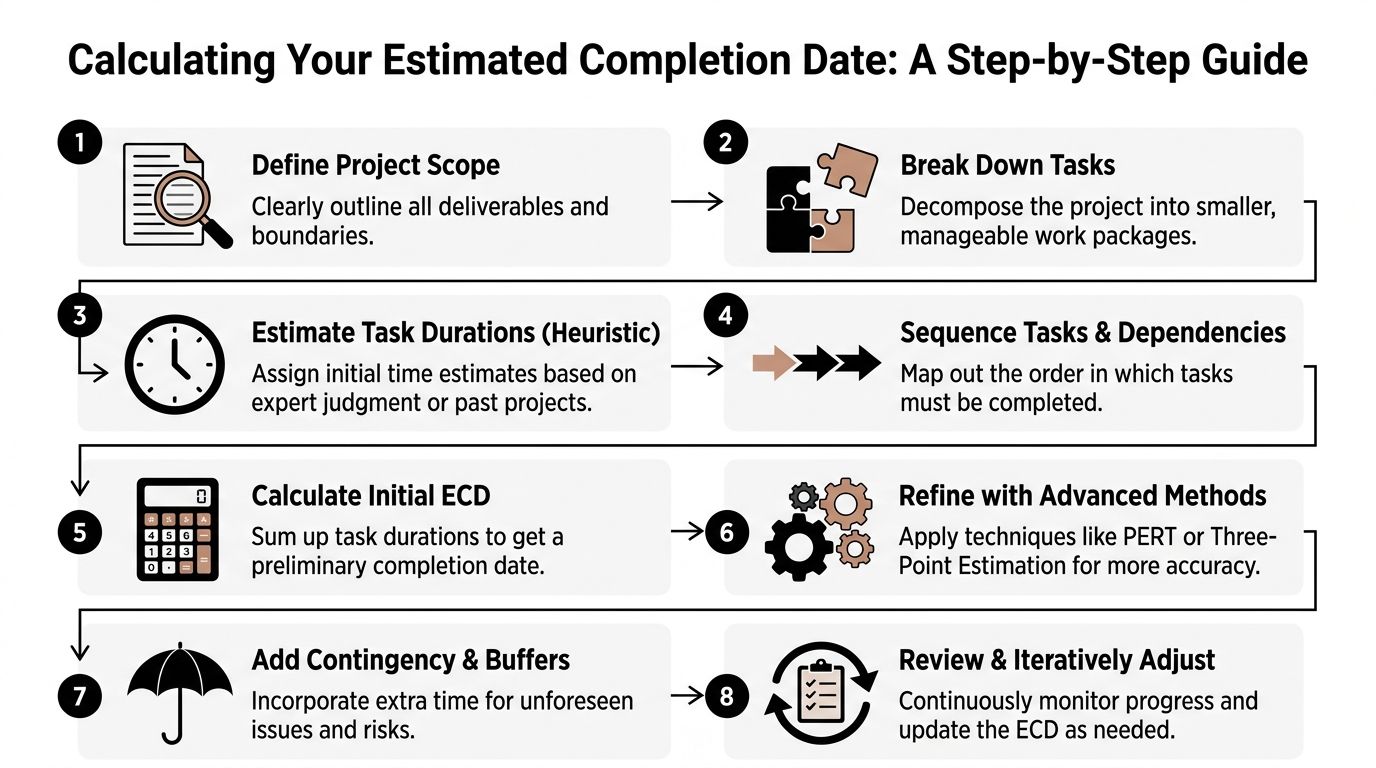
Use this sequence:
- Define the scope. State what is in, what is out, and what counts as done.
- Break the work into estimate-sized chunks. If a task is too large to picture clearly, split it again.
- Map dependencies. Mark what must happen in order and what can happen in parallel.
- Set checkpoint dates. Clear interim targets expose slippage before the final deadline is at risk. These project milestone examples are a good reference for sharpening milestone design.
- Use comparable work carefully. Similar past projects help, but only if the team, scope, and approval path are genuinely similar.
Product teams feel this fast. A weak roadmap creates weak estimates because the sequence of decisions is still fuzzy. Crafting effective product roadmaps helps clarify that sequence before a launch date gets committed.
Use three-point estimation instead of a single guess
Single-number estimates create false precision. Three-point estimation gives the team a better discussion and a better date.
The standard formula is Expected Time = (O + 4M + P) / 6, where:
- O is the optimistic case
- M is the most likely case
- P is the pessimistic case
This works because it forces the team to name uncertainty instead of hiding it. If the optimistic and pessimistic cases are close, the work is probably well understood. If the gap is wide, there is still discovery, dependency risk, or approval risk sitting inside the task.
Here is the practical difference:
| Method | Best use | Main weakness |
|---|---|---|
| Single-number estimate | Repetitive work with low variability | Masks uncertainty |
| Analogous estimate | Work that closely matches something completed before | Imports assumptions from the old project |
| Three-point estimate | Work with unknowns, cross-functional handoffs, or approval risk | Takes more discussion up front |
For more analytical teams, this embedded walkthrough adds a practical explanation of estimating completion confidence:
Add visible buffer, not hidden padding
Buffer belongs in the plan, not buried inside every task.
That distinction matters more than many leaders think. Hidden padding teaches people to protect themselves by inflating estimates. Visible buffer keeps the conversation honest. It shows where the risk sits, why the schedule needs protection, and what trade-offs are available if pressure increases.
A practical rule works well. Add buffer for known interruption points, rework risk, and reacquaintance time after pauses. Add more contingency when the work is novel, cross-functional, or approval-heavy. Add less when the team has done the same work repeatedly under similar conditions. A professional guide to estimated time of completion makes the same case and is useful if you want a simple outside reference.
Estimation impacts execution. A team will commit harder to a date that looks demanding but fair. A date with no visible allowance for risk feels fake, so people hedge their effort and protect themselves locally. A date with explicit assumptions gives managers room to make real decisions early, including cutting scope, adding support, or changing sequence.
Teams using AI planning tools such as Beyond Time have an advantage here. The estimate does not need to stay frozen after kickoff. The initial date can be built from task logic, milestone structure, and confidence ranges, then updated as real progress comes in. That gives you a completion date people can work toward now, without pretending the first draft was perfect.
From Static Guess to Dynamic Forecast
Monday starts with a confident finish date. By Thursday, one approval is late, a dependency slips, and a task that looked simple turns into rework. The teams that recover fastest are not the ones with the prettiest plan. They are the ones that treat the estimated completion date as a live forecast and adjust it before small variance turns into a miss.
Track planned versus actual
Forecasting gets stronger when the team builds a habit of checking reality against the plan. That sounds obvious, but in practice many teams only revisit the date when someone asks, “Are we still on track?” By then, options are narrower.
A better operating rhythm is simple and fast:
- Daily: Record what finished, what stalled, and what expanded beyond the original estimate.
- Weekly: Compare actual progress against milestone expectations and note the cause of any gap.
- At each dependency handoff: Recheck the remaining sequence, not just the next task.
The goal is not more reporting. The goal is earlier signal.
When a “two-hour” task slips three days in a row, that is not a rounding error. It usually points to one of three problems: hidden complexity, unclear ownership, or a dependency that was underestimated. Catch that early and the finish date stays manageable. Catch it late and the team starts negotiating from a position of stress.
This is also where the psychology matters. A frozen date creates theater. People protect the number, stop surfacing bad news, and hope they can make up time later. A live forecast does the opposite. It rewards honesty, because each update creates better options: trim scope, reorder work, add help, or accept the slip while it is still small.
Use confidence, not wishful thinking
A forecast should answer two questions. What is the most likely finish date? How confident are we in it?
One practical way to frame that discussion is with confidence ranges rather than a single point estimate. A project management tutorial shows how teams can calculate a completion date at a 95% confidence level using the formula (z × σ + μ), producing 45.803 days in its worked example, as shown in this project management tutorial on YouTube. The exact math matters less than the managerial shift. The conversation changes from “What date should we promise?” to “What date can this plan support?”
That distinction improves execution. Teams commit more consistently when the date feels demanding and credible. They drag their feet when the number looks political.
AI planning tools make this easier because they can recalculate based on current progress instead of forcing a manager to rebuild the schedule by hand. Good systems flag slippage patterns, surface risky dependencies, and show which changes will move the finish date the most. If you want a stronger operating model behind that process, this guide to software project planning for teams that need better forecast control gives a useful structure.
The strongest deadline is the one you update fastest when reality changes.
Common Estimation Pitfalls and How to Avoid Them
Some deadline failures come from weak methods. Others come from perfectly human judgment errors. Even a decent model can break if the team treats the first number as sacred, ignores scope drift, or confuses an internal forecast with a binding obligation.
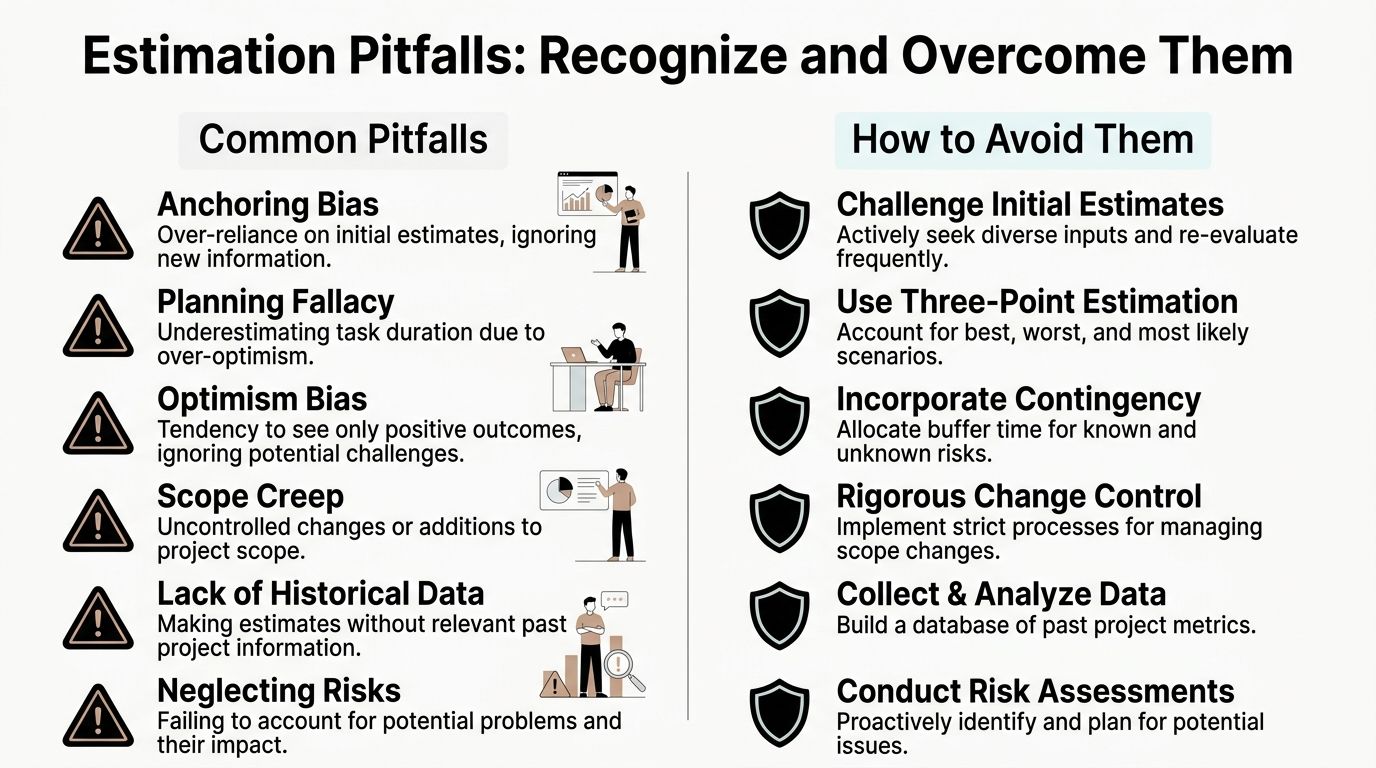
The traps that break good plans
A few pitfalls show up again and again.
- Anchoring bias: The first date gets announced early, then every later discussion bends around it. Counter this by scheduling explicit estimate reviews where the team must justify the current forecast from fresh evidence.
- Planning fallacy: People picture clean execution and forget approvals, interruptions, and rework. The fix is structured estimation and sharper task decomposition.
- Scope creep: “While we're here” changes eat the schedule. Teams need change control, even if it's lightweight.
- Missing historical context: Estimating in a vacuum makes optimism feel rational. Build a record of completed work, cycle times, and common blockers. If your team needs a stronger planning foundation, this article on software project planning gives a practical structure to tighten assumptions before dates are published.
A short reset question helps when plans start wobbling: If we were estimating this work today for the first time, would we still choose this date?
If the honest answer is no, your real problem isn't discipline. It's attachment.
When an estimate becomes binding
People often ask whether an estimated completion date is legally binding. The answer depends on context.
An internal project forecast is usually a planning tool. A contract, grant agreement, or formal obligation can be different. In a government grant FAQ, funds must be expended by the date “established in the agreement,” which makes that date binding in that context, as described in the South Carolina DHHS FAQ document%20FAQs%20Rural%20%20MUA%20Final.pdf).
That distinction matters because teams often use one phrase, “estimated completion date,” for two very different things:
| Context | Meaning of the date | How to treat it |
|---|---|---|
| Internal planning | Current forecast | Update as facts change |
| Contract or agreement | Enforceable deadline or condition | Escalate risk early and manage tightly |
Treating a forecast like a contract creates panic. Treating a contract like a soft estimate creates exposure. Smart managers separate those cases immediately.
Future-Proof Your Deadlines with AI Goal Systems
A team locks a launch date in January. By February, scope has shifted, one dependency is late, and the original estimate still sits in the dashboard like it means something. Everyone can feel the gap, but no one wants to touch the date because changing it looks like failure.
That is exactly how stale deadlines survive. They stop being forecasts and turn into symbols.
The old model assumed the plan would stay stable long enough for one estimate to hold. For repeatable work, that can still be good enough. For product work, cross-functional projects, consulting engagements, and personal goals with competing priorities, a static date often breaks long before the work is done.
The practical answer is not to stop estimating. It is to run deadlines inside a system that updates with the work.
Why static deadlines lose value
A fixed date only helps when the assumptions behind it are still true. Once task order changes, effort runs long, or a blocked dependency starts consuming slack, the original date becomes weaker each day unless someone recalculates it.
Execution psychology is a critical factor. People commit harder to a date they believe. They disengage from a date that clearly no longer matches reality. I have seen teams miss targets not because the work was impossible, but because the plan became unbelievable and motivation dropped with it.
A stronger system keeps the estimate connected to evidence. It shows what has been finished, what is running late, what moved up in priority, and what that means for the path to completion right now.
What AI goal systems improve
Good AI goal systems do more than draft a plan on day one. They help teams and individuals keep adjusting before small misses turn into deadline failure.
In practice, the best systems tend to:
- Break goals into sequenced milestones so the path is visible
- Track planned versus actual effort so slippage shows up early
- Reprioritize next actions based on constraints instead of treating every delay as a reason to push the final date
- Keep progress psychologically credible so urgency stays high without creating false pressure
That last point matters more than many managers admit. A deadline should create focus, not denial. When the calendar and lived experience drift apart, people either sandbag, panic, or stop trusting the plan. Adaptive goal systems reduce that gap by updating the roadmap while there is still time to act.
For a solo operator, that might mean changing this week's sequence to protect a client deliverable. For a team lead, it might mean spotting that testing is consuming more time than planned and cutting a low-value feature before the release date gets hit. The benefit is the same. You make decisions earlier, with less drama.
If you're comparing options, this guide to AI productivity tools for dynamic planning and execution is a useful place to start.
An estimated completion date still matters. The difference is that the date works best as one output of an active goal system, not the entire system itself.
If you want a system that turns goals into sequenced milestones, connects them to daily execution, and keeps planned-versus-actual performance visible, Tribble Software Private Limited built Beyond Time for exactly that job. It combines AI-generated roadmaps, milestone planning, routines, habits, time tracking, and daily critique so your estimated completion date stays connected to real work instead of wishful thinking.
Put this into practice
Free tools that match this article.
Goal Setting Worksheet
Turn a vague goal into milestones, habits, blockers, and a weekly review plan.
Try Goal WorksheetGoal SettingSMART Goal Validator
Instantly validate your goals against the SMART framework and get actionable improvement suggestions.
Try SMART ValidatorGoal SettingAI Milestone Generator
Turn your biggest goals into an actionable step-by-step plan in seconds with AI.
Try Milestone GeneratorTime ManagementTime Blocking Template
Map your day into focused time blocks with a free printable time blocking template.
Try Time BlockingKeep exploring this topic
Goal setting guide
Start with the fundamentals of setting goals that turn into action.
Goal frameworks compared
Choose between SMART goals, OKRs, BHAGs, and 12-week goals.
Time blocking guide
Turn priorities into protected calendar blocks.
15-minute time blocks
Plan and review your day with more realistic precision.
Related Articles
What Is Time Tracking: Your 2026 Productivity Guide
Discover what is time tracking, its methods, and how it boosts productivity. Learn to achieve your goals effectively with our 2026 guide.
Difference Between Short and Long Term Goals: A 2026 Guide
Learn the core difference between short and long term goals. This guide covers time horizons, purpose, and how to connect your vision to daily actions.
How to Improve Work Productivity: A Complete System
Learn how to improve work productivity with a step-by-step system. Go beyond simple tips to diagnose bottlenecks, build routines, and track progress.
Personal Productivity Systems to Stop Planning, Start Doing
Feeling busy but not productive? Learn how to choose, build, and adapt personal productivity systems like GTD, OKRs, and more to finally achieve your goals.

How to Track Multiple Goals Without Getting Overwhelmed
Learn a proven system for managing multiple goals simultaneously without losing focus or burning out. Practical frameworks for tracking 3-5 goals at once.
Accountability Partner Guide: Achieve Goals Faster
Learn how to find, structure, and get the most from an accountability partner. Research shows accountability can boost goal achievement by up to 95%.