
Difference Between Short and Long Term Goals: A 2026 Guide
Learn the core difference between short and long term goals. This guide covers time horizons, purpose, and how to connect your vision to daily actions.
You set a big goal in January. Launch the business. get promoted. finish the degree with distinction. run the race. By February, the goal still sounds good, but your daily decisions no longer connect to it.
That's where most goal setting breaks down.
The problem usually isn't ambition. It's architecture. People create a long-term vision, then keep a separate to-do list for the week, and they never build a working bridge between the two. The result is familiar: a strong burst of motivation, a messy middle, then a quiet drift into reactive work.
The difference between short and long term goals matters because each one does a different job. One creates direction. The other creates movement. If you confuse those roles, you either become busy without progress or visionary without execution.
A useful goal system treats both as parts of the same machine. Long-term goals give meaning to effort. Short-term goals turn that meaning into something you can schedule, track, and complete. When that connection is missing, even disciplined people stall. When it's present, momentum becomes much easier to sustain.
Practical structure proves more effective than motivation. You need a way to translate a multi-year ambition into milestones, then into weekly targets, then into actions that can survive a normal Tuesday full of interruptions.
Table of Contents
- Introduction Beyond the Dictionary Definition
- Defining Short Term and Long Term Goals
- A Detailed Comparison by Key Criteria
- Goal Setting Examples for Different Ambitions
- From Vision to Action A Practical Framework
- Common Goal Setting Pitfalls and How to Avoid Them
Introduction Beyond the Dictionary Definition
A basic definition of goals is often unnecessary. It's generally understood that short-term goals are closer and long-term goals are farther away. That information alone doesn't help when the calendar fills up, priorities collide, and the original plan starts slipping.
What helps is understanding why the two types of goals exist in the first place. A long-term goal answers, “Where am I going?” A short-term goal answers, “What do I need to finish next?” Those are different questions, and they require different kinds of thinking.
Short-term and long-term goals fail when they're managed as separate lists instead of one connected system.
That distinction changes how you work. A long-term goal should shape choices, trade-offs, and direction. A short-term goal should shape today's actions, this week's priorities, and what gets measured right now. If your annual vision doesn't affect your calendar, it's decoration. If your daily tasks don't point to a larger aim, they're maintenance.
In coaching, the pattern is consistent. People usually overinvest in one side. Some are excellent at dreaming and weak at execution. Others are productive every day but can't explain what all that effort is building toward. Neither pattern holds up for long.
The better approach is simple and demanding at the same time:
- Choose a meaningful long-term direction: something substantial enough to organize effort.
- Break it into near-term wins: milestones you can complete and verify.
- Track both levels differently: vision for the long term, evidence for the short term.
- Adjust without losing the thread: change tactics when needed, not the purpose every week.
That's the working answer to the difference between short and long term goals. It isn't just about duration. It's about role, design, and how each type supports actual achievement.
Defining Short Term and Long Term Goals
A short-term goal is usually something you can achieve within days, weeks, or a few months, with an upper limit of one year, while long-term goals typically require at least one year or more and often much more sustained planning, according to BoardEffect's explanation of short-term and long-term goal planning.

That timeline matters, but it's not the most useful way to think about the difference.
Short-term goals are execution tools
Short-term goals are the stepping stones. They're concrete enough to finish, check off, and evaluate. They give you immediate feedback, which is why they're so good at sustaining motivation. You don't have to wonder whether you're moving. You can see it.
A strong short-term goal tends to have a clear finish line. It's specific, measurable, and close enough that you can assign real work to it. That's why short-term goals work well for things like submitting applications, finishing a pitch deck, completing a training block, or shipping a project milestone.
In practice, they also create discipline. Because they're close to the present, they force prioritization. You can't hide behind abstract ambition when the deadline is this month.
Long-term goals are direction tools
Long-term goals play a different role. They act as the North Star. They set direction over years, not days, and they give meaning to all the smaller tasks that would otherwise feel disconnected.
Long-term goals aren't supposed to look like a task list. They're broader by design. They answer questions like: What kind of business am I building? What role am I growing into? What standard of health or mastery am I trying to reach? They require more planning and more flexibility because a lot can change over a long horizon.
A useful long-term goal should be stable enough to guide you and flexible enough to survive contact with reality.
That's why people often benefit from tools that help shape a future vision before they start breaking it down. Something like a 5-year plan generator can help turn a vague aspiration into a defined direction you can work backward from.
They are not competing categories
The difference between short and long term goals isn't that one matters more. It's that each solves a different problem.
- Short-term goals solve the problem of action.
- Long-term goals solve the problem of direction.
- Short-term goals create traction.
- Long-term goals create coherence.
When people say they're “focused on the long term,” they often mean they haven't translated vision into execution. When they say they're “just focused on what's in front of them,” they often mean they're busy without a bigger frame.
The right setup uses both. One tells you where to aim. The other tells you what to do next.
A Detailed Comparison by Key Criteria
The fastest way to understand the difference between short and long term goals is to compare how they behave under pressure. They don't just differ by calendar length. They differ in what they demand from you, how you evaluate them, and how you respond when conditions change.
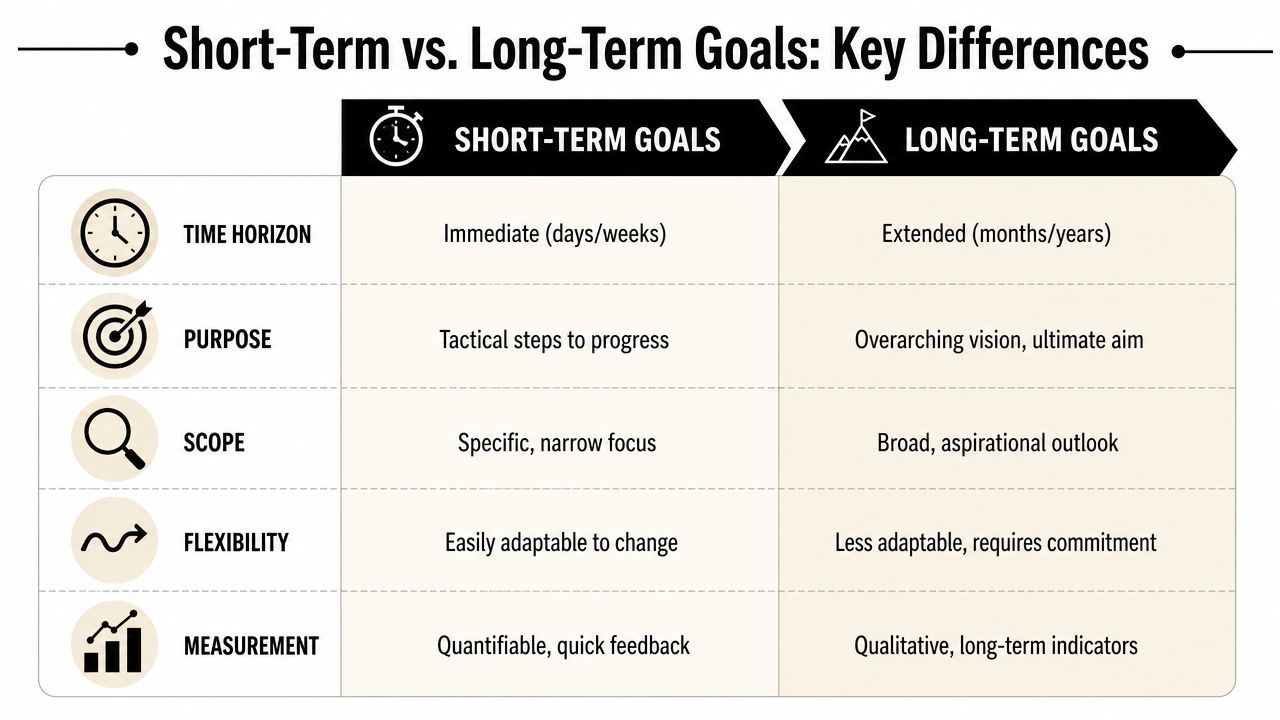
Here's the working comparison.
| Criterion | Short-Term Goals | Long-Term Goals |
|---|---|---|
| Time Horizon | Days, weeks, or months, usually under one year | One year or more, often spanning years |
| Purpose | Tactical progress and immediate movement | Strategic direction and overall vision |
| Scope | Narrow, specific, and concrete | Broad, aspirational, and contextual |
| Measurement | Quantifiable near-term completion | Progress through milestones over time |
| Deadlines | Hard deadlines help maintain focus | Flexibility matters as conditions evolve |
| Adaptability | More rigid to protect execution | More adaptable to protect strategy |
| Effort Style | Direct action and task completion | Planning, sequencing, and persistence |
| Motivation | Quick wins and visible momentum | Meaning, identity, and future payoff |
Time horizon
Short-term goals live close to the present. They belong to the part of planning where you can still see the finish line clearly. That's why they work well for sprint-style execution.
Long-term goals live farther out. They stretch across uncertainty, changing constraints, and shifting opportunities. That longer horizon is exactly why they need a different management style.
If a goal is close enough to schedule precisely, treat it like execution. If it stretches across changing conditions, treat it like strategy.
Purpose and motivation
Short-term goals are built to move work forward now. They create urgency, pace, and visible completion. That's motivating because completion feels real. You finished the draft. You made the calls. You passed the exam module. You hit the training target.
Long-term goals motivate differently. They don't give you the same immediate reward. Instead, they answer a deeper question: why this work matters at all. Becoming a market leader, moving into senior leadership, graduating into a chosen field, or building a healthier body composition won't happen in a single push. The long-term goal gives those repeated short pushes a reason.
Measurement and feedback
This is one of the most practical differences. According to Speexx on long-term and short-term goal setting, short-term goals are measured by quantifiable achievements within 30 days for rapid visibility, while long-term goals are tracked through periodic milestones. The same source notes that short-term targets benefit from rigid deadlines, while long-term goals need flexibility as strategy changes.
That's exactly what shows up in real work.
A short-term goal should usually answer with a clean yes or no. Was the proposal sent? Was the module completed? Did the team reach the monthly target? Long-term goals need a more layered review. You ask whether the milestones still make sense, whether the direction still holds, and whether the path needs revision.
Risk and adaptability
Short-term goals should be relatively rigid. If you keep changing them, you destroy focus. You need a hard edge around what counts as done.
Long-term goals need more flexibility. Not because they're weaker, but because they sit farther from the present. Markets shift. workloads change. your interests evolve. strategies that looked sensible at the start can become dead weight later.
The mistake is reversing these. Some people constantly edit their weekly goals, then stubbornly cling to a long-term plan that no longer fits reality. That produces motion without progress.
Effort and focus
Short-term work is usually narrower and more intense. You concentrate on direct outputs. That often means multitasking across several short-term goals at once, as long as each one is clearly bounded.
Long-term work asks for endurance. It's less about intensity in a single week and more about maintaining aligned effort over time. A person can brute-force a short-term sprint. They can't brute-force a multi-year objective without a system.
A practical way to separate the two is to ask:
- What needs finishing soon: that's likely a short-term goal.
- What needs sustained commitment: that's likely a long-term goal.
- What can be scored immediately: short-term.
- What needs milestone reviews: long-term.
If you manage both with the same rules, one of them will break.
Goal Setting Examples for Different Ambitions
Definitions only become useful when they survive contact with real life. The easiest way to see the difference between short and long term goals is to watch how a big ambition gets translated into smaller commitments.
For businesses, short-term goals tend to drive immediate outcomes like monthly sales targets, while long-term goals focus on vision-driven outcomes such as becoming the market leader in five years, as described by MarshBerry on the importance of both short-term and long-term strategic goals. The same logic applies to careers, academics, and fitness.
Startup founder
A founder's long-term goal might be to build a respected product company in a category they want to own. That vision is strategic. It informs product choices, hiring priorities, and positioning.
Short-term goals would look much more grounded:
- Validate demand: talk to target users and document recurring problems.
- Ship a usable version: release the smallest product people can adopt.
- Improve conversion points: tighten onboarding, activation, and feedback loops.
- Prepare for growth: organize operating metrics, messaging, and investor materials.
Each short-term target has a different job, but all of them support the same long-term direction.
Corporate professional
A working professional may have a long-term goal of moving into senior management or leading a function. That's not something you achieve by writing “get promoted” on a planner.
The short-term layer performs the core work. It might include leading a visible project, improving communication with stakeholders, building decision-making credibility, and documenting measurable contributions. If you need sharper examples of what measurable progress looks like, this set of measurable goal examples is a useful reference point.
Promotion is a long-term outcome. Building evidence that you can already operate at the next level is the short-term work.
University student
A student's long-term goal might be graduating into a strong career path or earning admission to advanced study. That's broad enough to guide choices, but too broad to manage day to day.
The short-term goals are more practical. Finish coursework ahead of deadline. improve one weak subject. meet professors during office hours. build a portfolio. apply for internships. Those actions may feel small in isolation, but they create the profile that makes the long-term outcome more likely.
Fitness enthusiast
A fitness goal often exposes the difference most clearly. A long-term ambition could be improving body composition, building strength, or completing a major event. That vision provides direction, but it doesn't tell you what to do this week.
Short-term goals do. Complete training sessions. prep meals consistently. protect sleep. log performance. review recovery. adjust volume if work stress spikes. The long-term result comes from repeated short-term adherence, not from repeating the big aspiration louder.
What works across all four examples is the same principle: the long-term goal creates the standard, and the short-term goals create the proof. When those two levels stay connected, effort compounds instead of scattering.
From Vision to Action A Practical Framework
Naming goals isn't the primary hurdle. The difficulty often lies in operationalizing them. A goal is useful only when you can trace a straight line from the vision you care about to the actions you'll repeat.

A practical system has three levels. The long-term objective sits at the top. Measurable milestones sit in the middle. Daily and weekly actions sit at the bottom. If one layer is missing, the whole structure gets shaky.
Start with the objective
Begin with a long-term goal that is specific enough to guide trade-offs, but broad enough to matter. “Be successful” isn't usable. “Build a profitable consulting practice,” “move into a director-level role,” or “complete a degree with a strong body of work” gives you something clearer.
This top layer should answer three things:
- Direction: what future are you trying to create?
- Reason: why does that future matter to you?
- Constraint: what are you willing to prioritize or sacrifice for it?
If those answers are fuzzy, the rest of the system will stay fuzzy too.
Turn the objective into milestones
Most progress gets won or lost at this stage. A single long-term goal requires and consists of many smaller, short-term goals, and frameworks like OKRs help connect short-term key results to the long-term objective, creating a loop where daily activity supports the larger vision, according to the U.S. Chamber guide to creating long-term vs short-term goals.
Use that logic directly.
If the objective is the destination, milestones are the checkpoints that prove you're on the road. They should be demanding but realistic. For this, SMART thinking helps. The milestone needs to be specific, measurable, achievable, relevant, and time-bound.
A clean way to structure this is:
- Name the objective in plain language.
- List the milestone outcomes that would make the objective credible.
- Put each milestone in sequence so you know what comes first.
- Assign ownership and timing to each one.
Don't break a long-term goal into random tasks. Break it into milestone outcomes that change what becomes possible next.
If you want a deeper look at the mechanics, these goal setting frameworks are useful because they show how different systems translate broad intent into measurable execution.
Convert milestones into weekly and daily execution
Goals are no longer merely theoretical.
Take each milestone and ask, “What repeated actions would make this inevitable?” That question forces you below the level of aspiration and into behavior. A milestone like “finish the certification” becomes weekly study blocks, practice tests, and review sessions. A milestone like “improve client pipeline” becomes outreach, follow-ups, proposal work, and calendar protection.
For founders especially, this often overlaps with workload design. If your calendar is full of reactive work, your short-term goals will collapse even when your long-term vision is solid. That's why practical guidance on effective time management for entrepreneurs matters. It helps turn ambition into protected execution time instead of leaving it to chance.
A useful weekly filter looks like this:
- Which milestone matters most right now
- What actions directly move it
- What can be deferred, delegated, or dropped
- What gets scheduled, not merely intended
Here's a helpful walkthrough on turning goals into action.
Review the system instead of relying on mood
A good system includes regular reviews. Weekly reviews work well for short-term execution because they keep your actions honest. Longer goals need less frequent but more strategic review. You're checking whether the milestones still fit, whether the sequence still makes sense, and whether the objective still deserves commitment.
This review process is what keeps short and long term goals integrated. Without it, you either drift into busywork or stay attached to a plan that no longer reflects reality.
The standard to aim for is simple. Your long-term goal should shape your milestones. Your milestones should shape your week. Your week should shape your day. When that chain is intact, progress stops feeling random.
Common Goal Setting Pitfalls and How to Avoid Them
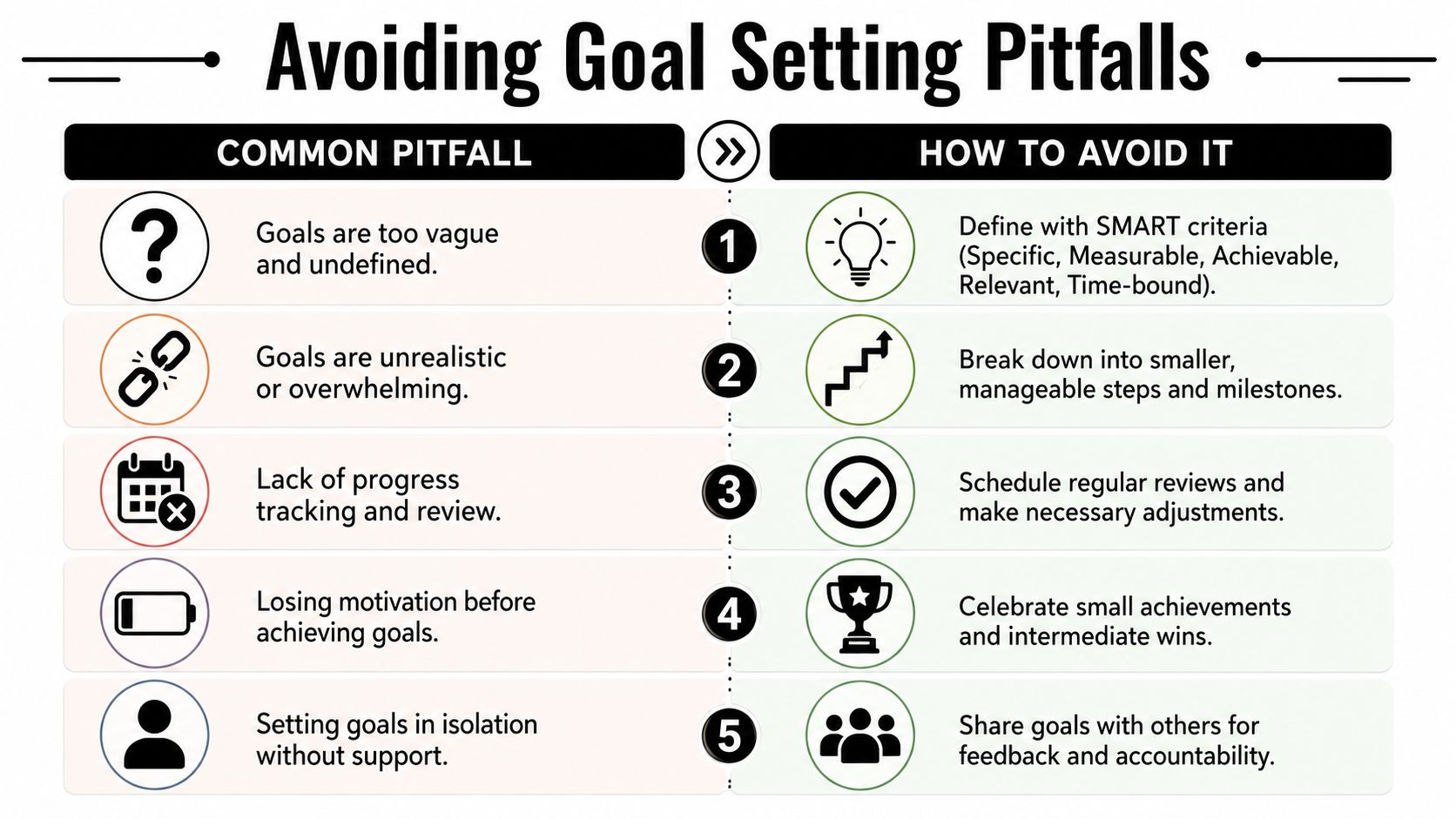
Most goal systems don't fail because people are lazy. They fail because the structure is wrong. The mistakes are predictable, which means they're fixable.
Pitfall one chasing vagueness
A vague long-term goal sounds inspiring but gives you nothing to work with. “Do better in my career” or “get healthier” can't guide a real plan.
The fix is to define the outcome in concrete terms, then force it through measurable milestones. Ambition matters, but vagueness kills execution.
Pitfall two collecting tasks without strategy
Some people do the opposite. They create a long list of short-term tasks with no larger logic. That produces activity, not progress.
Use a simple test: if a short-term goal doesn't clearly support a larger objective, question why it's on the list at all.
Busy people often mistake motion for alignment. The calendar can be full while the goal system is empty.
Pitfall three using the wrong scheduling method
Research published in Experimental Psychology found that clock-time scheduling works best for long-term goals, while event-time scheduling works best for short-term goals, as explained in the study on scheduling and goal pursuit. In practice, that means a long-term goal benefits from fixed dates on a calendar, while a short-term goal can often work better when tied to a triggering event such as finishing a project phase.
That distinction helps prevent friction. Long-term plans need stable anchors. Short-term actions often need agility.
Pitfall four refusing to adjust
People either change plans too often or never change them at all. Neither works.
Review the strategy without rewriting the mission every week. If your workload is so overloaded that strategic work never gets protected, you may also need better support systems, including smarter handoff habits. These delegation tips to regain focus are useful when too much low-value work is crowding out your actual goals.
The difference between short and long term goals becomes useful only when the two stay connected. Vision without execution stays imaginary. Execution without vision becomes noise. Build the bridge, maintain it, and let your daily work prove where you're headed.
Tribble Software Private Limited built Beyond Time for exactly this problem. It's an AI-powered goal achievement system that turns long-term objectives into sequenced milestones, daily routines, and trackable momentum. If you want a practical way to connect vision, execution, habit building, and accountability in one place, it's worth exploring.
Put this into practice
Free tools that match this article.
Goal Setting Worksheet
Turn a vague goal into milestones, habits, blockers, and a weekly review plan.
Try Goal WorksheetGoal SettingSMART Goal Validator
Instantly validate your goals against the SMART framework and get actionable improvement suggestions.
Try SMART ValidatorGoal SettingAI Milestone Generator
Turn your biggest goals into an actionable step-by-step plan in seconds with AI.
Try Milestone GeneratorTime ManagementTime Blocking Template
Map your day into focused time blocks with a free printable time blocking template.
Try Time BlockingKeep exploring this topic
Goal setting guide
Start with the fundamentals of setting goals that turn into action.
Goal frameworks compared
Choose between SMART goals, OKRs, BHAGs, and 12-week goals.
Time blocking guide
Turn priorities into protected calendar blocks.
15-minute time blocks
Plan and review your day with more realistic precision.
Related Articles
A Goal Planning Template That Actually Works: OKR Method
Stop just setting goals. Use our OKR-based goal planning template to turn big ambitions into a daily action plan. Includes a free downloadable template.

Master Your Estimated Completion Date in 2026
Calculate and manage an accurate, motivating estimated completion date. Our 2026 guide covers formulas, tracking, and common pitfalls to help you achieve goals.
What Is Time Tracking: Your 2026 Productivity Guide
Discover what is time tracking, its methods, and how it boosts productivity. Learn to achieve your goals effectively with our 2026 guide.

How to Track Multiple Goals Without Getting Overwhelmed
Learn a proven system for managing multiple goals simultaneously without losing focus or burning out. Practical frameworks for tracking 3-5 goals at once.
Accountability Partner Guide: Achieve Goals Faster
Learn how to find, structure, and get the most from an accountability partner. Research shows accountability can boost goal achievement by up to 95%.
Work-Life Balance Goal Setting: A Framework That Actually Works
Learn how to set goals across work and life without sacrificing one for the other. A practical framework for balancing ambition with wellbeing.