Master Goal Setting Frameworks for Success
Goal setting frameworks - Explore top goal setting frameworks like SMART & OKRs. Choose the right one to turn plans into daily action and achieve your goals.
You pick a goal with real energy behind it. This time you'll get fit, finish the thesis, ship the product, or finally build a consistent writing habit. For a few days, maybe even a few weeks, the goal feels alive. Then work gets messy, life gets noisy, and the goal slips out of your hands.
That's usually not a motivation problem. It's a structure problem.
A goal without a framework is like trying to build a second floor without scaffolding. You can see what you want to create, but there's nothing holding the effort together when the first delay, bad week, or competing priority shows up. That's why so many smart, capable people keep setting goals and still feel stuck.
A founder might say, “I want better growth,” but never define what “better” means. A student might aim to “study more,” yet never decide when, how, or what to study first. Someone improving their health may know the destination but still need concrete systems, including practical resources like how to set calorie targets, to translate intent into daily choices.

Goal setting frameworks solve that problem. They give shape to ambition. Beyond that, they help you turn a high-level goal into something you can act on this week, today, and even in the next hour.
Table of Contents
- Beyond New Year's Resolutions
- Why a Framework Is Your Goal's Best Friend
- A Deep Dive into Four Powerful Frameworks
- How to Choose the Right Goal Setting Framework
- From Framework to Action The Missing Link
- Connecting Your Goals, Actions, and Progress
Beyond New Year's Resolutions
New Year's goals get a bad reputation, but the calendar isn't the actual issue. The problem is that people often make promises in headline form. “Get healthier.” “Grow the business.” “Be more productive.” Those sound meaningful, but they don't tell you what to do when Tuesday gets crowded.
A framework turns a wish into a working plan. It gives the goal edges, checkpoints, and a way to tell whether you're moving or drifting. That shift matters because most goals don't fail in dramatic fashion. They fade gradually through missed decisions, vague next steps, and too many competing options.
A vague goal creates daily confusion. A structured goal reduces the number of decisions you have to make under pressure.
Think about the difference between saying “I want to do well this semester” and saying “I will complete reading notes for two classes every weekday from 4 to 5 p.m. and review them every Friday.” The first sounds inspiring. The second creates momentum.
That's the promise of goal setting frameworks. Not more motivational language. Better design.
Why a Framework Is Your Goal's Best Friend
A good framework works like a recipe for a difficult dish. You still need to cook, but the recipe tells you what ingredients matter, what order to follow, and how to know if you're on track. Without that structure, you improvise too much. Sometimes that works. Usually it leads to inconsistency.
What a framework adds
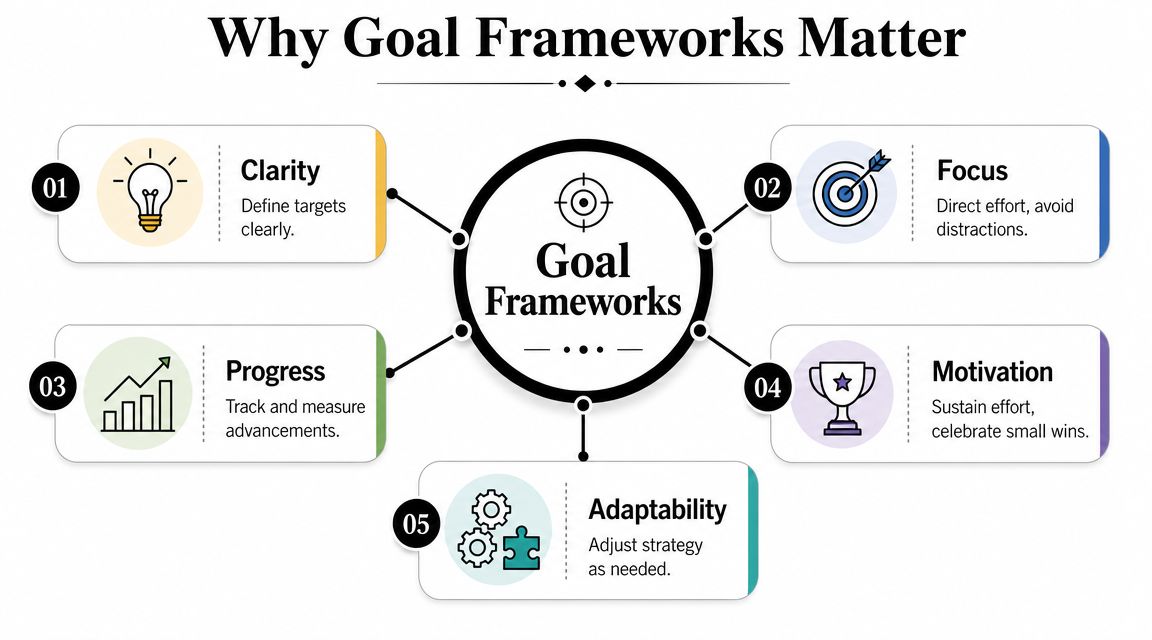
Frameworks help in five practical ways:
- Clarity: They force you to define what success looks like.
- Focus: They reduce side quests and keep effort pointed in one direction.
- Progress tracking: They make it easier to compare planned work with actual work.
- Motivation: Small wins become visible, which keeps energy from collapsing.
- Adaptability: You can adjust the plan because the moving parts are visible.
This is one reason written goals matter. Built In notes that writing goals down and using structured methods can increase your chances of success by 33% in its summary of goal-setting research and methods like backcasting and HARD goals (Built In on structured goal setting).
Why structure changes behavior
When a goal stays in your head, your brain treats it like a loose intention. It feels important, but it competes with every urgent email, meeting, and distraction. Once the goal enters a framework, it becomes easier to review, measure, and revise.
That matters psychologically. You get clearer feedback. You can see whether the problem is effort, timing, difficulty, or prioritization. You also remove a common source of stress, which is uncertainty about what to do next.
A framework doesn't guarantee success. It does something more useful. It gives you a repeatable way to make progress when enthusiasm fades.
Practical rule: If you can't tell whether you're ahead, behind, or blocked, your goal is still too vague.
A Deep Dive into Four Powerful Frameworks
You sit down on Monday with a goal like "get healthier," "grow the business," or "finally finish the course." By Tuesday, the goal has split into ten possible tasks, three new worries, and no clear starting point. That is the implementation gap. The goal sounds real, but your calendar still has no instructions.
Different frameworks help in different ways. Some work like a street map and help you make the next few turns. Others work like a trail map and help you stay oriented when the path gets steep or unclear. The useful question is not "Which framework is best?" It is "Which framework helps me turn this goal into the next repeatable action?"
SMART for clear execution
SMART stands for Specific, Measurable, Achievable, Relevant, and Time-bound. It is the framework to use when the main problem is fuzziness. You know the direction, but the goal still sounds too broad to act on.
Deel's overview of goal-setting frameworks describes SMART as especially useful for creating clear execution boundaries, while also noting that it can feel restrictive for bigger strategic ambitions (Deel on SMART and OKRs).
Here is the practical shift SMART creates. It turns "I want to improve in math" into a study target you can schedule.
- Specific: Raise my calculus grade
- Measurable: Earn an A on the next exam
- Achievable: Attend tutoring twice a week and complete four practice sets
- Relevant: This course affects my major progress
- Time-bound: Before the exam in six weeks
Notice what happened. The goal stopped being a hope and started becoming a plan. You can now decide what goes on Tuesday at 4 p.m.
The same pattern works at work. "Improve onboarding" is vague because no one knows what to do first. A SMART version could be: "Rewrite the first-run checklist, test it with new users, and review completion rates by the end of the month." That gives the team a scope, a deadline, and a way to review whether the work helped.
SMART is a good fit when:
- You control the work directly: study plans, personal habits, project deliverables
- You already know the strategy: the question is execution, not direction
- You need a clean handoff from goal to calendar: specific actions are easier to assign and track
If you want to tighten a draft goal before you commit to it, a SMART goal validator can help you spot where it is still vague or hard to measure.
OKRs for ambitious outcomes
OKRs stands for Objectives and Key Results. This framework helps when a goal is bigger than a single task list. It keeps attention on the result you want to create, while still giving you markers to review along the way.
An Objective sets the direction. A Key Result shows evidence that movement is happening. Teams often use a small set of key results for each objective and review them on a regular rhythm, because OKRs are built for alignment and course correction, not just personal discipline.
A startup team might use OKRs like this:
| Element | Example |
|---|---|
| Objective | Become the obvious first choice for our ideal customer |
| Key Result 1 | Improve trial-to-paid conversion |
| Key Result 2 | Increase qualified demo requests |
| Key Result 3 | Reduce drop-off in onboarding |
The common mistake is treating key results like a to-do list. "Launch email campaign" is work. "Increase qualified demo requests" is the outcome that tells you whether the work mattered. That distinction matters because teams can complete a long task list and still miss the ultimate goal.
OKRs work well when the challenge is coordination. Marketing, product, sales, and customer success may all influence the same outcome, so the framework gives everyone a shared target without forcing every team into the same checklist.
Use OKRs when:
- Several people contribute to one result
- You need room for experimentation
- You want regular review conversations about progress, blockers, and tradeoffs
If SMART is a turn-by-turn route, OKRs is the map you pin on the wall so everyone can see where the group is headed.
HARD for emotionally charged effort
HARD stands for Heartfelt, Animated, Required, and Difficult. This framework is useful when the issue is not clarity but commitment. You may already know what to do. The problem is staying with the goal once the novelty wears off.
A creator building a portfolio could frame the goal this way:
- Heartfelt: I care about becoming known for my work.
- Animated: I can picture sending the finished portfolio to clients with confidence.
- Required: I need stronger professional opportunities this year.
- Difficult: Finishing it will push my current skills and consistency.
HARD adds fuel. It connects the goal to identity, emotion, and consequence. That matters for long projects, personal reinvention, health changes, and other goals where progress is slow and distractions are constant.
A measurable goal without emotional weight often becomes background noise.
That is why HARD is useful as a companion framework. You might use SMART to define the plan, then use HARD to remind yourself why the plan deserves effort on low-energy days. One gives structure. The other gives staying power.
If a goal looks sensible on paper but never gets your attention in real life, the missing piece is often emotional commitment.
WOOP for obstacle-aware planning
WOOP stands for Wish, Outcome, Obstacle, Plan. It helps close the gap between intention and behavior by planning for friction before it shows up.
That makes it especially helpful for habits and routines, where the same obstacle appears again and again.
Say you want to build a morning writing habit:
- Wish: Write consistently before work.
- Outcome: Finish a draft you have been postponing.
- Obstacle: You check messages first and lose the morning.
- Plan: If I reach for my phone before writing, then I will place it in another room and start with ten minutes of drafting.
WOOP is simple, but it does something powerful. It takes a predictable failure point and turns it into a pre-decided response. Instead of relying on willpower in the moment, you rehearse the move in advance.
That is why WOOP is so useful for the implementation gap. A high-level goal can tell you what matters. WOOP helps you handle the exact moment when the plan is most likely to break. If SMART gives you a clear target and OKRs give you outcome markers, WOOP helps protect the daily behavior that keeps progress alive.
Used together, these frameworks are less like definitions in a textbook and more like tools in a workshop. SMART sharpens the task. OKRs connect effort to outcomes. HARD keeps the goal emotionally credible. WOOP prepares you for the moment you would usually drift off course.
How to Choose the Right Goal Setting Framework
You sit down on Monday with a serious goal. Maybe it is to grow revenue, finish a certification, or finally build a consistent workout routine. Then you hit a familiar snag. SMART looks useful. OKRs look useful. WOOP also makes sense. Now the problem is not ambition. It is choosing a map before you can start walking.
That choice gets easier when you stop asking which framework is best in general and start asking what kind of trip you are planning. Some maps are built for a short drive with a clear destination. Others help you set direction when the route will change along the way. Goal frameworks work the same way. Each one helps with a different part of the implementation gap between "I want this" and "here is what I will do today."
The research behind modern goal setting points to a handful of recurring ingredients: clear targets, meaningful difficulty, commitment, feedback, and an honest view of task complexity. You do not need one framework that does all five equally well. You need the one that matches the problem in front of you.
Start with the kind of journey you're on
A useful first filter is the difference between a destination problem and a driving problem.
A destination problem means you already know roughly where you want to go, but the target needs sharper edges. "Exercise more" needs structure. "Submit three job applications each week" is easier to act on. SMART usually fits here because it turns a fuzzy intention into a target you can schedule, measure, and review.
A driving problem is different. You know the direction, but the road is bigger, messier, or shared with other people. A company might want to improve customer retention or launch a new product category. The exact tasks may change month to month, but the objective still needs to guide everyone's effort. OKRs fit this situation because they connect a broad aim to visible markers of progress.
Some goals fail for a third reason. The plan is clear, but the person does not feel committed to it when life gets busy. HARD helps when commitment is the weak point. It gives the goal emotional weight, which matters when the work is long or uncomfortable.
Then there are goals that break at the same spot every time. You mean to study, but the phone pulls you in. You plan to write, but email fills the hour. WOOP is strong here because it prepares your response before the obstacle appears.
Use these questions to sort the fit:
- Do I need a sharper target? Choose SMART.
- Do I need shared direction and review points? Choose OKRs.
- Do I need stronger personal commitment? Choose HARD.
- Do I need a plan for recurring friction? Choose WOOP.
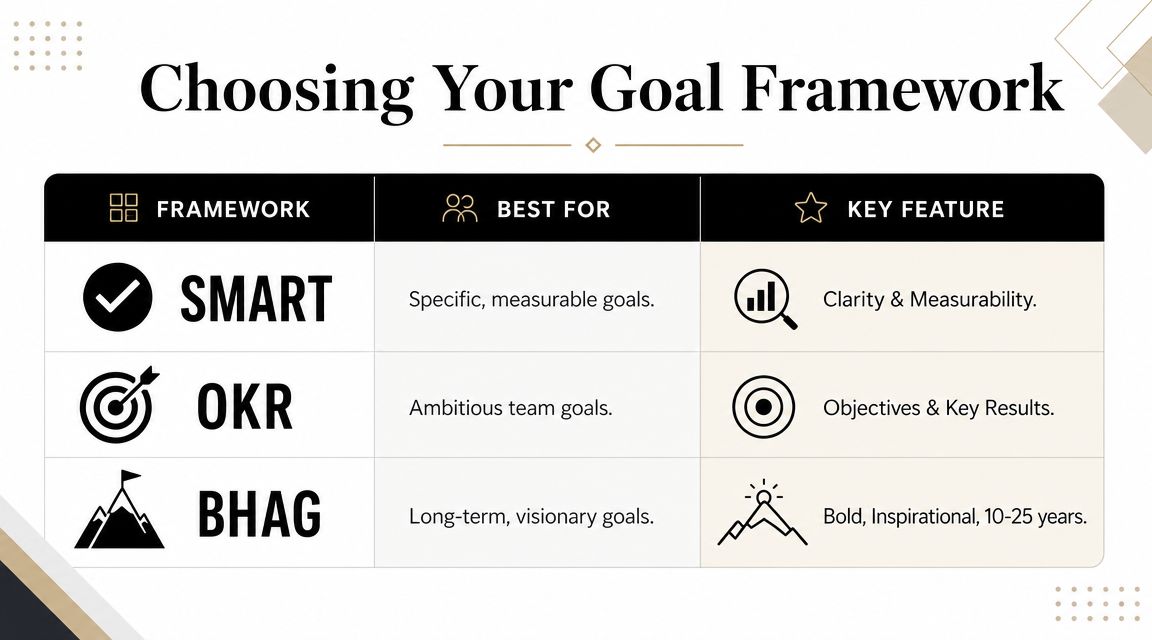
Here is the quick matching guide.
| Situation | Best fit |
|---|---|
| You need a clear, controllable target | SMART |
| You need ambitious alignment across people | OKRs |
| You need emotional drive for a meaningful challenge | HARD |
| You need to prepare for recurring obstacles | WOOP |
A short explainer can help if you prefer to see frameworks discussed visually:
A simple matching guide
Some goals fit more than one framework. That is normal because goals have layers.
A team objective may need OKRs at the top and SMART goals underneath so each person knows what to deliver this week. A personal fitness goal may need SMART for structure and WOOP for the moment you are tempted to skip the workout. A career change may need HARD to keep the goal meaningful during setbacks, then SMART to translate that motivation into applications, portfolio work, and networking blocks.
The practical test is simple: choose the framework that best answers the question you are currently stuck on.
If the sticking point is "What exactly am I aiming at?" use SMART.
If the sticking point is "How do we align many moving parts?" use OKRs.
If the sticking point is "Why am I not staying committed?" use HARD.
If the sticking point is "Where do I usually go off track?" use WOOP.
That shifts the decision from theory to use. It also keeps you from collecting frameworks instead of using one.
If you freeze while comparing options, you may be dealing with a decision bottleneck, not a goal-setting bottleneck. This guide on overcoming analysis paralysis is useful when framework shopping starts replacing action.
You can also sort your goals before picking a framework. A goal prioritization matrix for ranking competing priorities helps when several goals all feel urgent and you need to decide which one deserves a real execution system first.
From Framework to Action The Missing Link
Monday at 9:00 a.m., a well-written goal can still feel useless.
You know what you want. The framework is clear. Then the week starts, meetings move, energy drops, and the goal sits there like a destination on a map with no route marked in. That gap between a defined goal and a doable plan is the part many guides skip.
Research summarized by Swydo notes that many guides explain goal writing but miss execution, and that meta-analytic evidence shows concrete if-then plans significantly increase goal attainment compared with goal intention alone (Swydo on the implementation gap and if-then plans).
Why good goals still fail
A framework gives you direction. It names the destination and, in some cases, the checkpoints. It does not automatically decide what lands on your calendar Tuesday afternoon or what you should do after a missed week.
That implementation gap is where many guides fall short.
A SMART goal can be specific and still never shape your day. An OKR can align a team and still leave each person guessing about the next concrete step. The problem is rarely ambition. The problem is translation.
Your goal works like a map. Your execution system works like turn-by-turn directions.
Without that second layer, people are forced to improvise again and again. Improvisation feels flexible, but it often produces delay, decision fatigue, and avoidable resets.
Your goal is not your system. Your system is the set of recurring actions that keep the goal moving when your mood changes.
The Monday morning translation
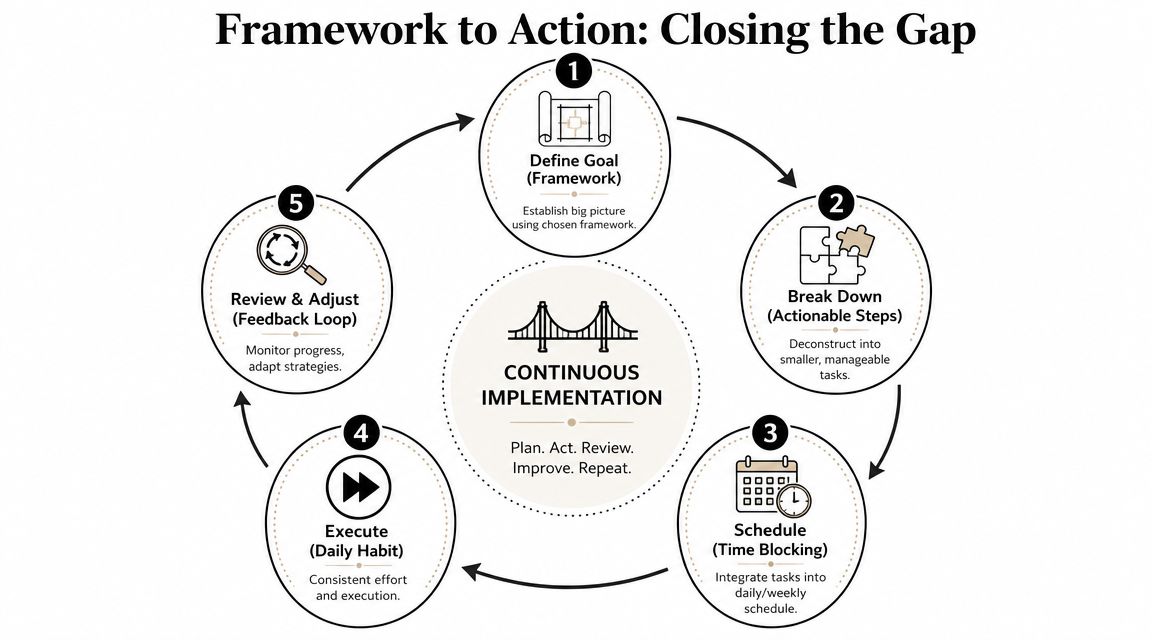
The practical fix is to convert the framework into lower levels of action, one layer at a time. If the goal is the destination, these layers are the route, the daily turns, and the backup route when traffic hits.
Start with milestones.
Milestones break a large goal into stages you can complete and review. If your goal is “launch a new product onboarding flow,” the milestones might be research, draft, build, test, and release.
Turn each milestone into weekly outputs.
Weekly outputs are visible pieces of finished work, not vague effort. For the research milestone, that might mean five customer interviews completed, notes organized, and a shortlist of friction points written up.
Put tasks into time, not just into a list.
A list answers what matters. A calendar answers when it will happen. If a task has no time assigned, it is competing with everything else you could do that day.
Create recovery rules before you need them.
This is the bridge from intention to consistency. If you miss a work block, then reschedule it in the next available session. If you feel resistance, then shrink the task to the smallest version that still counts. If a week goes off track, then review the milestone and reset the next seven days instead of trying to “catch up” all at once.
Here is what that looks like for a student using SMART plus WOOP:
| Level | Example |
|---|---|
| Goal | Improve performance in chemistry by the next exam |
| Milestone | Finish weak-topic review |
| Weekly output | Complete two problem sets and one tutoring session |
| Daily action | Study chemistry from 7 to 8 p.m. on weekdays |
| Recovery rule | If evening study is missed, do a 20-minute review at lunch the next day |
Notice what changed. The framework did not disappear. It got translated into behavior.
That is the missing link. High-level goals become useful only when they answer four practical questions: what matters this month, what must ship this week, what happens today, and what you will do when the plan breaks.
Digital systems can help keep those layers connected in one place. Tribble Software Private Limited's Beyond Time is one example. It uses an OKR-based model to connect objectives, milestones, routines, and planned versus actual time. That kind of setup helps because execution often breaks when planning, scheduling, and review live in separate tools.
Connecting Your Goals, Actions, and Progress
The power of goal setting frameworks isn't in the acronym. It's in the chain they create between intention, action, and feedback. Once that chain exists, your goals stop floating above daily life and start shaping it.
That's also why habit support matters. Goals create direction, but repeated actions create evidence. If you want a stronger routine layer under your goals, it helps to study sustainable habit tracking systems that make consistency easier to see and maintain.
A modern setup usually needs three connected parts:
- A framework: to define the goal well
- A planning layer: to turn the goal into milestones and scheduled work
- A tracking layer: to compare intention with reality and adjust fast
When those parts stay disconnected, people overplan and under-execute. When they work together, progress becomes easier to diagnose. You can tell whether the issue is focus, workload, timing, or follow-through.
If you want a deeper look at that feedback loop, progress tracking software for goals is worth exploring. The key idea is simple. Don't just set goals. Build a system that shows you what to do, whether you did it, and what to change next.
Keep going with Beyond Time
Choose your framework, then build the system that makes it stick.
- Goal Setting Worksheet — Apply any framework with a structured worksheet.
- 5 Year Plan Generator — Turn your framework into a 5-year roadmap.
- Why New Year Resolutions Fail — The framework mistake behind most failed goals.
- Best Goal Setting Apps 2026 — Find the right app to support your chosen framework.
Tribble Software Private Limited builds Beyond Time, an AI-powered goal achievement system for turning objectives into measurable milestones, daily plans, and review loops. If you want help bridging the gap between a framework on paper and action in real life, it's a practical place to start.
Put this into practice
Free tools that match this article.
Goal Setting Worksheet
Turn a vague goal into milestones, habits, blockers, and a weekly review plan.
Try Goal WorksheetGoal SettingSMART Goal Validator
Instantly validate your goals against the SMART framework and get actionable improvement suggestions.
Try SMART ValidatorGoal SettingAI Milestone Generator
Turn your biggest goals into an actionable step-by-step plan in seconds with AI.
Try Milestone GeneratorGoal SettingOKR Generator
Transform any aspiration into a structured OKR with measurable key results in seconds.
Try OKR GeneratorKeep exploring this topic
Goal setting guide
Start with the fundamentals of setting goals that turn into action.
Goal frameworks compared
Choose between SMART goals, OKRs, BHAGs, and 12-week goals.
Guide articles
Explore more guide articles from the Beyond Time blog.
goal setting frameworks
Read more articles tagged goal setting frameworks.
Related Articles
The 2026 Daily Routine Checklist: 8 Core Systems
Tired of to-do lists? Build a daily routine checklist that drives results. Explore 8 core systems for goal alignment, AI-powered focus, and true accountability.
AI Accountability Partner: Smarter Goal Setting
Tired of missed goals? An AI accountability partner provides the structure & feedback you need. Explore benefits, workflows, and tools.
The Force of Habit: Master Your Autopilot for Success
Learn what the force of habit is and how to use its power. This guide explains the neuroscience and gives you evidence-based strategies to build good habits.
How to Be Efficient and Productive: A 2026 System
Stop being busy and start being efficient and productive. Learn a practical, AI-enhanced system to set goals, track progress, and build unstoppable momentum.
Mastering AI Workflow Automation for Business Success
Transform operations with AI workflow automation. This guide covers concepts, architectures, & implementation for founders, managers, & creators.
8 Peer Feedback Examples: Drive Growth in 2026
Discover 8 peer feedback examples for positive, corrective, & developmental conversations. Drive results & build momentum with effective feedback in 2026.