Regain Focus and Clarity: A System for High Achievers
Stop feeling busy and start being effective. Learn a practical, evidence-backed system to build sustained focus and clarity for meaningful, measurable results.
Your calendar is packed. Slack or Teams keeps blinking. Your inbox refills faster than you clear it. By late afternoon, you've answered people, moved tasks around, and sat through meetings, yet the one piece of work that mattered still isn't done.
That's where individuals start looking for focus and clarity. They don't need another vague reminder to “eliminate distractions.” They need a system that works inside real life, where clients reply late, managers interrupt, and your own brain gets noisy after too much switching.
Start with a quick audit from the past week. Write down your top 3 attention leaks. Put each one in one of these buckets:
- External distractions like messages, meetings, notifications, and people dropping in
- Internal distractions like overthinking, anxiety, urge-checking, and mental clutter
- Workflow friction like unclear priorities, bad task sequencing, or starting the day without a plan
This simple step matters because many people confuse motion with progress. They try habit after habit without knowing what problem they're solving. The result is more effort, not more clarity.
There's also a difference between feeling focused and being effective. Mainstream advice often covers sleep, hydration, meditation, time blocking, and notification control, but it rarely shows how to measure whether those tactics improved output, decision quality, or error rates, which leaves a gap for anyone who wants to know whether their focus system is working, not just whether it feels good in the moment, as noted by Klear Mind Clinics on measuring focus beyond feeling focused.
What follows is a closed-loop approach. You'll diagnose where attention leaks, build a routine that protects your best thinking, and measure whether the system improves real work.
Table of Contents
- Introduction The Productivity Paradox
- Diagnose Your Personal Attention Leaks
- Architect Your Daily Focus Routine
- Implement a Weekly Clarity Cadence
- Build a Feedback Loop to Measure Focus
- Troubleshoot Common Focus Roadblocks
Introduction The Productivity Paradox
At 4:30 p.m., the day can look full and still feel unfinished. You answered messages, joined meetings, cleared small requests, and moved a dozen tasks forward a few inches. Then you open the one piece of work that needs clear thinking and realize your attention is gone.
That tension sits at the center of the productivity paradox. Modern work tools help busy professionals respond faster, but they also make sustained thought harder to protect. The result is a day that feels active while meaningful output stays flat.
A better starting question is “Where does my attention go under normal work pressure?” That question produces evidence. Evidence lets you build a system, test it, and keep only what improves output.
Run a quick audit before you change anything
For the next three workdays, keep a short note on paper or in your notes app. Each time you lose focus, log three things:
- What you were trying to do
- What pulled you away
- How long it took to return
Keep it simple. A rough log is enough.
Practical rule: If you cannot name your recurring distractions, you cannot design around them.
Context matters here. A count without a frame can send you in the wrong direction. A summary from Sycamore Tennessee on statistical context and base rates explains why the same number can mean very different things depending on the denominator and comparison point. The same principle applies to focus. Five interruptions across an entire day is different from five interruptions inside your only 90-minute thinking block.
Why busy professionals stay stuck
Many capable people are not short on effort. They are short on visibility. They can see deadlines, requests, and meetings. They often cannot see the hidden tax of task switching, reactive checking, and the time it takes to regain depth after each interruption.
Random tips fail for that reason. The advice may be sound, but it is disconnected from the conditions of your work. Silence notifications, try a breathing exercise, use time blocks. Any of those can help. Without a way to measure whether they changed your actual output, though, you are left with a routine that feels productive instead of one that proves it.
That is the difference in this guide. Focus and clarity are treated as a closed-loop system. You will identify what breaks attention, apply a few deliberate constraints, and then measure whether those changes improved completed work, not just good intentions.
Busy work will always expand to fill the day. Clear systems keep it from taking the whole week.
Diagnose Your Personal Attention Leaks
Many individuals try to fix focus too early. They download an app, copy a morning routine, or block social media, while the actual problem sits elsewhere. Diagnosis comes first.
Run a simple attention audit
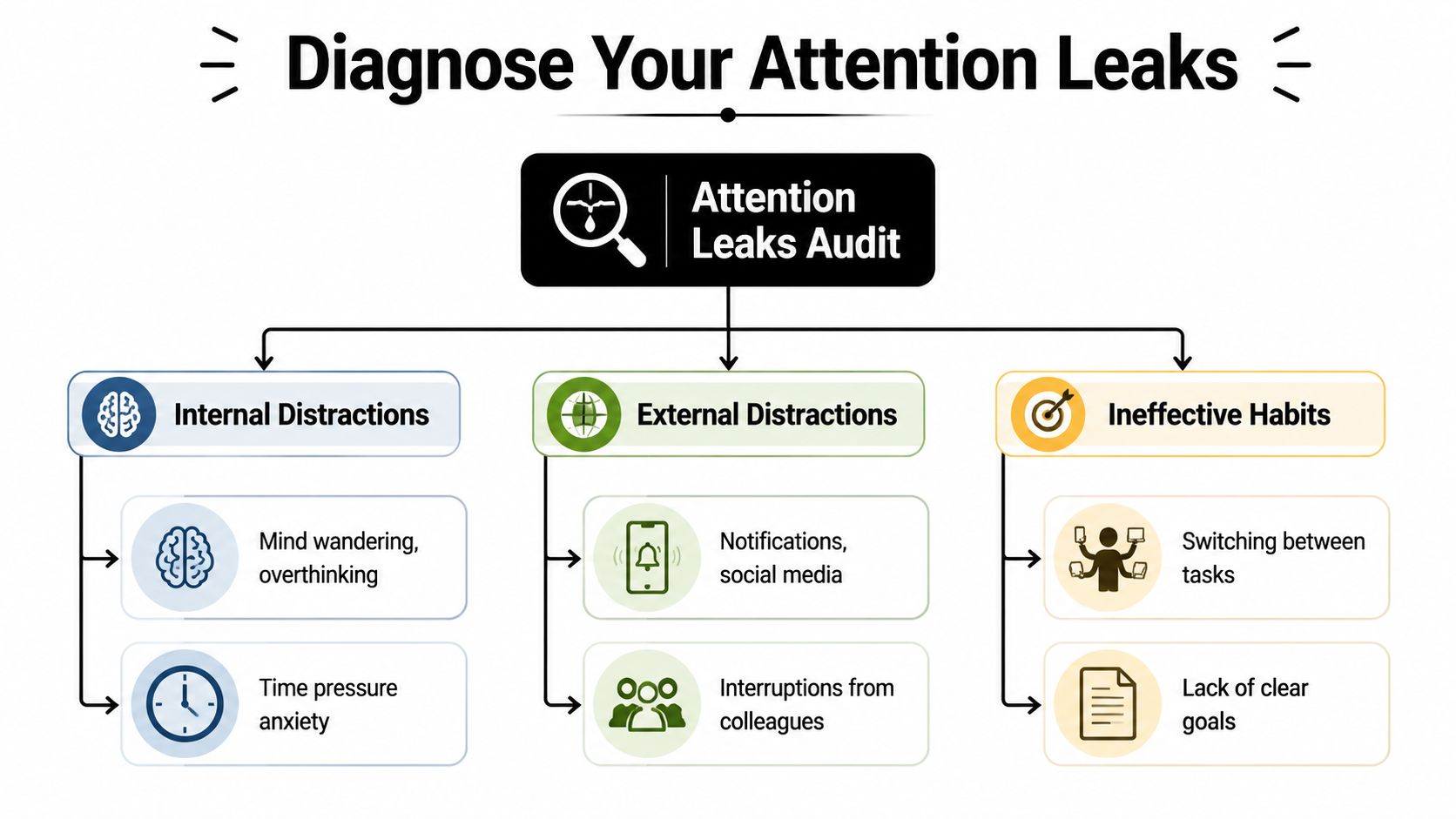
Your audit needs only a few categories:
| Category | What it looks like | Typical clue |
|---|---|---|
| Internal distractions | mind wandering, urge-checking, overthinking | you're at the desk but not on the task |
| External distractions | messages, meetings, colleague interruptions | your environment keeps choosing for you |
| Ineffective habits | multitasking, vague task lists, poor sequencing | you start often and finish slowly |
A lot of distraction pressure is structural, not personal. Microsoft's Work Trend Index reported that after-hours meetings for knowledge workers rose 16% year over year in 2025, and workers averaged 117 emails per day and 153 Microsoft Teams messages on workdays, which shows how much modern workflows interrupt attention, according to Radiology Key's summary of focus challenges in busy work environments.
That matters because shame is a bad diagnostic tool. If your environment keeps slicing the day into fragments, you don't need more guilt. You need better design.
Some readers also discover that their attention pattern is more persistent than simple overload. If distractibility, unfinished tasks, impulsive switching, or inconsistency have shown up across roles and settings, it's worth reviewing understanding ADHD at work symptoms as a practical resource for distinguishing normal overload from a pattern that may need more specific support.
Use time blocking and micro-sprints together
Time blocking and micro-sprints solve different problems. Time blocking protects space. Micro-sprints improve execution inside that space.
A founder's day makes the distinction clear. Suppose the morning includes investor follow-up, product review, and hiring decisions. If the founder leaves the day open, reactive work expands and all three get mixed together. A blocked calendar creates separation: one block for strategy, one for communication, one for team decisions.
Inside the strategy block, micro-sprints help. Instead of staring at a large task like “prepare board update,” the founder works in short bursts aimed at visible outputs, such as drafting the narrative, tightening metrics commentary, or rewriting the opening summary.
Use this combination:
- Block deep work for specific outputs. Don't write “work on strategy.” Write “draft product memo” or “review hiring rubric.”
- Use micro-sprints when resistance is high. If starting feels heavy, shrink the target to one concrete chunk.
- Reserve communication windows. Email and chat become less invasive when they have a scheduled home.
- Note re-entry cost. If one interruption wrecks a whole block, that's useful evidence. Protect that block harder next time.
The fastest way to lose clarity is to give equal access to everything that wants your attention.
People often discover one of two dominant patterns. The Reactive Responder spends the day answering and never steering. The Procrastinating Planner spends the day refining lists, priorities, or tools without shipping anything meaningful. Both feel busy. Neither is reliably focused.
The audit tells you which one you become under pressure.
Architect Your Daily Focus Routine
A strong day doesn't happen because you wake up motivated. It happens because the day has a shape that supports attention before the noise begins.
Build the day around one meaningful target
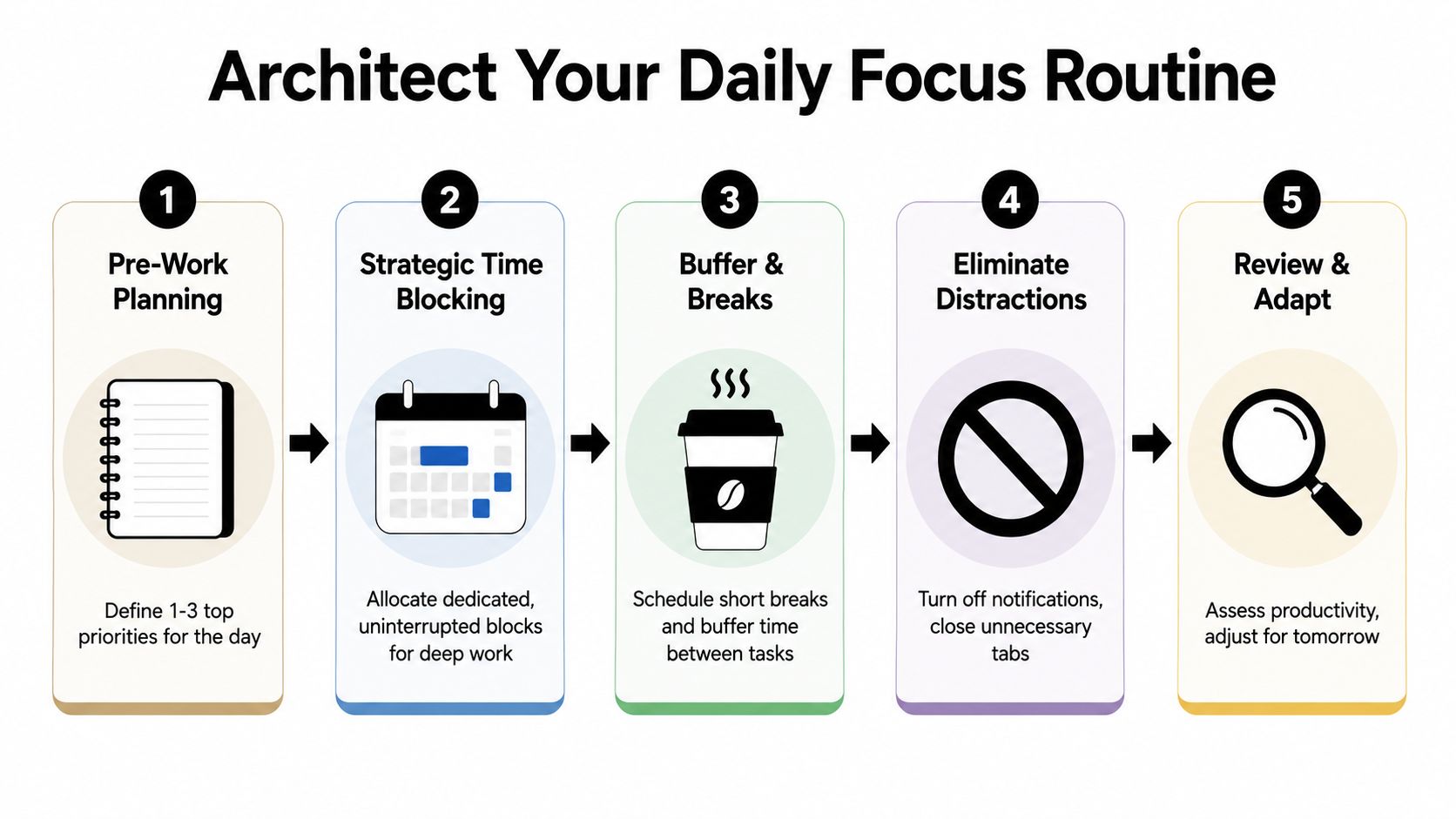
Start with a single Most Important Task. Not the longest task. Not the most emotionally loaded one. The task that would make the day feel solid even if the rest went sideways.
For founders, that might be a hiring decision, investor update, product spec, or pricing review. For managers, it may be a decision memo, performance preparation, or project unblock. For students, it's usually a defined study output, not “study more.”
A simple daily structure works well:
- One deep priority in your best energy window
- One support priority that keeps momentum moving
- One admin cluster for shallow work that must get done
If you need a practical template, this daily routine checklist is a useful starting point for turning intentions into a repeatable sequence.
Protect deep work without becoming rigid
Rigid calendars break the first time real life intrudes. That doesn't mean time blocking fails. It means the block needs better boundaries.
Use three kinds of blocks:
| Block type | Purpose | Rule |
|---|---|---|
| Deep work block | demanding thinking and creation | no inbox, no chat, no meetings |
| Reactive block | replies, triage, coordination | handle inbound work in batches |
| Buffer block | spillover and reset | absorb delays without wrecking the day |
Evidence-based focus guidance associates work cycles of about 90 minutes followed by recovery breaks, plus daily mindfulness practice of as little as 10 to 12 minutes, with better attentional control and mental clarity, according to the Human Clarity Institute report on why people struggle to focus.
That doesn't mean every person must force a perfect 90-minute session. It means attention tends to improve when you work long enough to get traction, then stop before quality collapses.
A few practical protections help more than people expect:
- Close decision loops early. If you know the next action before a block starts, you waste less energy ramping up.
- Hide optional inputs. Tabs, dashboards, and message badges are invitations to switch.
- Use a visible finish line. “Write first draft” beats “work on report.”
- Take a real break. Recovery doesn't mean scrolling another feed.
Later in the day, it helps to shift from depth to coordination. That's when meetings, approvals, and replies do less damage.
A short demonstration can help if you want to see a routine translated into actual planning behavior.
Turn the daily plan into a weekly strategy
Daily focus and clarity improves when the week has a direction. Otherwise, each morning starts from zero and every request feels equally urgent.
The weekly layer is simple. Decide what this week is for. Then let each day carry a piece of that work. That framing reduces daily indecision because the important work was chosen before the inbox began shouting.
Working rule: A calendar should reflect priorities already decided, not absorb priorities from whoever interrupts first.
At this point, many busy professionals finally feel relief. They stop trying to win each day independently and start designing days as part of a larger sequence.
Implement a Weekly Clarity Cadence
A focused week needs two moves. Look back carefully. Then look forward deliberately.
Look back with evidence
Your weekly review shouldn't become journaling theater. Keep it grounded in what happened.
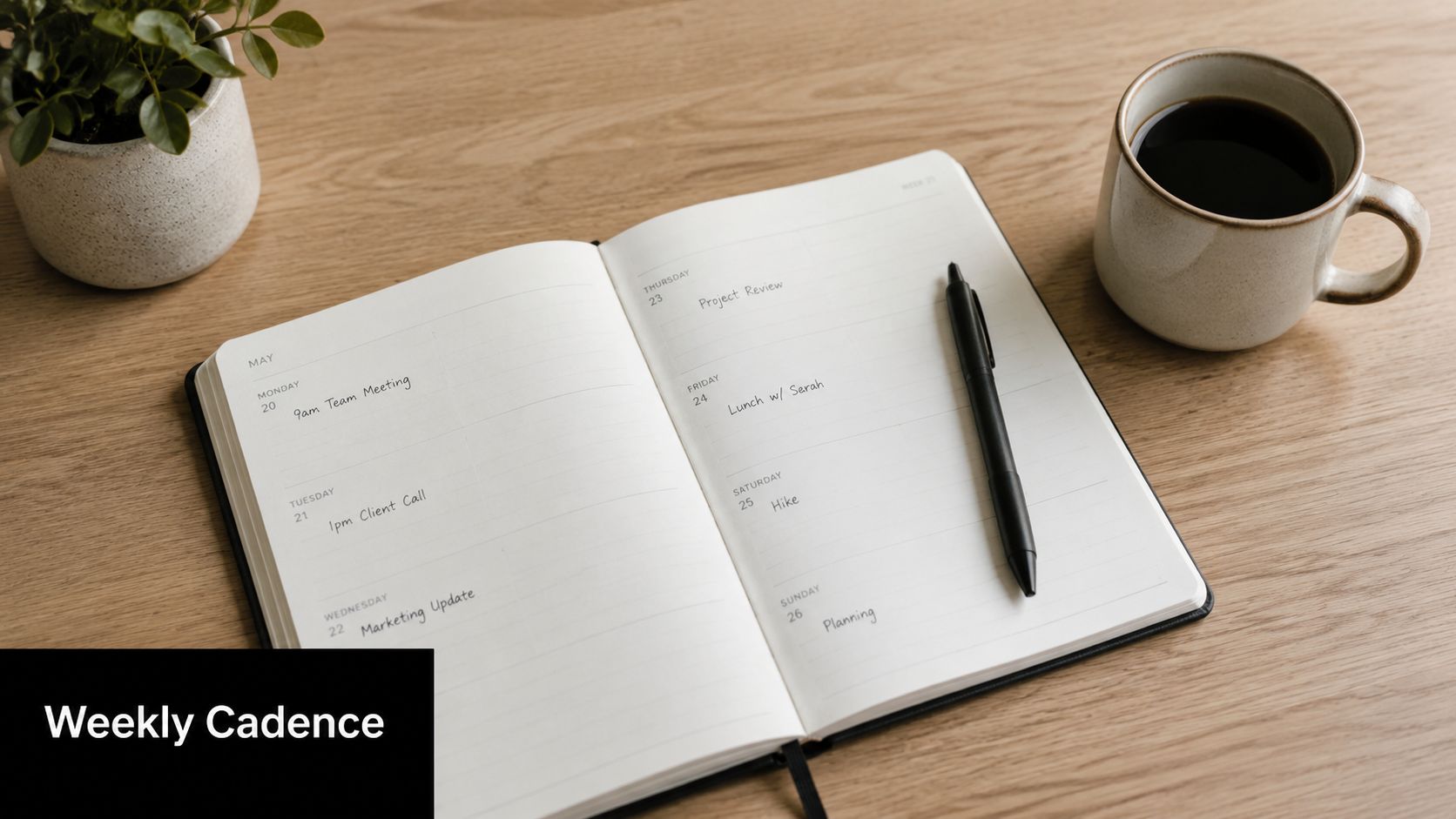
Use a planned versus actual log. At the end of the week, compare what you meant to do with what received your best time. The point isn't to judge yourself. It's to identify where the system broke.
Three review questions usually surface the truth:
- What did I finish that mattered?
- Where did planned deep work get replaced by reactive work?
- Which interruptions were preventable, and which were part of the role?
If you think visually, a workspace like Slashspace for knowledge workers can help gather notes, tasks, and thinking in one place so your review is easier to see and less scattered.
Look forward with intent
Once you know what slipped, plan the next week with fewer assumptions. Don't automatically copy unfinished tasks forward.
Instead, redesign the environment:
| Problem you saw | Better move next week |
|---|---|
| deep work kept getting crowded out | place it earlier and shorten the admin list |
| meetings split every meaningful block | group meetings on fewer windows if possible |
| you overplanned the day | reduce commitments and leave buffer space |
| unclear tasks caused avoidance | define the next visible action before the week starts |
If you want a lighter planning structure, a focus session planner can help turn weekly intentions into actual work sessions with clearer boundaries.
A good weekly cadence also separates focus metrics from vanity metrics. Vanity metrics create the illusion of discipline. They include things like color-coded calendars, perfect task boards, or the number of productivity tricks you used. Focus metrics are closer to execution. They tell you whether important work happened.
That shift changes the emotional tone of planning. You stop asking, “Did I stay organized?” and start asking, “Did I protect attention for the work that mattered most?”
Build a Feedback Loop to Measure Focus
Most focus advice is incomplete. It tells you what might help, then leaves you to guess whether it worked. A better system measures impact.
Track focus metrics instead of vanity metrics
Your measurement system should stay small and useful. Experts on KPI design recommend tying metrics directly to strategic outcomes and often limiting reporting to 3 to 5 critical metrics so data overload doesn't bury the signal, as described by Intrafocus on moving from data overload to business clarity.
For personal execution, that same principle works well. Pick a few indicators that connect to outcomes you care about.
Examples of useful focus metrics include:
- Protected deep work completed instead of “hours worked”
- Priority tasks finished instead of “tasks checked off”
- Planned blocks kept instead of “calendar fully booked”
- Error reduction or decision quality notes instead of “felt productive”
These are better because they tie attention to actual work, not appearance.
Use planned versus actual to find the real problem
A planned-versus-actual loop is simple enough to keep and strong enough to teach you something every week.
Try this format:
| Planned | Actual | What happened |
|---|---|---|
| draft proposal in morning deep block | spent block on urgent replies | inbox was open and one client issue expanded |
| review hiring candidates | moved to late afternoon and rushed | no buffer after meetings |
| finish analysis memo | partially done | task was too vague to start quickly |
This kind of record removes drama. You're no longer saying, “I'm bad at focus.” You're saying, “My plan failed because the task was fuzzy,” or “I put deep work after too many meetings,” or “I left communications channels open.”
When focus breaks, assume a system bug before you assume a character flaw.
If you prefer pen and paper, use pen and paper. If you want software support, use software. One option is productivity tracking software, and Tribble Software Private Limited's Beyond Time also supports planned-versus-actual tracking around goals, milestones, routines, and time use. The tool matters less than the loop.
Keep the metric set deliberately small
People often sabotage measurement by tracking too much. They record mood, caffeine, sleep, start time, end time, interruptions, app usage, calendar adherence, and ten more variables. Then they abandon the whole system.
Use a narrower lens. Three to five metrics is often enough. Anything beyond that usually becomes maintenance work.
You can also borrow one practical idea from data teams. Start with the outcome, then work backward. If your outcome is “ship better work with less cognitive drag,” your supporting metrics should help explain whether that happened. If a metric doesn't change a decision, it probably doesn't belong in the set.
The benefit is clarity. You stop collecting trivia and start noticing areas of greatest impact. Maybe morning blocks produce your cleanest thinking. Maybe admin work expands when you leave communication channels open all day. Maybe mindfulness before a demanding block gives you a steadier start. The point isn't to prove a grand theory. It's to discover what genuinely improves your own focus and clarity in real conditions.
Troubleshoot Common Focus Roadblocks
You block two hours for concentrated work, then a client issue blows up at 9:12, Slack fills with questions, and by noon the day is running someone else's agenda. That is normal in many roles. The fix is not to chase an ideal schedule that ignores reality. The fix is to build a recovery pattern that keeps reactive work from consuming the whole week.
When your role is reactive
Managers, operators, support leads, and founders often cannot disappear for long stretches. Trying to force a pure deep-work model usually creates more stress than output.
Use structured reactivity. Set clear windows for replies, escalations, and coordination. Keep one protected block for work that requires judgment, writing, planning, or analysis. A 45-minute block you defend four days a week will usually produce more than a two-hour block that gets interrupted daily.
This trade-off matters. Fast response can protect relationships and keep projects moving. Constant availability usually lowers work quality, increases task switching, and leaves important decisions to the end of the day, when attention is weakest.
When the system breaks for a day
Bad days do not need dramatic resets. They need a clean restart.
Use a smaller recovery sequence than your instincts want:
- Finish one important task. Ignore the urge to rescue the entire backlog.
- Protect one block tomorrow. Rebuilding the whole week usually turns into planning theater.
- Set the first step before you stop. Leave a visible starting point for the next session.
I have seen busy professionals recover faster when the reset is almost boring. Simple systems survive rough weeks because they ask less of you when your attention is already strained.
When you still do not feel focused
Subjective focus is unreliable. Some days feel productive and produce mediocre work. Other days feel scattered, yet still move the right projects forward.
That is why closed-loop systems work better than tip collecting. Judge your approach by what happens to output, decision quality, rework, and completion rate over time. If a tactic helps you start faster but creates more mistakes, it is not helping enough. If a routine feels rigid but leads to better work with less spillover into evenings, it may be worth keeping.
The practical answer is steady measurement and adjustment. Focus and clarity come from diagnosis, routines, and a feedback loop that shows which habits improve your work under real conditions.
If you want a structured way to turn goals into daily action, Tribble Software Private Limited offers Beyond Time, an AI-powered system that connects objectives, milestones, routines, and planned-versus-actual time tracking so you can see where your attention goes and adjust with more precision.
Put this into practice
Free tools that match this article.
Time Blocking Template
Map your day into focused time blocks with a free printable time blocking template.
Try Time BlockingTime ManagementWeekly Schedule Optimizer
Generate an optimized weekly schedule with AI-powered time blocking for maximum productivity.
Try Schedule OptimizerTime ManagementWeekly Schedule Template
Plan your week with a free printable weekly schedule template for goals, routines, and focus blocks.
Try Schedule TemplateFocusFocus Session Planner
Create AI-optimized focus sessions with structured work blocks and refreshing breaks.
Try Focus PlannerKeep exploring this topic
Time blocking guide
Turn priorities into protected calendar blocks.
15-minute time blocks
Plan and review your day with more realistic precision.
Goal setting guide
Start with the fundamentals of setting goals that turn into action.
Goal frameworks compared
Choose between SMART goals, OKRs, BHAGs, and 12-week goals.
Related Articles
How to Be Efficient and Productive: A 2026 System
Stop being busy and start being efficient and productive. Learn a practical, AI-enhanced system to set goals, track progress, and build unstoppable momentum.
How to Improve Focus: A 6-Step System for Deep Work
Learn how to improve focus with a practical, evidence-backed system. This guide covers everything from sleep and nutrition to time-blocking and daily routines.
Master Task Prioritization Techniques: Boost Productivity
Stop juggling tasks. Learn powerful task prioritization techniques, from Eisenhower to RICE, to focus on what matters and achieve your goals in 2026.
How to Improve Work Productivity: A Complete System
Learn how to improve work productivity with a step-by-step system. Go beyond simple tips to diagnose bottlenecks, build routines, and track progress.
Master Your Time Blocked Calendar: 2026 Productivity Guide
Learn to design a time blocked calendar that works. This 2026 guide covers templates, tracking planned-vs-actual, and troubleshooting. Take control of your day.

A Goal Planning Template That Actually Works: OKR Method
Stop just setting goals. Use our OKR-based goal planning template to turn big ambitions into a daily action plan. Includes a free downloadable template.