How to Improve Focus: A 6-Step System for Deep Work
Learn how to improve focus with a practical, evidence-backed system. This guide covers everything from sleep and nutrition to time-blocking and daily routines.
You sit down to work, open the document you've been avoiding, and within minutes your attention fractures. A message pings. You remember an email you forgot to send. You check one tab for “just a second” and end up somewhere else entirely. By the time you return to the task, your energy is lower and the work feels heavier than it did when you started.
That pattern isn't a character flaw. It's usually a systems problem. People often try to improve focus by collecting random tips, but disconnected tactics don't hold up under a real workload. Focus improves when your biology, environment, work rhythm, and review process all support the same goal.
If you want to know how to improve focus, stop treating concentration like a mood and start treating it like a trainable operating system. Elite performers don't rely on willpower alone. They build repeatable conditions, then review the results and adjust. That's the standard we want.
Table of Contents
- Build Your Biological Baseline for Peak Concentration
- Engineer Your Environment for Deep Work
- Execute with Intentional Work Sprints
- Measure Your Focus to Manage It
- Build Daily Rituals for Lasting Concentration
- Your Action Plan for Unbreakable Focus
Build Your Biological Baseline for Peak Concentration
Focus starts in the body. If your brain is under-rested, under-recovered, or running on erratic routines, no app will rescue your concentration for long. You can still force output for a while, but it's expensive. You'll feel more friction, switch tasks faster, and need more stimulation just to stay on track.
The most useful mindset shift is this. Don't ask, “How do I make myself focus harder?” Ask, “What condition is my nervous system in before I begin?”
Treat focus like a physiological output
Harvard Health notes that adults should aim for 7 to 8 hours of sleep nightly and at least 150 minutes of moderate-intensity aerobic exercise per week to support attention and concentration, and that getting less than 6 hours significantly impairs attention span, as explained in Harvard Health's concentration guidance. That gives you a real baseline, not vague wellness advice.
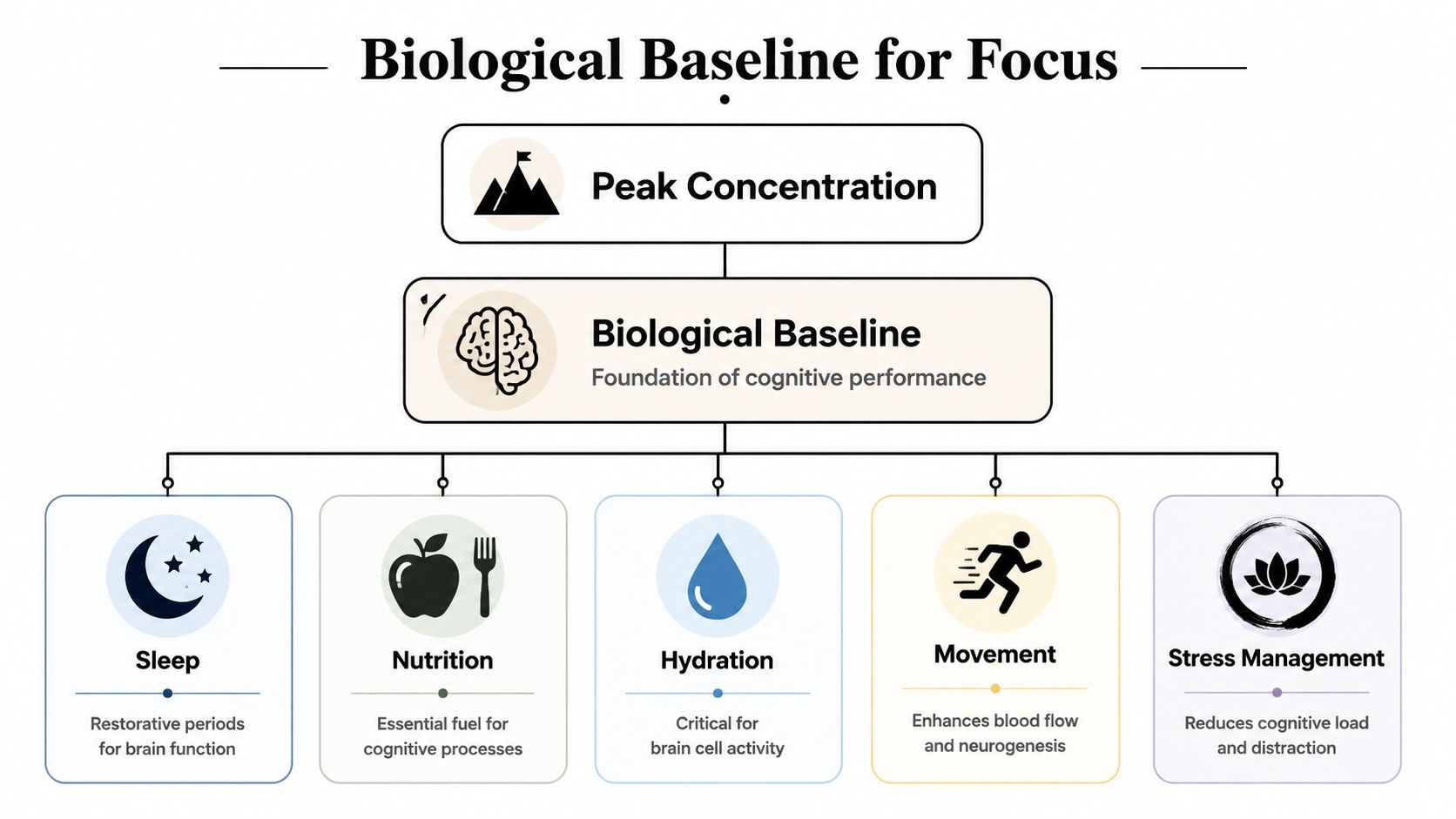
Sleep matters because attention is one of the first things to degrade when recovery slips. Exercise matters because steady aerobic work supports the brain functions that help you stay with a task instead of drifting away from it. You don't need to become obsessive. You do need to stop pretending late nights and sedentary days are neutral.
Practical rule: If your focus collapses by midday, check sleep consistency and movement before you buy another productivity tool.
Nutrition, hydration, and stress also shape the quality of your concentration, even if they don't need complicated optimization. You'll often find quick improvement once you stop skipping meals, stop working dehydrated, and stop carrying unresolved mental clutter into every session. The issue usually isn't a lack of information. It's a lack of consistency.
Set your non-negotiable baseline
Use a short baseline checklist:
- Sleep target: Go to bed and wake up at roughly the same time. Consistency matters because your alertness follows rhythm, not just total hours.
- Movement quota: Hit your weekly aerobic work across the week instead of saving it for one heroic session.
- Work fuel: Eat in a way that avoids dramatic energy swings during your most demanding hours.
- Hydration habit: Keep water visible and easy to reach so you don't spend half the day slightly depleted.
- Stress unloading: Write down open loops before deep work so your brain doesn't keep rehearsing them.
A lot of people look for sharper focus through stimulation alone. Sometimes that helps for a narrow window, especially during long or irregular workdays, but it's still a supplement to a baseline, not a substitute for it. If you work demanding schedules, this resource on nicotine-free focus for shifts is a useful example of thinking about support tools in context rather than treating them like magic.
Here's the trade-off. Building your biological baseline is slower than downloading a new app, but it's also more durable. When your body supports concentration, every other focus method works better.
Engineer Your Environment for Deep Work
Willpower is unreliable in a noisy setup. If your desk invites multitasking and your devices keep interrupting you, you'll spend the day recovering from distractions instead of doing real work. Good focus comes from reducing decisions before the session starts.
The requirement isn't more discipline. A better cockpit is what's needed.
Run a distraction audit
Take one workday and notice what pulls you off task. Don't judge it. Just record it. In most cases, the same culprits show up repeatedly: phone checks, chat alerts, email refreshing, clutter on the desk, too many tabs, or work that wasn't clearly defined.
Once you know the pattern, fix the environment in layers:
- On your phone: Turn off nonessential notifications. If you need the device nearby, place it face down and out of arm's reach.
- On your computer: Close every tab that isn't required for the current task. If a tab supports “maybe later” work, it doesn't belong in the active session.
- In your workspace: Remove visual leftovers from unrelated projects. Your desk should answer one question clearly: what am I doing right now?
The best environment for deep work feels slightly boring. That's a feature, not a problem.
If attention regulation is harder because of neurodivergent patterns, environmental design matters even more. This guide to managing ADHD with apps is worth reading because it treats tools as support for real behavior, not as abstract hacks.
Build a workspace that cues focus
Your environment should send one clear signal when work begins. That signal can be simple, but it should be repeatable. A specific lamp on. Headphones on. One notebook open. One browser window. Same seat. Same start routine.
A quick comparison helps:
| Setup | What it encourages | What happens |
|---|---|---|
| Open desk, many tabs, active notifications | Reactive behavior | You respond more than you create |
| Clean desk, single task visible, alerts silenced | Single-tasking | You settle faster into real work |
Use cues that reduce friction:
- Create a default focus mode: A device setting that silences noise during work blocks.
- Keep the next action visible: Not “work on project.” Write the actual next move, such as draft outline, review notes, or clean up analysis.
- Separate communication from creation: Don't keep inboxes open while doing work that requires thought.
What doesn't work is rebuilding your setup every day. You want a stable environment that makes starting easier and distraction more inconvenient.
Execute with Intentional Work Sprints
Once your baseline and environment are in place, you need a work rhythm. Many people struggle at this stage. They sit down with a vague intention to “focus for a while,” then wonder why their mind keeps slipping. Attention works better when the effort has edges.
A sprint gives your brain a clear beginning, a defined demand, and permission to stop briefly before fatigue spills into the next block.

Use a sprint rhythm instead of vague effort
The Pomodoro Technique is still one of the most practical systems because it's simple and specific. The structure is 25 minutes of focused work followed by 5 minutes of break, and after four rounds, you take a 15-minute break, as described in Healthline's overview of concentration methods. That same source notes the method has success rates over 75% in professional settings when users minimize distractions, and some studies show a 40% improvement in daily productivity after 3 weeks of consistent use.
Those numbers matter less than the mechanism. The technique trains single-tasking. It teaches you to stay with one defined piece of work long enough to make progress, but not so long that your attention degrades into fake work.
Use this sequence:
- Pick one concrete task.
- Set a timer for 25 minutes.
- Work on only that task.
- Stop when the timer ends.
- Take a 5-minute break away from the task.
- Repeat up to four rounds, then take the longer break.
If you want a structured way to set these blocks up before you begin, a focus session planner can help turn good intentions into a specific session design.
Protect the break so the next sprint works
People often misuse breaks. They open social media, restart messaging, or drift into a task that hooks them emotionally. Then the break becomes a derailment.
Don't use a break to enter another cognitive rabbit hole. Use it to reset.
A useful break is physical and light. Stand up. Walk. Refill water. Look away from the screen. Avoid anything that creates emotional residue or requires reorientation. If you need stimulation to stay on task, choose something neutral rather than something designed to capture attention.
This short walkthrough shows how many people apply work sprints in practice:
There's also a scaling decision to make. Use short sprints for cognitively demanding starts, resistant tasks, and days when motivation is low. Use multiple sprint cycles for larger projects. The mistake is assuming every task needs marathon concentration from the first minute. Often, momentum appears after the first clean block.
Measure Your Focus to Manage It
Individuals often judge their focus by feel. That's unreliable. A day can feel busy and still be scattered. Another day can feel slow but contain two excellent work blocks that moved the right things forward.
If you want to improve focus systematically, measure behavior instead of trusting memory.
Track planned versus actual
The simplest useful method is planned versus actual tracking. Before a work block, decide what you intend to do. After the block, record what occurred. Keep it brief. You don't need a diary. You need evidence.
Here's what that can look like:
| Work block | Planned | Actual | Gap |
|---|---|---|---|
| Morning sprint | Draft proposal intro | Drafted half intro, answered messages | Messages broke the block |
| Afternoon sprint | Review slide deck | Finished review | Plan matched capacity |
This method changes your relationship with distraction. Instead of saying, “I had a bad day,” you can say, “My work blocks break when I leave chat open,” or “I plan complex tasks too late in the day.” That's actionable.
Use these prompts after each block:
- What was the intended task
- What did I do
- What interrupted me
- Was the task too big, unclear, or poorly timed
Turn your data into better decisions
A feedback loop only works if the data changes tomorrow's plan. Otherwise tracking becomes another form of procrastination. The point isn't to admire the log. The point is to tighten the system.
That's why scoring can help. A simple productivity score calculator can turn scattered observations into a clearer read on how consistently your days align with your intentions.
Reality check: If your planned work and actual work rarely match, your problem may not be focus alone. It may be task definition, scheduling, energy timing, or interruption control.
Over time, patterns emerge. You'll notice which hours support deep work, which tasks trigger avoidance, and which environmental decisions preserve attention. This is how elite performers train. They don't rely on motivation to explain variance. They review the tape and adjust the process.
The strongest benefit of measuring focus is emotional. You stop making global judgments about yourself. You start making precise corrections.
Build Daily Rituals for Lasting Concentration
People who stay focused over months don't wake up inspired every day. They run rituals that lower the cost of doing what matters. A ritual isn't about making work feel sacred. It's about making the right action easier to repeat.
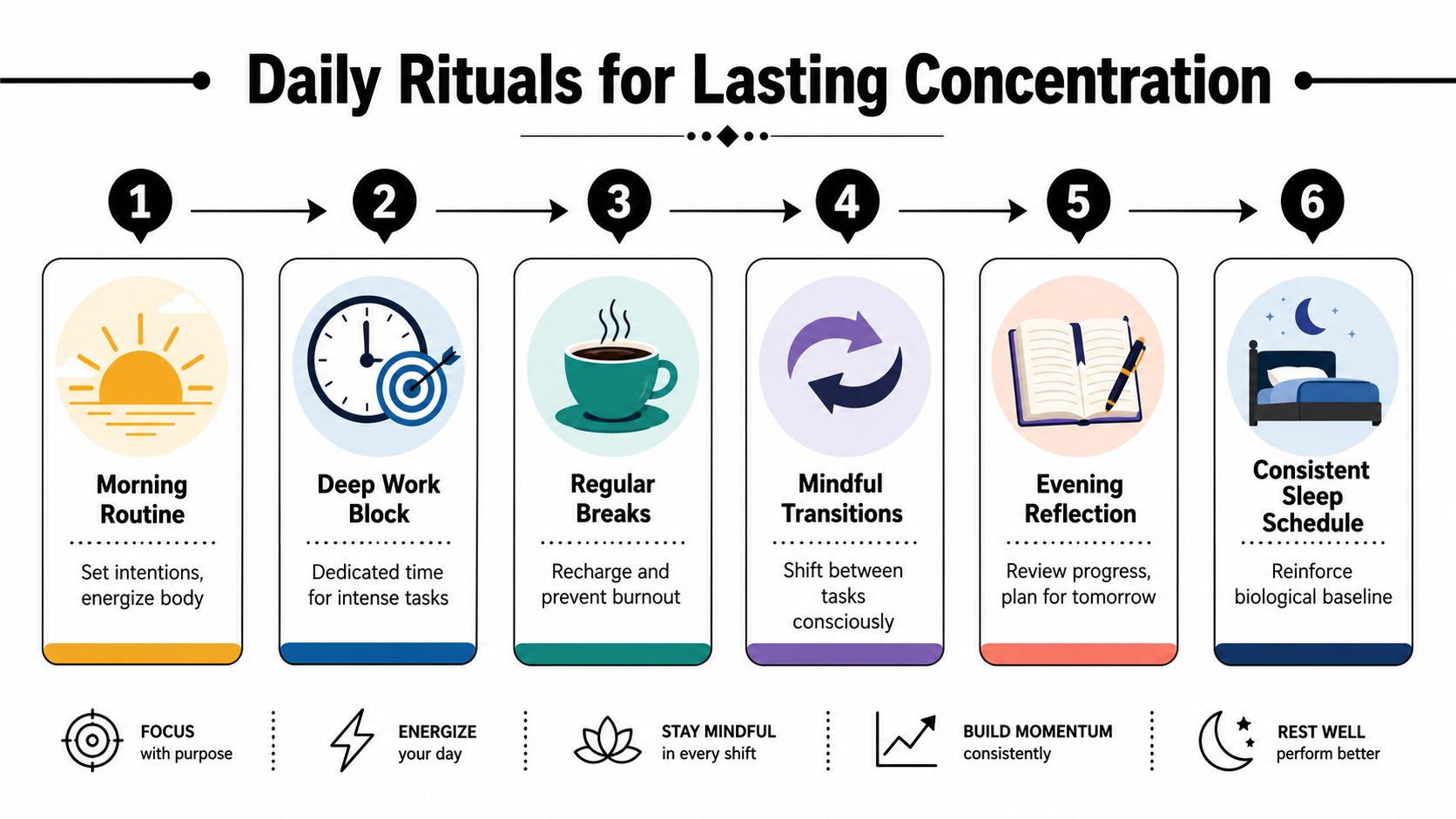
The two rituals that matter most are a morning prime and an evening critique.
Start with a morning prime
Your morning prime should be short enough that you'll do it, even on crowded days. Five minutes is enough if you use it well. The aim is to decide what today's focus is before the world starts making decisions for you.
A strong morning prime includes:
- Name the main win: What single task would make today count
- Choose the first block: When will you do it, and for how long
- Remove one obstacle: Silence a device, clear the desk, or define the first action
- Check your state: Are you mentally ready for hard work, or do you need a brief reset first
Many people over-plan in the morning. Don't build a fantasy schedule. Build a credible one. If you know meetings will fragment the afternoon, protect your most demanding work earlier.
If you want more structure around habit formation, this article on how to build better habits is a practical companion to the concentration system here.
End with an evening critique
The evening critique is where improvement becomes compounding rather than accidental. Review the day briefly. Compare what you planned with what happened. Then identify one adjustment for tomorrow.
Use questions like these:
- What block went best, and why?
- Where did I lose focus?
- Was the problem energy, environment, task clarity, or interruption?
- What single change would improve tomorrow most?
Professionals don't just practice. They review practice.
This ritual matters because it closes the loop. Without review, you repeat the same avoidable mistakes and call them “bad days.” With review, your concentration gets sharper because each day teaches the next one.
What doesn't work is vague reflection. “Need to focus more tomorrow” won't change behavior. “Start proposal work before opening email” might.
Your Action Plan for Unbreakable Focus
If you've been trying to learn how to improve focus through isolated hacks, replace that approach with a full system. Build the body first. Reduce friction in the environment. Work in deliberate sprints. Track planned versus actual. Review the day and make one correction. That loop is what creates reliable concentration.
A simple first week rollout
Don't implement everything at once. Sequence it.
- Day 1: Set your sleep and movement baseline. Decide when deep work is most realistic.
- Day 2: Clean your desk and remove digital interruptions that repeatedly break attention.
- Day 3: Run two work sprints with one clearly defined task.
- Day 4: Start logging planned versus actual for each serious block.
- Day 5: Add a morning prime before work begins.
- Day 6: Add an evening critique and write one adjustment for tomorrow.
- Day 7: Review the week and keep only what proved useful in real conditions.
If you want another outside perspective to compare against your own system, these practical tips for better focus are a useful supplement.
What works and what usually fails
What works is boring on purpose. Repetition. Clear task boundaries. Cleaner environments. Honest review. Better recovery. Most strong focus systems look simple from the outside because they remove chaos rather than add novelty.
What usually fails is intensity without structure. People try to force deep work while tired, distracted, overcommitted, and fully reachable. Then they blame themselves for not concentrating. The problem isn't always effort. It's often that the system keeps producing fragmentation.
Start small, but be strict about the essentials. A clean 25-minute block done daily beats a dramatic but inconsistent push. A brief nightly critique beats endless self-analysis. Focus gets stronger when you stop negotiating with obvious distractions and start training attention like a skill.
Tribble Software Private Limited built Beyond Time for people who want that kind of system rather than another pile of motivation. It connects goals, habits, planned versus actual time tracking, and daily AI critique so you can see where your focus breaks and what to fix next. If you want a data-driven way to turn attention into consistent execution, it's worth exploring.
Put this into practice
Free tools that match this article.
Time Blocking Template
Map your day into focused time blocks with a free printable time blocking template.
Try Time BlockingTime ManagementWeekly Schedule Optimizer
Generate an optimized weekly schedule with AI-powered time blocking for maximum productivity.
Try Schedule OptimizerTime ManagementWeekly Schedule Template
Plan your week with a free printable weekly schedule template for goals, routines, and focus blocks.
Try Schedule TemplateFocusFocus Session Planner
Create AI-optimized focus sessions with structured work blocks and refreshing breaks.
Try Focus PlannerKeep exploring this topic
Time blocking guide
Turn priorities into protected calendar blocks.
15-minute time blocks
Plan and review your day with more realistic precision.
Morning routine template
Build a practical morning routine around energy and focus.
Evening routine ideas
Wind down in a way that supports sleep and tomorrow’s goals.
Related Articles
Regain Focus and Clarity: A System for High Achievers
Stop feeling busy and start being effective. Learn a practical, evidence-backed system to build sustained focus and clarity for meaningful, measurable results.
How to Be Efficient and Productive: A 2026 System
Stop being busy and start being efficient and productive. Learn a practical, AI-enhanced system to set goals, track progress, and build unstoppable momentum.
How to Improve Work Productivity: A Complete System
Learn how to improve work productivity with a step-by-step system. Go beyond simple tips to diagnose bottlenecks, build routines, and track progress.
A Goal Planning Template That Actually Works: OKR Method
Stop just setting goals. Use our OKR-based goal planning template to turn big ambitions into a daily action plan. Includes a free downloadable template.

Weekly Goal Tracker: How to Plan and Achieve Your Goals
Design a weekly goal tracker that works. This guide shows you how to connect big objectives to daily tasks, build a tracker, and use AI to stay on course.

Master Your Estimated Completion Date in 2026
Calculate and manage an accurate, motivating estimated completion date. Our 2026 guide covers formulas, tracking, and common pitfalls to help you achieve goals.