A Goal Planning Template That Actually Works: OKR Method
Stop just setting goals. Use our OKR-based goal planning template to turn big ambitions into a daily action plan. Includes a free downloadable template.
You probably already have a goal planning template somewhere. It might be a Notion page, a spreadsheet, a notes app checklist, or a PDF you filled out with energy on a Sunday night and ignored by Wednesday.
That isn't a motivation problem. It's a system problem.
Articulating one's desires is common. Fewer can define what progress looks like. Even fewer can connect that progress to what they'll do today at 2:15 p.m. That missing link is why good intentions keep turning into stale plans.
The template below fixes that by combining an OKR structure with something most planning systems skip: daily execution tied to time. Instead of stopping at goals and milestones, it pushes all the way down to routines, habits, and 15-minute planned-vs-actual tracking so you can see whether your week is moving or drifting.
Table of Contents
- Why Most Goal Plans Fail and How This One Is Different
- Deconstructing Your Ambition The OKR Template Structure
- From Blank Template to Actionable Roadmap
- Connecting Milestones to Daily Momentum and Time Tracking
- Goal Planning Templates in Action Sample Personas
- Supercharge Your Plan with AI and Real-Time Tracking
Why Most Goal Plans Fail and How This One Is Different
A lot of goal plans die the same way. You start with ambition, write down a handful of priorities, maybe even color-code them, then life crowds in. Meetings expand. Email fills the gaps. Low-value tasks win because they're visible and urgent. The plan still exists, but it's no longer driving behavior.
That pattern shows up at the organizational level too. Only 20% of companies successfully complete around 80% of their strategic goals, and only 16% of employees clearly understand their company's priorities, according to the statistics compiled in Mooncamp's goal-setting data roundup. The problem isn't a lack of goals. It's weak translation from strategy into clear, shared action.
Most templates stop too early
Most goal planning templates help with naming the goal. Some help with deadlines. A few help with milestones. But they still leave a practical gap:
- They define intention, not execution. You write “launch newsletter” or “improve health” but never define what happens on Tuesday morning.
- They track lagging outcomes only. You notice the missed result after the month is gone.
- They don't tell you where the plan broke. Was the goal unrealistic, the milestone unclear, or the time never protected?
Practical rule: If your template can't tell you what to do this week and how much time you actually spent doing it, it's a wish list.
The goal planning template that works best in practice has to do three jobs at once. It has to clarify the destination, define the proof of progress, and connect each milestone to recurring behavior. That's where the OKR method is useful, not as corporate jargon, but as a clean hierarchy.
The difference is the planning-doing link
A useful plan answers four questions fast:
- What am I trying to achieve?
- How will I know it's working?
- What sequence gets me there?
- What will I do today that moves one piece forward?
That last question is where most systems collapse.
The template in this article is built to survive real calendars, not ideal ones. It starts with an OKR structure, then drops each milestone into routines, habits, and calendar blocks. Instead of reviewing progress only at the end of the month, you review it weekly and compare planned time to actual time. That gives you a feedback loop while the goal is still recoverable.
Deconstructing Your Ambition The OKR Template Structure
A strong goal planning template works like a map. You don't need every detail of the journey on day one, but you do need the hierarchy right. If the map is fuzzy at the top, daily actions become random. If the map is too abstract, the plan looks impressive and still goes nowhere.
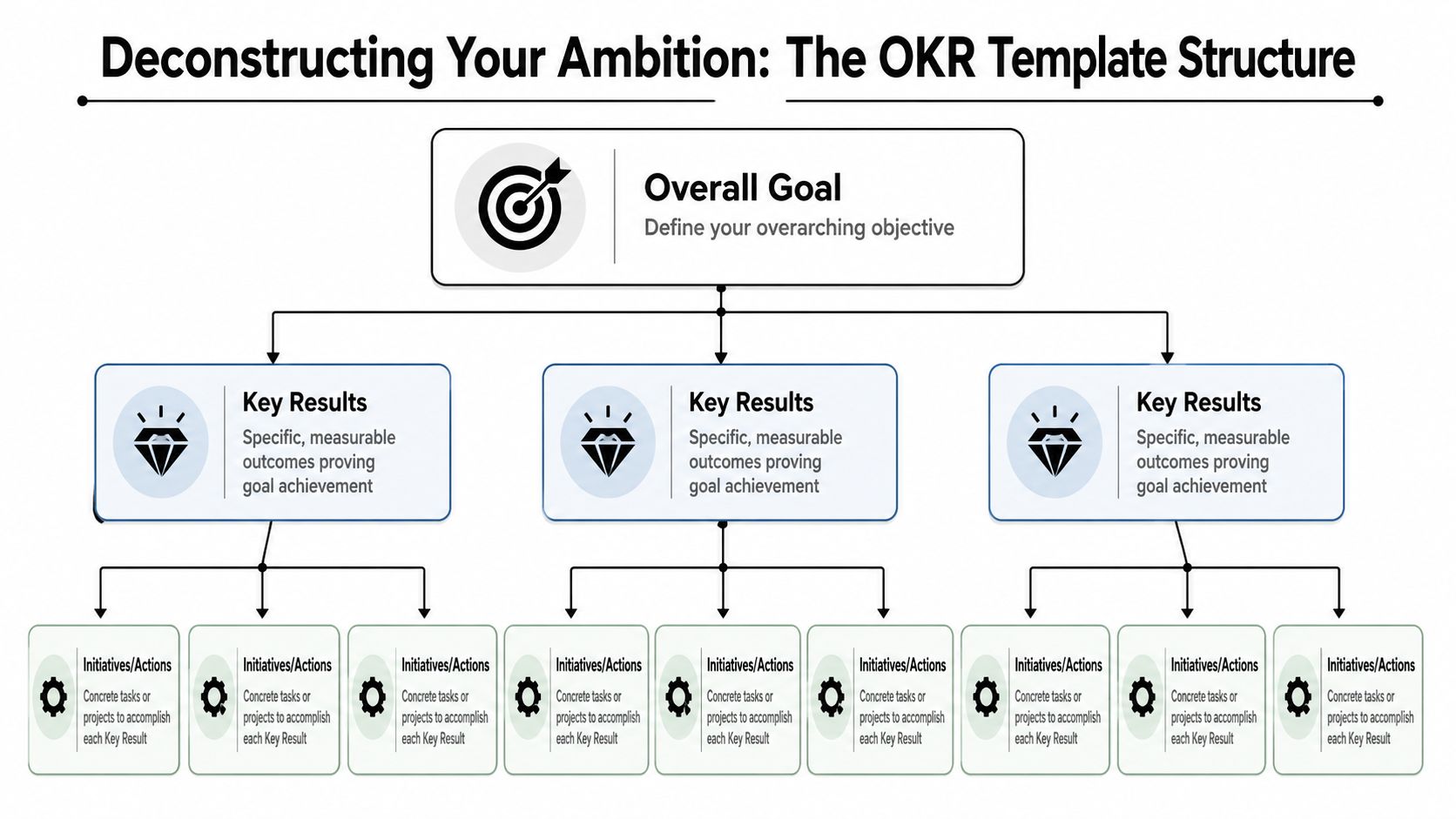
If you want a worksheet version to fill in as you read, this goal-setting worksheet gives you the same structure in a simple format.
The objective is the destination
The objective is the headline. It should be concrete enough to guide choices and meaningful enough to keep you engaged when the work gets repetitive.
Bad objective: “Do better at marketing.”
Better objective: “Build a reliable inbound pipeline for our product.”
The objective is not a task list. It's not “write blog posts,” “hire a designer,” or “go to the gym.” Those are means. The objective is the destination those actions serve.
A useful test is this: if you completed a bunch of tasks but still couldn't say whether the goal was achieved, the objective is too vague.
Key results prove progress
Key results are the signposts on the road. They tell you whether the objective is becoming real. In an OKR-based goal planning template, these are measurable outcomes, not activity counts for their own sake.
Examples:
- For a founder, a key result might be “establish a repeatable demo booking flow.”
- For a student, it might be “submit all major assignments before the internal deadline.”
- For a professional, it might be “improve campaign execution quality and review rhythm.”
You usually want a small set. Too many key results create noise. Too few create ambiguity.
Here's the distinction that matters:
| Element | What it is | Example |
|---|---|---|
| Objective | The destination | Build a reliable inbound pipeline |
| Key Result | Evidence you're on track | Publish and distribute a consistent stream of high-intent content |
| Task | A unit of work | Draft article outline |
| Output | What you made | A published article |
| Outcome | What changed because of it | Better pipeline quality and consistency |
Milestones turn outcomes into movement
A milestone sits below the key result. It marks a meaningful checkpoint in sequence. At this stage, many people confuse tasks with milestones.
A task is “draft landing page copy.”
A milestone is “landing page approved and ready for publishing.”
That difference matters because milestones create accountability around completion, not busyness.
A plan gets easier to execute when each milestone ends in something binary. Done or not done. Approved or not approved. Scheduled or not scheduled.
For most goals, each key result can be broken into a short sequence of milestones such as:
- Setup milestone for tools, resources, or decisions
- Production milestone for creating the asset or doing the work
- Validation milestone for review, testing, or feedback
- Deployment milestone for launch, submission, or rollout
If you skip milestones, your goal planning template becomes too high-level to guide action. If you overstuff it with tiny tasks, it becomes a maintenance chore. The sweet spot is a clear objective, a handful of key results, and milestones that mark real progress without drowning you in admin.
From Blank Template to Actionable Roadmap
The challenge isn't usually a lack of ambition. It's a struggle with conversion. They know the broad aim, but they can't turn it into a plan that survives contact with a week full of interruptions.
The easiest way to fix that is to fill the template in a strict sequence. The OKR generator can help you draft the structure, but the thinking still matters. A good template isn't about filling boxes. It's about forcing better decisions.
Start with a sharp objective
The process works best when you begin with one vague ambition and tighten it until it becomes usable. “Get healthier,” “grow my business,” and “be more organized” are all legitimate desires. They're just too broad to direct behavior.
The method I trust most follows a six-stage decomposition protocol summarized by Effy's goal-setting template guide: define the objective using SMART criteria, break the goal into 3 to 5 sequenced milestones, assign resources, establish a weekly review cadence, implement a planned-vs-actual analysis, and integrate a feedback mechanism.
Use questions like these:
What exactly do I want to be different by the end of this goal period?
If I achieved this goal, what visible evidence would exist?
What deadline makes this real without making it absurd?
A strong objective is specific, time-bound, and relevant to a real priority. It should also be achievable enough to invite commitment, not just fantasy.
Choose key results you can actually steer
Once the objective is clear, define the few outcomes that would prove progress. At this stage, people often pick vanity metrics or things they can't directly influence.
A better standard is controllability. Ask whether your weekly choices can move the result.
For example, if your objective is to improve professional visibility, your key results might be tied to publishing, outreach consistency, and follow-up quality. Those are easier to steer than broad hopes like “become more well-known.”
A simple filter helps:
- Keep it measurable. You should know whether the result happened.
- Keep it meaningful. The result should matter to the objective, not just look tidy in a tracker.
- Keep it few. Three good key results beat a long list you'll stop reading.
Break each result into sequenced milestones
The template begins its operational phase. Each key result needs a sequence, not a pile. Sequenced milestones create order, and order reduces resistance.
For each key result, write the milestones in the order they naturally unfold. Then attach the support needed for each one.
For example:
Define the deliverable
Clarify what “done” means for the milestone.Assign resources
Add tools, collaborators, files, or dependencies.Schedule the review rhythm
Protect a weekly check-in. Keep it brief and consistent.Run planned-vs-actual analysis
Compare what you meant to do with what happened.Add feedback points
Build in review from a manager, coach, teammate, or your own weekly reflection.
That sequence matters because it prevents a common failure mode. People create a beautiful goal planning template, then never revisit it until the deadline is near. The review rhythm is what keeps the plan alive.
Connecting Milestones to Daily Momentum and Time Tracking
A milestone on paper doesn't create motion. Time on calendar does. Repeated behavior does. Honest tracking does.
That's the point where many goal systems break. They help you decide what matters, then leave you alone with a crowded day and no mechanism for protecting the work.

Lead measures beat vague effort
The missing layer is usually lead measures. These are the actions that precede the result. If your milestone is “publish four articles,” the lead measures might be “two writing blocks each week,” “research session on Monday,” and “edit pass on Thursday.”
That distinction matters because, as summarized in Smartsheet's discussion of goal-tracking template gaps, 63% of people abandon goals within the first month due to lack of immediate momentum feedback, and standard templates often omit real-time lead vs. lag tracking plus planned-vs-actual time analysis. In practice, that means people can see they missed the result, but they can't see why the result slipped.
A useful translation process looks like this:
| Milestone | Daily or weekly behavior linked to it |
|---|---|
| Finish proposal draft | Two focused writing blocks |
| Publish article | Research block, drafting block, editing block |
| Prepare exam revision pack | Daily review session and weekly consolidation |
| Launch outreach sequence | Copywriting session, review slot, send block |
Use 15-minute tracking to catch drift early
The biggest difference comes from this: Instead of asking, “Did I make progress?” ask, “How many 15-minute blocks did this goal receive?”
That sounds simple because it is. It also removes a lot of self-deception.
If a founder says content is strategic but spends almost no tracked time on it, the issue isn't clarity. It's allocation. If a student says revision matters but the calendar shows fragmented effort, the issue isn't discipline alone. It's a lack of protected routines.
A practical workflow:
- Pick one active milestone per key result. Don't try to push everything at once.
- Translate it into recurring blocks. Example: write from 8:00 to 9:00 on Monday and Wednesday.
- Track in 15-minute increments. Short enough to notice drift, simple enough to sustain.
- Review planned versus actual weekly. If the gap is wide, fix the system before blaming yourself.
- Link habits to triggers. After coffee, open draft. After lunch, review flashcards. After standup, send outreach.
If a goal matters, it needs a recurring slot before your day fills up with reactive work.
You can build this manually with a calendar, but it helps to use a dedicated time-blocking template so your milestones aren't floating separate from your schedule.
The deeper point is this. Most stalled goals don't fail in dramatic fashion. They fail through tiny daily misses that no one notices soon enough. Fifteen-minute tracking gives you a small enough lens to spot the problem while it's still fixable.
Goal Planning Templates in Action Sample Personas
A good goal planning template should work across very different contexts. The structure stays stable. The content changes. That's a sign the framework is solid.
Here's how the same model looks for three common situations.
Founder example
A founder usually needs a plan that balances strategy with execution pressure. The trap is setting broad company goals without translating them into owner-led weekly action.
Marketing manager example
A marketing manager needs a template that doesn't collapse into campaign chaos. The objective should guide prioritization, not just document activity already in motion.
Student example
A student needs a system that handles fluctuating energy, class schedules, and deadlines without becoming another procrastination ritual.
| Persona | Objective | Key Result 1 | Sample Milestone for KR1 |
|---|---|---|---|
| Startup founder | Build a more reliable inbound growth engine | Publish a consistent stream of problem-aware content tied to product demand | Finalize a monthly content calendar with topics mapped to buyer questions |
| Corporate marketing manager | Improve campaign execution quality and review discipline | Create a repeatable campaign planning and post-launch review rhythm | Standardize one campaign brief template and use it for the next live campaign |
| University student | Increase academic consistency across the term | Complete coursework and revision through a weekly study rhythm | Build a subject-by-subject study plan and schedule recurring review blocks |
The founder's plan usually works best when each milestone leads to a concrete shipping rhythm. That might include topic selection, outline approval, drafting, publishing, and distribution. The danger isn't lack of ideas. It's fragmented attention.
The marketing manager's version often lives or dies on dependencies. If legal review, design input, or stakeholder sign-off sit outside the template, the plan looks neat and the campaign still misses. In this case, milestones should include approval checkpoints, not just production tasks.
Good templates don't just capture what you'll do. They surface what could block you.
For the student, the goal planning template has to be lighter. Too much complexity becomes avoidance. I usually recommend a simple chain: objective, key result, weekly study blocks, and a short review every week to adjust based on upcoming deadlines.
The common thread across all three is simple. The objective sets direction. The key result defines proof. The milestone creates sequence. Then the calendar carries the load.
Supercharge Your Plan with AI and Real-Time Tracking
Static templates are useful up to a point. They give shape to your thinking. They force decisions. They make the invisible visible. But they still rely on you to notice drift, rewrite the plan, and adapt when real life changes the conditions.
That's where many people stall.
When the plan slips
Most plans don't fail because the person forgot the goal. They fail because one of these happened:
- The key result was too ambitious for the current season
- The milestone sequence was wrong
- Too little time was protected
- The routine broke after disruption and never restarted
When that happens, don't throw out the whole goal planning template. Adjust the live parts.
A practical recovery sequence:
Shrink the active scope
Keep the objective. Reduce the number of active milestones.Recalculate effort
Compare intended time with actual time. If the work never got scheduled, fix that first.Shorten the feedback loop
Review weekly, not vaguely “when things calm down.”Adapt the routine to context
Busy week, travel, low energy, exam season, launch week. The method should bend without disappearing.
That last point matters more than people think. A useful parallel is nutrition tracking. People often do better with tools that fit real meals and real behavior instead of idealized plans. That's why context-aware tools like PlateBird's AI calorie tracking are helpful. They reduce friction between intention and daily use, which is exactly what better goal systems should do too.
Why adaptive systems are replacing static templates
A projection summarized in Atlassian's discussion of goal-setting templates notes that 78% of users are seeking smart goal systems that learn from behavior, while over 90% of available templates remain static, and that gap is linked to a 40% higher failure rate in non-standard work environments compared to adaptive systems. That lines up with what many founders, professionals, and students already feel. Static plans assume stable days. Real life rarely offers that.
An adaptive system does something a PDF or spreadsheet can't. It notices patterns. It learns where your plan consistently breaks. It helps you revise the execution layer without abandoning the objective.
That becomes even clearer when you see the workflow in action:
If you want to start manually, do that. A strong template is still better than scattered intentions. But if your goals keep failing in the same place, the answer usually isn't more inspiration. It's a system that can connect objectives, milestones, routines, and real-time feedback in one loop.
Tribble Software Private Limited built Beyond Time for exactly that gap between planning and doing. You can start with the free web tools to map your goals, then use the iOS app to turn them into sequenced milestones, daily habits, and 15-minute planned-vs-actual tracking. If you want a goal planning template that doesn't stop at intention, try the system and let it handle the execution layer with you.
Put this into practice
Free tools that match this article.
Goal Setting Worksheet
Turn a vague goal into milestones, habits, blockers, and a weekly review plan.
Try Goal WorksheetGoal SettingSMART Goal Validator
Instantly validate your goals against the SMART framework and get actionable improvement suggestions.
Try SMART ValidatorGoal SettingAI Milestone Generator
Turn your biggest goals into an actionable step-by-step plan in seconds with AI.
Try Milestone GeneratorGoal SettingOKR Generator
Transform any aspiration into a structured OKR with measurable key results in seconds.
Try OKR GeneratorKeep exploring this topic
Goal setting guide
Start with the fundamentals of setting goals that turn into action.
Goal frameworks compared
Choose between SMART goals, OKRs, BHAGs, and 12-week goals.
Time blocking guide
Turn priorities into protected calendar blocks.
15-minute time blocks
Plan and review your day with more realistic precision.
Related Articles

Difference Between Short and Long Term Goals: A 2026 Guide
Learn the core difference between short and long term goals. This guide covers time horizons, purpose, and how to connect your vision to daily actions.
Weekly Goal Tracker: How to Plan and Achieve Your Goals
Design a weekly goal tracker that works. This guide shows you how to connect big objectives to daily tasks, build a tracker, and use AI to stay on course.
How to Improve Work Productivity: A Complete System
Learn how to improve work productivity with a step-by-step system. Go beyond simple tips to diagnose bottlenecks, build routines, and track progress.
What Is the Difference Between Tactics and Strategy?
Learn what is the difference between tactics and strategy. This guide clarifies their scope and timeline, with examples, connecting vision to action for 2026
How to Be Efficient and Productive: A 2026 System
Stop being busy and start being efficient and productive. Learn a practical, AI-enhanced system to set goals, track progress, and build unstoppable momentum.
Master Your Estimated Completion Date in 2026
Calculate and manage an accurate, motivating estimated completion date. Our 2026 guide covers formulas, tracking, and common pitfalls to help you achieve goals.