
Weekly Goal Tracker: How to Plan and Achieve Your Goals
Design a weekly goal tracker that works. This guide shows you how to connect big objectives to daily tasks, build a tracker, and use AI to stay on course.
Monday starts with good intentions. By Tuesday afternoon, your calendar is full, your notes are scattered, and the week is already being decided by other people's priorities.
That's usually the moment people reach for a bigger to-do list. More boxes. More tabs. More urgency. But a longer list rarely creates clarity. It just records overwhelm more neatly.
A good weekly goal tracker does something different. It helps you decide what this week is for, how you'll know if you're making progress, and what might knock you off course before it happens. Used well, it becomes the bridge between your long-term objectives and the actions you take today.
Most advice stops at printable templates or a generic habit chart. Useful, sometimes. Sufficient, rarely. What matters is the system underneath the tracker: how goals are chosen, how they're measured, and how obstacles are handled when motivation drops.
Table of Contents
- Beyond the Weekly To-Do List
- From Ambition to Objectives Defining What Matters This Week
- Designing Your Weekly Goal Tracker Templates and Tools
- Milestones Metrics and Saboteurs
- The Review Ritual Creating Weekly Momentum
- Advanced Integration and Real-World Examples
Beyond the Weekly To-Do List
A to-do list is reactive by default. It collects everything shouting for attention, then leaves you to sort urgency from importance in real time. That's why many capable people stay busy all week and still feel like they didn't move anything meaningful forward.
A weekly goal tracker should be more selective. Instead of asking, “What do I need to do?” it asks, “What must be true by the end of this week for this to count as progress?” That shift changes your behavior immediately. You stop treating every task equally.
The difference between tasks and goals
Tasks are actions. Goals are outcomes.
“Reply to investor emails” is a task. “Send revised pitch deck to top prospects” is a weekly goal if that outcome moves a larger objective forward. “Study biology” is vague. “Complete and review two chapters of exam material” is trackable.
When people say their tracker didn't work, the problem usually isn't the tracker. It's that they filled it with activity instead of outcomes.
Practical rule: If you can complete an item and still make no meaningful progress, it doesn't belong in your weekly goal tracker.
A solid system does three jobs at once:
- It narrows focus: You identify the few outcomes that matter most this week.
- It creates alignment: Each weekly goal connects to a larger objective, not a random burst of motivation.
- It improves recovery: When the week gets messy, you can reorient quickly because your priorities are already defined.
What effective tracking actually looks like
The tracker itself can be simple. A page in a notebook. A spreadsheet. An app. The format matters less than the operating logic behind it.
Use this standard:
| Element | Weak version | Strong version |
|---|---|---|
| Goal | Work on website | Publish homepage copy draft |
| Measure | Try my best | Define what completed looks like |
| Timing | Sometime this week | Tie milestones to specific days |
| Obstacle planning | Hope nothing interrupts | Name likely friction in advance |
That last column is where most systems fall apart. People assume discipline will handle the hard part. It usually doesn't. If procrastination, overcommitment, and context switching keep derailing your weeks, your tracker has to account for them directly.
A useful weekly goal tracker isn't just a planning tool. It's a decision system. It helps you choose less, track better, and recover faster when the week doesn't go according to plan.
From Ambition to Objectives Defining What Matters This Week
Big goals are exciting until they hit a normal workweek. “Launch a new product,” “get healthier,” or “ace finals” all sound clear at a high level. The confusion starts when you ask what to do by Friday.
That's where most weekly planning gets fuzzy. People either choose goals that are too broad to finish, or they choose easy tasks that feel productive but don't change the larger picture.

Start from the bigger objective
Start with a quarterly or annual objective. Then ask one disciplined question: What is the most important outcome I can produce this week that advances this objective?
If the larger objective is “launch a new product,” this week's goal probably isn't “launch the product.” It might be:
- Validate positioning: Complete customer interviews and extract language patterns
- Reduce launch risk: Finalize onboarding flow copy for the first-time user journey
- Create a decision point: Ship the prototype to internal testers and collect feedback
Each of those is concrete, outcome-focused, and achievable within a week.
If you need a structure for turning broad ambitions into sharper weekly targets, these goal setting frameworks are a useful reference point. The framework matters because it prevents weekly goals from becoming disconnected errands.
Choose the week's highest-leverage move
Most professionals overstuff their weekly plan. They confuse ambition with volume. In practice, the best weeks usually center on a small number of high-impact objectives.
I recommend choosing one to three weekly objectives. Fewer than that can be too narrow if your life includes work, health, and personal commitments. More than that often turns into hidden multitasking.
Use this filter before adding a goal:
- Would completing this noticeably move a larger objective forward?
- Can I describe the result clearly?
- Will I know by week's end whether it happened?
- Is this a goal, not just maintenance work?
A weekly plan becomes credible when every goal has a visible connection to something bigger.
A student can apply the same logic. If the semester objective is “perform well in final exams,” this week's target might be “finish the first pass of chemistry revision notes” instead of “study chemistry.” A founder aiming to improve sales might choose “rewrite and send the outbound sequence to the top prospect segment” instead of “work on outreach.”
Avoid the three common mistakes
Some weekly goals look legitimate but fail in use. Watch for these patterns:
- The oversized goal: It's too large for a single week, so progress feels vague.
- The vague goal: It sounds worthy but has no finish line.
- The borrowed goal: It matters to someone else, but not enough to sustain your focus.
When a goal survives those filters, it deserves a place in your weekly goal tracker. Until then, it's just an intention.
Designing Your Weekly Goal Tracker Templates and Tools
The best tool is the one you'll consistently review. That said, different tools fail in different ways. Paper is flexible but easy to ignore. Spreadsheets are visible but can become maintenance-heavy. Apps create continuity, but only if they fit your real workflow.

The move toward digital tracking didn't happen by accident. The shift accelerated in the early 2010s, moving people from static paper checklists to dynamic platforms. Modern apps on Google Play serve millions in markets like the US and Germany and combine planning with progress statistics in a single dashboard, offering real-time visibility paper systems can't match, as shown in the Google Play listing for Weekly Goals Habits Tracker.
Notebook for simplicity
A notebook works best for people who think clearly on paper and don't need automation. It lowers friction. Open the page, write the week's objectives, add milestones, review daily.
A simple layout is enough:
- Top section: This week's one to three outcomes
- Middle section: Milestones for each goal
- Bottom section: Risks, blockers, and notes from the week
The strength of paper is presence. You can keep it visible on your desk. The weakness is that it doesn't calculate anything for you, and it won't connect your weekly goals to routines, calendar decisions, or historical patterns.
Spreadsheet for visibility
A spreadsheet is the most practical middle ground for many professionals. It keeps everything visible, searchable, and easy to score.
Use columns like these:
| Column | What goes there |
|---|---|
| Goal | The weekly objective stated as an outcome |
| Why it matters | The larger objective it supports |
| Milestones | Concrete steps due during the week |
| Status | Not started, in progress, completed |
| Metric | What success looks like |
| Saboteur | Likely obstacle |
| Countermeasure | What you'll do when that obstacle appears |
| Notes | End-of-week lessons |
This format is strong because it forces precision. It also makes handoff and collaboration easier for managers or founders working with a team.
If you want ideas before building your own sheet, these top goal planning resources offer a useful range of planning formats. Use them as references, not as a replacement for thinking through your own system.
App workflow for connected execution
Apps become useful when they do more than store a list. The strongest ones connect objectives, milestones, and daily execution in one place.
A good app workflow looks like this:
- Capture the higher-level objective
- Break it into sequenced milestones
- Assign the week's priority outcomes
- Link those outcomes to routines or scheduled work blocks
- Review daily and adjust based on reality
For people who want a more structured digital setup, a weekly schedule template can help turn abstract goals into actual blocks on the calendar. That's often the missing link. A goal without time reserved for it is still just a preference.
Here's a quick walk-through format that mirrors how a connected digital tracker can support weekly planning:
Paper captures intention. Spreadsheets organize it. Apps are strongest when they also influence what you do today.
Choose based on your failure mode, not your aspiration. If you abandon complex systems, start with paper. If your goals disappear into disconnected tabs, use a spreadsheet. If your problem is translating plans into daily execution, an app-based workflow usually gives you the strongest structure.
Milestones Metrics and Saboteurs
A weekly goal usually looks reasonable on Monday. By Thursday, it starts to slip for predictable reasons. The work was bigger than it looked, progress was hard to judge, or the first obstacle knocked the goal out of the week.
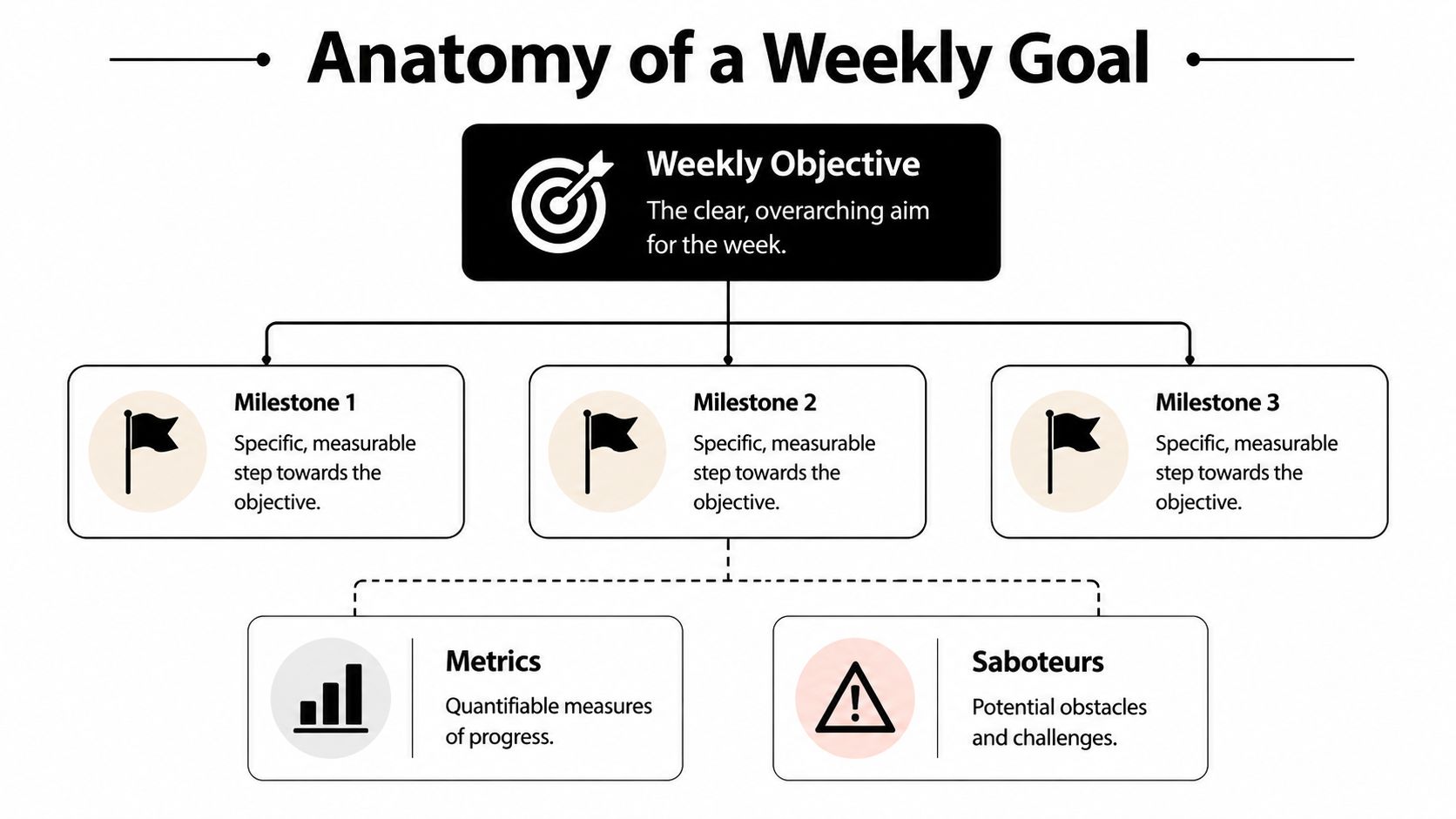
That is why a useful tracker needs more than a goal field and a checkbox. Each weekly goal should include three working parts: milestones, metrics, and saboteurs. Together, they turn intention into something you can execute under real conditions, not ideal ones.
Break one objective into visible steps
A weekly objective needs visible proof of movement. Milestones provide that proof.
Take a goal like “prepare investor update.” In a strong tracker, that does not sit as one vague line item for the whole week. It gets broken into a few meaningful checkpoints:
- Collect source material: Pull metrics, product updates, and hiring notes
- Draft the narrative: Write the update in plain language
- Finalize and send: Review, edit, and distribute by a set day
That level of detail works well because it guides the week without turning the tracker into a full project plan. In practice, three to five milestones is usually enough. Fewer, and the goal stays fuzzy. More, and you are tracking tasks that belong in a separate execution list.
If you want help drawing that line, these examples of milestones in project management show the difference between a real milestone and routine activity.
Score progress instead of relying on a yes or no
Weekly tracking breaks down when every goal is measured as complete or incomplete. That hides useful information. A goal that is 80 percent done and a goal that never started should not teach you the same lesson.
Mark Koester outlines a practical scoring approach in his goal scoring method. In his system, he sets one or two priority goals called “Weekly Things” and 4–8 support objectives. He assigns 3 possible points to the priority goals, so completing 1 out of 2 gives 1.5 points, while completing both gives 3 points. He uses a similar 3-point structure for support objectives by dividing total completed by total attempted and multiplying by 3. He reports that his weekly score has ranged from 2 to 5, with over 4 as his mark for a strong week.
The value of that approach is not the exact formula. It is the feedback. A scoring system helps you spot whether the issue is execution, planning, or ambition level.
Use that idea in your own tracker:
- Track completion percentage: Completed goals divided by set goals
- Separate priority goals from support goals: A core outcome should count more than maintenance work
- Review the trend over several weeks: Low scores often point to overload. Very high scores can mean the goals are too safe
A broader guide to tracking your progress can help if you want more ways to measure momentum without building an overly complicated system.
Neutralize saboteurs before the week goes sideways
This is the part many templates miss.
They ask what could get in the way, but they do not force a response. That leaves people with vague entries like “distractions” or “unexpected meetings,” which are accurate and still useless. A discussion on LinkedIn highlights the pattern clearly. Many people identify obstacles in theory but never convert them into a specific defensive move.
The fix is simple. Pair each recurring saboteur with a predefined response inside the tracker. That removes decision friction in the moment, which is where many weekly systems fail.
| Saboteur | What it sounds like | Countermeasure |
|---|---|---|
| Procrastination | I'll start when I have a clear block | Schedule the first step, not the whole project |
| Overcommitment | I can fit one more priority in | Limit the week to a small number of real goals |
| Context switching | I'll make progress between meetings | Protect one uninterrupted work block |
| Perfectionism | I need more time before I share this | Define a draft standard and ship version one |
The same saboteurs tend to repeat. Professionals who miss weekly goals are rarely surprised by new obstacles every Friday. They are usually running into the same few patterns with no built-in response.
That is also where modern AI tools can help. A system like Beyond Time can surface recurring delay patterns, show which milestones keep stalling, and prompt a corrective action before the week is lost. Used well, AI does not replace judgment. It makes your judgment faster and more consistent.
If a saboteur shows up every week, treat it as part of the system design. Put the countermeasure in the tracker before the week begins.
The Review Ritual Creating Weekly Momentum
Most trackers fail in the review, not the planning. People fill them out on Sunday or Monday, feel organized for a moment, then never look again until the week is gone.
That breaks the whole system. A weekly goal tracker only works when it changes your decisions during the week, not just your intentions at the start.
The daily reset
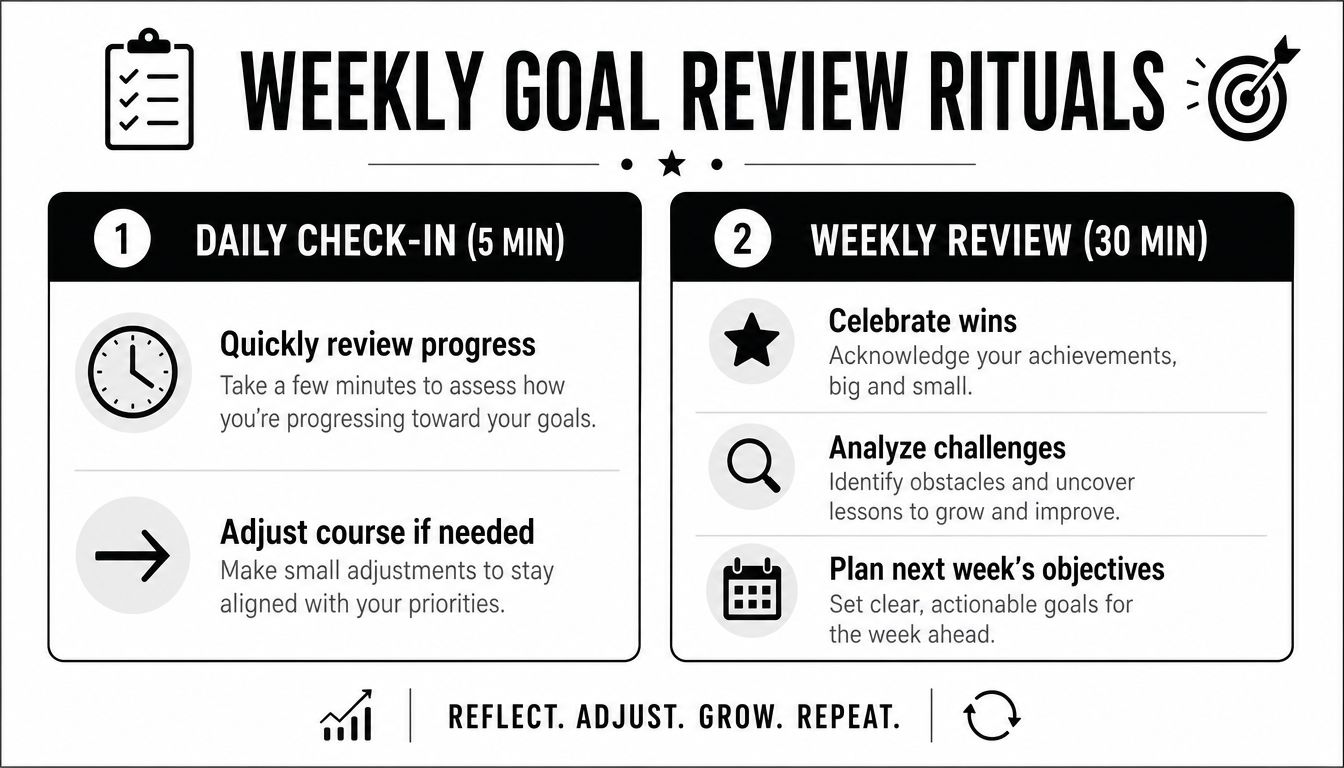
A short daily check-in keeps the tracker alive. It doesn't need to be elaborate. Five minutes is enough if the questions are sharp.
Use this checklist each morning or at the end of the previous workday:
- What changed: Did new work enter the week that affects the plan?
- What matters today: Which milestone deserves protected attention?
- What's at risk: Which goal is slipping and why?
- What needs adjustment: Delay, delegate, shrink, or recommit
This daily rhythm prevents a common mistake. People notice a week is off-track only after too much drift has already happened.
Review isn't administrative work. It's how you stop one bad day from becoming a lost week.
Some AI-based tools now support this with a daily critique that surfaces the most impactful focus for the day. That can be helpful when you're too close to your own work to see what matters most. The benefit isn't magic. It's faster prioritization.
The weekly review
The weekly review is longer and more reflective. Thirty minutes is generally enough if one stays focused and avoids turning it into journaling theater.
Use a simple sequence:
Close the loop on commitments
Mark what was completed, partially completed, deferred, or dropped.Score the week accurately Use your scoring system or completion rate. Don't soften the result.
Study the misses
Ask whether the failure came from unclear goals, weak scheduling, unrealistic scope, or a known saboteur.Capture the lesson
One sentence is enough. “Too many priorities.” “Needed a draft deadline earlier.” “Meetings consumed the only deep-work window.”Choose next week's carry-forward carefully
Don't automatically migrate unfinished goals. Some deserve deletion, not rollover.
A review becomes sustainable when it produces better planning, not guilt. The point isn't to prove that you tried hard. The point is to learn how you operate under real conditions.
What good momentum feels like
Momentum isn't constant motivation. It's trust in your own system.
When the review ritual is working, you start the week with fewer fake priorities. You catch drift earlier. You stop being surprised by the same obstacles. Over time, your weekly goal tracker becomes less of a planner and more of a feedback loop.
That's the difference between writing goals and building a practice.
Advanced Integration and Real-World Examples
A weekly goal tracker works best when it doesn't live alone. It should connect to your calendar, your task manager, and any system that shows how your time gets used.
Where the tracker fits in a larger system
For founders and operators, the weekly tracker should sit between strategic goals and the daily calendar. The objective sets direction. The tracker defines the week's outcomes. The calendar protects time for the milestones. If you also use time tracking, planned-versus-actual review can reveal whether the problem is commitment, estimation, or interruption.
For students, the same structure applies. The semester goal drives the week. The weekly tracker breaks it into revision outcomes. The calendar assigns study blocks. A quick review shows whether the issue was difficulty, avoidance, or unrealistic planning.
For health and fitness, the tracker becomes most useful when it links behavior to constraints. Don't just track “work out.” Track the week's intended sessions, likely friction, and what happens when energy is low or the schedule changes.
Three practical examples
A founder with a product launch objective might choose one weekly goal: finalize onboarding copy for the first user flow. Milestones include drafting the copy, reviewing with product, and pushing the approved version to implementation. The saboteur is reactive Slack work. The countermeasure is a protected writing block before meetings begin.
A student preparing for finals might choose two goals: complete one set of revision notes and finish a timed practice section. The saboteur is perfectionism disguised as “more prep.” The countermeasure is defining what counts as a completed first pass before starting.
Someone focused on fitness might set a weekly goal of completing planned sessions and preparing meals that support training. The saboteur is schedule volatility. The countermeasure is choosing backup workout windows before the week starts.
Start with one week. Pick real objectives. Add milestones. Score the results. Name your saboteurs before they show up. That's enough to build a tracker that changes behavior.
If you want a system that turns goals into measurable milestones, links them to daily routines, and adds AI support for focus, review, and accountability, explore Beyond Time by Tribble Software Private Limited. It's built for people who are done collecting plans and want a tighter loop between intention and execution.
Put this into practice
Free tools that match this article.
Goal Setting Worksheet
Turn a vague goal into milestones, habits, blockers, and a weekly review plan.
Try Goal WorksheetGoal SettingSMART Goal Validator
Instantly validate your goals against the SMART framework and get actionable improvement suggestions.
Try SMART ValidatorGoal SettingAI Milestone Generator
Turn your biggest goals into an actionable step-by-step plan in seconds with AI.
Try Milestone GeneratorGoal SettingOKR Generator
Transform any aspiration into a structured OKR with measurable key results in seconds.
Try OKR GeneratorKeep exploring this topic
Goal setting guide
Start with the fundamentals of setting goals that turn into action.
Goal frameworks compared
Choose between SMART goals, OKRs, BHAGs, and 12-week goals.
Time blocking guide
Turn priorities into protected calendar blocks.
15-minute time blocks
Plan and review your day with more realistic precision.
Related Articles

A Goal Planning Template That Actually Works: OKR Method
Stop just setting goals. Use our OKR-based goal planning template to turn big ambitions into a daily action plan. Includes a free downloadable template.

What Is a Work Plan? Your 2026 Guide to Success
Discover what is a work plan and how to craft one effectively in 2026. Learn components, examples, and mistakes to turn your goals into reality.
How to Improve Work Productivity: A Complete System
Learn how to improve work productivity with a step-by-step system. Go beyond simple tips to diagnose bottlenecks, build routines, and track progress.

Difference Between Short and Long Term Goals: A 2026 Guide
Learn the core difference between short and long term goals. This guide covers time horizons, purpose, and how to connect your vision to daily actions.
What Is the Difference Between Tactics and Strategy?
Learn what is the difference between tactics and strategy. This guide clarifies their scope and timeline, with examples, connecting vision to action for 2026

How to Be Efficient and Productive: A 2026 System
Stop being busy and start being efficient and productive. Learn a practical, AI-enhanced system to set goals, track progress, and build unstoppable momentum.