What Is a Work Plan? Your 2026 Guide to Success
Discover what is a work plan and how to craft one effectively in 2026. Learn components, examples, and mistakes to turn your goals into reality.
You probably have a goal sitting in the back of your mind right now.
Maybe it's launching a side project, finishing a thesis, training for a race, rebuilding your team's workflow, or finally getting that promotion. The goal sounds clear when you say it out loud. Then you sit down to begin, and everything turns fuzzy. What do you do first? What can wait? How do you know whether you're on track?
That's where people get stuck. Not because they lack ambition, but because ambition without structure creates friction.
A work plan solves that problem. It gives shape to a goal. It turns “I want to do this” into “Here's what happens next, who owns it, when it starts, what success looks like, and what could get in the way.” If you've ever wondered what is a work plan, the short answer is this: it's the blueprint that helps you move from intention to completion.
Table of Contents
- From Big Idea to Actionable Blueprint
- The 6 Core Components of Any Effective Work Plan
- Why a Work Plan Is Your Secret Weapon for Success
- How to Create Your First Work Plan in 5 Simple Steps
- Work Plan Examples for Every Ambition
- Avoiding Pitfalls and Linking Your Plan to Reality
From Big Idea to Actionable Blueprint
A lot of people treat planning like paperwork. That's why they avoid it.
They think writing, coding, studying, selling, training, designing, or managing is the work. Planning feels like a delay. But when the goal is big enough, skipping the plan usually means you'll spend more time hesitating, redoing work, or chasing tasks in the wrong order.
Think about a road trip. Saying “I want to drive across the country” is a goal. A map turns that goal into a route. It shows the stops, the timing, the fuel needs, and the places where you might hit trouble. A work plan does the same thing for any meaningful objective.

Project management guidance describes a work plan as an action plan that gets you from a stated goal to completed deliverables. It usually includes tasks, milestones, resources, budgets, timelines, risks, and assumptions, and it turns broad objectives into sequenced, measurable steps, as explained in ProjectManager's guide to making a work plan.
That definition sounds formal, but the idea is simple. If you want to launch a podcast, your work plan might include choosing a topic, naming the show, recording episodes, editing audio, designing cover art, and setting a publishing schedule. If you want a promotion, your work plan might include skill development, visible projects, stakeholder relationships, and regular check-ins with your manager.
A goal tells you where you want to go. A work plan tells you how you'll actually get there.
This is why work plans show up far beyond corporate teams. Governments use them too. The phrase statistical work plan appears in public-sector planning, including the Central Statistics Office in Ireland's Statistical Work Plan 2026, which describes it as a tool for transparency and visibility around official statistics. That's useful context because it shows the idea isn't narrow or industry-specific. A work plan is a universal coordination tool.
The 6 Core Components of Any Effective Work Plan
A good work plan isn't a random list of tasks. It has a structure. When people say planning “didn't work,” they often mean they wrote a to-do list and hoped it would somehow manage the whole project for them.
A stronger approach is to build around six parts that keep the plan clear and usable.
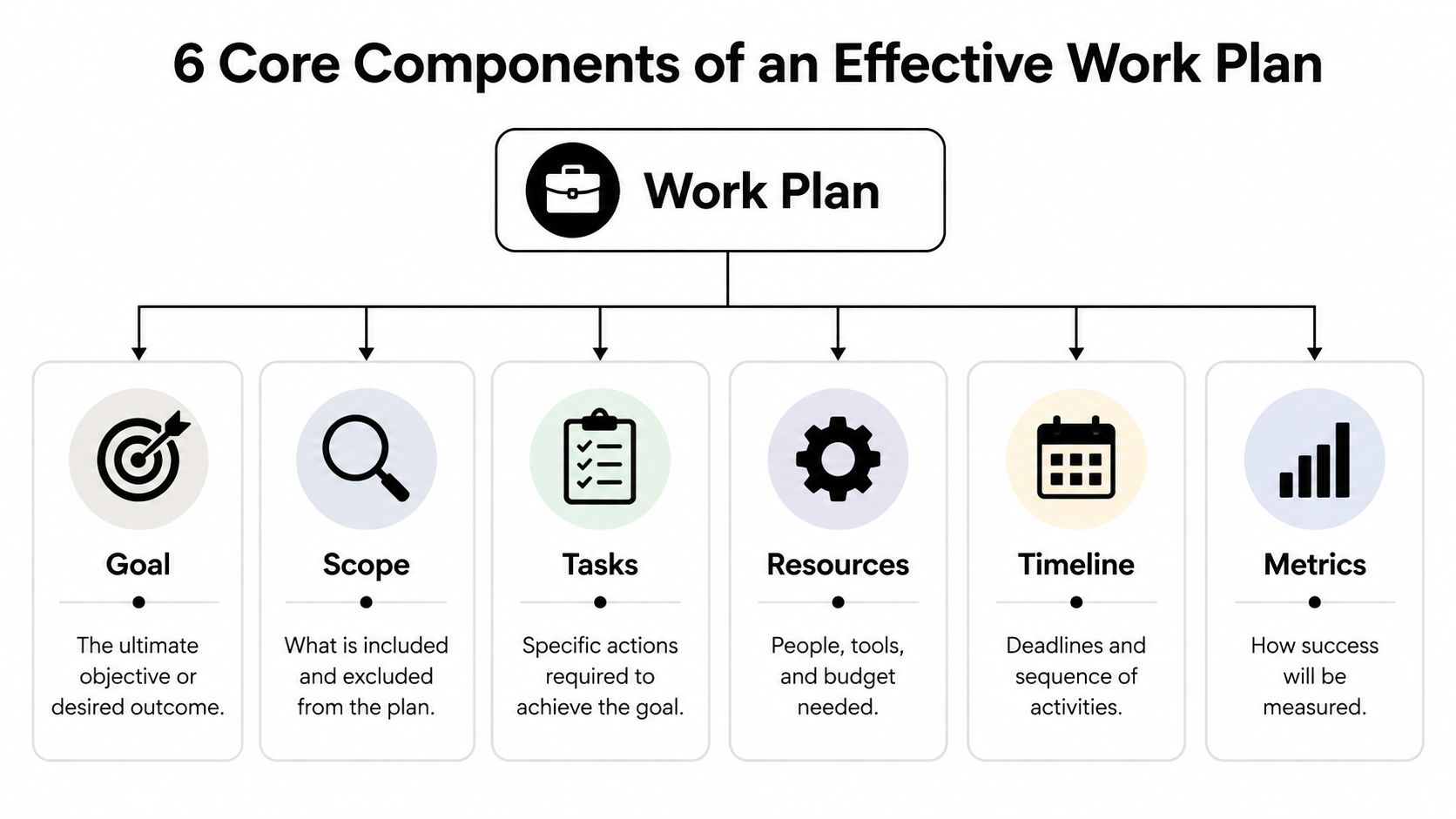
A goal that is specific enough to act on
A vague goal creates vague effort.
“Improve the website” sounds productive, but nobody knows what it means. “Launch a new services website that clearly explains three offers and includes a contact form” gives the team something concrete. Here, SMART thinking is useful. Your goal should be specific, measurable, achievable, relevant, and time-bound.
If you're using a recurring example like a website launch, the goal becomes the north star. Every later decision should tie back to it.
Scope that keeps the plan honest
Scope answers one of the most overlooked questions in planning. What's included, and what isn't?
People frequently expand projects beyond their initial scope. A website redesign turns into a rebrand. A dissertation turns into a side research project. Marathon training turns into a nutrition overhaul, gear research sprint, and sleep experiment all at once.
A simple scope note might look like this:
- Included: Homepage, services page, about page, contact form, copywriting, design, testing
- Excluded: Full rebrand, new logo, multilingual content, paid ad campaign
That boundary protects focus.
Tasks that can actually be done
Tasks are where ambition meets action. They need to be small enough that a real person can start them without guessing.
“Work on website” is not a task. “Draft homepage headline options” is. “Research dissertation” is not a task. “Read and annotate five core papers” is.
MIT describes a work plan as a schedule that shows task sequence, start and end dates, and who performs each task in MIT's work plan guide. That's why the task list needs to be operational, not aspirational.
Practical rule: If a task feels hard to start, it's probably still too big.
Resources and timeline that reflect reality
Every plan needs to answer two practical questions. What do we need, and when will this happen?
Resources can include people, software, budget, time blocks, equipment, or outside help. Timeline means more than due dates. It also means order. Some tasks can happen in parallel. Others depend on earlier work.
In formal settings, work plans often include task-level budget, labor category, estimated hours, outputs, and performance dates, as shown in HUD's work plan business guide. Even if your plan is personal, the same principle applies. You're allocating limited resources and creating accountability.
A quick example for a website launch:
| Component | Example |
|---|---|
| Goal | Launch a clear service website |
| Scope | Five pages, contact form, no rebrand |
| Tasks | Write copy, design pages, build form, test mobile |
| Resources | Founder, designer, web builder, copy docs |
| Timeline | Copy first, then design, then build, then test |
| Metrics | Site is live, pages complete, form works |
Metrics that tell you whether the work worked
Completion is not always the same as success.
You can finish a project and still miss the core objective. That's why the final component is metrics. Decide in advance what “done” means. For a student, it may mean submitting a final draft by the deadline. For a manager, it may mean all deliverables approved and handed off. For a runner, it may mean completing every week of the training block.
Metrics don't have to be fancy. They just have to be clear enough that you can judge progress without self-deception.
Why a Work Plan Is Your Secret Weapon for Success
People rarely struggle because they're lazy. More often, they struggle because the work is mentally expensive before it's physically hard.
A large goal creates background stress. Your brain keeps asking open loops. What am I forgetting? What should I do first? Is this even the right next move? That uncertainty drains energy.
Without a plan work feels heavier than it is
When there's no work plan, everything feels equally urgent. You jump between tasks, respond to the loudest request, and confuse motion with progress.
That's one reason teams spend so much effort on optimizing business operations. Better operations usually come down to clearer processes, cleaner handoffs, and fewer avoidable decisions. A work plan supports that same logic at the project level.
It also helps individuals. If your day keeps dissolving into reactive work, a plan gives you a reference point. You can ask, “What was the intended sequence?” instead of “What feels urgent right now?” If you want a companion read on execution habits, this guide on how to improve work productivity fits well with the planning mindset.
With a plan progress becomes visible
A plan gives you something powerful that raw effort can't. It makes progress visible.
Milestones create mini-finish lines. Assigned ownership removes ambiguity. Dependencies reduce wasted effort. Risks get named before they become emergencies. Even motivation changes because people can see movement.
Here's the contrast:
- Without a work plan: You keep everything in your head, underestimate the workload, and discover blockers late.
- With a work plan: You can see the path, spot constraints earlier, and make calmer decisions.
- Without a work plan: Team members duplicate work or wait for instructions.
- With a work plan: People know what they own and what needs to happen before their part starts.
A work plan doesn't guarantee success. It does make failure easier to catch early, which is often just as important.
How to Create Your First Work Plan in 5 Simple Steps
The easiest way to learn what is a work plan is to build one. Start simple. A one-page plan is better than a perfect plan that never gets written.
Use a notebook, Google Docs, Notion, Airtable, Asana, Trello, or a spreadsheet. The format matters less than the clarity.
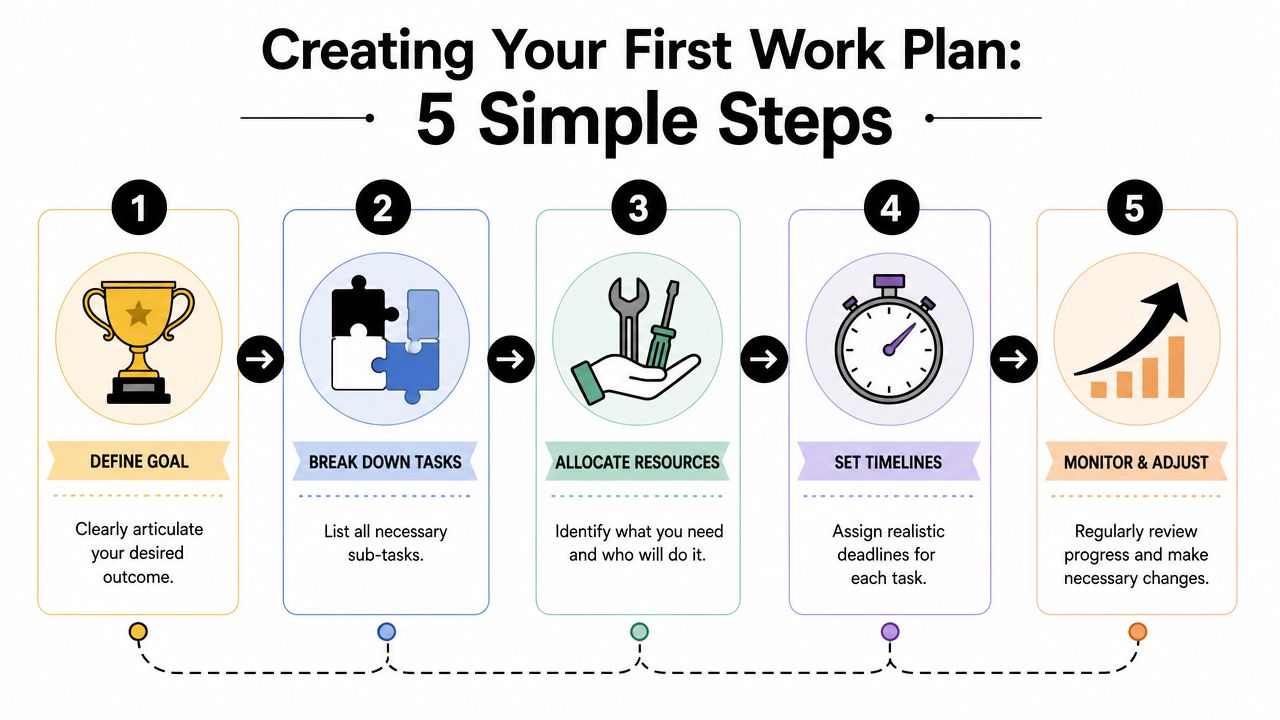
Step 1 Define the finish line
Write the goal in one sentence. Then define what success looks like when the work is complete.
Bad example: “Get healthier.”
Better example: “Complete a consistent training plan that prepares me to run a marathon.”
If you need help tightening loose goals into something usable, these goal-setting frameworks can make the first step much easier.
Step 2 Work backward from major milestones
Don't begin with the first tiny task. Begin with the major checkpoints.
If your goal is to submit a dissertation, milestones might include approved proposal, literature review completed, full draft completed, revisions completed, and submission. If your goal is a product launch, milestones might include validated concept, prototype built, user feedback gathered, and launch assets ready.
Backward planning helps because it reveals the major stages before you get lost in details.
Here's a quick walkthrough before the template.
Step 3 Break milestones into small tasks
Once the milestones are clear, break each one into actions.
For example, “prototype built” could include user flow sketch, wireframes, clickable mockup, feedback review, and revised version. Keep reducing until the task is obvious enough to start.
A useful test is this. Could someone else pick up the task and understand what to do without a long meeting? If not, refine it again.
Step 4 Assign owners resources and dates
Every task needs a home.
Who owns it? When does it start? When should it end? What does it depend on? What tool, budget, or support does it require? These considerations enable a work plan to become an execution document instead of a wish list.
Use this simple structure:
| Task | Owner | Start Date | End Date | Status | Dependencies |
|---|---|---|---|---|---|
| Draft homepage copy | Maya | TBD | TBD | Not started | Goal approved |
| Design homepage layout | Leo | TBD | TBD | Not started | Draft copy complete |
| Build contact form | Sam | TBD | TBD | Not started | Design approved |
| Mobile testing | Maya | TBD | TBD | Not started | Site build complete |
Step 5 Review the sequence and update as you go
Look at the full plan and ask three questions:
- What has to happen first
- What can happen at the same time
- Where are we making optimistic assumptions
Then begin. A work plan should guide action, not trap it.
Keep the first version simple. You're not trying to predict every twist. You're trying to create enough structure to move confidently.
Work Plan Examples for Every Ambition
A work plan is flexible because the underlying logic stays the same even when the goal changes. You still need a clear outcome, milestones, tasks, timing, ownership, and a way to tell whether you're done.
Founder building an MVP
A startup founder wants to launch a minimum viable product. The goal is not “build the app.” The goal is narrower. Release a basic version that solves one painful problem for one customer group.
The founder's milestones might include problem validation, feature selection, prototype, first test users, and launch. If they're planning a digital product or site, this guide to effective website project planning is a useful practical reference. The founder's tasks would likely include customer interviews, wireframes, technical setup, onboarding flow, and feedback loops.
Professional running a quarterly project
A marketing manager is responsible for a quarterly campaign. Without a work plan, the project turns into scattered meetings and late approvals.
With a work plan, the manager maps campaign brief, message development, creative production, launch prep, reporting, and review. Each stage gets an owner and a dependency. If you want examples of checkpoints that make planning easier, this article on project milestone examples can help you define the right markers.
Student finishing a dissertation
A student often thinks the dissertation is one giant task. That's exactly why it becomes overwhelming.
A work plan breaks it into proposal, source collection, reading notes, chapter outlines, draft writing, supervisor feedback, revisions, and submission prep. The student can also assign weekly reading blocks and writing targets. The plan reduces panic because the next step is always visible.
Runner preparing for a marathon
A marathon plan is a work plan in athletic clothing.
The goal is race completion. Milestones could include base fitness, long-run progression, recovery weeks, race simulation, taper, and race day. Tasks include scheduled runs, strength sessions, rest, hydration habits, and gear checks. Ownership is simple because it belongs mostly to one person, but accountability still matters. The runner can track completed sessions and adjust when life interrupts training.
A modern tool can make this easier to maintain digitally. Tribble Software Private Limited builds Beyond Time, which connects goals, milestones, routines, and time tracking in one system. For someone juggling work, study, or fitness goals, that kind of setup can help turn a static plan into a daily operating system.
Avoiding Pitfalls and Linking Your Plan to Reality
The biggest mistake people make is treating the plan like a frozen document. Real work doesn't behave that way.
One source on work plans points out a common failure: plans often stay static and give little guidance on buffer time or what to do when work starts slipping. It argues that planning should account for uncertainty and act as a dynamic control system, especially in hybrid and AI-assisted work environments, as discussed in this analysis of work plans.
Common mistakes that weaken a plan
A few patterns show up again and again:
- Tasks are too large: People write “prepare presentation” instead of separating research, outline, slides, rehearsal, and revision.
- Dates are fantasy dates: They assign deadlines without considering workload, approvals, or competing responsibilities.
- No one owns the work: Everyone assumes someone else is handling it.
- The plan disappears after kickoff: It gets written once, saved, and ignored.
How to keep a plan alive in real life
Use a short review rhythm. Look at the plan regularly and ask what changed, what slipped, what's blocked, and what needs to be resequenced.
Add buffer where uncertainty is high. If a task depends on feedback, outside approval, or new learning, don't pretend it will move like clockwork. Build breathing room around it.
You can also connect the work plan to bigger systems. OKRs help align projects to broader goals. Time tracking shows whether your calendar matches your priorities. Weekly reviews help you catch drift early. That combination turns a plan from a document into a decision-making tool.
The best work plan is not the most detailed one. It's the one you'll actually revisit, revise, and use.
If you want help turning goals into milestones, routines, and daily execution, Tribble Software Private Limited offers Beyond Time, an AI-powered system built to connect planning with follow-through. It's designed for founders, professionals, students, and self-improvers who want more than a static checklist.
Put this into practice
Free tools that match this article.
Goal Setting Worksheet
Turn a vague goal into milestones, habits, blockers, and a weekly review plan.
Try Goal WorksheetGoal SettingSMART Goal Validator
Instantly validate your goals against the SMART framework and get actionable improvement suggestions.
Try SMART ValidatorGoal SettingAI Milestone Generator
Turn your biggest goals into an actionable step-by-step plan in seconds with AI.
Try Milestone GeneratorTime ManagementTime Blocking Template
Map your day into focused time blocks with a free printable time blocking template.
Try Time BlockingKeep exploring this topic
Goal setting guide
Start with the fundamentals of setting goals that turn into action.
Goal frameworks compared
Choose between SMART goals, OKRs, BHAGs, and 12-week goals.
Time blocking guide
Turn priorities into protected calendar blocks.
15-minute time blocks
Plan and review your day with more realistic precision.
Related Articles

Weekly Goal Tracker: How to Plan and Achieve Your Goals
Design a weekly goal tracker that works. This guide shows you how to connect big objectives to daily tasks, build a tracker, and use AI to stay on course.
A Goal Planning Template That Actually Works: OKR Method
Stop just setting goals. Use our OKR-based goal planning template to turn big ambitions into a daily action plan. Includes a free downloadable template.
Difference Between Short and Long Term Goals: A 2026 Guide
Learn the core difference between short and long term goals. This guide covers time horizons, purpose, and how to connect your vision to daily actions.
What Is the Difference Between Tactics and Strategy?
Learn what is the difference between tactics and strategy. This guide clarifies their scope and timeline, with examples, connecting vision to action for 2026
Master Your Estimated Completion Date in 2026
Calculate and manage an accurate, motivating estimated completion date. Our 2026 guide covers formulas, tracking, and common pitfalls to help you achieve goals.

10 Best Apps for Daily Routine in 2026
Find the best apps for daily routine to organize your life. We review Todoist, Structured, Beyond Time, and more to boost your productivity in 2026.