What Is the Difference Between Tactics and Strategy?
Learn what is the difference between tactics and strategy. This guide clarifies their scope and timeline, with examples, connecting vision to action for 2026
Your calendar is full. Your task list keeps growing. You answer messages, attend meetings, review documents, and put out small fires all day. Still, at the end of the week, you have a hard time answering one simple question: Did I move closer to what matters?
That uneasy feeling usually doesn't come from laziness. It comes from misalignment. You're doing plenty, but your daily actions may not connect to a larger direction. That's where the difference between strategy and tactics becomes more than management jargon. It becomes the line between motion and progress.
Think of it this way. Strategy is the destination on the map. Tactics are the turns you take to get there. If you only focus on turns, you can stay busy and still end up somewhere you never meant to go. If you only pick a destination and never start driving, you stay parked.
Many managers hit this problem just as their responsibilities grow. They're no longer judged only by how much work they complete. They're judged by whether their team is moving in the right direction. If that sounds familiar, this guide on focus and clarity at work is a useful companion to the ideas below.
Table of Contents
- Are You Busy or Are You Making Progress
- Strategy Is the Why and Tactics Are the How
- A Detailed Comparison of Core Differences
- Strategy and Tactics in the Real World
- Two Common Mistakes That Kill Progress
- How to Translate Strategy into Daily Action
Are You Busy or Are You Making Progress
A rising manager often looks successful from the outside. Their inbox is active. Their team relies on them. Their day is packed from morning to evening. But inside, they feel scattered.
One manager I worked with had this exact problem. She was leading projects across hiring, customer onboarding, and internal operations. Every day brought urgent requests. She handled them well. But when her director asked how her work supported the company's top priorities, she paused too long before answering.
That pause is revealing.
It usually means your tactics are running faster than your strategy. You're reacting well, but you're not selecting work through a clear lens. You say yes to useful tasks, but not all useful tasks are important. Some are just nearby.
The trap of visible effort
Work rewards visible activity. Responding quickly looks productive. Shipping something small feels satisfying. Clearing a queue gives you relief. None of that is bad. The problem starts when activity becomes your only proof of value.
Here are common signs you've slipped into that trap:
- Your week feels full, but fuzzy: You worked hard, yet you can't point to one meaningful advance.
- You keep switching priorities: What feels urgent in the moment keeps replacing what matters most.
- Your team gets mixed signals: People know what's due this week, but not what the bigger goal is.
- You measure completion, not progress: Finished tasks look good on paper, but they don't always change outcomes.
Practical rule: If your calendar explains what you did, but not why you did it, you have a tactics problem.
The fix isn't to work harder. It's to connect effort to intent. Once you understand what is the difference between tactics and strategy, you can look at your day differently. You stop asking, "What should I do next?" and start asking, "What action best supports the outcome I'm trying to create?"
That shift sounds small. In practice, it changes how you plan, delegate, and decide.
Strategy Is the Why and Tactics Are the How
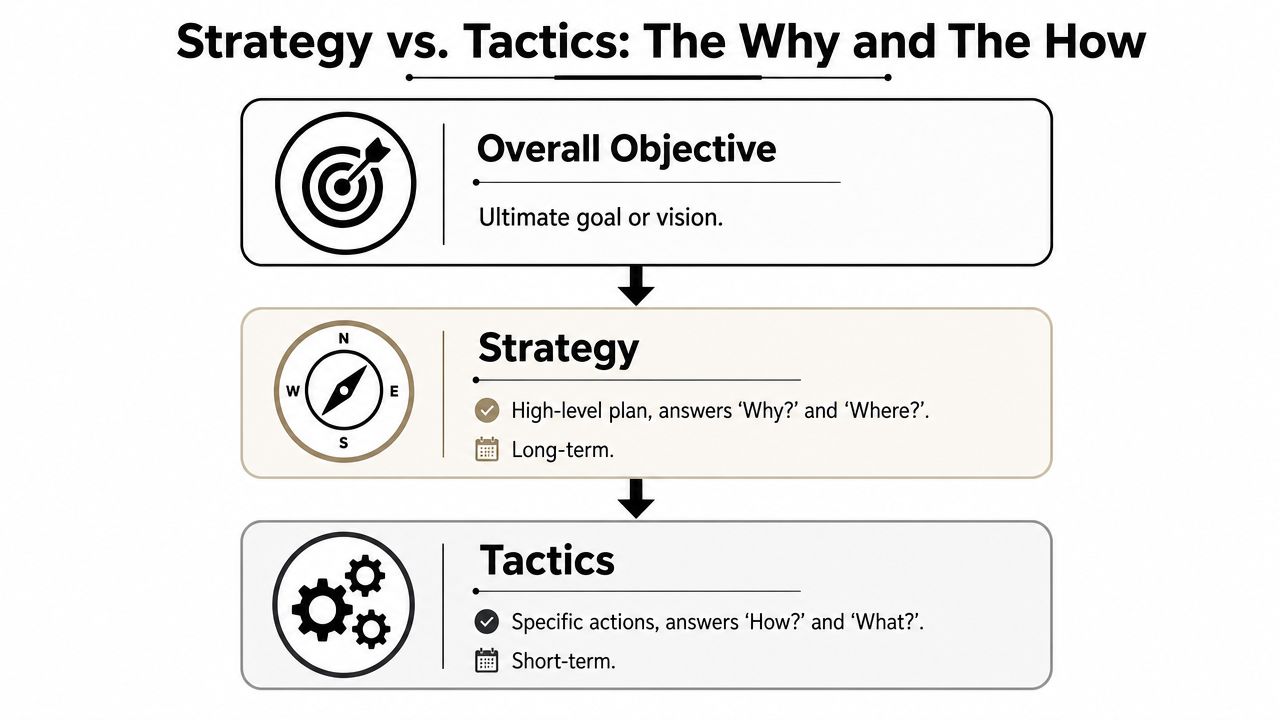
At the simplest level, strategy is your high-level plan for achieving an important goal. It answers questions like: Where are we going? Why does this direction make sense? What kind of advantage are we trying to create?
Tactics are the specific actions you take to execute that plan. They answer a different set of questions: What will we do this week? Which steps come first? How will we act in practice?
A lot of confusion disappears once you see that these terms operate at different altitudes.
The general and the captain
A useful analogy is a military one. A general decides how to win a war. That is strategy. The general chooses the broader objective, where to concentrate resources, and what success will look like.
A captain leads a unit through a specific maneuver in a particular battle. That is tactics. The captain decides who moves where, when to advance, and how to respond to immediate conditions.
Both matter. But they are not interchangeable.
If the captain runs a flawless maneuver that doesn't support the larger campaign, the unit may still lose ground overall. If the general creates a brilliant campaign with no practical execution, the plan never leaves the map.
Why managers confuse the two
Managers usually don't mix up the words because they don't know the dictionary definition. They mix them up because real work blends levels together. A quarterly priority can feel strategic in one meeting and tactical in another.
The easiest way to stay clear is to ask one question: Am I choosing direction, or am I choosing actions?
- If you're deciding the destination, tradeoffs, and logic, you're in strategy.
- If you're deciding tasks, methods, and timing, you're in tactics.
For teams trying to make goals clearer across the business, MyCulture.ai's goal-setting guide gives a practical way to think about alignment before work starts splintering into disconnected efforts.
Strategy gives meaning to action. Tactics give action a way to happen.
Another way to frame it is this: strategy narrows your options on purpose. Once you've chosen a path, many possible actions should fall away. If every tactic still looks equally attractive, the strategy probably isn't specific enough.
If you're building your own planning language, these goal-setting frameworks for personal and team use can help you separate vision, outcomes, and tasks without overcomplicating things.
A Detailed Comparison of Core Differences
If you still find yourself asking what is the difference between tactics and strategy, a side-by-side comparison helps. Definitions are useful, but decisions become easier when you can test ideas against a few criteria.
| Criterion | Strategy | Tactics |
|---|---|---|
| Time horizon | Long-term direction | Short-term action |
| Scope | Broad and cross-functional | Narrow and specific |
| Focus | Achieving the larger goal | Completing the next move |
| Measurement | Outcome and progress toward intent | Activity, output, and immediate execution |
| Flexibility | More stable, changes with care | More adaptable, changes often |
Strategy works at the level of direction
Strategy reaches farther into the future. It deals with positioning, priorities, and choices you don't want to reverse casually. A company may decide to focus on enterprise clients instead of small businesses. A student may decide to build toward graduate school instead of entering the workforce immediately. A manager may decide that team capacity should go first to retention, not acquisition.
Those are strategic choices because they shape many later decisions.
They're also broad. Strategy often touches multiple parts of the system at once. It affects budget, hiring, communication, and sequencing. That's why strategy requires judgment. You're not just picking what to do. You're deciding what not to do.
If you're trying to sharpen that judgment, a set of prompts like these 8 decision making questions can help you test whether a choice belongs at the strategic level or the tactical one.
Tactics work at the level of execution
Tactics are much closer to the ground. They are the concrete moves that make strategy visible. If your strategy is to improve customer retention, tactics might include rewriting onboarding emails, training support staff on common friction points, or changing the follow-up sequence after sign-up.
These actions are narrower by design. They should be specific enough that someone can own them, schedule them, and complete them.
They should also be adaptable. If one approach isn't working, you adjust. You don't need to rewrite the entire strategy every time a tactic underperforms. Good operators know how to change methods without losing direction.
The wrong metric creates the wrong behavior
One of the biggest practical differences is how you measure each level.
Strategic measurement asks, "Are we moving toward the intended outcome?" Tactical measurement asks, "Did we execute the planned action well?" Those aren't the same thing.
A team can execute every campaign on schedule and still fail strategically if the campaigns don't support the actual objective. A student can study for many hours and still struggle if those hours go to easy material instead of weak areas.
Use this distinction when reviewing work:
- For strategy: Look for signs of movement toward the larger objective.
- For tactics: Look for completion quality, consistency, and responsiveness.
- For both together: Ask whether the action taken can reasonably influence the outcome sought.
A strong tactic can fail because the strategy is wrong. A strong strategy can fail because no one turned it into repeated action.
Flexibility matters here too. You should revise tactics often enough to stay effective. You should revise strategy only when evidence, conditions, or priorities genuinely change. If you rewrite strategy every week, you don't have a strategy. You have mood-based planning.
Strategy and Tactics in the Real World
Abstract definitions help. Real examples make the idea stick because they show how strategy and tactics live inside ordinary decisions.

A startup trying to win a category
A software startup wants to become the go-to choice in a narrow business niche. That's not a tactic. It's a strategic aim because it defines the market position the company wants to hold.
The tactics might include publishing educational content for that niche, offering a lower-friction entry plan, and building integrations with tools those customers already use. None of those actions is the strategy itself. They are methods chosen because they support the strategy.
Founders often get tangled. They say, "Our strategy is content marketing." It usually isn't. Content marketing is a tactic. The strategy is the reason content matters in the first place, such as earning trust in a market that buys carefully and values expertise.
A marketing team trying to build visibility
A marketing leader may decide the team needs stronger brand awareness in a crowded market. That strategic choice gives context to the team's work. It tells people what kind of outcome matters.
The tactical layer looks very different. The team might redesign social templates to improve consistency, test new ad messaging, partner with a creator whose audience matches the brand, or refresh the website headline. Each action is concrete, owned, and testable.
Notice the pattern. The strategy doesn't tell the designer exactly what to create on Tuesday. The tactic does. But the tactic shouldn't exist in a vacuum. It earns its place because it serves the larger intention.
A student aiming for academic distinction
This distinction also matters outside business. A student may set a strategy of graduating with honors while building strong relationships with faculty in a chosen field. That's a long-range direction.
Tactics would include blocking study sessions each week, joining a study group for the hardest course, visiting office hours, and revising papers before deadlines. Those are practical moves. They translate ambition into habits and calendar choices.
Personal goals become more manageable when you can separate these levels. Without strategy, people chase whatever feels productive that day. Without tactics, they collect inspiring goals and wonder why nothing changes.
Two Common Mistakes That Kill Progress
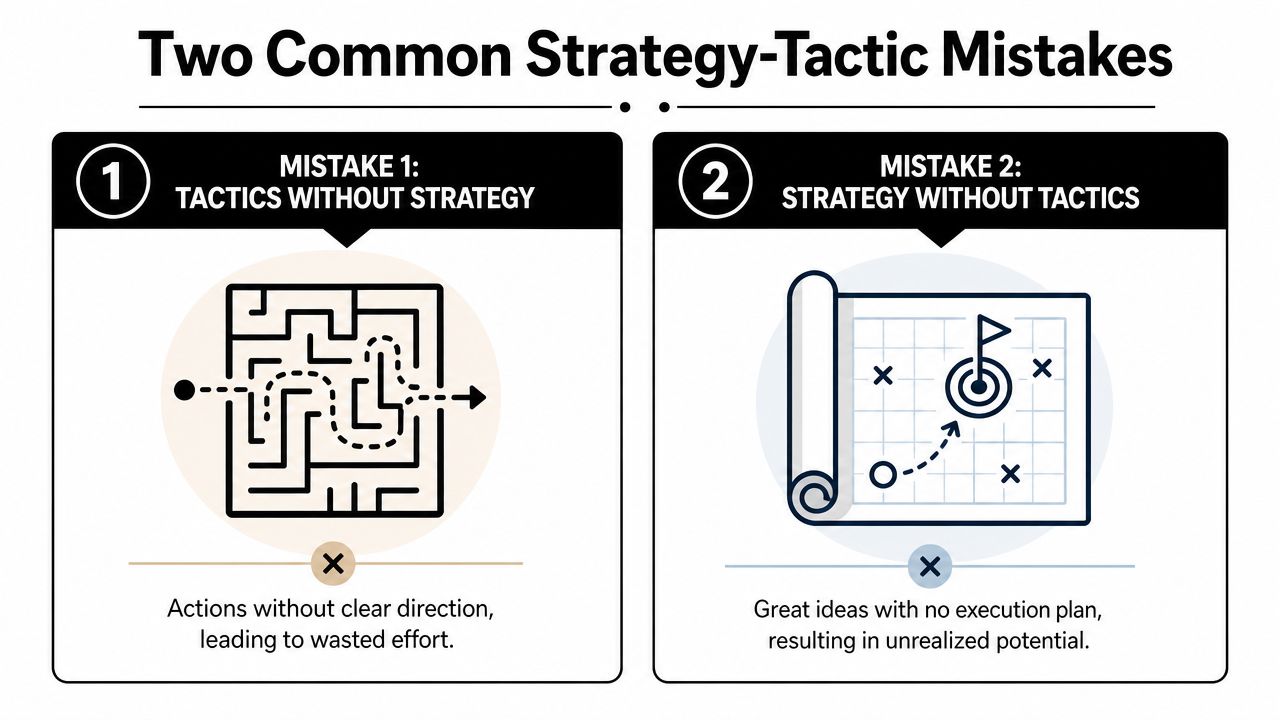
Most planning problems fall into one of two buckets. People either act without direction, or they define direction without action. Both create frustration. They just feel different while they're happening.
Mistake one is movement without direction
This is tactics without strategy. It shows up as endless activity, quick responses, and constant busyness. The person looks effective because they're always doing something.
But the work doesn't accumulate. One task doesn't strengthen the next. Priorities change based on who asked most recently or what feels urgent. Teams in this mode often feel tired and strangely unaccomplished at the same time.
Warning signs include:
- You say yes too easily: Every request seems valid because no clear filter exists.
- Your projects don't connect: You finish tasks, but they don't build toward a shared result.
- You keep restarting: Effort gets redirected before it compounds into anything meaningful.
If you can't explain how today's work supports a larger goal, you're probably managing tasks instead of leading outcomes.
Mistake two is vision without execution
This is strategy without tactics. It often sounds impressive. The plan is ambitious, the language is polished, and the intent is sound. Then nothing operational happens.
You see this when a team leaves an offsite energized, writes a strategy document, and returns to the same old work patterns on Monday. The plan never becomes assignments, routines, or deadlines. It lives in slides, not behavior.
Look for these clues:
- Goals stay abstract: People know the aspiration but not the next move.
- Ownership is fuzzy: Everyone supports the strategy, but no one owns the actions.
- Review meetings feel repetitive: The same ideas come up because no concrete execution loop exists.
Diagnostic test: If your strategy can't be translated into what someone should do this week, it isn't operational yet.
Progress requires both levels working together. Strategy sets direction. Tactics create traction. Remove either one and the system breaks.
How to Translate Strategy into Daily Action
The hardest part isn't defining strategy or listing tactics. It's building a reliable bridge between them. That's where many managers stall. They know the goal. They know work needs to happen. They don't have a clean method for linking the two.
One practical bridge is the OKR model, which stands for Objectives and Key Results.
Use OKRs as the bridge
The Objective is the strategic layer. It describes a meaningful direction in plain language. It should be clear enough to inspire action and specific enough to guide choices.
The Key Results sit in the middle. They define what evidence would show that the objective is advancing. They are not task lists. They are outcome markers.
The tactics sit below those key results. These are the actions, routines, experiments, and deliverables that help move the key results forward.
A simple example looks like this:
- Objective: Become the most trusted onboarding experience in our category.
- Key Result: Improve the quality and consistency of the early customer journey.
- Tactics: Rewrite onboarding emails, simplify the setup checklist, train support on first-week issues, review customer questions each Friday.
That hierarchy matters because it keeps work from drifting. A daily task isn't just a task anymore. It's attached to a key result, which is attached to an objective.
If you're building a process around launches or cross-functional execution, this guide for successful product launches is helpful because it shows how strategic intent can be broken into concrete checkpoints without losing momentum.
Turn key results into a weekly operating system
The biggest mistake with OKRs is stopping at the planning document. To make the model useful, convert it into a weekly review habit.
Ask these questions each week:
- What objective matters most right now
- Which key result needs attention
- What specific actions this week will influence it
- What should I stop doing because it doesn't support the goal
That last question is often the most important. Strategy isn't only about choosing actions. It's also about removing distractions that don't deserve your time.
A practical walkthrough can help make that shift from theory to routine:
Your personal system matters here as much as your planning framework. If your tasks live in one place, your goals in another, and your calendar somewhere else, connection breaks down. That's why many professionals benefit from stronger personal productivity systems that tie priorities to actual daily behavior.
When people finally understand what is the difference between tactics and strategy, their schedule starts to change. Meetings get filtered more carefully. Task lists get shorter and sharper. Goals stop feeling abstract because each week has a visible connection to something larger.
If you want help turning big goals into sequenced milestones, daily actions, and clear accountability, Tribble Software Private Limited builds Beyond Time for exactly that job. It connects objectives, key results, routines, habits, and tracked work into one system so you can spend less time managing lists and more time making real progress.
Put this into practice
Free tools that match this article.
Goal Setting Worksheet
Turn a vague goal into milestones, habits, blockers, and a weekly review plan.
Try Goal WorksheetTime ManagementWeekly Schedule Template
Plan your week with a free printable weekly schedule template for goals, routines, and focus blocks.
Try Schedule TemplateTime ManagementTime Blocking Template
Map your day into focused time blocks with a free printable time blocking template.
Try Time BlockingGoal SettingSMART Goal Validator
Instantly validate your goals against the SMART framework and get actionable improvement suggestions.
Try SMART ValidatorKeep exploring this topic
Goal setting guide
Start with the fundamentals of setting goals that turn into action.
Time blocking guide
Turn priorities into protected calendar blocks.
Goal frameworks compared
Choose between SMART goals, OKRs, BHAGs, and 12-week goals.
15-minute time blocks
Plan and review your day with more realistic precision.
Related Articles
A Goal Planning Template That Actually Works: OKR Method
Stop just setting goals. Use our OKR-based goal planning template to turn big ambitions into a daily action plan. Includes a free downloadable template.
Difference Between Short and Long Term Goals: A 2026 Guide
Learn the core difference between short and long term goals. This guide covers time horizons, purpose, and how to connect your vision to daily actions.
Weekly Goal Tracker: How to Plan and Achieve Your Goals
Design a weekly goal tracker that works. This guide shows you how to connect big objectives to daily tasks, build a tracker, and use AI to stay on course.
Master Your Estimated Completion Date in 2026
Calculate and manage an accurate, motivating estimated completion date. Our 2026 guide covers formulas, tracking, and common pitfalls to help you achieve goals.
What Is a Work Plan? Your 2026 Guide to Success
Discover what is a work plan and how to craft one effectively in 2026. Learn components, examples, and mistakes to turn your goals into reality.
How to Build Better Habits: A Science-Backed Playbook
Learn how to build better habits that last. Our guide provides a science-backed framework, tracking templates, and troubleshooting for real-world results.