How to Be Efficient and Productive: A 2026 System
Stop being busy and start being efficient and productive. Learn a practical, AI-enhanced system to set goals, track progress, and build unstoppable momentum.
Most advice on how to be efficient and productive starts in the wrong place. It starts with hacks. Wake up earlier. Clean your inbox. Use a Pomodoro timer. Download another task app.
That advice fails because busyness is easy to optimize. Meaningful output is harder. You can color-code your calendar, process messages faster, and still end the week with no real movement on the work that matters.
The better approach is a closed loop. Start with clear outcomes. Turn them into milestones. Attach those milestones to routines and time blocks. Track what happened in 15-minute increments. Then use a daily critique, ideally with AI support, to spot patterns and tighten the system. That's how you become efficient and productive at the same time.
Table of Contents
- The Productivity Trap Why Being Busy Is Not Enough
- Set Clear Direction with the OKR Framework
- Build Your Roadmap with Milestones and Habits
- Achieve Radical Accountability Through Analysis
- Refine Your Momentum with Daily AI Intelligence
- Becoming Truly Efficient and Productive
The Productivity Trap Why Being Busy Is Not Enough
A packed day doesn't prove you were productive. It usually proves you were available.
That distinction matters because many people don't have a time management problem. They have a value allocation problem. They're moving all day, but the movement sits in shallow work, reactive communication, cleanup, and maintenance.
Research from Eagle Hill found that 68% of workers spend significant time on low-value, inefficient tasks, and 64% say workplace tools erode productivity or slow them down in its analysis of inefficient task load at work. That matches what shows up in practice. People don't usually fail because they're lazy. They fail because low-value work colonizes the day.
Being busy is often just well-organized drift.
The trap gets worse when productivity advice treats efficiency and productivity as the same thing. They aren't. Efficiency is reducing waste. Productivity is increasing meaningful output. If you answer email faster, you may be more efficient. If you finally finish the proposal, ship the feature, publish the article, or close the loop on hiring, you're productive.
A lot of systems stop at personal organization. They help you track tasks, but they don't force a connection between your strategic goals and your next hour. That gap is where momentum dies.
Three signs you're stuck in the trap:
- Your calendar is full: but your most important goal keeps sliding to next week.
- You complete many tasks: but most of them maintain the system rather than improve it.
- You feel tired at day's end: yet you can't point to a result that materially moved the business, project, or goal forward.
The fix isn't another list. It's a tighter operating system that links high-level direction to daily execution and then learns from your actual behavior.
Set Clear Direction with the OKR Framework
The fastest way to become efficient and productive is to stop treating every task as equally important. Most aren't. Some create significant impact. Many just create motion.
Why most goal setting fails
Common goal setting breaks because it's vague. “Grow my business.” “Get healthier.” “Be more consistent.” Those are intentions, not operating targets.
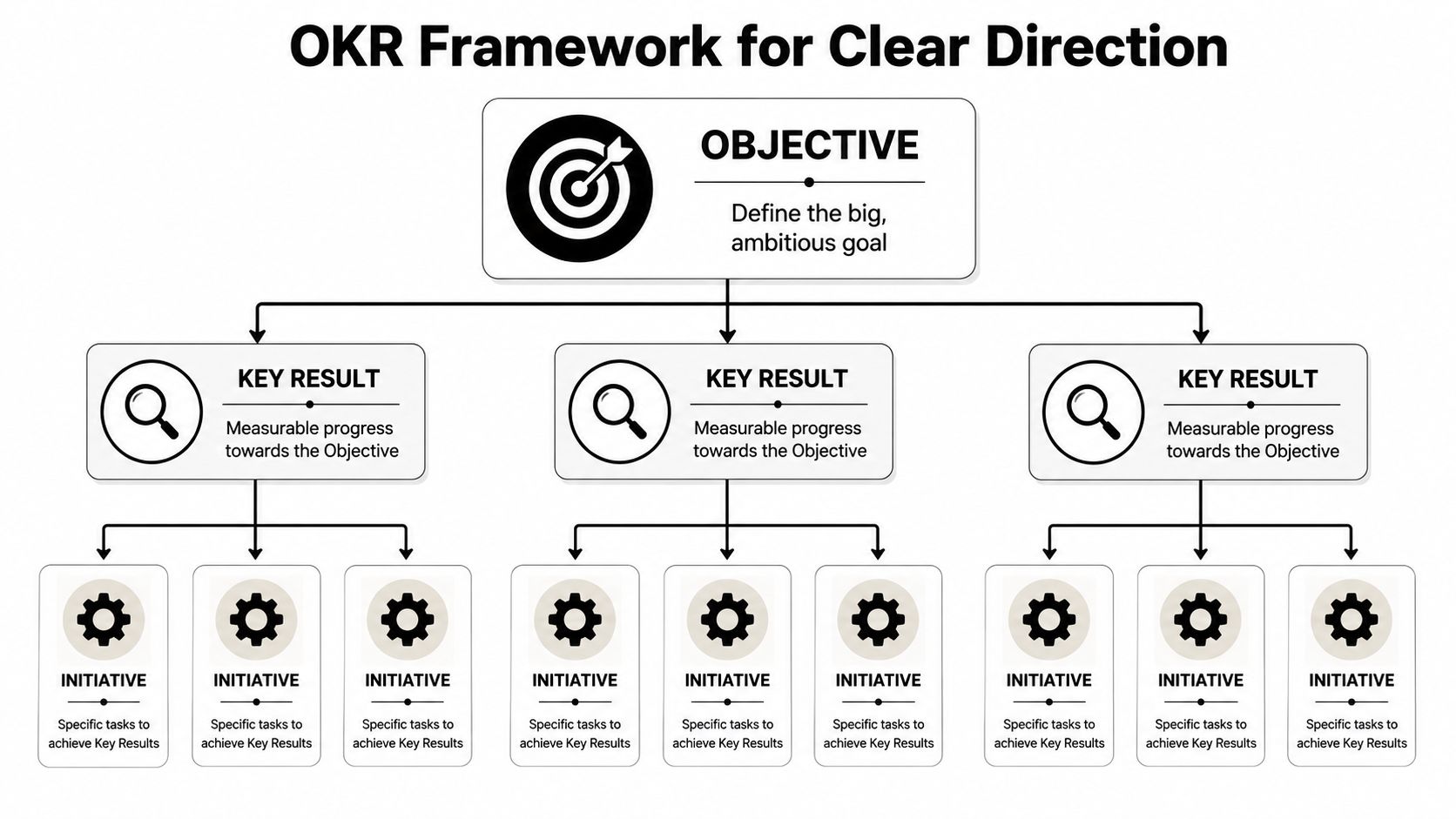
OKRs, or Objectives and Key Results, solve that by separating ambition from measurement. The Objective names the meaningful outcome in plain language. The Key Results define what progress looks like in observable terms. Then initiatives sit underneath as the actual work.
The strongest companies don't win by shaving small amounts of waste alone. The most successful companies are over 40% more productive than their peers because they focus on expanding output rather than just cutting costs, as Bain explains in its piece on why great companies obsess over productivity. That's the right lens for individuals too. If your system only helps you do admin faster, you may become more orderly without becoming more effective.
For a deeper comparison of structured approaches, this roundup of goal-setting frameworks for execution is useful because it shows where OKRs fit versus looser planning models.
Practical rule: If a goal can't change your week's priorities, it isn't a real goal yet.
A practical OKR example
Take a founder preparing a product launch.
A weak goal sounds like this: launch successfully in Q1.
A stronger OKR looks like this:
- Objective: Launch the product with clear early demand and a usable onboarding flow.
- Key Result 1: Complete the product onboarding sequence and remove major friction points.
- Key Result 2: Conduct a defined set of beta conversations and capture recurring objections.
- Key Result 3: Publish launch assets and run a consistent pre-launch outreach cadence.
Notice what changed. The objective is directional and motivating. The key results create boundaries. They tell you what counts. They also tell you what doesn't.
If a task doesn't support one of those key results, it should face a hard question. Is it necessary now, later, or never?
How to keep OKRs useful
OKRs fail when people turn them into a spreadsheet ritual. They should drive choices.
Use these filters:
Make the objective qualitative, not mushy
It should be ambitious but concrete enough that a stranger could understand what success means.Keep key results limited
If everything is a key result, nothing is. A short list creates pressure to choose.Separate outcomes from initiatives
“Write emails” is not a key result. It's an initiative. A key result reflects progress, not busyness.Review them against reality
If your calendar doesn't contain work tied to your key results, your OKR is decoration.
A good OKR system creates productive tension. It forces you to stop asking, “What can I get done today?” and start asking, “What output matters enough to deserve today?”
Build Your Roadmap with Milestones and Habits
An OKR gives direction. It doesn't tell you what Tuesday at 10:15 a.m. should look like. That's where most systems break.
The missing layer is the bridge between strategic intent and recurring execution. That bridge has two parts. First, you break each key result into milestones. Then you connect those milestones to habits, time blocks, and routines you can repeat.
Turn key results into milestones
A milestone is bigger than a task and smaller than a goal. It marks a meaningful checkpoint that proves the work is moving.
Suppose your key result is to complete beta validation for a new product. The wrong move is to dump twenty outreach tasks into a task manager. The better move is to sequence the work:
- Milestone one: finalize interview script and ideal user profile
- Milestone two: complete outreach block and book conversations
- Milestone three: run conversations and summarize patterns
- Milestone four: turn findings into product or messaging changes
That sequencing changes behavior. Instead of juggling scattered tasks, you know the phase you're in. You also know what “done for now” looks like.
This is the same logic behind strong team execution. Gallup reports that organizations with connected and engaged employees see productivity improvements of 20% to 25% compared to disconnected workforces in its State of the Global Workplace coverage. Consistency and connection matter because people execute better when daily work clearly links to a shared objective. Personal systems need that same coherence.
For more concrete milestone patterns, this guide to examples of milestones in project management is worth studying.
Attach milestones to recurring behavior
Milestones don't execute themselves. Habits do.
In this way, many ambitious people sabotage themselves. They create a milestone like “secure beta user interviews” but never define the recurring behavior that produces it. A milestone without a schedule becomes wishful thinking.
Use this simple translation:
- Milestone becomes the checkpoint.
- Habit becomes the recurring action.
- Calendar block becomes the protected container.
For example:
- “Secure beta interviews” turns into outreach every Tuesday and Thursday morning
- “Refine onboarding flow” turns into one focused product review block after customer calls
- “Publish launch assets” turns into a writing block on Monday, edit block on Wednesday, finalization block on Friday
A strong system doesn't ask you to feel motivated. It asks you to show up to the right block often enough.
If you're managing several streams at once, the challenge isn't motivation. It's sequencing and conflict control. Teams handling overlapping deadlines can borrow from these strategies for chaos-free delivery, especially the idea of making active priorities explicit instead of pretending everything can move at once.
A useful daily rhythm looks like this:
- Morning block: one milestone-driving task before reactive work
- Midday check: review whether the current task still maps to a key result
- Afternoon admin window: contain email, coordination, and maintenance
- Shutdown review: log actual time and note what slipped
A sample breakdown you can copy
Here's a simple model for translating a key result into concrete movement.
| Key Result | Milestone 1 | Milestone 2 | Milestone 3 | Associated Habit |
|---|---|---|---|---|
| Improve product onboarding | Map current friction points | Rewrite onboarding steps | Test revised flow with users | Review onboarding feedback during a recurring product block |
| Build launch demand | Draft messaging angles | Publish launch assets | Run pre-launch outreach | Reserve recurring writing and outreach sessions each week |
| Validate customer pain points | Define interview questions | Conduct user conversations | Synthesize repeated objections | Hold a scheduled research block and same-day notes review |
A 15-minute execution method makes this operational. Instead of tracking your day in broad categories like “worked on product,” log what happened in short increments. Not because precision is glamorous, but because memory lies. Memory often retains intention, yet struggles with actual allocation.
Later in the day, use that record to ask blunt questions:
- Which blocks moved a milestone forward
- Which blocks were maintenance disguised as progress
- Which recurring habits need a better time slot
- Which milestone is stalled because the habit is too vague
That's when you stop living from task list to task list and start running a roadmap.
Before you move on, watch this walkthrough to see how this kind of execution layer works in practice.
Achieve Radical Accountability Through Analysis
The issue isn't a lack of motivation. It's a need for cleaner feedback.
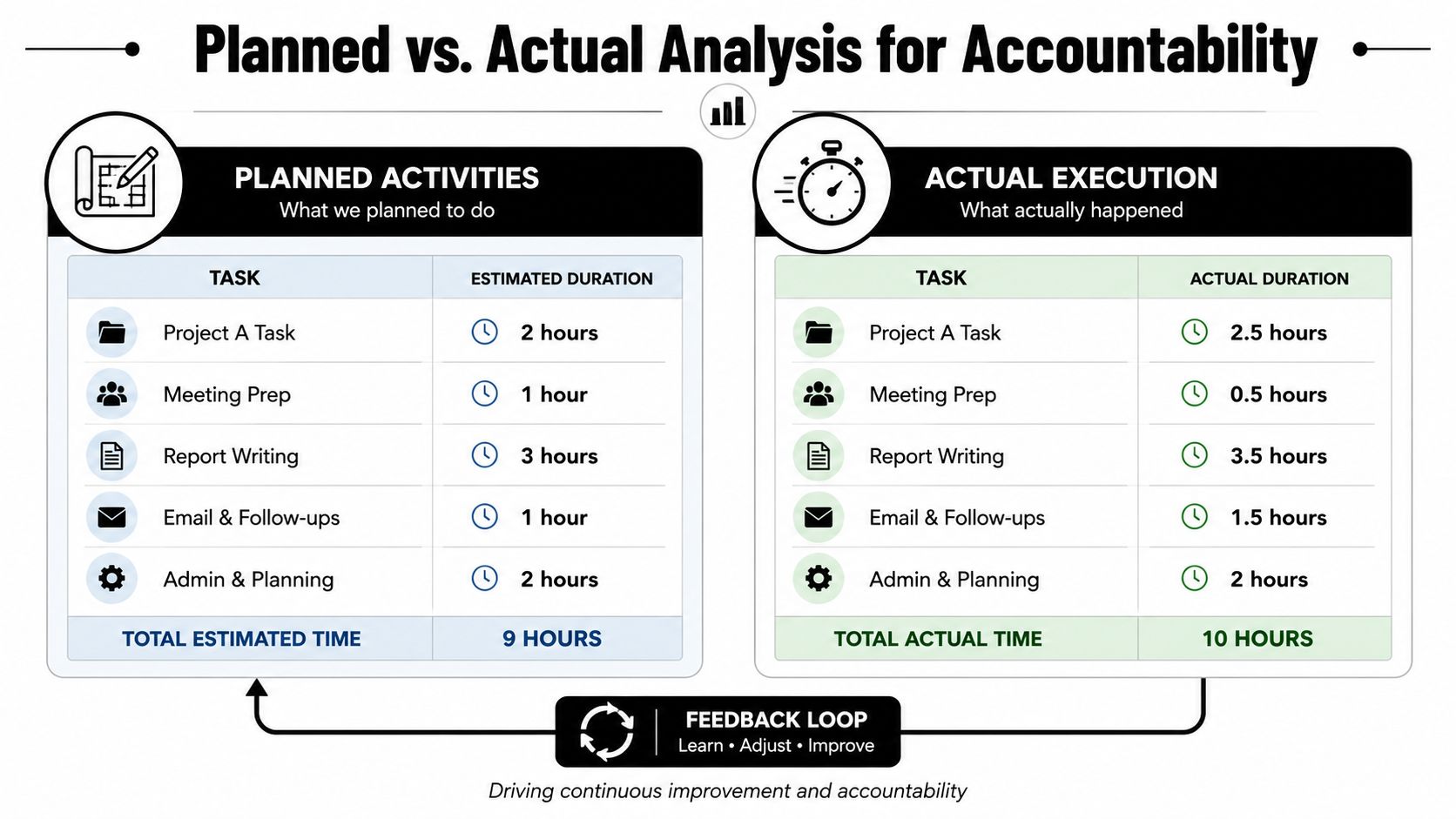
Time tracking alone isn't enough. A log can become another pile of data you never use. The value appears when you compare planned versus actual and force your system to explain itself.
Measure what happened, not what you hoped happened
Planned-vs-actual analysis is simple in concept. You decide where your best time should go. Then you record where it went. The gap tells the truth.
That approach lines up with a formal benchmarking method. A structured efficiency benchmarking process that defines metrics, sets benchmarks, normalizes data, and analyzes performance gaps can deliver 15% to 25% productivity improvements within 6 months, according to this efficiency benchmarking methodology overview. The useful part for personal execution isn't the statistic alone. It's the method. Progress improves when you compare against a standard and then study context, not just totals.
That's why planned-vs-actual review works. It shows whether the problem was estimation, interruption, energy, unclear task definition, or avoidance.
A practical scorecard can be very plain:
- Planned deep work: what block was reserved for milestone-moving work
- Actual deep work: what happened instead
- Variance: where you underused, overran, or replaced the block
- Context note: why it happened
- Adjustment: what changes tomorrow or next week
If your planned two-hour strategy block became forty minutes of slide cleanup and ninety minutes of chat responses, the issue isn't discipline in the abstract. The issue is that your day had no defense against shallow work.
For a broader framework, this piece on productivity measurement in real work helps separate output, effort, and noise.
A weekly review that actually changes behavior
Weekly reviews fail when they become journaling. Useful reviews create decisions.
Ask questions that expose patterns:
Where did planned milestone work consistently shrink?
Look for blocks that are always the first to get invaded.Which tasks repeatedly took longer than expected?
That usually signals hidden complexity, poor scoping, or low clarity.What produced disproportionate progress?
Keep those conditions. Protect the time, sequence, and environment.What looked urgent but did not move a key result?
Busy people leak their week through these activities.
Review your calendar like an operator, not a historian. You're not preserving memory. You're redesigning the machine.
A useful weekly review often ends with only a few changes:
- Cut one recurring low-value commitment
- Move one high-impact block to a better energy window
- Shrink one task that's too broad to start
- Add one constraint that prevents distraction during key work
That's radical accountability. Not guilt. Not self-criticism. Just pattern recognition with consequences.
The shift happens when you stop asking whether you were “productive” in general. General feelings are unreliable. Instead ask whether your time map matched your priorities. If it didn't, your system needs redesign.
Refine Your Momentum with Daily AI Intelligence
Manual review works. It also breaks when life gets crowded.
The reason to add AI to a personal operating system isn't novelty. It's consistency. An AI layer can inspect your planned-vs-actual data every day, remember recurring patterns, and surface opportunities you would otherwise miss because you're too close to your own habits.

Why AI belongs in the feedback loop
The broader productivity backdrop supports this shift. Global labor productivity grew only 0.4% in 2024, while the U.S. saw a 1.5% rise, a gap linked to more strategic adoption of advanced technologies such as AI, according to the productivity summary in this review of employee productivity statistics. The takeaway for individuals is straightforward. Strategic technology use can create bursts of output instead of tiny incremental gains.
That's exactly where AI helps. Not by replacing judgment, but by doing the repetitive analytical work humans rarely sustain:
- spotting when your best work happens
- identifying which planned blocks are fantasy
- noticing that certain meetings ruin the next two hours
- detecting when “quick admin” expands and consumes prime focus time
One factual example in this category is Beyond Time by Tribble Software Private Limited, which uses an OKR-based structure, 15-minute tracking, planned-vs-actual analysis, and a daily AI critique to connect goals with execution. That's one model of what an integrated system can look like when the planning layer and the feedback layer talk to each other.
What a daily AI critique should surface
A useful AI critique should not dump a dashboard on you. It should narrow your attention.
The single best output is a most impactful focus for the day. One recommendation. One action or block that has the strongest chance of restoring momentum on the work that matters.
That recommendation gets better when the system has memory. Over time, pattern intelligence can learn things like:
- You do stronger strategic work before meetings
- You avoid a certain project when the next step isn't defined
- You overestimate writing blocks and underestimate revision
- You finish important work more often when the task is tied to a milestone, not a generic to-do
The point of AI in productivity isn't automation for its own sake. It's sharper judgment, delivered before the day drifts.
This also applies to specific operational bottlenecks. If communication eats your schedule, reducing inbox drag matters. A curated review of best AI email assistant tools can help if email triage is one of the places your focused work keeps getting broken apart.
The standard for an AI productivity layer is simple. It should make your next decision clearer. If it only creates more data, more notifications, or more summaries to read, it's adding friction, not momentum.
Becoming Truly Efficient and Productive
To become efficient and productive, you need one system, not five disconnected habits.
Start with an OKR so your effort has direction. Break each key result into milestones so progress becomes visible. Attach those milestones to routines and protected time blocks so execution stops depending on mood. Review planned versus actual so the truth of your week is visible. Then use daily AI critique to tighten the loop and surface the next highest-impact move.
That combination changes the game. You stop treating productivity as personal heroics and start treating it as system design.
This matters even more in distributed work, where weak operating rhythms create silent drift. If your work depends on async collaboration, this guide to effective remote operations is a useful companion because it reinforces the same principle: clarity beats constant activity.
Being efficient and productive isn't about cramming more into the day. It's about making sure your next 15 minutes serve something bigger, then learning from the result.
If you want a tool built around this exact loop, Tribble Software Private Limited offers Beyond Time, an AI-powered goal achievement system that connects OKRs, milestones, habits, 15-minute time tracking, planned-vs-actual review, and daily AI critique in one workflow.
Put this into practice
Free tools that match this article.
Time Blocking Template
Map your day into focused time blocks with a free printable time blocking template.
Try Time BlockingTime ManagementWeekly Schedule Optimizer
Generate an optimized weekly schedule with AI-powered time blocking for maximum productivity.
Try Schedule OptimizerGoal SettingGoal Setting Worksheet
Turn a vague goal into milestones, habits, blockers, and a weekly review plan.
Try Goal WorksheetAssessmentProductivity Score Calculator
Discover your productivity score and get personalized recommendations to improve.
Try Productivity ScoreKeep exploring this topic
Goal setting guide
Start with the fundamentals of setting goals that turn into action.
Goal frameworks compared
Choose between SMART goals, OKRs, BHAGs, and 12-week goals.
Time blocking guide
Turn priorities into protected calendar blocks.
15-minute time blocks
Plan and review your day with more realistic precision.
Related Articles
Regain Focus and Clarity: A System for High Achievers
Stop feeling busy and start being effective. Learn a practical, evidence-backed system to build sustained focus and clarity for meaningful, measurable results.
How to Improve Focus: A 6-Step System for Deep Work
Learn how to improve focus with a practical, evidence-backed system. This guide covers everything from sleep and nutrition to time-blocking and daily routines.
Master Task Prioritization Techniques: Boost Productivity
Stop juggling tasks. Learn powerful task prioritization techniques, from Eisenhower to RICE, to focus on what matters and achieve your goals in 2026.
How to Improve Work Productivity: A Complete System
Learn how to improve work productivity with a step-by-step system. Go beyond simple tips to diagnose bottlenecks, build routines, and track progress.
Master Your Time Blocked Calendar: 2026 Productivity Guide
Learn to design a time blocked calendar that works. This 2026 guide covers templates, tracking planned-vs-actual, and troubleshooting. Take control of your day.

A Goal Planning Template That Actually Works: OKR Method
Stop just setting goals. Use our OKR-based goal planning template to turn big ambitions into a daily action plan. Includes a free downloadable template.