8 Actionable Examples of Self Discipline for 2026
Explore 8 powerful examples of self discipline for founders, students, and professionals. Learn actionable habits and systems to achieve your goals in 2026.
What separates people who follow through from people who keep restarting the same goals every Monday? It usually isn't grit in the dramatic sense. It's structure. Most advice about self-discipline still treats discipline like a personality trait, as if some people have it and others don't.
That framing breaks down fast in real life. People don't fail only because they're weak-willed. They fail because the goal is vague, the routine is too heavy, the environment keeps interrupting them, or the system depends on making the right choice over and over when they're tired. Better psychology-oriented guidance points in a different direction: disciplined behavior lasts longer when it fits your actual life, becomes automatic through repetition, and uses simple implementation intentions such as “if X happens, then I will do Y” (Flinders University on self-discipline and habit design).
That's the gap most articles miss. They tell you to “be more disciplined” without showing you what discipline looks like operationally.
Below are 8 actionable examples of self discipline that work because they reduce friction, expose patterns, and turn good intentions into repeatable systems. These aren't motivational slogans. They're practices founders, students, professionals, and creators can run.
Table of Contents
- 1. Daily Time Tracking and Planned-vs-Actual Analysis
- 2. OKR-Based Goal Setting with Sequenced Milestones
- 3. Routine and Habit Stacking Linked to Goals
- 4. Morning Focus Priority Selection and Daily AI Critique
- 5. Accountability Systems with Pattern Intelligence and Personal AI Memory
- 6. Resistance to Distraction Through Time-Boxed Deep Work Blocks
- 7. Progress Tracking and Visible Momentum Maintenance
- 8. Regular Review and Reflection Rituals
- 8-Strategy Self-Discipline Comparison
- Your Blueprint for Lasting Discipline
1. Daily Time Tracking and Planned-vs-Actual Analysis
Many individuals are disciplined in theory and sloppy in measurement. They plan a focused day, then spend hours in reactive work and still tell themselves they were “busy.” Time tracking fixes that because it makes hidden behavior visible.
This is one of the strongest examples of self discipline because it replaces self-story with evidence. If you planned ninety minutes for proposal writing and it took half a day because Slack kept pulling you away, you've learned something useful. You don't need guilt. You need a better estimate and a better boundary.
To keep the process light, start with time tracking basics and planned-vs-actual reviews. Logging in short intervals lowers resistance. Reviewing the mismatch between what you intended and what happened gives you honest feedback without turning the day into a courtroom.
Here's a quick walkthrough before you try it:
Why this works
A founder can use this to see whether hiring, selling, or product work is eating the week. A consultant can spot which client work is profitable and which always expands beyond scope. A student can learn whether “studying all afternoon” really meant focused revision or half-focus mixed with phone checks.
Practical rule: Track first. Judge later. The point is to improve future planning, not to punish yourself for reality.
What doesn't work is reviewing every day with too much emotion. Daily data is noisy. Weekly review is where patterns appear.
- For founders: Record planned strategic work before the day starts, then compare actual time spent on hiring, sales, meetings, and admin.
- For professionals: Track deep work, meetings, and reactive communication separately so overload becomes obvious.
- For students: Log study blocks by subject and type of work, such as reading, retrieval practice, or problem sets.
Habit templates
Difficulty level: Medium
Use a simple template:
- Before the day: Write your top tasks and your planned time for each.
- During the day: Log what you did in short intervals.
- End of week: Review where estimates were wrong, where distractions entered, and what should change next week.
The trade-off is straightforward. Tracking creates friction at first. But that small friction prevents larger waste later. If you want discipline that lasts, start by making time visible.
2. OKR-Based Goal Setting with Sequenced Milestones
People often call themselves undisciplined when the actual problem is that the goal is too foggy. “Get healthier,” “grow my business,” and “do better this semester” don't give the brain anything concrete to execute. Discipline gets easier when the path is staged.
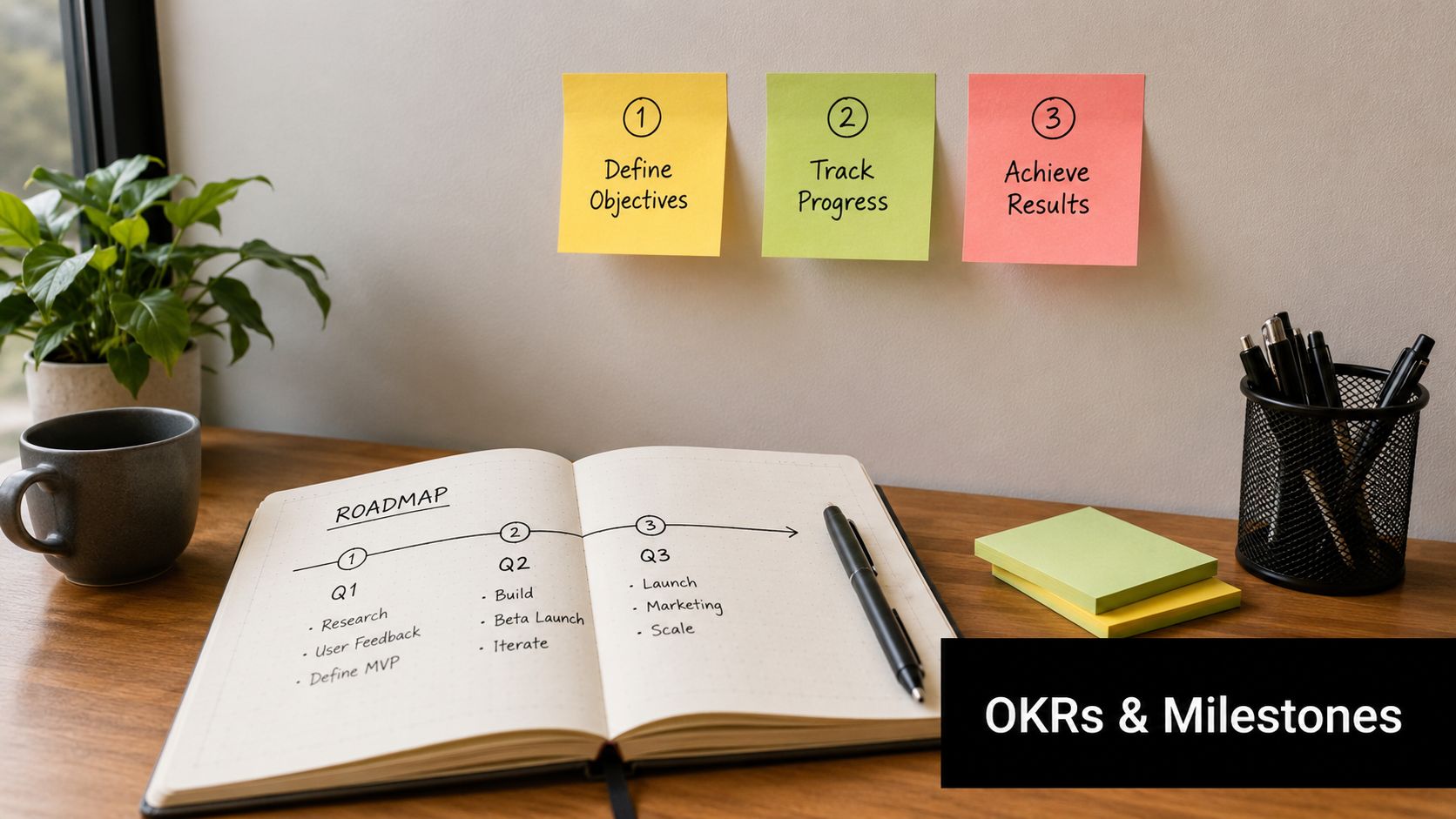
OKRs help because they force precision. You define an objective, then attach key results, then break those into milestones that happen in sequence. That sequence matters. A founder can't expect consistent sales discipline without first building a repeatable outreach process. A student can't expect strong exam performance without mapping readings, practice, and revision windows in order.
For a structured approach, use goal-setting frameworks that translate ambition into milestones.
What good discipline looks like here
Good discipline here doesn't mean obsessing over giant targets. It means knowing the next milestone and working it in order. That's why OKRs are useful for founders, product managers, students, and professionals aiming for promotion. They shrink the psychological distance between today and the larger goal.
If you want help drafting clear objectives and milestone language, AI tools for strategic goal setting can be useful for brainstorming and refinement. They're most helpful after you already know what outcome matters.
A disciplined person usually isn't doing more things. They're doing the next right thing in sequence.
Habit templates
Difficulty level: Medium to Hard
Try these templates:
- Founder template: Objective. Improve sales consistency. Key results. Sharpen pipeline hygiene, outreach consistency, and follow-up quality. Milestones. Finalize offer, define lead list, write scripts, schedule outreach blocks, review replies weekly.
- Professional template: Objective. Earn more responsibility. Key results. Improve delivery quality, communication, and leadership visibility. Milestones. Own one project, document wins, lead one recurring meeting, ask for structured feedback.
- Student template: Objective. Improve performance in one subject. Key results. Complete syllabus coverage, practice under test conditions, fix weak topics. Milestones. Weekly topic map, timed practice, error review, office hours follow-up.
What doesn't work is loading one objective with too many key results. That creates fake ambition and weak execution. Fewer targets usually produce steadier discipline.
3. Routine and Habit Stacking Linked to Goals
A lot of people build habits that feel good but don't move anything important. They meditate, journal, stretch, and organize their desk, then wonder why the business, grades, or project still stalls. Discipline improves when routines connect directly to outcomes.
That's where habit stacking helps. You attach one action to another so the routine runs with less decision-making. The stronger move is to stack habits that serve a real goal, not just a vague sense of self-improvement. Planning for fifteen minutes, reviewing one milestone, and starting the first work block is better than a long “productive” morning routine that never reaches actual work.
Build routines around outcomes
This system works best when the routine is short enough to repeat and specific enough to matter. Modern guidance on self-discipline increasingly emphasizes fit and automaticity over brute-force resistance. People tend to stick with disciplined behavior when it aligns with intrinsic reasons, can be repeated until it becomes habitual, and is adapted to what they can realistically maintain, not what sounds impressive (Pursuit on self-control and everyday outcomes).
That same population-level analysis linked higher self-control with meaningful everyday outcomes. Each one-point increase in self-control was associated with being about 8 to 10 percentage points less likely to be obese, 7 to 8 percentage points less likely to smoke, 9 to 10 percentage points less likely to drink excessively, and 7 percentage points more likely to be able to raise A$3,000 in an emergency (University of Melbourne Pursuit summary)).
- Founder stack: Open laptop, review weekly objective, choose one milestone, begin outbound or strategy work.
- Professional stack: Sit down, silence chat, open project brief, work on the hardest task before email.
- Student stack: Finish class, go to library, review notes, do one retrieval-practice set before going home.
Habit templates
Difficulty level: Easy to Medium
Keep the routine to two or three linked actions at first. Open-ended routines fail because they require constant negotiation. Time windows work better than intentions like “I'll do it later.”
What doesn't work is copying someone else's routine just because it looks disciplined. If the sequence doesn't fit your energy, schedule, or goals, you'll keep breaking it and blaming yourself.
4. Morning Focus Priority Selection and Daily AI Critique
Some people stay busy all day because they never settle the hardest question early enough. What matters most today? If you don't answer that before messages, meetings, and small requests arrive, the day gets decided for you.
One strong example of self discipline is choosing a single highest-impact task each morning before the noise begins. That task should move a milestone, remove a blocker, or finish a meaningful deliverable. Not ten priorities. One primary focus.
Pick one thing before the day scatters
This works especially well with an external critique. AI can be useful here because it isn't emotionally attached to your favorite busywork. If you feed it your goals, current projects, deadlines, and constraints, it can challenge whether your “top task” is truly impactful or just familiar.
A founder might choose “rewrite investor update and send it before noon.” A product manager might choose “resolve one decision blocking engineering.” A writer might choose “finish the draft section that enables the rest of the article.” A student might choose “master one concept I've been avoiding, then test recall.”
If your daily focus doesn't connect to a milestone, it's probably maintenance, not progress.
Habit templates
Difficulty level: Easy
Use this morning script:
- Question one: What single action would make today count?
- Question two: What am I tempted to do instead because it feels easier?
- Question three: What block of time will protect the main priority?
Then schedule the focus block before checking communication channels if possible.
What doesn't work is picking a focus item that's too large. “Work on the business” isn't a priority. “Draft the pricing page copy” is. Discipline improves when the target is narrow enough to complete or clearly advance in one sitting.
5. Accountability Systems with Pattern Intelligence and Personal AI Memory
Traditional accountability is inconsistent. A coach asks how the week went. You summarize from memory. You forget the moments that mattered. The useful version of accountability remembers what you said you'd do, what you did, and what patterns keep repeating.
That's why persistent tracking systems matter. They don't just store tasks. They create a behavioral record. Over time, you can see which days produce your best work, which routines break before lunch, and which contexts make you procrastinate.
Accountability that remembers
AI memory is more useful than generic motivation. If a system notices that you consistently finish hard writing tasks in the morning, lose focus after too many meetings, or avoid outreach on days without a script prepared in advance, it can help you adjust before the same failure repeats.
A founder can use CRM and personal work data together to notice when selling slips. A student can compare study locations, subjects, and energy levels. A professional can spot the difference between days spent shipping and days spent reacting. If you want to see how this broader category is evolving, these real-world AI agent examples show how systems are increasingly designed to retain context and support repeated decision-making.
Accountability works better when it's specific, continuous, and hard to rewrite from memory.
Habit templates
Difficulty level: Medium
A practical setup looks like this:
- Track commitments: What did you say you would do this week?
- Track conditions: Where were you, when did you work, what interrupted you?
- Review patterns: Which conditions kept showing up on strong days and weak days?
What doesn't work is collecting too much data with no review. If the system never surfaces patterns, it becomes digital clutter. The value is not in recording everything. It's in noticing the recurring conditions behind follow-through.
6. Resistance to Distraction Through Time-Boxed Deep Work Blocks
Discipline is often less about forcing yourself to start and more about defending yourself once you have started. Attention gets shredded by notifications, open tabs, coworker pings, and the habit of checking for novelty whenever the task becomes difficult.
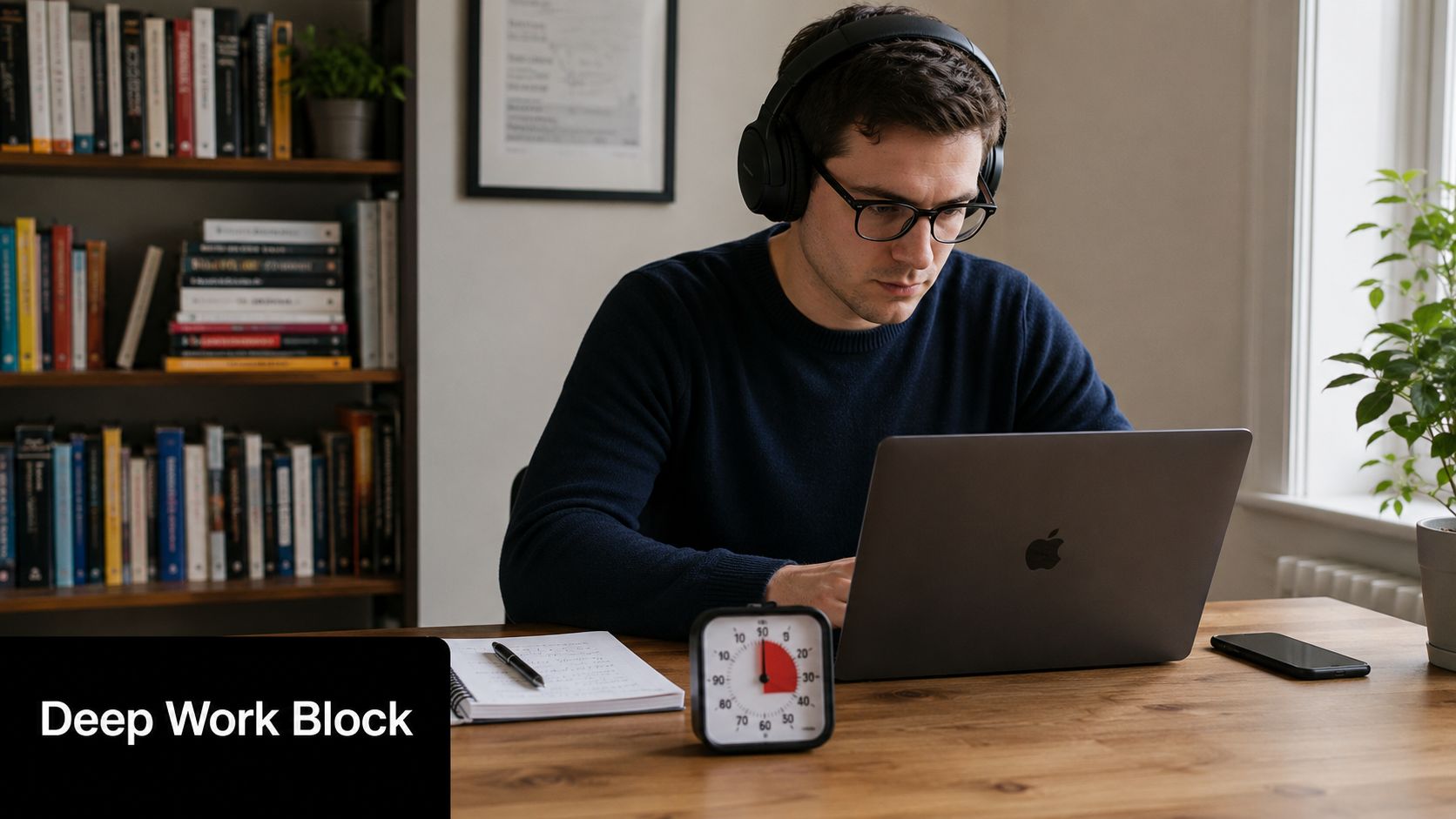
That's why deep work blocks remain one of the clearest examples of self discipline. You pre-commit a block of time to one cognitively demanding task and protect it from interruption. Engineers use these blocks for architecture or debugging. Writers use them for draft production. Students use them for active recall and problem-solving. Founders use them for fundraising, strategy, or difficult decisions.
Protect the hard work first
The mistake is scheduling deep work after your calendar is already full. By then, discipline has to fight uphill. Put the demanding block in place first, then let meetings fill the remaining space.
Recent commentary on discipline has become more realistic about this. Many people improve not by trying harder in the abstract, but by removing “discipline stealers,” reducing distractions, and building environments where the desired action becomes the default (discussion of environmental friction and self-trust). That's especially relevant when digital tools are designed to interrupt you all day.
For practical tactics on focused work design, overcoming work distractions offers a useful complement to time-boxing.
Habit templates
Difficulty level: Medium to Hard
Use a simple pattern:
- Choose one hard task: No admin, no inbox cleanup.
- Set the block: Start with a length you can protect.
- Remove friction: Phone away, chat muted, unnecessary tabs closed.
- Track output: Note what moved, not just that time passed.
What doesn't work is calling any uninterrupted time “deep work.” If the task is shallow, the block won't build real discipline. Use protected attention for the work that changes outcomes.
7. Progress Tracking and Visible Momentum Maintenance
People stay disciplined longer when progress is visible. Without visible movement, even good systems can feel pointless. That's why dashboards, streaks, graphs, and milestone boards matter. They turn abstract effort into something you can see.
This works in fitness, academics, business, and creative work. GitHub contribution graphs reward consistency. Sales pipelines show whether deals are moving. A Notion dashboard can make weekly milestone completion impossible to ignore. Language learners keep going because a streak tells them the habit is still alive.
Make momentum visible
The key is to track meaningful signals, not vanity metrics. A founder should care more about meaningful milestone completion than a perfectly color-coded workspace. A student should care more about practice completed and errors corrected than hours “spent with the book open.”
One weight-loss self-monitoring study illustrates the point well. In the “Well-Disciplined” group, participants maintained high adherence to self-monitoring, with adherence ranging from 66% to 98%, and three participants lost 12% to 13% of their initial body weight during the first six months. They maintained that loss through the final maintenance period, unlike lower-adherence groups (long-term self-monitoring case study on sustained weight loss).
For digital systems built around this idea, progress tracking software for goals and milestones shows how visible progress can support consistency.
Habit templates
Difficulty level: Easy
Use one visible tracker per major goal:
- Founder: Milestones completed this week and stalled items.
- Professional: Project deliverables shipped and next dependencies.
- Student: Practice sessions completed, weak topics remaining, assignment status.
What doesn't work is tracking too many metrics. Momentum should clarify action, not bury it. One dashboard you check beats five dashboards you ignore.
8. Regular Review and Reflection Rituals
Some people work hard for months on systems that no longer fit. They're being disciplined, but not intelligently. Reflection prevents that trap.
A review ritual creates a pause where effort turns into learning. Weekly reviews catch short-term drift. Monthly or quarterly reviews catch bigger problems, like a goal that no longer matters or a routine that keeps failing under the same conditions.
Reflection makes discipline adaptive
Self-discipline shouldn't become rigid self-punishment. One of the most important long-term findings in this area comes from the Dunedin cohort. Reported in American Scientist, childhood self-control was associated by midlife with major differences in health, wealth, and crime outcomes independent of intelligence and family background. Among participants in the bottom fifth of childhood self-control, 22% attempted or died by suicide by age 38 compared with 7% in the top fifth, 32% later fell below the poverty line compared with 10% in the top fifth, and 43% had criminal convictions compared with 13% in the top fifth. Among the 5% of the cohort who had been incarcerated, more than 80% came from the two lowest quintiles of childhood self-control (American Scientist on the lifelong impact of early self-control).
The lesson isn't “be harsher on yourself.” It's that self-regulation has real life consequences, so the system has to be good enough to keep working over time.
Review questions beat motivational speeches. What worked? What kept breaking? What should change next week?
Habit templates
Difficulty level: Easy to Medium
Use a simple review structure:
- What worked: Which routines or blocks helped?
- What didn't: Where did the system keep failing?
- What changes: What gets removed, reduced, or redesigned?
What doesn't work is using reviews to defend effort. If the system isn't producing consistent action, change the setup. Discipline gets stronger when reflection leads to adjustment.
8-Strategy Self-Discipline Comparison
| Practice | Implementation Complexity 🔄 | Resource Requirements ⚡ | Expected Outcomes ⭐📊 | Ideal Use Cases 📊 | Key Advantages 💡 |
|---|---|---|---|---|---|
| Daily Time Tracking and Planned-vs-Actual Analysis | 🔄 Moderate, daily logging + weekly review | ⚡ Low, simple apps, small time overhead | ⭐📊 High visibility into time use, improved estimates, leak identification | Consultants, developers, students, founders needing accuracy | 💡 Data-driven accountability, better future planning |
| OKR-Based Goal Setting with Sequenced Milestones | 🔄 High, upfront structuring and sequencing | ⚡ Medium, planning time, tooling, coordination | ⭐📊 Clear measurable progress, alignment, reduced decision fatigue | Teams, startups, long-term strategic projects, promotions | 💡 Breaks ambition into measurable, ordered steps |
| Routine and Habit Stacking Linked to Goals | 🔄 Medium, design and iteration over weeks | ⚡ Low–Medium, habit anchors, environment design | ⭐📊 Automated, sustained behaviors that advance goals | Habit formation, daily goal-linked tasks, fitness, creatives | 💡 Minimizes willpower by chaining habits to context |
| Morning Focus Priority Selection and Daily AI Critique | 🔄 Low–Medium, daily selection plus AI input | ⚡ Medium, AI tool access, habit of protected time | ⭐📊 Consistent high-leverage daily progress, less paralysis | Founders, product managers, writers, knowledge workers | 💡 Ensures single, strategic daily action; AI surfaces leverage |
| Accountability Systems with Pattern Intelligence & Personal AI Memory | 🔄 High, integration, ongoing data capture | ⚡ High, AI systems, data storage, privacy controls | ⭐📊 Continuous feedback, pattern insights, predictive recommendations | Individuals seeking deep habit change, founders, quantified-self users | 💡 Always-on, non-judgmental accountability and trend-based guidance |
| Resistance to Distraction Through Time-Boxed Deep Work Blocks | 🔄 Medium, scheduling and environment control | ⚡ Low–Medium, calendars, blockers, physical setup | ⭐📊 High-quality focused output and flow, measurable milestone progress | Engineers, writers, designers, anyone needing deep concentration | 💡 Protects focus, reduces context-switching, boosts work quality |
| Progress Tracking and Visible Momentum Maintenance | 🔄 Low–Medium, metric selection and dashboarding | ⚡ Medium, tracking tools, regular updates | ⭐📊 Tangible momentum, motivation, easier course correction | Fitness, OKRs, students, sales pipelines, project management | 💡 Reinforces effort with visible wins and trend insights |
| Regular Review and Reflection Rituals | 🔄 Low–Medium, scheduled, structured reviews | ⚡ Low, periodic time and simple templates | ⭐📊 Better learning, timely course correction, refined strategy | Weekly/quarterly planning, agile retrospectives, personal growth | 💡 Turns experience into actionable insights; prevents wasted effort |
Your Blueprint for Lasting Discipline
Self-discipline isn't a fixed trait that some people were born with and others missed. It behaves more like a trainable operating system. The more you reduce ambiguity, lower friction, and make feedback visible, the less you need to depend on mood.
That's why the best examples of self discipline don't look dramatic from the outside. They look ordinary. Someone tracks their time accurately. Someone chooses one real priority before opening email. Someone reviews progress every week instead of waiting for a crisis. Someone protects a deep work block and treats distraction as a design problem, not a moral failure.
The deeper shift is this: stop asking, “How do I force myself to be disciplined?” Start asking, “What system would make disciplined action easier to repeat?” That question leads to better solutions. It pushes you toward routines that fit your life, milestones that make progress visible, and environments that remove common failure points before they show up.
You also don't need all eight systems at once. In practice, that backfires. Too much structure becomes another form of procrastination. Pick one weak point and fix that first. If your days disappear, start with time tracking. If your goals feel vague, set OKRs with sequenced milestones. If you begin well and then drift, build a review ritual or a visible progress tracker. If your attention keeps breaking, protect one deep work block every day or every few days.
Over time, these systems reinforce each other. Clear goals make daily focus easier. Time tracking improves reviews. Reviews improve routines. Visible progress makes it easier to keep going. That's how discipline stops feeling like constant resistance and starts feeling like momentum.
Tools can help if they connect the full loop instead of solving only one piece. Beyond Time, from Tribble Software Private Limited, is one example of a system built around connected goals, milestones, routines, habits, time tracking, and AI-supported accountability. The point isn't to collect more productivity tools. It's to use a setup that turns intention into repeatable action.
Start small. Run one system for a week. Keep what works. Change what doesn't. That's what durable discipline looks like.
Keep going with Beyond Time
Beyond Time turns self-discipline into a repeatable system — here are the best places to dig in.
- Goal Prioritization Matrix — Rank what matters most before your week starts.
- Daily Routine Examples for High Performers — Real routines you can borrow and adapt.
- Habit Goal Connection — Why habits without goals quietly stall.
- 30 Day Challenge Generator — Build a custom 30-day discipline sprint today.
If you want one place to turn goals into milestones, track planned versus actual time, build routines, and get AI-supported daily guidance, explore Tribble Software Private Limited and see how Beyond Time fits your workflow.
Put this into practice
Free tools that match this article.
Goal Setting Worksheet
Turn a vague goal into milestones, habits, blockers, and a weekly review plan.
Try Goal WorksheetLearningAI Study Plan Generator
Generate a personalized study plan with proven learning techniques for exam success.
Try Study PlannerCareerCareer Roadmap Planner
Plan your career progression with AI-powered roadmaps, skill gap analysis, and actionable milestones.
Try Career PlannerTime ManagementWeekly Schedule Template
Plan your week with a free printable weekly schedule template for goals, routines, and focus blocks.
Try Schedule TemplateKeep exploring this topic
Goal setting guide
Start with the fundamentals of setting goals that turn into action.
Beyond Time for students
See how students connect semester goals, study blocks, and routines.
Beyond Time for professionals
Plan career goals, weekly execution, and focused work in one system.
Goal frameworks compared
Choose between SMART goals, OKRs, BHAGs, and 12-week goals.
Related Articles
AI Accountability Partner: Smarter Goal Setting
Tired of missed goals? An AI accountability partner provides the structure & feedback you need. Explore benefits, workflows, and tools.
The Force of Habit: Master Your Autopilot for Success
Learn what the force of habit is and how to use its power. This guide explains the neuroscience and gives you evidence-based strategies to build good habits.
How to Be Efficient and Productive: A 2026 System
Stop being busy and start being efficient and productive. Learn a practical, AI-enhanced system to set goals, track progress, and build unstoppable momentum.
8 Peer Feedback Examples: Drive Growth in 2026
Discover 8 peer feedback examples for positive, corrective, & developmental conversations. Drive results & build momentum with effective feedback in 2026.

Regain Focus and Clarity: A System for High Achievers
Stop feeling busy and start being effective. Learn a practical, evidence-backed system to build sustained focus and clarity for meaningful, measurable results.
The 2026 Daily Routine Checklist: 8 Core Systems
Tired of to-do lists? Build a daily routine checklist that drives results. Explore 8 core systems for goal alignment, AI-powered focus, and true accountability.