AI Accountability Partner: Smarter Goal Setting
Tired of missed goals? An AI accountability partner provides the structure & feedback you need. Explore benefits, workflows, and tools.
You already know the pattern. You set a serious goal, open three apps, write a decent plan, and still drift by noon. The problem usually isn't ambition. It's the gap between what you intend to do and the moments when distraction, avoidance, or low energy take over.
That's where an AI accountability partner becomes useful. Not as a motivational toy, and not as a chatbot you talk to when you feel guilty. The useful version is a system that turns goals into visible commitments, checks whether you followed through, and adjusts the next step before your day gets away from you.
Used well, it can make your workday feel less like a willpower contest and more like a guided operating system.
Table of Contents
- What Exactly Is an AI Accountability Partner
- Human Partners vs AI Partners A Direct Comparison
- Your Daily AI Accountability Workflow and Prompts
- An AI Partner in Action A Beyond Time Case Study
- How to Choose the Right AI Partner for You
- The Future of Personal Achievement Is Augmented
What Exactly Is an AI Accountability Partner
An AI accountability partner isn't just a reminder bot. The effective version combines three functions into one working loop: structured goal setting, progress tracking, and adaptive feedback.
That matters because individuals often fail at accountability in predictable ways. They keep goals vague, they review progress inconsistently, and they react emotionally instead of operationally when they fall behind. A good AI system fixes those three failure points by forcing clarity, keeping a running record, and turning “I should do better” into a specific next action.
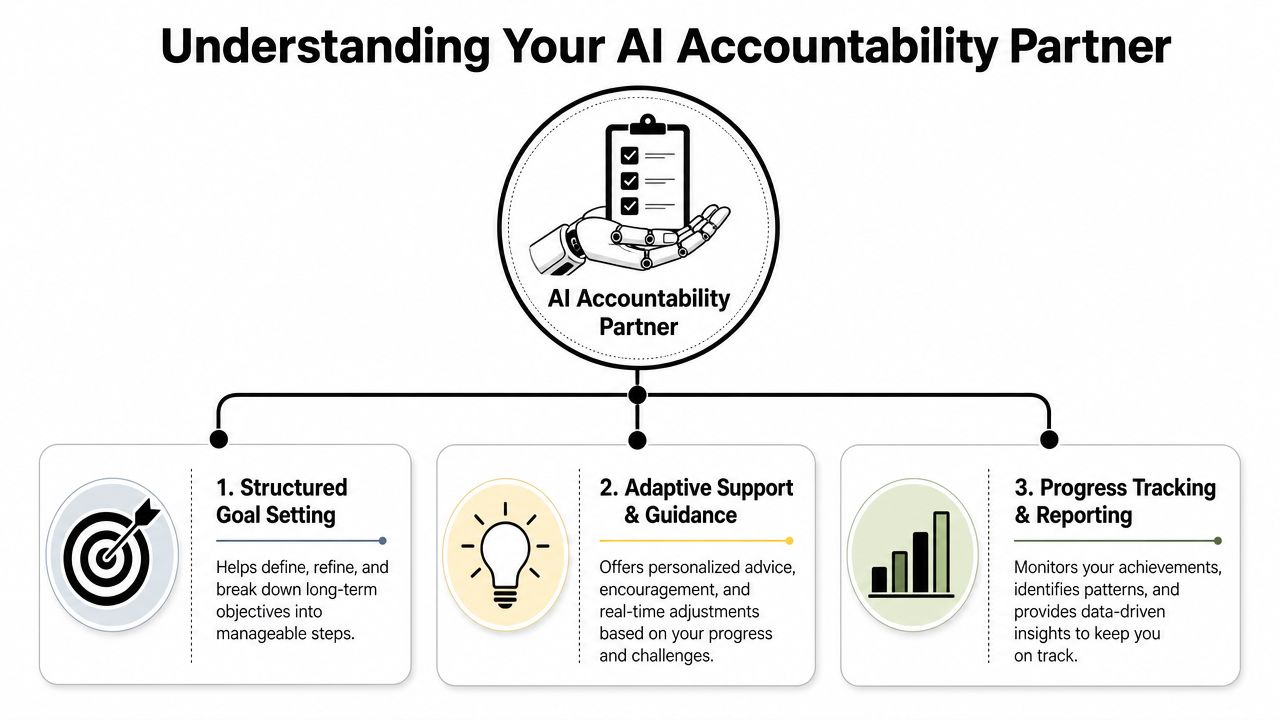
The three functions that actually matter
Structured goal setting
The AI helps turn a fuzzy objective into something trackable. “Get healthier” becomes “walk after lunch, prep meals on Sunday, and log workouts.” “Grow my startup” becomes “ship onboarding rewrite, contact partners, and review funnel blockers.”Progress tracking and reporting
Many tools struggle at this stage. Logging progress has to be easy enough that you'll do it. If the system asks too much of you, you'll stop using it. If it asks too little, it becomes decorative.Adaptive support
The AI should respond to your actual behavior, not an idealized version of you. If you keep postponing deep work until late afternoon, it should spot that pattern. If your plan is overloaded, it should challenge it.
The reason this works isn't mystical. It follows the logic of accountability research. In a study summarized by Accountablo's review of Dr. Gail Matthews' work, 267 participants were observed, and people who merely thought about goals achieved a 43% success rate, while those who wrote goals down, formed specific action commitments, and submitted weekly progress reports to an external person achieved 76%, a 33% increase in goal attainment. The useful takeaway is narrow and practical: writing, committing, and reporting beat private intention.
Practical rule: If your AI tool doesn't require you to define deliverables and report on them regularly, it isn't really doing accountability. It's doing encouragement.
This also explains why the best systems feel a bit demanding. They ask you to specify what “done” means. They ask what blocked you. They ask what happens next. That's the point.
You can see the same pattern in adjacent health tools. An AI body composition scale becomes useful not because it is “smart,” but because it creates a repeated measurement loop people can respond to. Accountability works the same way. Inputs become visible. Trends become hard to ignore.
For people who want a stronger self-review layer, this kind of system pairs well with a structured reflection practice like AI reflection prompts and routines. Reflection alone won't keep you on track, but reflection attached to commitments often will.
What doesn't count
A lot of tools market themselves as accountability products when they're really one of these:
- Reminder apps that send generic nudges
- Chatbots that answer questions but don't track commitments
- Habit streak tools that treat every goal like a checkbox
- Journals that help you process feelings but don't tighten execution
Useful accountability has some friction. You have to declare what you're doing, report whether it happened, and face the mismatch.
Human Partners vs AI Partners A Direct Comparison
A human accountability partner can be excellent. So can an AI one. They solve different problems, and individuals often get better results when they stop pretending the two are interchangeable in every situation.
Here's the direct comparison I use when evaluating systems.
| Attribute | Human Partner | AI Partner |
|---|---|---|
| Availability | Limited by schedules and time zones | Available anytime |
| Emotional support | Strong when the relationship is good | Limited and often shallow |
| Objectivity | Can be clouded by history or politeness | More consistent in tone and process |
| Follow-up consistency | Depends on the person's discipline | Usually reliable if configured well |
| Privacy comfort | Can feel awkward for sensitive goals | Often easier for private or embarrassing tasks |
| Adaptability at scale | Hard to maintain across many goals | Handles multiple projects well |
| Challenge quality | Can be sharp and nuanced | Strong on structure, weaker on emotional nuance |
| Friction to start | Requires coordination | Usually immediate |
Where AI matches humans
For structured objectives, AI is better than many people expect. A longitudinal randomized controlled trial summarized by Accountablo found no statistically significant difference in goal attainment between AI coaching and human coaching for structured objectives, with p > 0.05. The same summary notes that AI can effectively replace human coaches for process tracking, while lacking emotional complexity, empathy, and relational depth.
That lines up with what practitioners see in real workflows. If the task is concrete, the AI can do a lot:
- Break a goal into steps
- Ask for status updates
- Flag missed commitments
- Keep records without forgetting context
- Push you back toward the next actionable item
For things like writing sprints, study plans, lead follow-up, exercise consistency, and project execution, that's often enough.
Where humans still win
Humans are better when the problem isn't just execution. They're better when shame, grief, fear, burnout, conflict, or identity are mixed into the goal. A strong human partner can hear hesitation in your voice, notice avoidance you haven't named, and challenge you in a way that lands emotionally.
AI doesn't really do that. It can simulate empathy, but simulation isn't the same as a relationship.
A human can say, “You keep calling this a productivity issue, but you sound scared of failing in public.” An AI usually won't reach that depth unless you steer it there, and even then it may miss the mark.
That's why hybrid setups work well. Use AI for daily process accountability. Use a human for higher-stakes conversations, emotional interpretation, and honest challenge.
The practical trade-off
If you need constant availability, low social friction, and fast check-ins, AI has an edge. If you need care, context, and emotional truth-telling, a person still matters more.
The mistake is choosing based on ideology. Choose based on failure mode.
- If you keep forgetting your plan, AI is often enough.
- If you keep lying to yourself about why you're stuck, a human may be essential.
- If your goal is ambitious and messy, combine both.
The strongest setups I've tested treat AI like the daily operator and a human like the strategic mirror.
Your Daily AI Accountability Workflow and Prompts
Many individuals experience poor outcomes from an AI accountability partner when they use it reactively. They check in when they're already off track. A better approach is to build the tool into the rhythm of the day.

The daily workflow that works best is simple: morning direction, midday correction, evening review. The exact app matters less than the cadence. What matters is that the AI has enough context to challenge vague plans and enough repetition to detect patterns.
Benchmarks from Focus Together show that users engaging with AI agents featuring real-time adaptation report 34% higher session completion rates compared to static reminder systems, with median focus duration increasing from 18 to 26 minutes when energy-level matching is active. That's the practical reason adaptive check-ins beat fixed reminders. Timing and tone matter.
Morning Kickstart
Start the day by deciding what counts.
A good morning check-in should identify one primary outcome, two secondary tasks, likely blockers, and the best work window based on your energy. Don't ask the AI to “motivate” you. Ask it to sharpen the plan.
Use prompts like these:
Priority prompt
“I have these goals today: finish client proposal, reply to investor emails, and work out. Help me choose the single highest-leverage task for the next three hours and explain why.”Calendar reality check
“Here's my schedule for today. Find where I'm overcommitted, tell me what to cut, and rewrite the day into a realistic plan.”Focus sprint setup
“I feel mentally scattered. Based on that, give me a low-friction first work block with one clear deliverable and a short start ritual.”
This is also where you should define what completion looks like. “Work on proposal” is weak. “Draft introduction and pricing section” is stronger.
Best practice: Ask the AI to convert every major task into a visible output. If there's no output, there's nothing to hold you accountable to.
Midday Momentum
Midday is where plans usually break. Meetings run long. Energy drops. You realize the morning estimate was wrong.
This is the moment to use the AI as a recalibration layer instead of a guilt machine.
Try prompts like:
Progress reset
“It's midday. I finished X, stalled on Y, and avoided Z. Diagnose what happened and give me a recovery plan for the rest of the day.”Blocker analysis
“I keep switching tabs instead of finishing this task. Ask me three questions to find the underlying blocker, then recommend the next step.”Energy-matched adjustment
“My energy is low but I still need to make progress. Redesign the next 90 minutes for low cognitive load without losing momentum.”
A strong AI system should also notice recurring behavior. If you always underestimate admin work, or repeatedly push deep work into low-energy hours, it should start recommending a different task order.
For people trying to build a stable rhythm, a checklist-based planning habit helps. A resource like a daily routine checklist for realistic execution can be particularly useful. The goal isn't perfection. The goal is consistency under real conditions.
After you've worked through a few cycles, this kind of walkthrough is worth watching for prompt ideas and check-in style:
Evening Review
Evening review is where improvement compounds, assuming you keep it short enough to sustain.
Don't write a diary entry. Run a debrief. Ask what was planned, what happened, what caused the gap, and what should change tomorrow.
Use prompts like:
Execution review “Compare what I planned with what I finished today. Show me where my estimates or priorities were off.”
Pattern spotting
“Based on my last few check-ins, what patterns do you see in when I procrastinate or lose focus?”Tomorrow setup
“Turn today's unfinished work into a realistic first block for tomorrow morning. Keep it small enough that I won't resist starting.”
The people who benefit most from an AI accountability partner don't use it for inspiration. They use it to reduce ambiguity, tighten feedback, and recover quickly after imperfect days.
An AI Partner in Action A Beyond Time Case Study
Abstract advice only goes so far. It helps more to see how an AI accountability system works when a person has a concrete objective and a messy week.
The Goal
Take a founder trying to launch a new onboarding flow for a startup product. The core objective isn't “improve onboarding.” That's too broad to drive action. The useful version becomes something like: define the objective, set measurable milestones, assign work blocks, and review whether time spent matched the original plan.
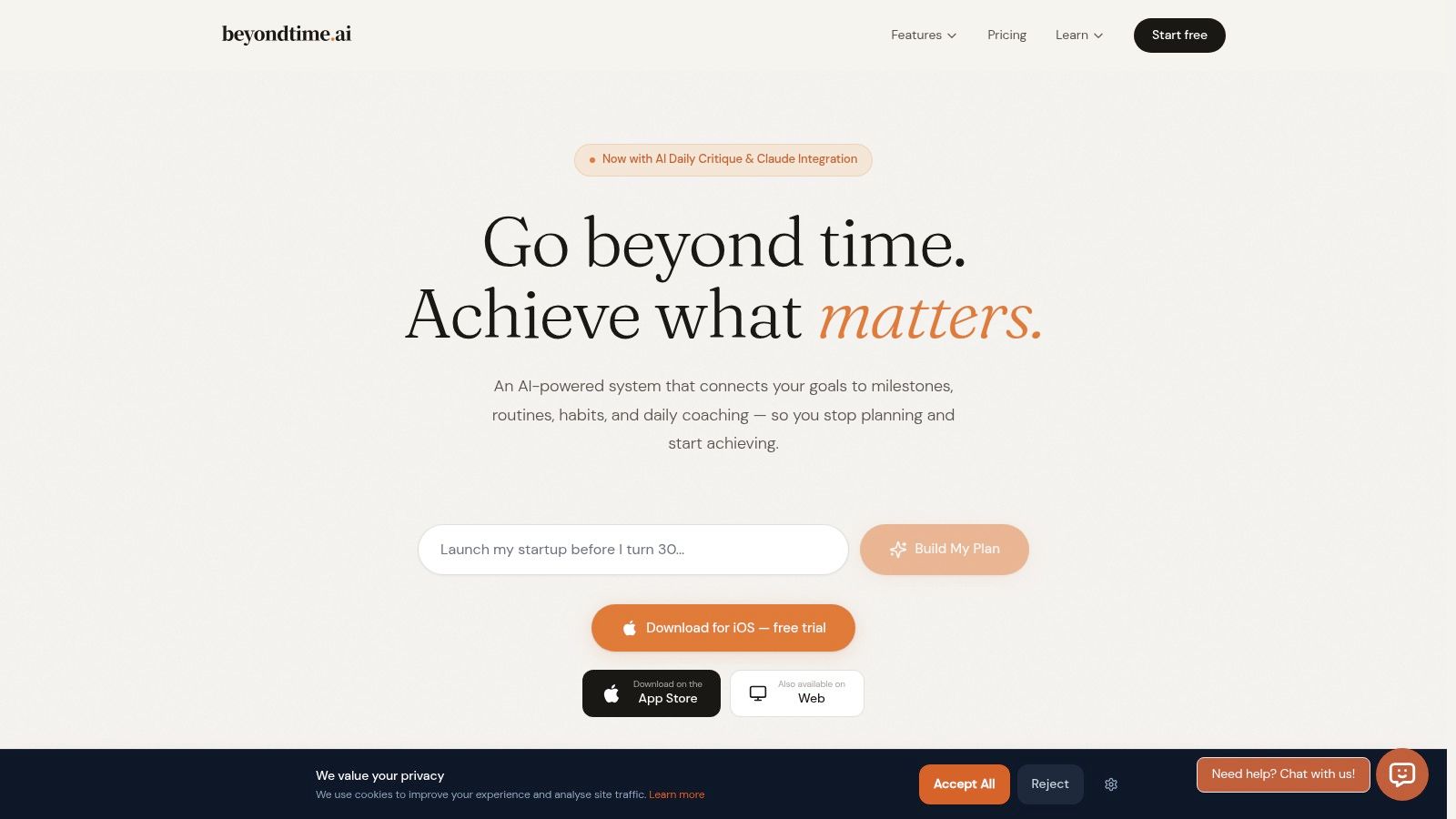
Beyond Time is a good example of the category done properly. It doesn't stop at chat. It connects goals, milestones, daily focus, and planned-vs-actual execution in one loop.
The founder starts by setting an OKR-style objective. Then the system breaks that objective into sequenced milestones. Instead of staring at a large project, the founder sees a next layer of work: review user drop-off notes, rewrite first-run copy, define handoff events, test the new path.
The Daily Loop
Each morning, the AI critique surfaces the single most impactful focus for the day. That matters because founders often don't have a planning problem. They have a prioritization problem. Everything feels urgent, so they jump between product, hiring, support, and sales.
A focused critique changes the day from “touch everything” to “finish the one move that enables the rest.”
Then comes the accountability layer. The iOS app's 15-minute planned-vs-actual time tracking forces a comparison between intention and reality. If the founder planned a block for onboarding copy but spent most of it in Slack or bug triage, the mismatch becomes visible. That's where the system earns its keep.
You don't need more self-awareness in the abstract. You need a record of where your time actually went and what that says about your priorities.
Over several days, the founder starts seeing patterns. Product strategy gets postponed when meetings stack too early. Deep work happens more reliably before communications work. “Quick checks” in chat often break concentration and expand.
That's what a real AI accountability partner should produce: not just encouragement, but pattern intelligence tied to action. The goal becomes a sequence. The sequence becomes a schedule. The schedule becomes behavior you can inspect.
Why this case matters
This kind of setup works because every layer reinforces the others:
- Goals create direction
- Milestones remove vagueness
- Daily critique narrows focus
- Time tracking reveals execution gaps
- Review loops improve the next plan
Many tools do one of these things. Far fewer connect them tightly enough to change daily behavior. When people say an AI partner “helped them get disciplined,” what usually happened is more mechanical. The system made drift visible sooner and made the next move easier to choose.
How to Choose the Right AI Partner for You
The best AI accountability partner depends less on features and more on the kind of risk attached to your goal. People often choose based on interface polish or prompt quality. That's not enough.
If your goal is ordinary productivity, almost any competent system can help. If your goal touches health, recovery, compulsive behavior, or another high-stakes domain, your standard should be much higher.
Start With Risk Level
For general work goals, a simple structure is often enough. You need clear commitments, recurring check-ins, and integrations with the tools you already use.
For high-stakes behavior change, shallow accountability can become misleading. A review from Find Recovery on AI accountability in recovery highlights an underserved need: nuanced integration between predictive relapse analytics and real-time mood or activity monitoring, which is critical for recognizing risk triggers. That's a different category of product requirement entirely.
In other words, if the consequences of failure are serious, you shouldn't settle for a generic productivity bot dressed up as support.
The Evaluation Questions That Matter
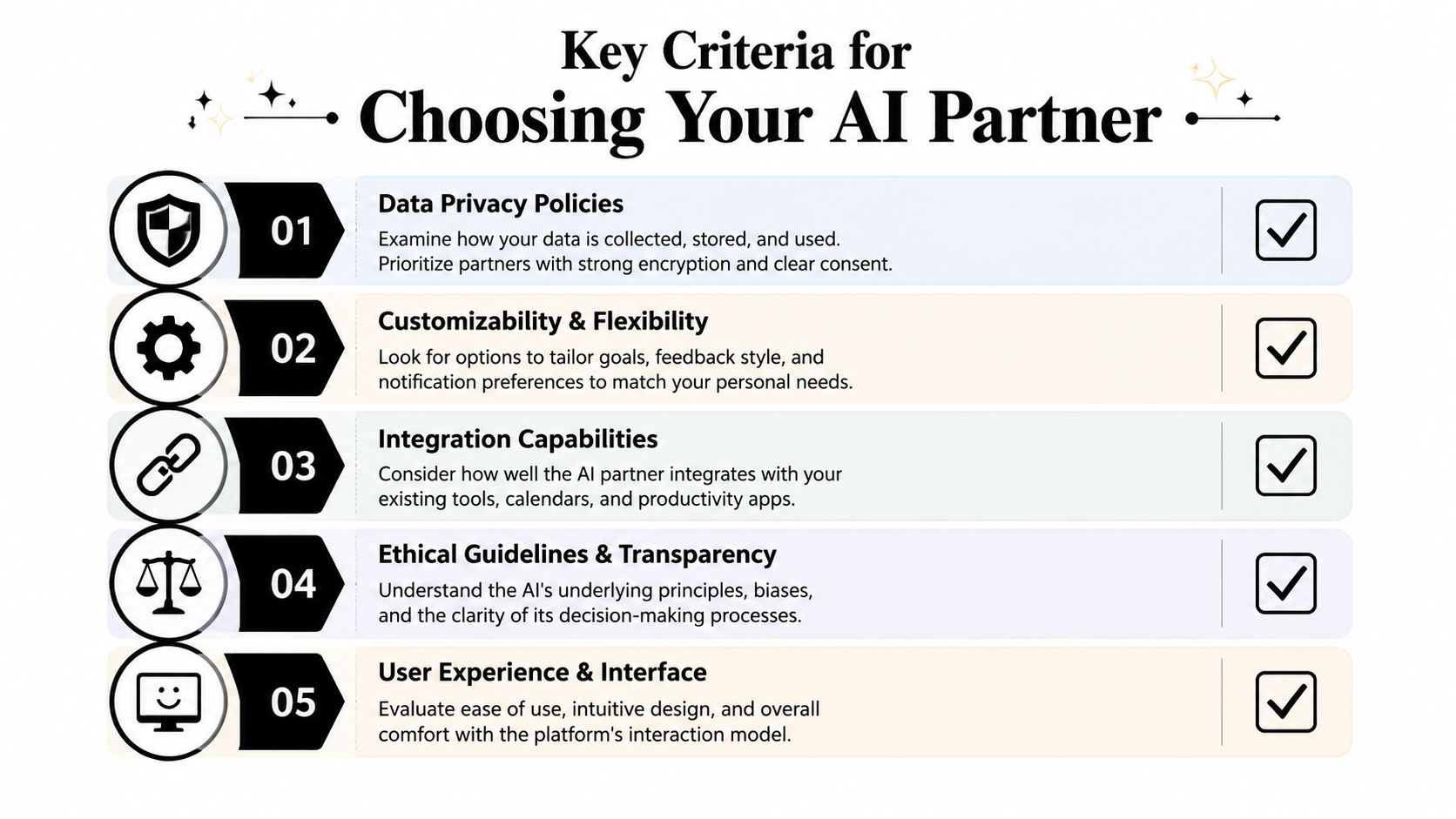
When I test tools in this category, I care about five questions.
How does it handle data?
Read the privacy language, not just the homepage claims. You're often feeding these tools your goals, routines, weak points, and sometimes emotional data.Does it fit your existing workflow?
If it requires a brand-new behavior stack, adoption usually drops. The most practical systems work inside tools you already use or make check-ins frictionless.Can it adapt to your patterns?
Static reminders wear out quickly. You want a system that changes prompts, timing, and recommendation style based on how you behave.Is it specialized enough for your use case?
Startup execution, exam prep, fitness adherence, and addiction recovery are not the same problem. Don't treat them as if they are.Does it explain its logic clearly enough that you trust it?
This is where many tools fail. If you want a sharp overview of why users hesitate, this breakdown of challenges to AI trust is useful because it frames trust as a design and transparency issue, not just a branding issue.
A polished interface can hide a weak accountability model. Judge the loop, not the landing page.
For a broader view of the category itself, it also helps to review different AI productivity tools for goal execution. The important thing is to compare them by accountability depth, not novelty.
What usually works best
For most professionals, the strongest option is a tool that does three things well:
- It captures commitments in plain language.
- It asks for progress in a way you'll actually answer.
- It turns missed follow-through into a revised plan, not a generic pep talk.
If a product can't do those three things, it may still be useful. It just isn't a strong accountability partner.
The Future of Personal Achievement Is Augmented
Personal achievement is moving away from heroic self-discipline and toward better systems. That doesn't mean effort matters less. It means effort works better when it has structure around it.
An AI accountability partner is most useful when it acts like a practical co-pilot. It helps define the next move, notices when your day drifts, and keeps a clean record of the gap between intention and action. That's more valuable than inspiration because it changes behavior in real time.
The broader shift is easy to miss. We're not replacing ambition, judgment, or human support. We're giving those things a tighter operating loop. Founders, students, creators, and operators already use AI to brainstorm and write. The bigger opportunity is to use it to stay aligned with the work that matters most.
If you follow the AI space closely, directories that find leading AI investors can be useful for seeing where serious attention is flowing across the ecosystem. But at the personal level, the important change is simpler: better tools now make follow-through easier to design.
The future isn't automated achievement. It's augmented follow-through.
If you want a practical system rather than another motivational app, Tribble Software Private Limited builds Beyond Time as an AI-powered goal achievement platform that connects objectives, milestones, routines, habits, time tracking, and daily coaching into one accountability loop. It's built for people who want their plans to survive contact with a real day.
Put this into practice
Free tools that match this article.
Goal Setting Worksheet
Turn a vague goal into milestones, habits, blockers, and a weekly review plan.
Try Goal WorksheetGoal SettingSMART Goal Validator
Instantly validate your goals against the SMART framework and get actionable improvement suggestions.
Try SMART ValidatorGoal SettingAI Milestone Generator
Turn your biggest goals into an actionable step-by-step plan in seconds with AI.
Try Milestone GeneratorGoal SettingOKR Generator
Transform any aspiration into a structured OKR with measurable key results in seconds.
Try OKR GeneratorKeep exploring this topic
Goal setting guide
Start with the fundamentals of setting goals that turn into action.
Goal frameworks compared
Choose between SMART goals, OKRs, BHAGs, and 12-week goals.
Best goal tracking apps
Compare tools for goals, habits, and progress tracking.
Best habit tracker apps
Compare habit apps by use case, depth, and daily workflow.
Related Articles
Productivity Tracking Software: Your Complete 2026 Guide
Discover what productivity tracking software is, how to choose the right tool, and how to use it to achieve real goals. A complete guide for 2026.
Progress Tracking Software: A Guide to Achieving Your Goals
Discover how progress tracking software can turn your goals into achievements. This guide covers features, use cases, and how to choose the right tool for you.
The Force of Habit: Master Your Autopilot for Success
Learn what the force of habit is and how to use its power. This guide explains the neuroscience and gives you evidence-based strategies to build good habits.
How to Be Efficient and Productive: A 2026 System
Stop being busy and start being efficient and productive. Learn a practical, AI-enhanced system to set goals, track progress, and build unstoppable momentum.
Goal Planning Tools: Achieve Your 2026 Targets
Discover the best goal planning tools for founders, teams, & individuals. Our 2026 review covers OKR, habit trackers, & AI systems to hit targets.
10 Best Productivity Apps for Mac in 2026
Discover the 10 best productivity apps for Mac in 2026. Our curated list covers task managers, focus tools, and automation to boost your workflow.