Goal Planning Tools: Achieve Your 2026 Targets
Discover the best goal planning tools for founders, teams, & individuals. Our 2026 review covers OKR, habit trackers, & AI systems to hit targets.
You probably already know the feeling. A quarter starts with a clean set of ambitions, a fresh document, maybe a few sticky notes, and a burst of motivation. Then the demanding week arrives. Meetings take over, priorities collide, and the goal system you meant to use becomes another thing to maintain.
That's why goal planning tools matter only when they reduce friction between intention and execution. The best ones don't just hold goals. They create a working rhythm. They tell you what to review, what to own, and what to do next. That distinction matters because in the 2026 OKR Benchmark Report across 330 organizations, teams using automated weekly check-ins completed 43% more OKRs, and organizations requiring single ownership saw 26% higher completion. In practice, that means cadence and accountability beat inspiration.
The market is crowded because the need is real. The broader productivity apps market is valued at USD 14.46 billion in 2026 and projected to reach USD 30.85 billion by 2034, while the AI-driven productivity tools segment is projected to grow faster, according to Fortune Business Insights on productivity apps. But the useful split isn't “best overall.” It's workflow fit. Some tools are built for personal achievement, some for SMB alignment, and some for enterprise OKR governance.
This list is organized with that reality in mind. If you want a simple habit tracker, you shouldn't buy an enterprise OKR suite. If you run a company with layered reporting, a personal productivity app won't save you. The right choice depends on how goals move through your week.
Table of Contents
- 1. Beyond Time by Tribble Software
- 2. Microsoft Viva Goals
- 3. Quantive Results
- 4. Perdoo
- 5. WorkBoard
- 6. Weekdone
- 7. ClickUp Goals
- 8. Asana Goals
- 9. Tability
- 10. Strides
- Top 10 Goal Planning Tools Comparison
- Final Thoughts
1. Beyond Time by Tribble Software
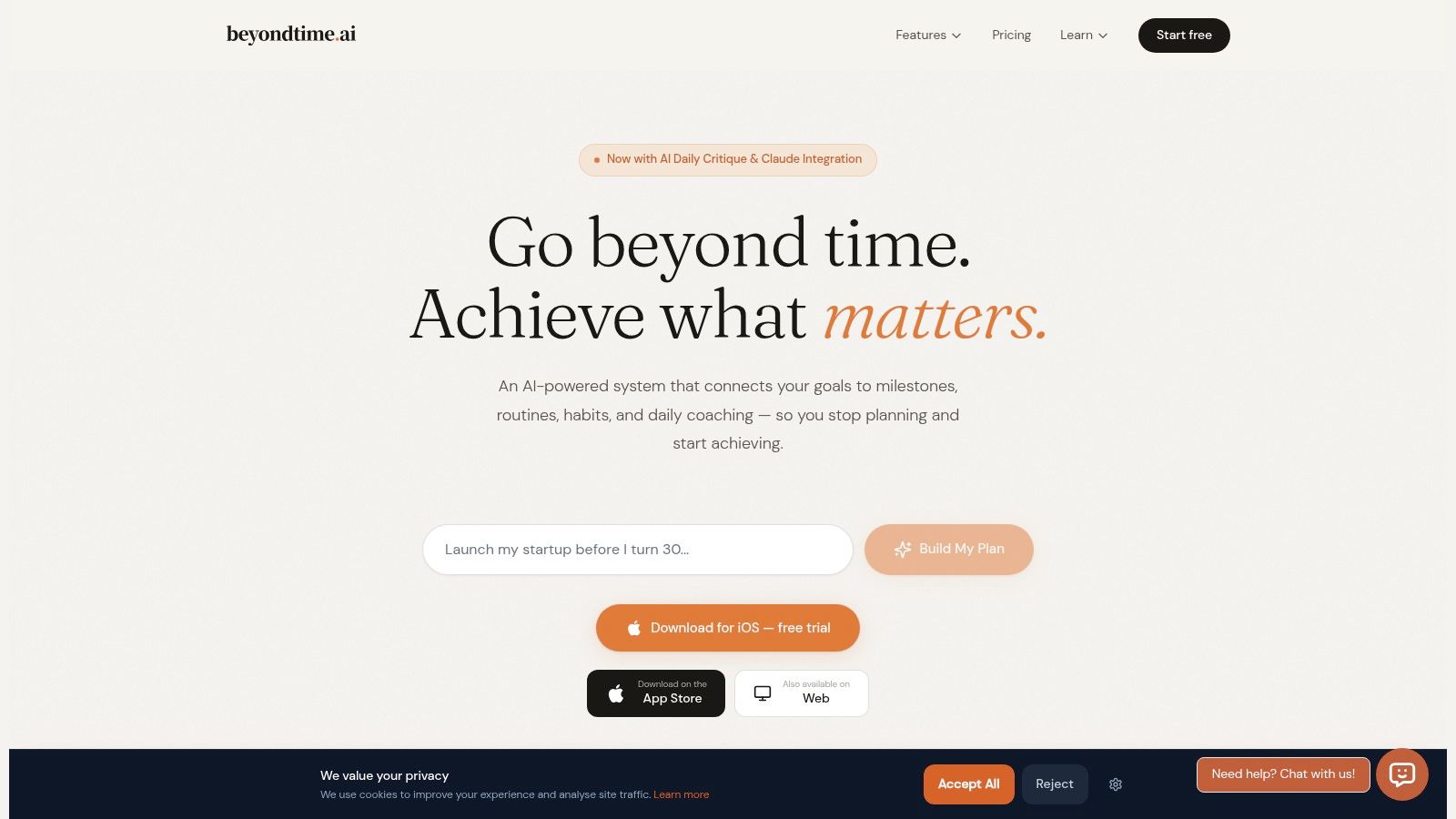
Monday morning usually looks the same. The quarterly goal is clear, the project board is full, and by Tuesday afternoon the day has been consumed by messages, meetings, and reactive work. Beyond Time is built for that gap between intention and actual behavior.
What makes it different is its workflow. It starts with goals and milestones, then pushes downward into routines, habits, and tracked time. In practice, that makes it less like a static planning tool and more like a personal execution system for people who need their priorities to survive a normal workday.
The web app covers goal and milestone management at no cost. The iOS app adds the harder part to fake. You can log time in 15-minute blocks, compare planned time against actual time use, and get a daily AI critique that surfaces the highest-impact task. For readers comparing workflow types across this list, Beyond Time sits closest to personal achievement and self-managed execution, not enterprise OKR governance.
Why it stands out
A lot of tools in this category are good at setting direction. Fewer are good at keeping that direction visible once the week gets messy. Beyond Time closes that loop by tying roadmap creation to recurring routines and daily review. If you are weighing different goal-setting frameworks for execution-focused planning, that distinction is usually the deciding factor.
Practical rule: If a tool cannot connect weekly priorities to calendar reality or time use, it remains a planning layer rather than an execution system.
Beyond Time also sends goals into Claude, ChatGPT, Cursor, Windsurf, and other MCP-compatible tools. That becomes useful quickly for founders, builders, and solo operators who already do a meaningful share of their work inside those environments. Keeping goals available where work takes place reduces context switching and lowers the odds that priorities drift out of sight.
Where it fits best
This is a strong fit for founders, operators, students, creators, and other self-directed professionals. It works best for people who want one system to plan outcomes, shape daily behavior, and review whether their time matched their priorities.
The trade-off is clear. Teams that need procurement-ready controls, formal admin layers, and cross-department OKR rollups will outgrow it. This is not the strongest choice for enterprise alignment. It is a stronger choice for individual execution and small-team accountability, which gives this list an important contrast with the heavier OKR platforms that follow.
A few limitations are worth stating plainly. The free web tier is useful, but the full experience lives in the paid iOS product. The time tracking, daily critique, expanded context, and stronger AI model access are part of that paid layer. Public social proof on the site is still fairly limited, so the best evaluation method is product fit in your own workflow, not logo count.
Here's the practical summary:
- Best strength: Connects goals to routines, habits, and time tracking so follow-through is visible.
- Best for: People who want a personal execution system, not just a place to record goals.
- Main caution: If you do not want mobile-centered tracking or AI coaching, its biggest advantages may go unused.
2. Microsoft Viva Goals
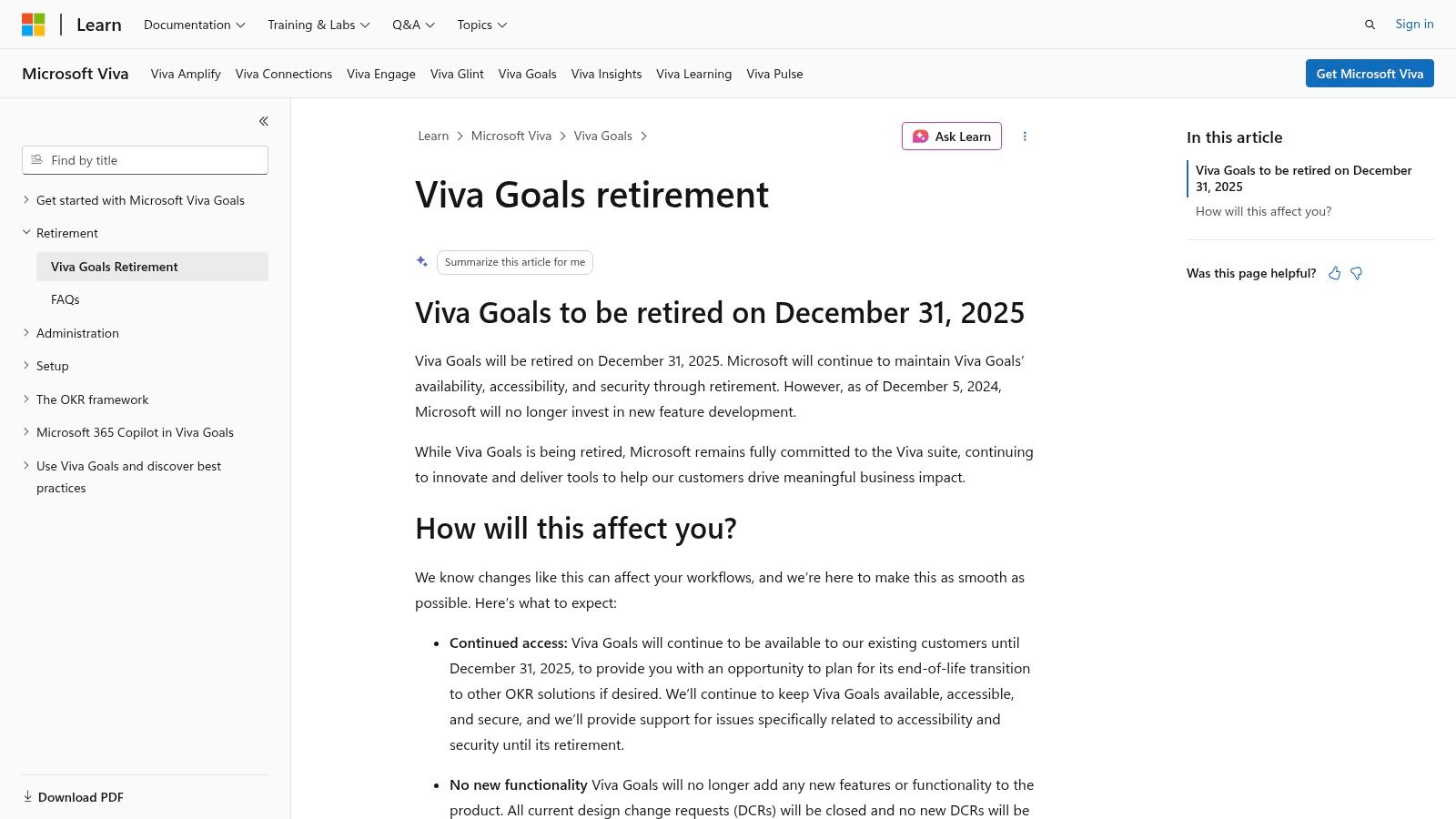
Microsoft Viva Goals makes the most sense when your company already lives inside Microsoft 365 and Teams. In that setting, the product's biggest advantage isn't novelty. It's reduced resistance. Goals show up where people already communicate, review work, and check status.
That matters because OKR programs usually fail at the workflow level, not the theory level. Teams agree on goals, then forget to revisit them. A tool inside Teams has a better shot at becoming part of the operating rhythm than a separate platform employees only remember during quarterly reviews.
Best for Microsoft-first organizations
Viva Goals is built for organizations that want standardized OKR processes, alignment views, and automated progress updates connected to existing systems such as Jira, Tableau, and Zendesk. The portfolio and dashboard layer helps leadership see roll-ups across company, team, and individual levels without inventing a new reporting ritual.
The trade-off is weight. If you're a smaller company without a strong Microsoft footprint, it can feel like a lot of platform for a lightweight need. But for enterprises that want fewer tools and clearer adoption paths, that's exactly the point.
When goals run inside the software people already open every morning, you remove one of the biggest adoption barriers.
Published SKU pricing is also helpful. Many enterprise tools hide behind demos and custom quotes, which slows early evaluation. You can explore it through Microsoft Viva Goals.
3. Quantive Results
Quantive Results is for companies that don't want OKRs to be a presentation layer. They want goals tied to live business data, detailed reporting, and a more serious analytics model. That usually means scale-ups, larger SaaS businesses, and enterprises with multiple teams feeding progress from several systems.
Its strength is the data spine. Insights, custom reports, connectors, and bulk change tools make it viable for organizations where manual updates become unworkable. If you've ever seen a team abandon OKRs because updating them felt like duplicate admin, you'll understand why this matters.
Best for data-heavy OKR programs
Quantive is strongest when a company already has decent metric hygiene. It's not the best first OKR tool for an early startup that hasn't agreed on what should be measured. It is strong when leaders want key results tied directly to operational systems rather than narrative check-ins alone.
For teams comparing frameworks before buying software, this quick guide to goal setting frameworks that actually map to execution is a useful companion.
One caution: advanced tooling doesn't replace ownership. Earlier, I mentioned that structured cadence and clear ownership drive completion. Quantive can support that discipline well, but it won't create it for you. You still need a real operating model.
The product itself is here: Quantive Results.
4. Perdoo
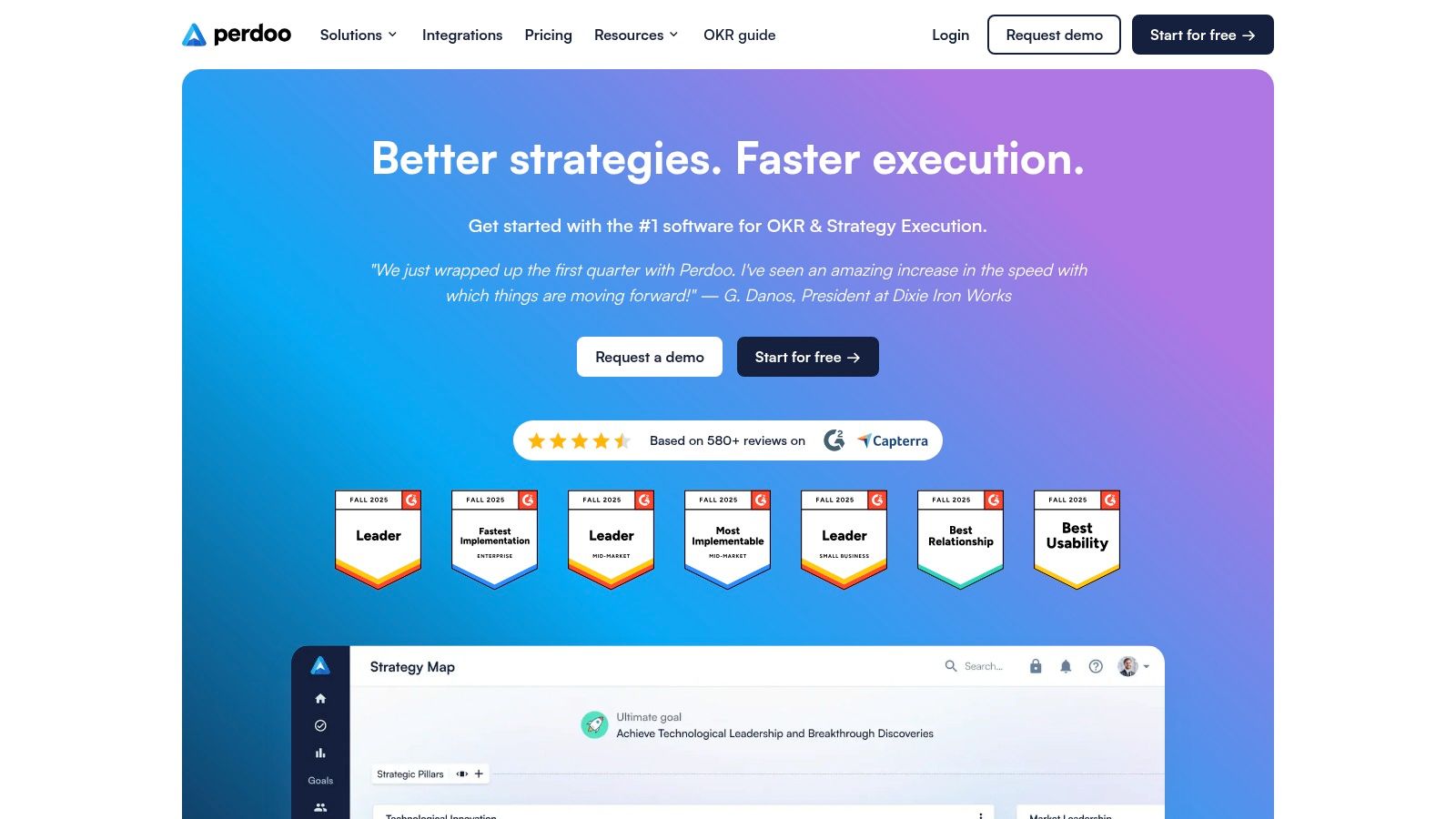
Perdoo has a practical middle-market appeal because it doesn't force a false choice between OKRs and KPIs. Many SMBs need both. They need strategic objectives that push change and health metrics that show whether the business is staying stable while that change happens.
Its Strategy Map is the feature I'd pay attention to first. Teams often understand their own targets but not how those targets connect to company direction. Perdoo makes that alignment visible quickly, which helps onboarding and reduces the usual “why is this our priority?” friction.
Best for SMBs that need strategy visible
Perdoo works well for companies that want guided rollout instead of building an OKR process from scratch. Templates, coaching support, and setup guidance make it friendlier than many enterprise-first platforms. That's useful if you have a lean ops team and can't spend months designing the perfect planning system.
A related lens is how you'll track progress after rollout. If you're evaluating specialist tools, this overview of OKR tracking software for ongoing visibility is worth a look.
Perdoo's trade-off is straightforward. It's polished and strategically clear, but some advanced coaching support can cost extra, and larger rollouts may involve annual commitments. Visit Perdoo if your company needs structured alignment without enterprise-level complexity.
5. WorkBoard
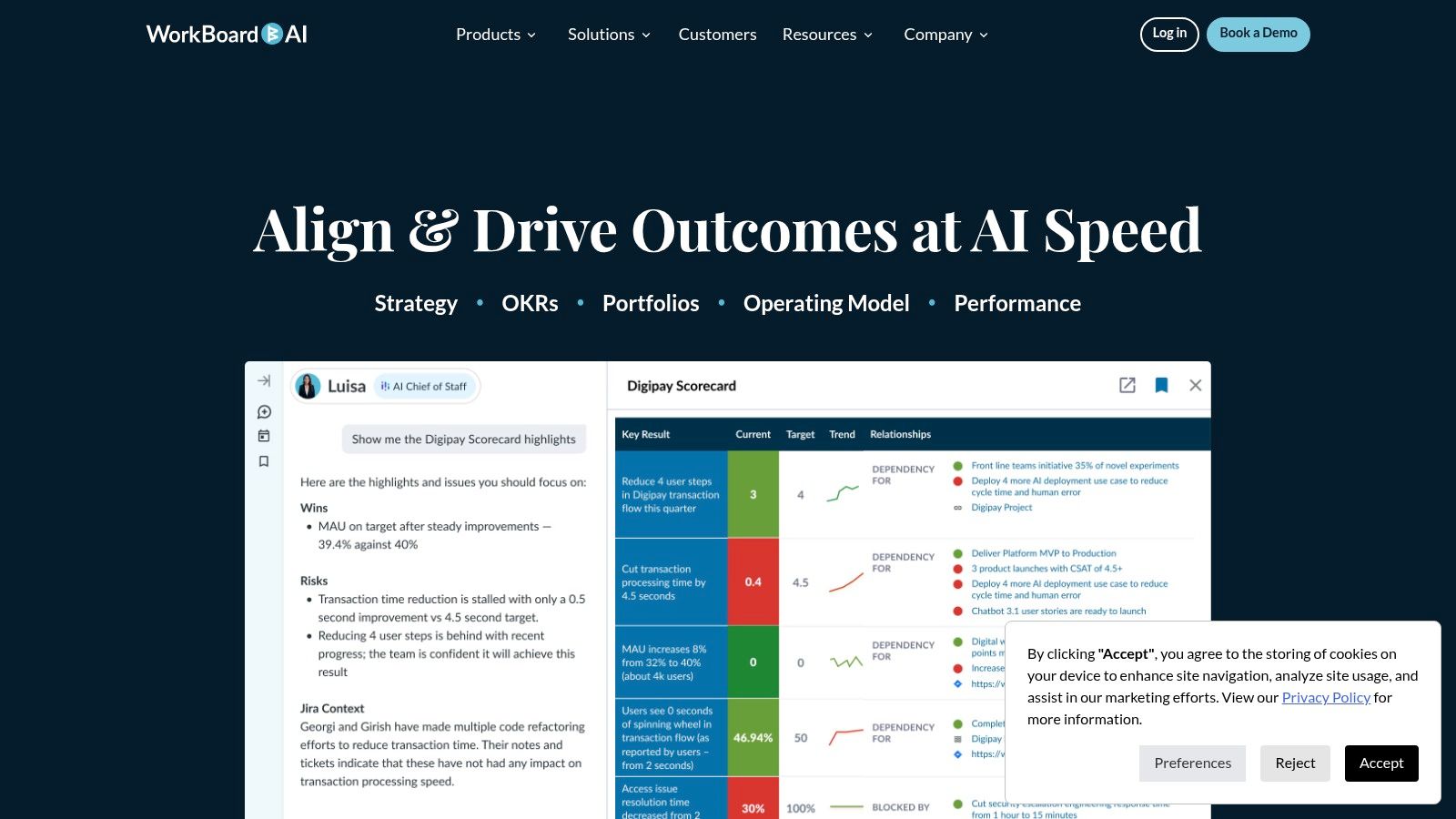
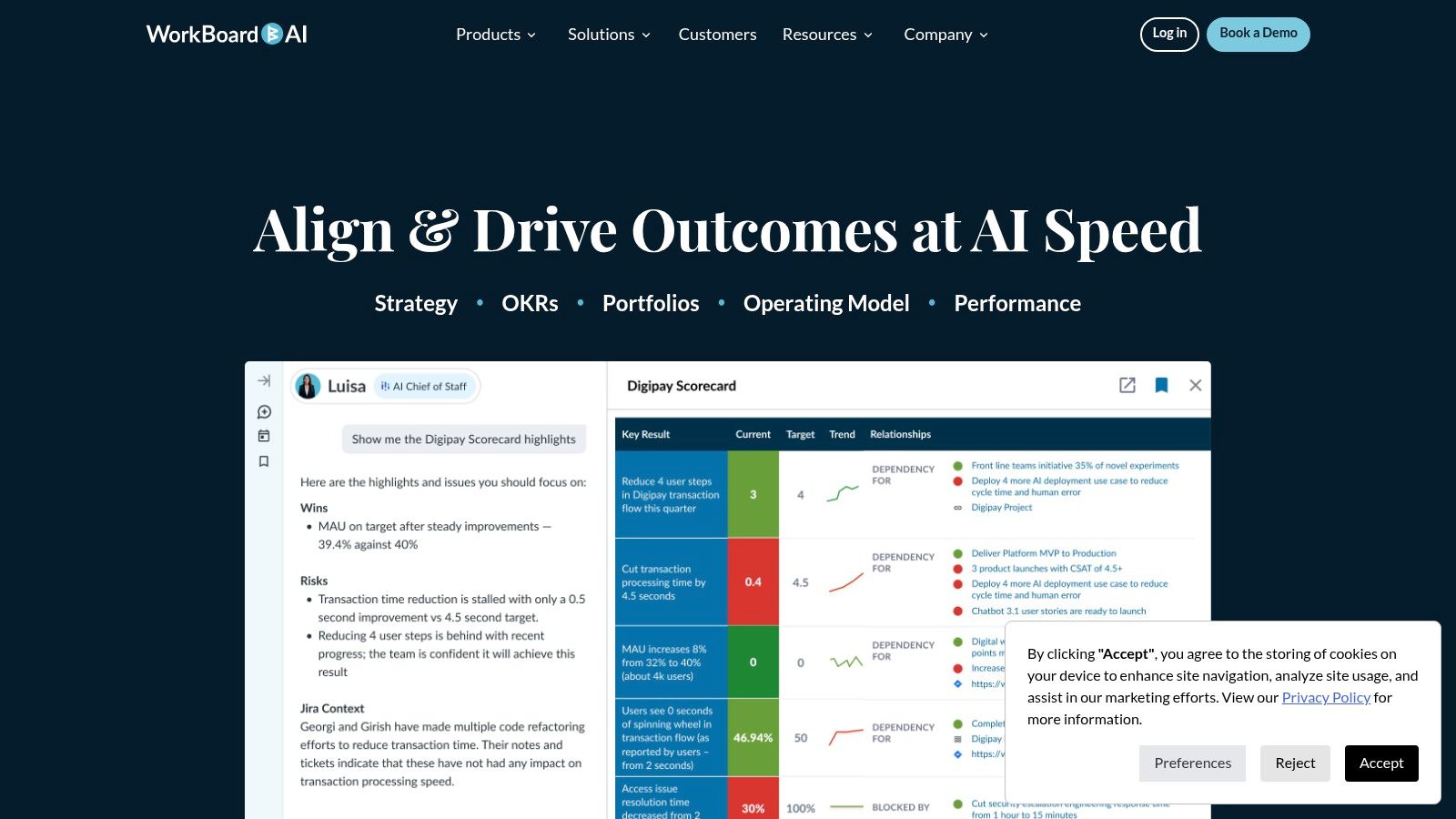
WorkBoard is built for organizations that treat goal execution as a management system, not a side feature. You see that in the emphasis on scorecards, portfolios, executive dashboards, and meeting cadence support. This isn't mainly about helping individuals stay motivated. It's about helping large organizations run quarter after quarter with consistency.
That distinction matters for senior teams. Executive goal reviews break down when each business unit reports in a different way. WorkBoard is designed to normalize that process and give leadership one place to review outcomes.
Best for executive operating cadence
If your company needs governance, structured roll-ups, and a clear portfolio view, WorkBoard belongs on the shortlist. It's especially relevant when strategy execution spans many teams, regions, or programs.
There is also a broader proof point behind this category. Mooncamp's OKR statistics overview notes that 83% of companies report a positive organizational impact from using the OKR framework. That doesn't mean every company needs an enterprise platform, but it does support the idea that a disciplined OKR system can produce real operating value.
- Use WorkBoard when: Leadership wants formal quarterly business reviews and consistent reporting.
- Skip it when: You need a lightweight team tool with minimal rollout effort.
- Expect: A more involved implementation than simpler SMB tools.
You can evaluate it at WorkBoard.
6. Weekdone
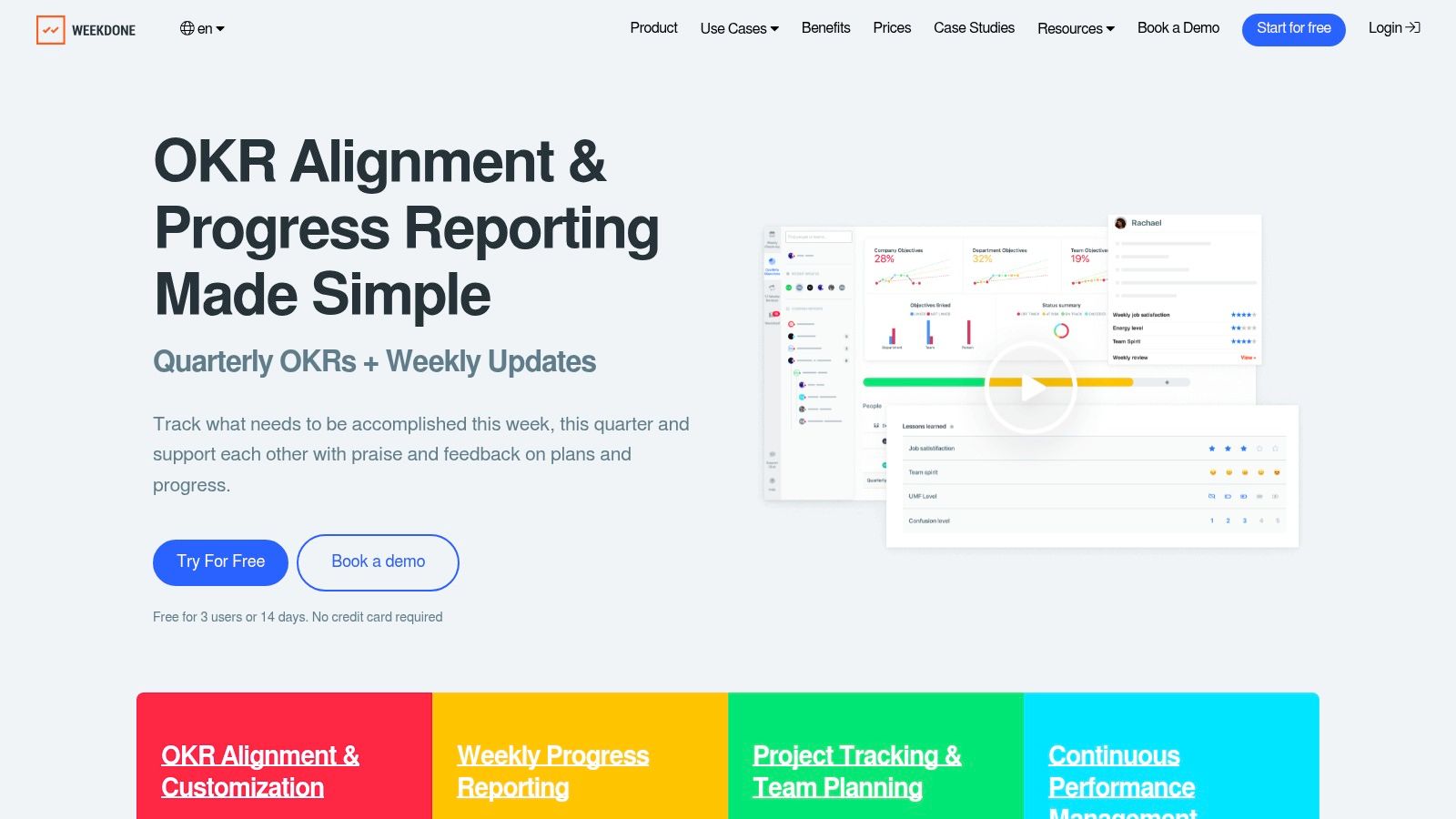
Weekdone is one of the better options for teams that are new to OKRs and don't want to buy a heavy platform before they've built a habit. Its core appeal is simple: quarterly goals stay connected to weekly planning through PPP check-ins, status reports, and a visible alignment tree.
That weekly rhythm is more important than many buyers think. Most OKR systems gradually fail when people only look at them in monthly or quarterly review settings. Weekdone keeps goals alive by giving teams a recurring way to log plans, progress, and problems.
Best for teams new to OKRs
The interface and educational resources lower the barrier to entry. I'd recommend Weekdone to SMBs, department leads, or startup teams that want enough structure to stay honest without turning goal management into an operations project.
It does have limits. Analytics aren't as deep as enterprise suites, and the integration layer is lighter than what larger organizations may want. But simplicity is exactly why it works for many teams.
A weekly check-in habit usually beats a sophisticated dashboard that no one updates.
Weekdone is available at Weekdone.
7. ClickUp Goals
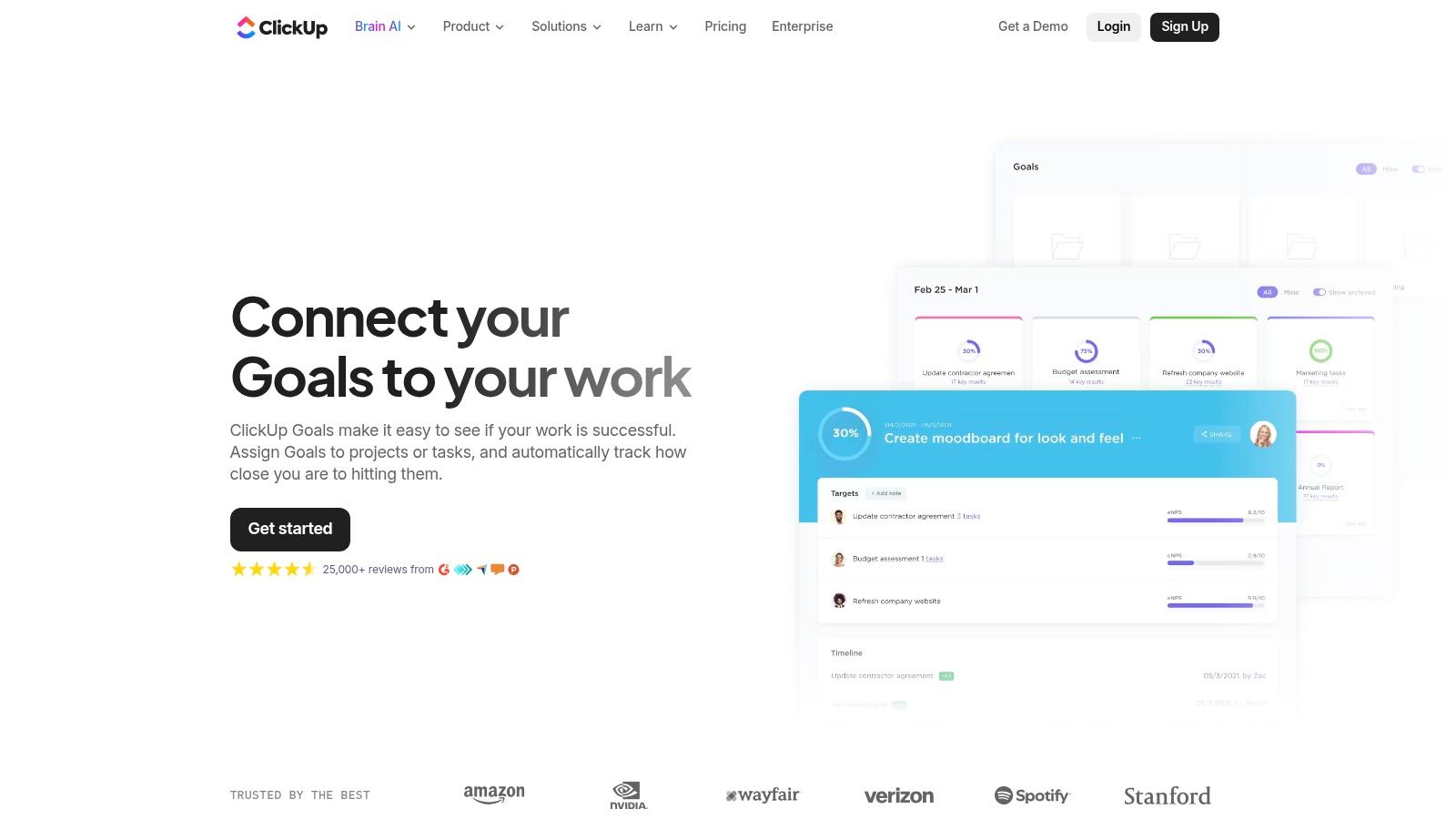
ClickUp Goals is a sensible choice when your team already uses ClickUp as its work OS and wants goals to inherit progress from tasks, sprints, and dashboards. In that setup, a separate OKR tool can create duplicate work. ClickUp avoids that by keeping goals close to execution.
Its strongest feature is automatic progress from linked work. That's practical, not flashy. Teams don't have to remember to update every key result manually if the underlying task system already reflects movement.
Best for task-driven teams
ClickUp is best for teams whose work is already task-centric and operationally detailed. Product teams, marketing teams, agencies, and cross-functional delivery groups often fit that profile. Goal folders and target types give enough structure for many internal planning cycles.
The trade-off is product breadth. ClickUp can feel heavy if all you want is a clean OKR layer. Some goal-related capabilities and limits also depend on your plan tier, so it's worth checking before a broader rollout.
If you're deciding between these two work-management ecosystems, this WeekBlast versus ClickUp review offers a useful outside comparison. For the product itself, start with ClickUp Goals.
8. Asana Goals
Asana Goals works best when the company already runs core work in Asana. That sounds obvious, but it's the whole decision. If projects, tasks, and cross-functional workflows already live there, adding goals inside the same system cuts context switching and improves the odds that progress stays current.
The product is strongest for organizations that want company, team, and individual goals linked directly to projects. Progress updates can flow from the work itself, which removes a lot of manual overhead.
Best for teams already running work in Asana
Asana's approach is cleaner than many dedicated OKR platforms for teams that don't need enterprise-level governance. It gives enough hierarchy to support OKR-style planning without forcing teams into a separate application and review ritual.
The limitation is familiar. More advanced capabilities tend to sit in higher tiers, and some organizations will still outgrow the reporting depth if they want a full executive OKR command center. For many mid-sized teams, though, that trade is acceptable because the adoption burden is lower.
One practical point stands out from the product adoption lens referenced earlier in the article: a goal tool only works if users move from sign-up to regular engagement. Embedding goals in an already-used platform often improves that transition.
You can explore the feature set at Asana Goals.
9. Tability
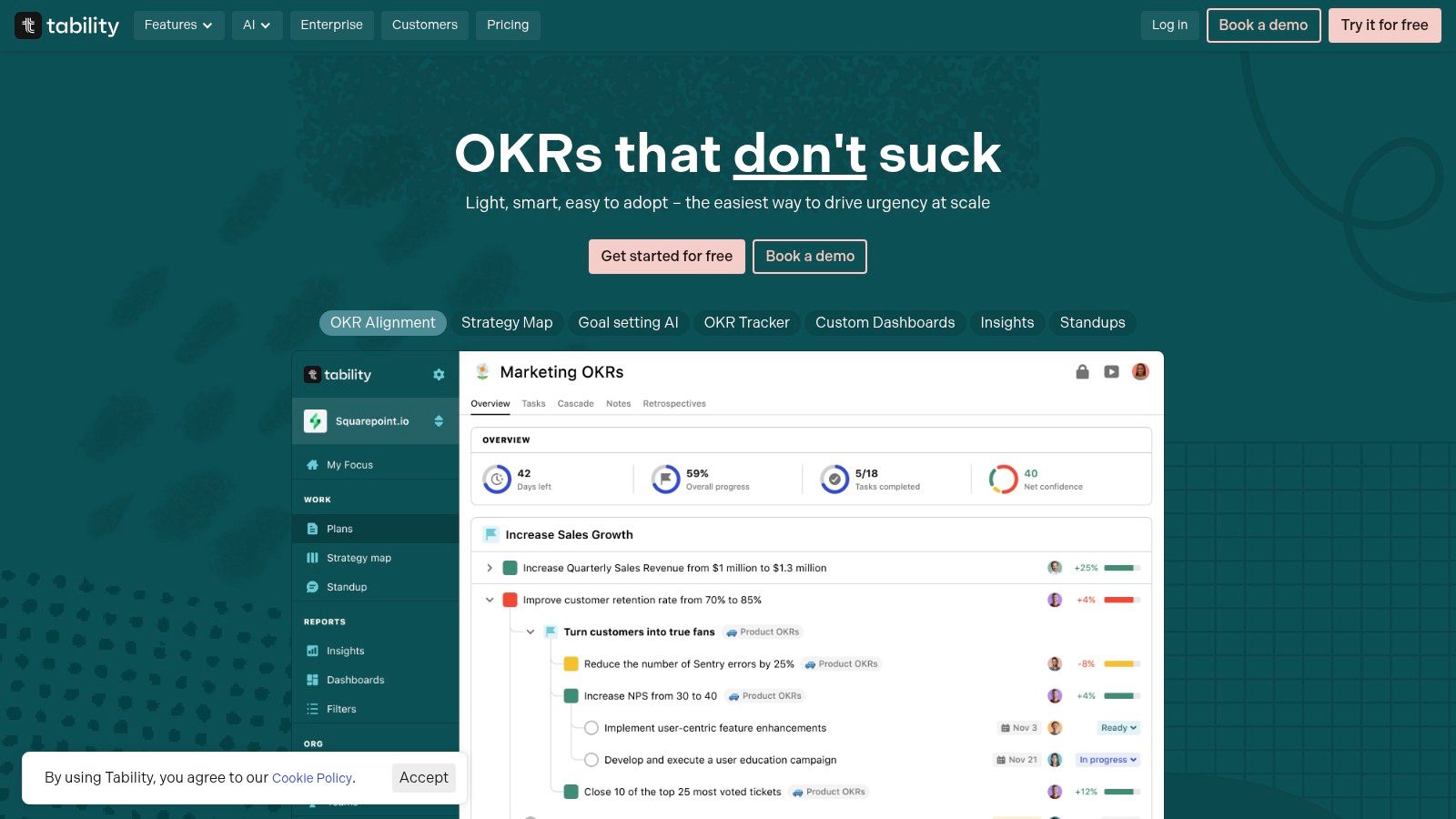
Tability is the lean choice for teams that want outcome tracking without enterprise ceremony. It's approachable, lighter than many OKR platforms, and easier to adopt for startups or small teams that want weekly discipline without a heavy admin burden.
That low-friction feel matters. A lot of founders say they want rigor, but what they can maintain is a simple weekly check-in and a clear view of outcomes. Tability fits that operating reality better than software built for enterprise PMOs.
Best for lean startup execution
The product mixes strategy mapping, task links, async standups, retrospectives, and report-ready views in a way that supports small-team cadence well. Slack integration also helps, because check-ins are easier to maintain when they show up inside existing communication flow.
Its trade-offs are fair. You won't get the same depth of analytics or connector breadth as larger platforms, and complex project execution may still belong in another system. But that's often the right compromise for a startup trying to keep planning lightweight.
There's also an important gap in the broader category that tools like Tability only partially solve. A systematic review in Frontiers on collaborative goal planning found no identified standardized approach for collaborative, recovery-oriented goal planning and noted that goals are often not well-aligned between practitioners and service users. Outside healthcare, the same problem shows up when managers and employees think they've aligned but haven't. Shared decision-making is still underbuilt in many tools.
You can try Tability.
10. Strides
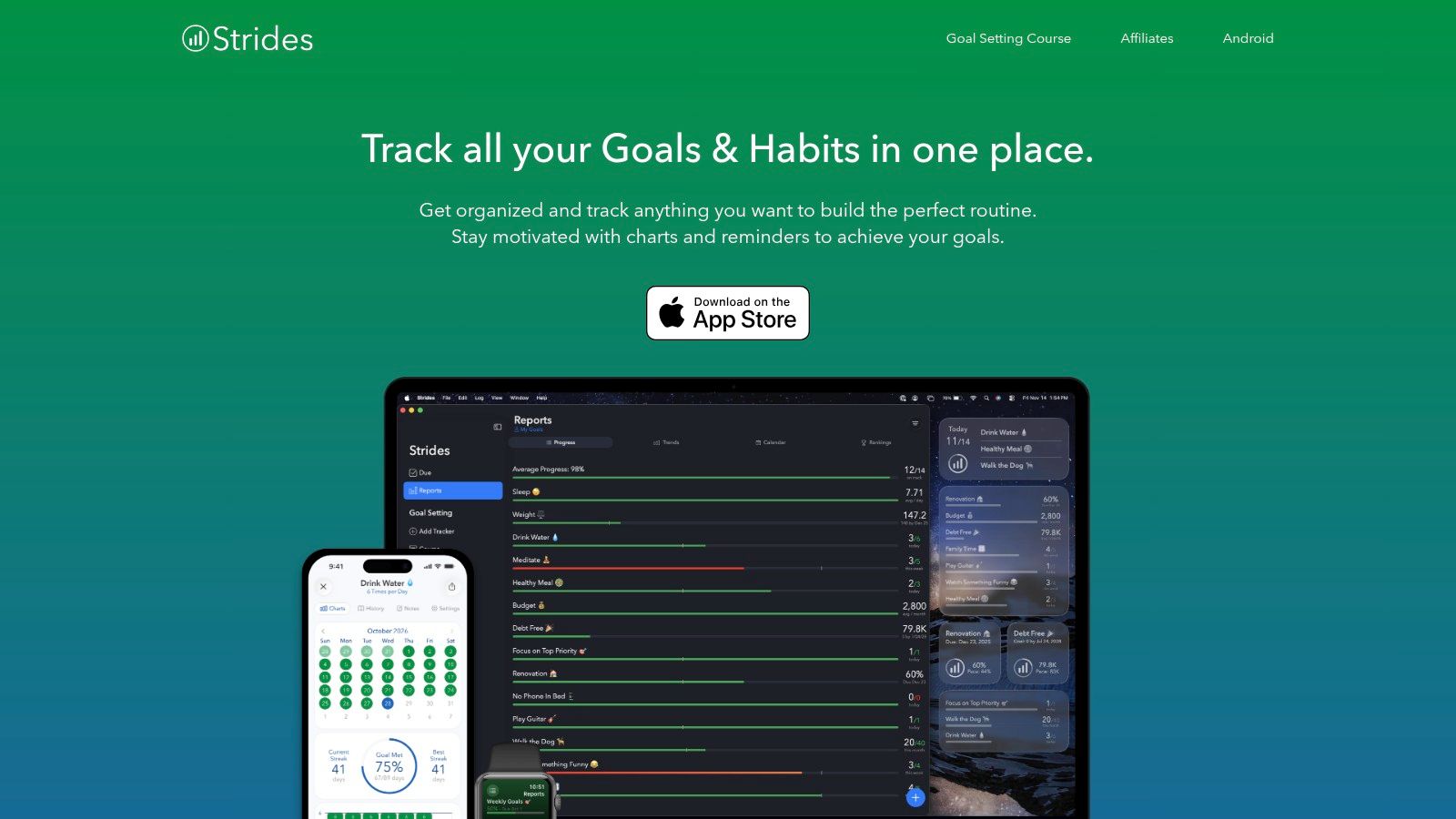
Strides is the personal option on this list. It's not trying to be a company-wide OKR platform, and that focus is part of its appeal. If you want a fast, flexible way to track habits, numerical targets, and personal projects on Apple devices, it does that well.
The experience is much closer to disciplined self-management than organizational alignment. You can set reminders, use templates, track streaks or progress types, and keep goals visible on iPhone, iPad, and Apple Watch.
Best for personal goal tracking on Apple devices
Strides is useful for health goals, study routines, personal finance habits, or solo professional development. It's especially good when you want a tracker you can maintain in under a minute per day. That simplicity is why consumer tools still matter, even as enterprise goal planning tools become more advanced.
The limitation is obvious. It's iOS-first, and it doesn't try to solve team alignment, company roll-ups, or strategic reporting. For many people, that's fine. A personal system should be small enough to survive busy weeks.
There's also a useful reality check from behavioral research. In an NIH study of 1.4 million users of activity tracking apps, only 18.2% of weight-loss goals were met without advanced intervention, while integrated self-monitoring features and predictive AI reached a 79% ROC AUC for forecasting goal achievement just seven days after a goal was set. The takeaway isn't that every personal tracker needs AI. It's that simple logging often isn't enough when goals are difficult.
You can view the app at Strides.
Top 10 Goal Planning Tools Comparison
| Product | Core features | Quality (★) | Price/value (💰) | Target audience (👥) | USP (✨/🏆) |
|---|---|---|---|---|---|
| Beyond Time by Tribble Software | AI-generated OKR milestones, habits/routines, 15-min time tracking, daily AI critique, integrations | ★★★★☆ AI-led, learning over time | Free web; iOS 2‑week trial → $4.99/mo or $29.99/yr 💰 | Founders, pros, students, self-improvers 👥 | ✨Personal AI memory & pattern intelligence; 15‑min planned-vs-actual 🏆 |
| Microsoft Viva Goals | Native Teams OKRs, integrations (Jira/Tableau/etc.), portfolio roll-ups | ★★★★ Integrated enterprise UX | Enterprise/Viva Suite pricing (published SKU) 💰 | Large MS365 organizations 👥 | ✨Runs inside Teams for minimal context switching 🏆 |
| Quantive Results (Gtmhub) | Live data connectors, insights/reports, bulk tools, admin/data model | ★★★★☆ Executive-grade analytics | Quote-based enterprise pricing 💰 | Scale-ups & enterprises needing analytics 👥 | ✨Robust data-driven OKRs and custom insights 🏆 |
| Perdoo | OKRs + KPIs, Strategy Map, templates, guided onboarding | ★★★★ Practical, fast time-to-value | Tiered plans; annual contracts/minimums possible 💰 | SMBs to mid-market teams 👥 | ✨Templates + onboarding for quick adoption |
| WorkBoard | Company-to-team alignment, scorecards, exec dashboards, cadence/governance | ★★★★ Enterprise execution focus | Higher/non-public pricing (enterprise) 💰 | Large enterprises needing governance 👥 | 🏆Deep governance, portfolio & cadence tooling |
| Weekdone | Visual OKR tree, weekly PPP check-ins, templates, pulse surveys | ★★★★ Simple & consistent cadence | Free trial & SMB pricing options 💰 | SMBs and teams new to OKRs 👥 | ✨Built-in weekly rhythm (PPP) for adoption |
| ClickUp Goals | Task Targets, auto progress from tasks, goal folders, platform-wide link | ★★★★ Integrated with work OS | Included across ClickUp plans (varies by tier) 💰 | Teams already using ClickUp 👥 | ✨Automatic task-linked progress; reduces app sprawl |
| Asana Goals | Company/team/individual goals, link to projects/tasks, API support | ★★★★ Good for in-Asana execution | Business/Enterprise tiers for advanced features 💰 | Organizations running work in Asana 👥 | ✨Goals live where execution happens; auto-updates |
| Tability | Strategy Map, weekly check-ins, outcome tracking, async standups | ★★★☆ Lean & approachable | Tiered SaaS pricing with free trial 💰 | Startups & small teams wanting low-admin OKRs 👥 | ✨Outcome-first, lightweight OKR experience |
| Strides | Habit/habit-number/project trackers, reminders, iOS widgets, Apple Health | ★★★★ Strong consumer habit UX | Free to start; Strides Plus (monthly/annual/lifetime) 💰 | Individuals focused on personal goals/health 👥 | ✨Flexible tracker types + Apple ecosystem integration |
Final Thoughts
Monday starts with good intentions. By Thursday, the plan is buried under meetings, task switching, and a backlog nobody wants to review. That is the essential buying context for goal planning tools. The right choice depends less on feature volume and more on the kind of workflow you need the tool to support every week.
Start with operating model, not vendor polish.
For personal achievement, the practical question is simple. Do you need help setting goals, or do you need a system that keeps those goals connected to your calendar, habits, and actual hours worked? Tools built for individuals often stop at tracking progress. Beyond Time takes a different route by tying goals to milestones, routines, daily review, and planned versus actual time. In practice, that makes it a better fit for people who lose momentum in execution, not people who just want a cleaner list of targets.
For SMB alignment, the trade-off shifts. Perdoo, Weekdone, Tability, ClickUp Goals, and Asana Goals can all work well, but for different reasons. Perdoo suits teams that need strategy visibility and KPI context. Weekdone is easier to adopt when a weekly check-in habit is the missing piece. Tability keeps overhead low for startup teams that want accountability without a formal OKR program. ClickUp Goals and Asana Goals make more sense when work already lives inside those platforms and adding another tool would create unnecessary friction.
Enterprise OKR software is a separate category. Microsoft Viva Goals fits Microsoft-first environments where adoption depends on Teams and existing identity infrastructure. Quantive Results is stronger when leadership needs deeper analytics and live business-data connections. WorkBoard earns its place in organizations that care about governance, portfolio reviews, and executive operating cadence as much as the goals themselves.
The broader shift is clear. Goal software is no longer judged only by dashboards and quarterly scorecards. A 2026 formative study on goal-setting interventions found that participants created their own goals, but those goals were not addressed during action-planning sessions. That gap matters. A plan breaks down when the system does not help at the moment someone has to decide what to do next.
Use that as your filter. Buy for daily follow-through if execution drift is the problem. Buy for alignment and review rhythm if teams are pulling in different directions. Buy for data depth and governance if reporting across a large organization is the problem.
Founders handling cross-cultural expectations, team communication, and execution pressure may also find this founder's guide for UAE expectations useful, especially when the friction sits as much in team context as in the software itself.
Tribble Software Private Limited builds Beyond Time for people who are done collecting goals and ready to execute them. If that operating style sounds familiar, test the free web app first and see whether the iOS experience matches how you work.
Put this into practice
Free tools that match this article.
Goal Setting Worksheet
Turn a vague goal into milestones, habits, blockers, and a weekly review plan.
Try Goal WorksheetGoal SettingSMART Goal Validator
Instantly validate your goals against the SMART framework and get actionable improvement suggestions.
Try SMART ValidatorGoal SettingAI Milestone Generator
Turn your biggest goals into an actionable step-by-step plan in seconds with AI.
Try Milestone GeneratorTime ManagementTime Blocking Template
Map your day into focused time blocks with a free printable time blocking template.
Try Time BlockingKeep exploring this topic
Best goal tracking apps
Compare tools for goals, habits, and progress tracking.
Best habit tracker apps
Compare habit apps by use case, depth, and daily workflow.
Goal setting guide
Start with the fundamentals of setting goals that turn into action.
Goal frameworks compared
Choose between SMART goals, OKRs, BHAGs, and 12-week goals.
Related Articles
10 Best Goal Setting Apps for 2026: A Full Review
Find the best goal setting apps for 2026. Our guide compares 10 top tools for OKRs, habits, and AI-powered planning to help you finally achieve your goals.
Unlock Your Potential: Top Personal Development Apps 2026
Discover the top 10 personal development apps for 2026. Compare AI coaching, OKRs, & habit tracking. Build a system, achieve your goals.
Progress Tracking Software: A Guide to Achieving Your Goals
Discover how progress tracking software can turn your goals into achievements. This guide covers features, use cases, and how to choose the right tool for you.
AI Accountability Partner: Smarter Goal Setting
Tired of missed goals? An AI accountability partner provides the structure & feedback you need. Explore benefits, workflows, and tools.
10 Best Apps for Daily Routine in 2026
Find the best apps for daily routine to organize your life. We review Todoist, Structured, Beyond Time, and more to boost your productivity in 2026.
10 Best Productivity Apps for Mac in 2026
Discover the 10 best productivity apps for Mac in 2026. Our curated list covers task managers, focus tools, and automation to boost your workflow.