The Force of Habit: Master Your Autopilot for Success
Learn what the force of habit is and how to use its power. This guide explains the neuroscience and gives you evidence-based strategies to build good habits.
You know this feeling. You open your phone for one quick check, and a few minutes later you're deep in messages, email, news, or a social app without remembering the exact moment you decided to do it. Or you drive a familiar route, arrive safely, and realize your mind was somewhere else for half the trip.
That isn't laziness or lack of discipline. It's the force of habit at work. Your brain is built to automate repeated behavior so you can save effort for harder problems. That system is useful when it supports your goals. It becomes costly when it runs routines you never chose on purpose.
For founders, students, and professionals, this matters more than most productivity advice admits. Big goals rarely fail because people don't care. They fail because daily behavior defaults to the easiest groove. If you learn how that groove forms, you can redirect it. You can make your autopilot serve the work that matters.
Table of Contents
- Your Brain on Autopilot
- The Habit Loop Explained
- The Neuroscience Behind Automaticity
- Good and Bad Habits in the Real World
- A Practical Framework for Habit Change
- From Habits to Goal Achievement
Your Brain on Autopilot
You merge onto the highway, settle into traffic, and think about a deadline, a meeting, or dinner plans. Then you're suddenly at your exit. You weren't asleep. You were running a learned sequence with very little conscious effort.

That's the simplest way to understand the force of habit. It's your brain's autopilot. It takes behaviors you've repeated enough times and turns them into shortcuts. Instead of asking, "What should I do now?" your brain says, "We've been here before. Run the usual script."
The same thing happens at your desk. You sit down to work, hit a moment of uncertainty, and reach for your phone. Or you feel afternoon fatigue and open another tab instead of taking a real reset. If you're trying to improve concentration, a guide on focus and clarity habits for knowledge work can help you spot where autopilot starts stealing attention.
Why autopilot feels invisible
Habits are quiet because they remove decision-making from the surface of awareness. That's why people often say, "I don't know why I did that." In many cases, the answer is simple. The environment cued a routine before deliberate thinking caught up.
Practical rule: If a behavior keeps happening in the same place, at the same time, or after the same trigger, treat it as a habit problem before you treat it as a motivation problem.
This is also why high-achievers can struggle with basic consistency. You can be ambitious and still have an autopilot built for distraction, delay, or overwork. Intelligence doesn't cancel habit loops.
Autopilot can be trained
The good news is that automaticity isn't the enemy. It's a powerful tool. Once you understand it, you can use it to make productive actions feel more natural. That's true for work routines, study sessions, and even movement. Some people look for ways to achieve vigorous cardio at your desk because they want healthy behavior to fit into an existing routine instead of depending on a burst of motivation later.
The question isn't whether you'll live by habit. You will. The question is whether those habits were designed by chance or by choice.
The Habit Loop Explained
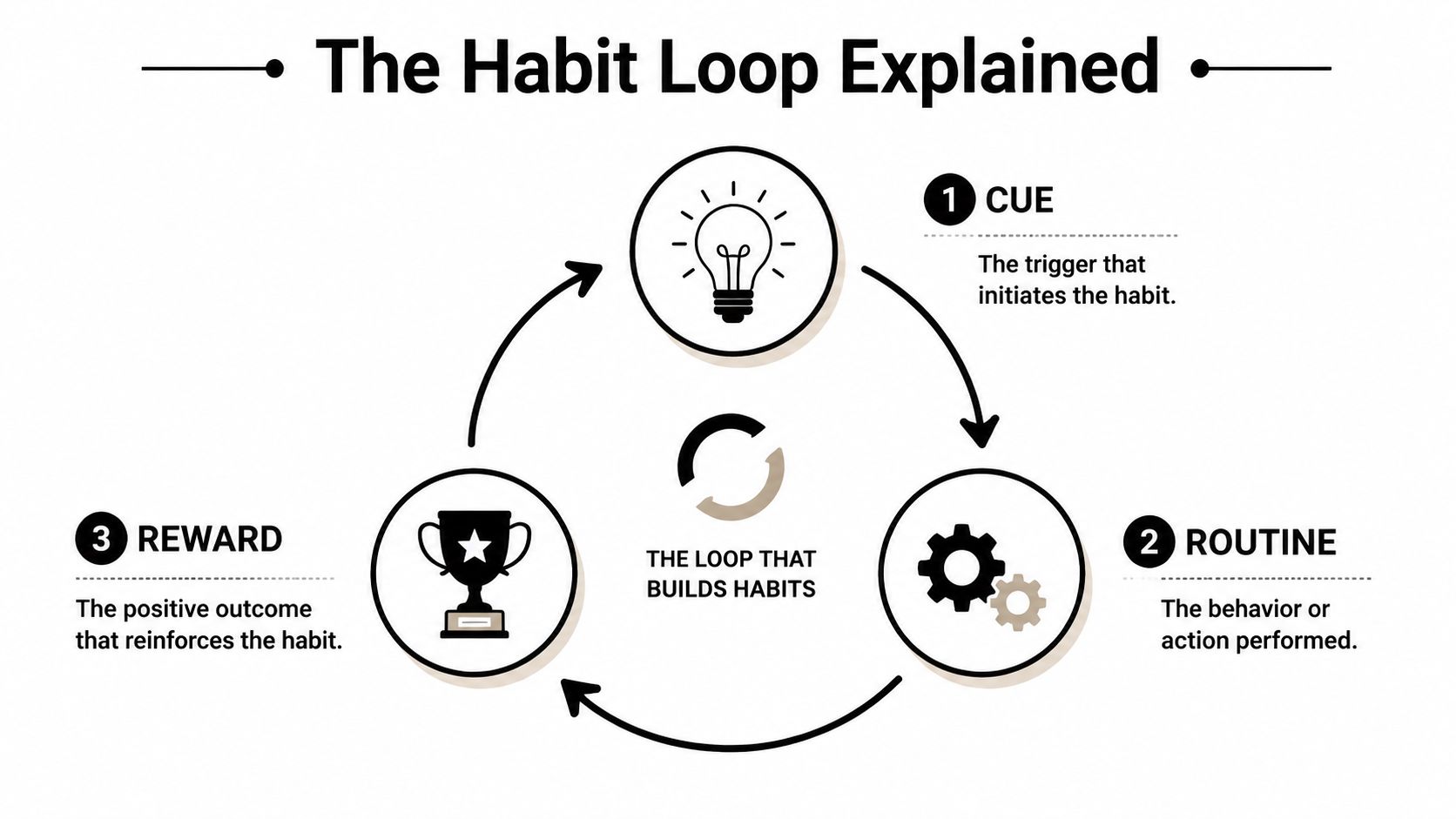
Most habits look complicated from the outside. Underneath, they tend to follow a simple pattern: cue, routine, reward.
Think about checking your smartphone.
Cue
A cue is the trigger. It tells your brain that a familiar script might be useful right now. The cue could be a buzz, a badge notification, boredom, awkwardness in an elevator, or the tiny discomfort of starting a difficult task.
A cue doesn't have to be dramatic. Often it's ordinary. Sitting on the couch. Closing one browser tab. Waiting for a document to load.
Routine
The routine is the behavior itself. You wake the phone, swipe, check messages, open one app, then another. This part is what people usually focus on because it's visible.
But the routine isn't where a habit really begins. If you only fight the routine, you'll often lose. The cue has already pushed you toward motion.
Reward
The reward teaches your brain, "That worked. Save it." With a phone habit, the reward might be novelty, relief, social connection, or a brief escape from mental friction.
Over time, your brain starts anticipating the reward before it arrives. That anticipation is what many people describe as a craving. You don't just respond to the cue. You start wanting the state change the routine promises.
The force of habit grows when the brain learns, "This trigger predicts a reliable payoff."
A simple analogy
A habit loop works like a well-worn path across a field. The first few crossings require attention. After enough passes, the route becomes obvious. You don't need to think hard about where to step. Your feet follow the path because it's easier than making a new one.
Here's how that looks in daily life:
| Part | Smartphone example | Work example |
|---|---|---|
| Cue | Notification sound | Hard task on your calendar |
| Routine | Unlock and scroll | Open inbox instead |
| Reward | Novelty or connection | Relief from discomfort |
Once you see the loop, confusing behavior becomes easier to decode.
- If the cue is strong, the habit starts fast.
- If the routine is easy, you repeat it often.
- If the reward feels reliable, your brain keeps the loop.
That gives you a practical lens. When a habit frustrates you, don't ask only, "How do I stop doing this?" Ask three better questions:
- What triggers it?
- What action follows automatically?
- What reward is my brain trying to get?
Those questions turn a vague struggle into something you can redesign.
The Neuroscience Behind Automaticity
You sit down to do focused work. Before the document fully loads, your hand is already reaching for email, messages, or a browser tab you did not plan to open. That moment can feel like a character flaw. It is usually a wiring pattern.
Habits feel personal, but the engine behind them is biological. Your brain has a simple bias: save effort where it can. Careful, deliberate thinking uses more energy than a familiar sequence. So with repetition, the brain shifts work away from heavy conscious control and toward circuits built to run learned routines with less friction.

That shift matters for high-achievers. Founders, students, and professionals often assume better results come from more discipline in the moment. Neuroscience points to a different lesson. Repeated behavior can become the default setting, which means your systems matter as much as your willpower.
The forest path in your brain
The clearest analogy is a path through a forest. The first walk is slow. You choose each step, push through brush, and pay attention to every turn. Walk the same route often enough and the path becomes easier to follow because the ground has already been shaped by repetition.
Your brain does something similar. Repeated firing across the same neural circuits makes a behavior easier to start and easier to finish. Over time, the routine asks for less conscious oversight.
That is why the popular "21 days" rule creates confusion. Habit formation usually takes longer and varies by behavior and context. A simple action done in a stable setting can become more automatic faster than a demanding routine tied to stress, fatigue, or competing cues. If a new behavior still feels effortful after a few weeks, that does not mean you are failing. It means the path is still being built.
For students trying to make that path easier, these essential study strategies for students pair well with habit design because they reduce friction at the exact point where automaticity is still weak.
What dopamine actually does
Dopamine is often described as the brain's pleasure chemical. That shortcut misses the useful part.
In habit learning, dopamine helps stamp in behaviors that seem worth repeating. Biotechniques' review of dopamine and habit research explains that dopamine signaling in the dorsomedial striatum is involved in whether repeated behavior becomes habitual. The review also discusses MIT research in primates showing that neurons track both the cost and the reward of a habit.
That helps explain why some routines stick even when they are not good for your goals. Your brain is not asking only, "Did this feel good?" It is also asking, "Did this work with low effort, and did it produce a reliable payoff?" Scrolling, checking metrics, and opening the inbox can win that calculation because they are easy and predictably stimulating.
A habit survives when the route feels cheap to run.
Why this matters for goal achievement
Neuroscience offers practical insights: if automaticity grows through repetition, low effort, and reliable reward, then goal achievement should be designed the same way.
A founder who wants to think strategically should not rely on a heroic decision every morning. A student who wants consistent study sessions should not negotiate with themselves every night. A better approach is to set up a repeatable sequence that lowers the cost of starting, keeps the cue obvious, and gives the brain a clear sense of completion.
That is the logic behind tools like Beyond Time. Instead of treating goals as abstract intentions, you turn them into repeatable operating patterns: one cue, one planned start point, one defined action, one visible record of completion. The brain is far more likely to automate a sequence it encounters in the same shape again and again.
The practical takeaway is simple. If you want a behavior to become automatic, stop asking only for more motivation. Reduce the number of decisions, keep the context stable, and repeat the same starting move until your brain begins to treat it like the obvious path.
Good and Bad Habits in the Real World
The force of habit becomes easier to respect when you see it in ordinary work and study patterns. Small routines don't stay small. They shape the kind of day you repeatedly live.
Founder
A founder starts each morning by reviewing a short dashboard, noting one risk, one opportunity, and the single metric that matters most today. That habit creates orientation. It nudges decisions toward the business instead of toward noise.
Another founder starts the day in Slack and email. Every message feels urgent, so the day turns into reactive firefighting. By late afternoon, strategic work hasn't moved.
The difference isn't effort. Both people are busy. One habit creates direction. The other trains constant interruption.
A repeated behavior doesn't need to be dramatic to change your trajectory. It only needs to happen often enough.
Professional
A manager blocks focused time for proposal writing, analysis, or planning, then closes communication tools during that window. Over time, deep work becomes the normal opening move for important tasks.
Another professional keeps notifications visible and responds as soon as something appears. That can feel responsible, but it trains fragmentation. Attention gets sliced into tiny pieces, and demanding work starts to feel unusually hard.
A useful way to spot the pattern is to ask, "What does this routine make easier tomorrow?" Good habits lower the cost of doing the right thing again.
Student
A student who spends a few minutes summarizing notes after class builds memory while the material is still fresh. That routine turns review into refinement rather than rescue. If you want practical examples of this kind of approach, these essential study strategies for students show how strong learning habits can be built from simple repeated actions.
A different student waits until pressure is high, then crams late into the night. Cramming can create the feeling of effort, but it often trains stress, inconsistency, and shallow recall.
A quick comparison
- Good habits usually feel small in the moment and valuable over time.
- Bad habits usually feel helpful in the moment and expensive over time.
- Productive routines remove friction from meaningful work.
- Counterproductive routines remove friction from avoidance.
That's why habit change is never just about self-improvement language. It's about daily mechanics. Your routines are either making future action lighter or making future action harder.
A Practical Framework for Habit Change
A founder sits down to do strategic work and opens email first. A student means to review notes and ends up on short videos. A professional plans to go to the gym after work, then drives home on autopilot and skips it. In each case, the problem is not a lack of ambition. The brain followed an old path because that path was rehearsed, familiar, and easy to enter.
Habit change works best when you stop treating behavior like a character test and start treating it like a system design problem. The brain builds routines the way feet wear down a path in a forest. Each repetition makes the route easier to follow next time. Your job is to make the useful path clearer and the unhelpful path harder to enter.
One practical rule captures this well: keep the cue, keep the reward, replace the routine. If stress pushes you toward distraction because you want relief, keep the need for relief in view. Then give it a better response, one that calms your system without pulling you away from your priorities.
Start with context, not motivation
High-achievers often overestimate intention and underestimate setup. But habits usually begin before a full debate happens in your head. A location, a time of day, a device on the desk, or the feeling that follows a difficult task can start the sequence.
That changes the strategy. Instead of asking, "How do I try harder?" ask, "What reliably happens right before this behavior?"
Use this quick audit:
- Map the trigger: Write down where the habit happens, what happened right before it, and what feeling was present.
- Name the payoff: Relief, stimulation, certainty, connection, and avoidance are common rewards.
- Redesign the first step: Make the desired behavior easier to begin than the unwanted one.
For memory-heavy work, consistency in context matters a lot. If you study a language, medicine, law, or any subject that depends on recall, it helps to review in the same window each day so the cue becomes predictable. This guide on how to use spaced repetition shows how recall improves when review is tied to a repeatable schedule instead of mood.
Build good habits by lowering resistance
The brain does not need a dramatic promise. It needs a repeatable entry point.
That is why habit change for ambitious people should start small and stay concrete. A vague goal like "be more disciplined" gives the brain nothing to run. A defined sequence gives it something to automate.
Here are four methods that work well:
Habit stacking
Attach a new behavior to one that already happens. After coffee, review your top priority. After class, summarize key points. After your last meeting, write tomorrow's first task. The existing habit becomes the cue.Start embarrassingly small
Read one page. Write three sentences. Review one flashcard set. Small starts lower the activation energy, which is often the hardest part of consistency.Design the environment
Put the instrument on a stand. Leave the notebook open. Move distracting apps off the home screen. Place friction in front of the habit you want less of, and remove friction from the one you want more of.Track consistency, not mood
Repetition wires the path. Mood does not. A simple planning system helps because it connects a goal to a cue, a routine, and a minimum version you can still do on a busy day. This guide on how to build better habits explains how to turn good intentions into scheduled action.
Coaching note: The best habit is the one you'll still perform on a tired Tuesday.
Digital tools matter when they reduce ambiguity. Instead of "work on thesis," schedule "open outline and revise one section." Instead of "get healthier," define a repeatable cue and the smallest successful action. For founders, students, and professionals using Beyond Time, that means linking a concrete daily behavior to a milestone so progress is visible, scheduled, and easier to repeat.
Here is a useful walkthrough for thinking about that process in a more visual way:
Break bad habits by redesigning the path
Old habits rarely disappear because you argued with them. They weaken when the route stops being easy.
Use friction on purpose:
- Hide the cue: If your phone pulls you into reactive mornings, charge it outside the bedroom or keep it away from your desk during focused work.
- Add delay: Give yourself a short pause before the old routine. Even a brief gap creates room for a different response.
- Change location: Habits are tied to place more than many people realize. A different room, seat, or route can interrupt the script enough for choice to return.
- Substitute the routine: If stress leads to scrolling, test a replacement that serves the same need, such as a short walk, a paper notebook, or one slow breath cycle before touching a device.
Context disruption is especially useful. If a habit has been repeated in the same setting for months, that environment becomes part of the routine. Change the setting and you often weaken the pull. The brain has fewer cues telling it which path to follow.
Turn habits into a working system
Habit change lasts when it is connected to a goal that matters and a cue that repeats. That is where many high-performers finally gain traction. They stop chasing motivation and start building a structure the brain can learn.
A practical weekly setup looks like this:
| Goal | Supporting habit | Cue | Minimum version |
|---|---|---|---|
| Finish a proposal | Daily writing block | Sit at desk after first coffee | Write for one focused block |
| Improve exam performance | Post-class review | End of lecture | Summarize key points |
| Build fitness consistency | Movement session | End of workday | Start the shortest planned session |
This framework is simple on purpose. Pick one goal. Tie it to one habit. Give that habit a cue and a minimum version. Then repeat it long enough for the path to become familiar.
That is how behavior change becomes goal achievement in practice.
From Habits to Goal Achievement
Goals sound exciting because they describe a future identity. Habits matter because they decide what you do today. The gap between the two is where most plans fail.
A founder doesn't build a company through occasional bursts of intensity. A student doesn't earn mastery through one heroic weekend. A professional doesn't become reliable through good intentions alone. Progress comes from repeated actions that become easier to start and harder to skip.
The force of habit is powerful precisely because it's ordinary. It lives in your first hour, your default response to friction, your study review, your work block, your evening reset. If those patterns are aligned, goals stop feeling abstract. They begin to accumulate.
If you want a simple starting point, build one habit stack around one important goal and make the first action easy enough to repeat without drama. If you need a template, a habit stack builder for goal-focused routines can help you map the sequence clearly.
Motivation will come and go. Systems stay. When your autopilot points in the right direction, success stops depending on mood and starts depending on structure.
Tribble Software Private Limited built Beyond Time for people who want that structure. It connects goals, milestones, routines, habits, and daily accountability into one system so you can turn ambitions into repeatable action instead of leaving them at the level of intention.
Put this into practice
Free tools that match this article.
Habit Tracker Template
Create a free printable habit tracker template — weekly or monthly. Customize your habits and download a clean PDF in seconds.
Try Habit TrackerHabit BuildingHabit Stack Builder
Use habit stacking to build new habits by attaching them to your existing routines.
Try Habit Stack BuilderHabit Building30-Day Challenge Generator
Build any habit with a personalized 30-day challenge featuring daily tasks and weekly milestones.
Try 30-Day ChallengeGoal SettingGoal Setting Worksheet
Turn a vague goal into milestones, habits, blockers, and a weekly review plan.
Try Goal WorksheetKeep exploring this topic
Atomic Habits summary
Apply the core behavior-change principles behind lasting habits.
Habit stacking guide
Attach new behaviors to routines you already do every day.
Goal setting guide
Start with the fundamentals of setting goals that turn into action.
Goal frameworks compared
Choose between SMART goals, OKRs, BHAGs, and 12-week goals.
Related Articles
How to Build Better Habits: A Science-Backed Playbook
Learn how to build better habits that last. Our guide provides a science-backed framework, tracking templates, and troubleshooting for real-world results.
Neuroscience of Habit Formation: Inside Your Brain
Discover what happens in your brain when habits form. Understand the basal ganglia, dopamine loops, and neural pathways behind automatic behavior.
AI Accountability Partner: Smarter Goal Setting
Tired of missed goals? An AI accountability partner provides the structure & feedback you need. Explore benefits, workflows, and tools.
How to Be Efficient and Productive: A 2026 System
Stop being busy and start being efficient and productive. Learn a practical, AI-enhanced system to set goals, track progress, and build unstoppable momentum.
8 Peer Feedback Examples: Drive Growth in 2026
Discover 8 peer feedback examples for positive, corrective, & developmental conversations. Drive results & build momentum with effective feedback in 2026.
Regain Focus and Clarity: A System for High Achievers
Stop feeling busy and start being effective. Learn a practical, evidence-backed system to build sustained focus and clarity for meaningful, measurable results.