Time Management for Entrepreneurs: Master 2026 Success
Master time management for entrepreneurs. Align goals, prioritize ruthlessly, and reclaim focus to build your business, not just manage, in 2026.
You open your laptop with a plan to work on growth. By 10 AM, you've answered a pile of emails, taken two unscheduled calls, fixed a marketing issue that nobody flagged yesterday, and approved something your team could probably have handled without you. You're busy, but you haven't moved the business forward in any meaningful way.
That gap is where most founder frustration lives. Not in laziness. Not in lack of ambition. In the mismatch between what the company needs from you and what your day keeps pulling you toward.
Good time management for entrepreneurs isn't about squeezing more tasks into the calendar. It's about building an operating system that survives messy days, protects strategic work, and gives you a way to recover when the week goes sideways. The system that works is simple enough to run under pressure and structured enough to produce repeatable progress: Goals -> Plan -> Execute -> Analyze.
Table of Contents
- Why Typical Time Management Fails Entrepreneurs
- Align Your Time with Your Ambition Using OKRs
- The Ruthless Prioritization and Planning Framework
- Winning the Day The 15-Minute Execution System
- Mastering Interruptions Meetings and Delegation
- Closing the Loop with Metrics and Iteration
Why Typical Time Management Fails Entrepreneurs
Most productivity advice assumes your day is stable. It assumes you control inputs, your priorities won't change by lunch, and the work sits waiting for your attention. Founder life doesn't work like that.
A typical morning can disappear into reactive work before you've created anything of substance. You check emails because they feel urgent. You take a quick call because it might matter. You jump into Slack because the team is blocked. Then you look up and realize the strategic work that compounds is still untouched.

That feeling isn't imaginary. In a survey of 2,000 U.S. small business owners, respondents said they lost an average of 1 hour and 36 minutes every day to tasks they considered unproductive, which adds up to roughly 8.4 hours a week, effectively a full workday, according to Talker Research's survey on entrepreneur time wasters.
Busy is not the same as useful
Founders usually don't need more effort. They need a better filter. A day packed with motion can still be a bad business day if none of that motion advances hiring, product, customer retention, distribution, or cash flow.
That's why disconnected tips rarely stick. Time blocking by itself won't save you if your calendar is built around other people's requests. A to-do list won't save you if every task looks equally important. Even solid advice from resources on time management for entrepreneurs only works when it's part of a larger operating system.
You're not losing control because you're undisciplined. You're losing control because the business keeps generating inputs faster than an unsystematic workflow can absorb them.
The fix is a system, not a hack
What works is an integrated loop. First, define what matters. Then plan around those priorities. Execute in a way that reflects reality, not fantasy. Finally, review the data and adjust next week.
If you want a useful starting point, build your own founder workflow the way you'd build a product. Keep only the pieces that work under stress. That's the same idea behind structured personal productivity systems, where the point isn't perfect behavior. It's repeatable decision-making when the day gets noisy.
Align Your Time with Your Ambition Using OKRs
Most founders don't have a calendar problem first. They have an alignment problem. If the company goals live in one place and the daily work lives somewhere else, the urgent stuff will win every time.
A lot of founders resist OKRs because they sound corporate. That's a mistake. Used properly, they are just a clean way to connect ambition to execution.
Why founders drift into operational work
The default state of a startup is operational pull. Fires appear faster than strategy blocks itself onto the calendar. That pattern is visible in the data too. A survey of founders found they spend 68.1% of their time working in the business and only 31.9% working on it, as noted by the U.S. Chamber's guide to entrepreneur time management.
That split explains why many founders feel productive and stuck at the same time. You're active. You're helping. You're solving. But you're doing too much work that keeps the current system running and not enough work that changes the system.
A founder version of OKRs
The version that works for entrepreneurs is lean.
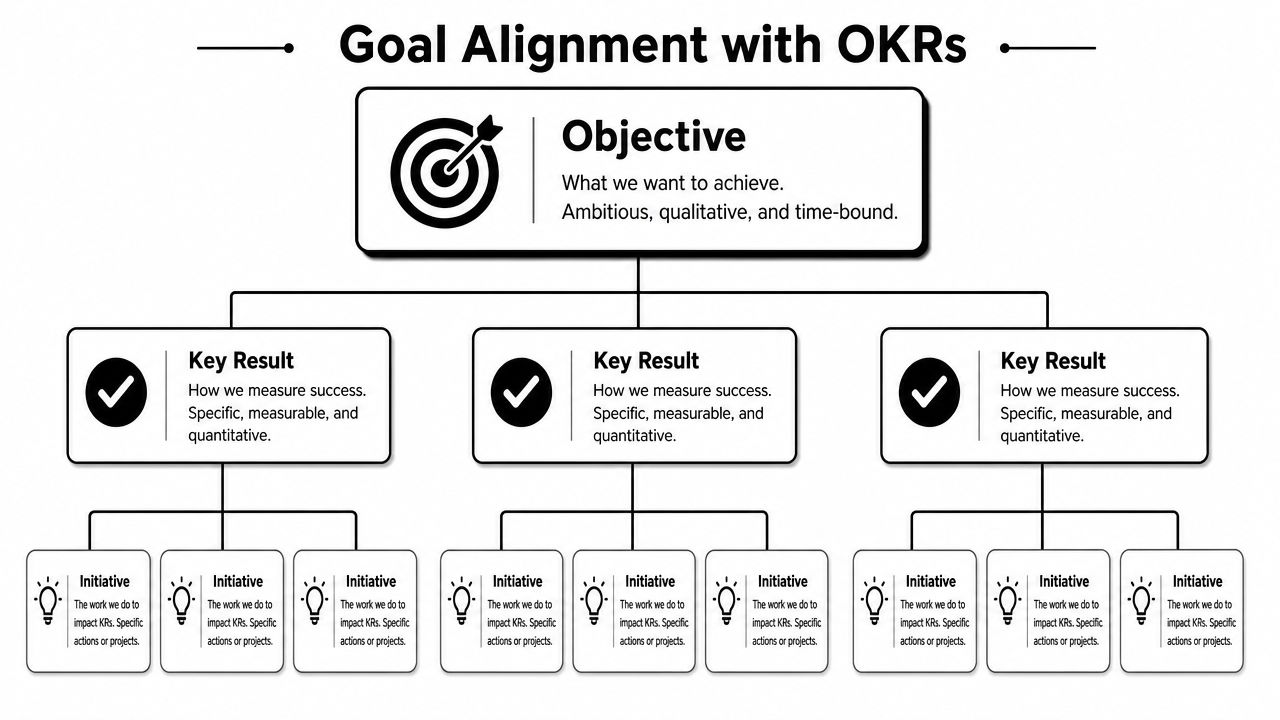
Use one Objective for the period you're planning. It should be ambitious, directional, and easy to remember. Then attach a small set of Key Results that tell you whether the objective is moving. After that, list the initiatives that could influence those results.
A simple founder stack looks like this:
| Layer | What it does | Founder test |
|---|---|---|
| Objective | Sets the destination | Would the team understand it without explanation? |
| Key Results | Defines success | Can progress be checked quickly? |
| Initiatives | Specifies the work | Will this actually move a Key Result? |
Three rules matter more than templates:
- Keep the objective qualitative. It should describe the business outcome you're pursuing, not a task list.
- Make Key Results measurable. If you can't tell whether you're getting closer, they won't guide decisions.
- Treat initiatives as bets. They are not sacred. If they don't move the result, replace them.
For founders who want a more structured way to set these up, frameworks like the ones in goal-setting systems for measurable progress are useful because they force the connection between long-range goals and near-term execution.
How OKRs become a daily filter
The value of OKRs isn't the document. It's the filter they create.
When a new request lands, ask three questions:
- Does this map to a current Key Result?
- Am I the only person who can do it well?
- Does it matter now, or does it only feel urgent?
If the answer to the first question is no, the task starts with a disadvantage. It might still deserve attention, but it should have to earn its place. That's how you reclaim strategic time. Not by pretending operations disappear, but by making sure they don't consume the whole week.
Practical rule: If a task cannot be connected to a current objective, a current Key Result, or a critical business risk, it should not take prime founder hours.
The point isn't bureaucracy. It's protection. Your company does not need you equally on every task. It needs you where your judgment, influence, and speed matter most.
The Ruthless Prioritization and Planning Framework
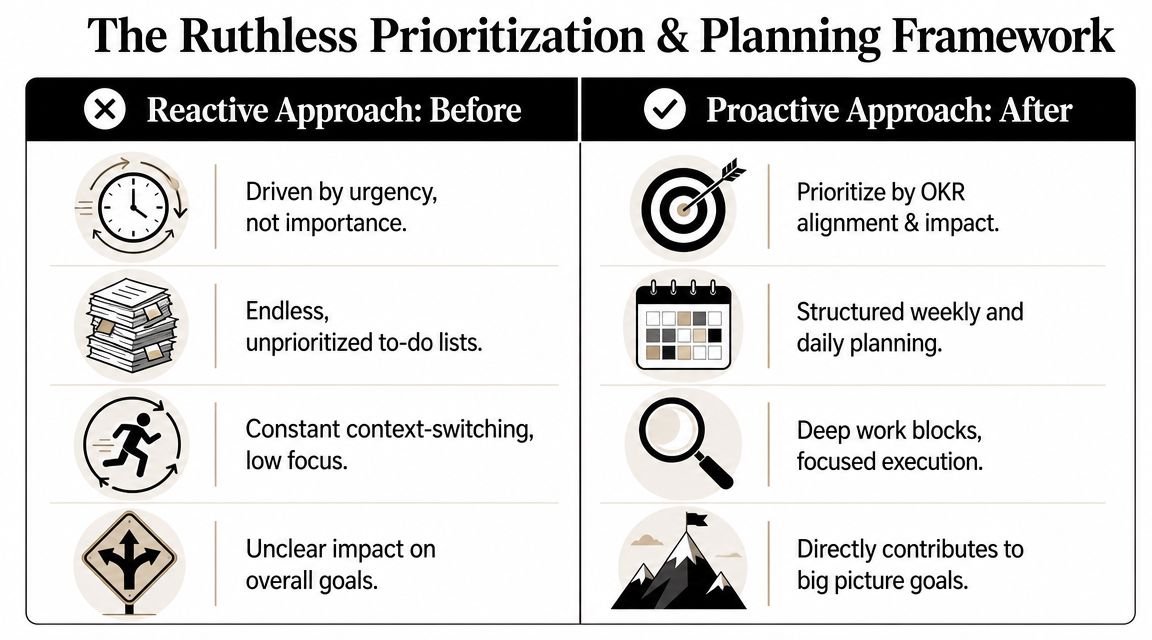
Once the goals are clear, the next mistake is turning them into a giant to-do list. That's where a lot of weekly planning dies. The list grows. Everything looks important. The loudest item wins.
Founders need a harder filter than "urgent versus important." The better model is impact versus effort, with OKR alignment sitting on top of it.
Stop planning from the inbox
The inbox is a collection point, not a command center. The same goes for Slack, text messages, and meeting invites. If you plan directly from those inputs, your week will reflect everyone else's priorities before it reflects your own.
A better weekly planning process is blunt:
- Collect everything. Pull tasks from email, notes, project tools, and team threads into one temporary list.
- Delete the obvious junk. Some tasks disappear as soon as you look at them outside their original context.
- Match surviving tasks to your OKRs. If they don't connect, they move down fast.
- Only then plan the week. The calendar gets built from priorities, not from incoming noise.
The founder prioritization matrix
Use four buckets. Keep them visible. Force every meaningful task into one of them.
| Quadrant | What belongs here | What to do with it |
|---|---|---|
| High impact, low effort | Fast moves with direct upside | Do early |
| High impact, high effort | Strategic projects | Schedule protected blocks |
| Low impact, low effort | Necessary but shallow work | Batch or delegate |
| Low impact, high effort | Drains disguised as work | Eliminate, postpone, or redesign |
This matrix sounds simple because it is. The value comes from honesty.
A founder will often mislabel tasks because emotional weight distorts judgment. A request from a big customer feels high impact. A design tweak feels important because it's visible. An internal approval feels necessary because it sits in your queue. The question isn't whether the task exists. The question is whether it deserves your best hours.
A few examples make the distinction clearer:
- Quick wins might include approving a pricing test, recording a short recruiting message for a top candidate, or sending a partnership intro that opens up distribution.
- Major projects include hiring for a key role, tightening onboarding, restructuring the sales process, or writing a product brief that unblocks the team.
- Fillers and delegate items are expenses, routine follow-ups, status checks, formatting, and repeat admin.
- Time sinks are tasks that consume attention without moving a business outcome. Founders usually know these when they see them.
A task can be urgent and still belong in the low-value bucket.
Turn priorities into a weekly agenda
The output of prioritization should not be a prettier list. It should be a weekly agenda with pre-committed blocks for strategic work.
A simple weekly build looks like this:
- Reserve your best energy windows for major projects.
- Group admin, approvals, and routine communication into batches.
- Put recurring decision time on the calendar. Hiring review, pipeline review, product review.
- Leave visible room for overflow and founder chaos.
- Decide in advance what gets dropped if the week breaks.
That last point matters. A real plan includes sacrifice. If a customer issue blows up on Tuesday, which project block moves, and which one doesn't? Most founders never answer that until the crisis arrives. Then they sacrifice the strategic block because it's quiet and nobody is waiting on it in real time.
The discipline is to protect at least one or two blocks each week that cannot be casually traded away. Those blocks are where the company changes shape.
Winning the Day The 15-Minute Execution System
A good week still falls apart at the daily level if execution is vague. "Work on product" isn't a plan. "Catch up on admin" isn't a plan either. Founders need a day structure that's precise enough to reveal drift fast.
The most reliable version I've seen is simple. Time-block the day, track in 15-minute increments, and compare what you planned against what happened.
Build the day before the day attacks you
Start each morning by reviewing the weekly blueprint and deciding what must happen today. Not everything that could happen. The few things that would make the day count.
Then assign actual blocks. Deep work gets a start time. Calls get boundaries. Admin gets a container so it doesn't leak into the whole afternoon.
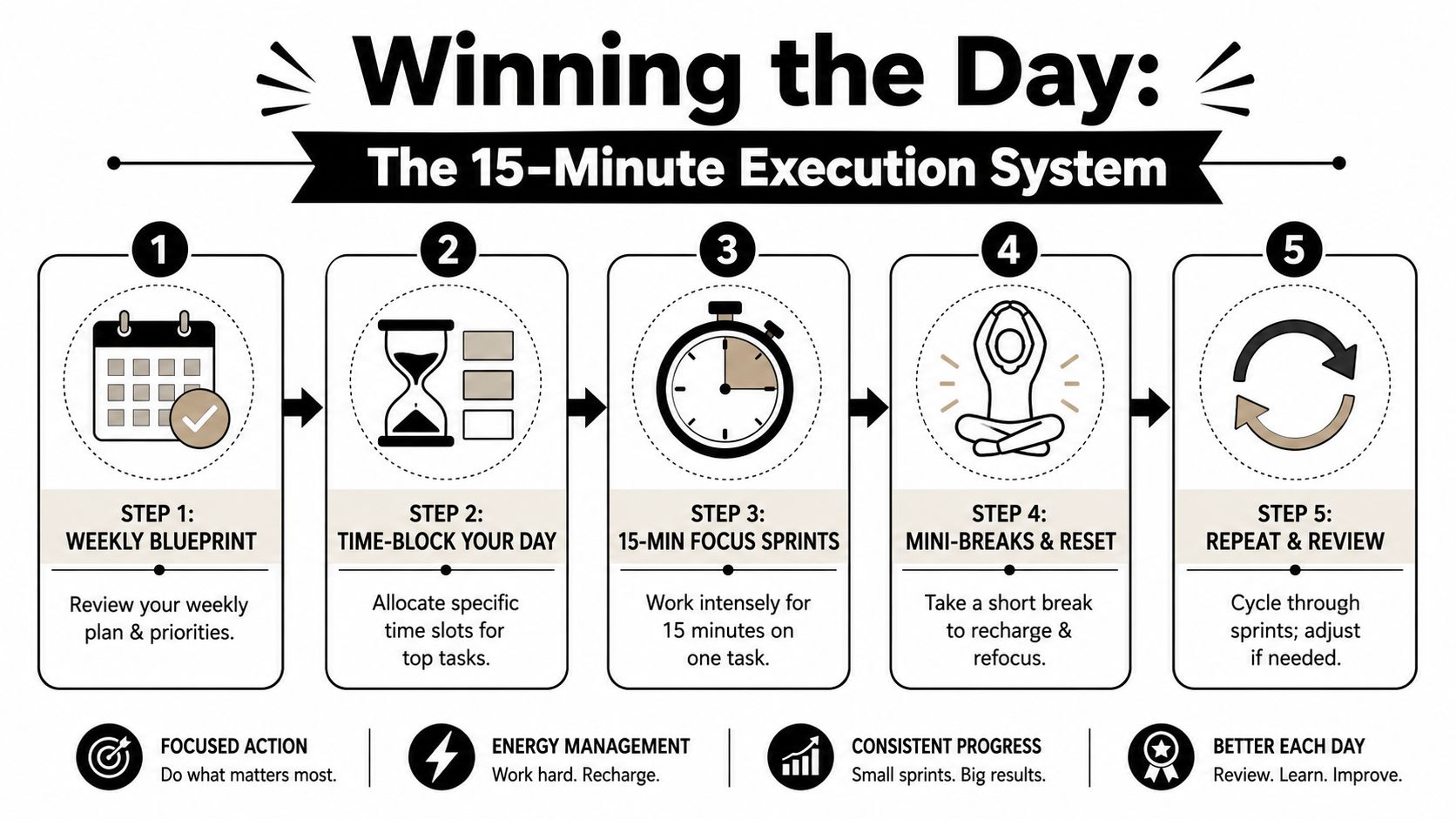
A practical founder day might look like this in plain language:
- Morning deep block. Product strategy, hiring decision-making, sales narrative, investor memo, or other work that benefits from uninterrupted thinking.
- Communication block. Email, Slack, approvals, follow-ups.
- Meetings window. Put meetings together instead of scattering them through the day.
- Late-day cleanup. Admin, review, and prep for tomorrow.
It's often overlooked that a full calendar is fragile. Entrepreneurs need planned slack rather than maximum utilization because startup work is variable and interruption-heavy, as discussed in the ASU guide to time management for entrepreneurs. That means white space is part of the design, not evidence of laziness.
If every minute is allocated, one surprise can wreck the entire day.
For a walkthrough of what focused daily planning can look like in practice, a tool like a focus session planner for structured work blocks can help turn abstract priorities into specific sessions.
Later in the day, when you're ready to reset your pace, this short explainer is useful:
Why 15-minute tracking changes behavior
Most founders think they know where their time goes. They usually know the categories, but not the leakage.
Tracking in 15-minute increments is uncomfortable at first because it removes ambiguity. You can't hide "I was working on marketing" inside a block when the reality was bouncing between analytics, Slack, a draft page, and a side conversation. The granularity exposes context switching.
Use simple labels:
- Deep work
- Meetings
- Communication
- Admin
- Firefighting
- Personal break
- Dead drift
That last category matters. Dead drift is the time between tasks that vanishes into low-value checking and reactive browsing. Entrepreneurs lose a surprising amount of the day there, even when they're trying to work.
Planned versus actual is where the learning happens
The ultimate benefit is realized as the day concludes. Compare the schedule you intended to run with the one you ran.
Ask a short set of questions:
- What block held up well?
- What got interrupted?
- What took longer than expected?
- What should never be scheduled at that time of day again?
Don't use this as self-judgment. Use it as operational data. If founder life forces constant switching between product, hiring, sales, and support, your system has to adapt to that reality. The answer isn't pretending interruptions won't happen. It's seeing patterns fast enough to redesign the next day before the same failure repeats.
Mastering Interruptions Meetings and Delegation
Planning creates offense. Defense matters just as much. If you don't protect time, the company will happily consume all of it.
The biggest drains are usually not secret. They are interruptions, meetings, and work that should have been delegated earlier.
Interruptions need rules, not hope
Most founders leave interruptions unmanaged because they want to stay accessible. That instinct is understandable and expensive.
Set response rules by channel. If something is urgent, define what urgent means and which channel earns an immediate answer. Everything else can wait for the next communication block. Teams usually adapt fast once the rules are clear.
A few practical standards work well:
- Use one channel for emergencies. If everything is urgent, nothing is.
- Batch internal replies. Constant availability trains the team to interrupt instead of decide.
- Ask for decision-ready input. When someone brings you a problem, require context, options, and a recommendation.
Teams don't create founder interruption by accident alone. Founders often train it through inconsistent access rules.
Most meetings should lose by default
Meetings steal more than their scheduled length. They break the before and after. A 30-minute call in the middle of a focus block can kill a whole morning.
Use a default-to-no filter. A meeting should happen only if the issue needs live discussion, fast alignment, or a decision that is blocked without conversation. Otherwise, use a document, a short recorded update, or a written decision thread.
When a meeting is necessary, tighten it:
| Meeting rule | Standard |
|---|---|
| Purpose | One decision or one outcome |
| Length | Keep it short and bounded |
| Attendees | Only people needed for the decision |
| Prep | Send context before the call |
| End state | Owner, next step, deadline |
A lot of repetitive work around scheduling, reminders, follow-ups, and routine workflows doesn't need more meetings either. If you're reducing manual admin, these BAMF automation strategies are a practical reference for identifying repetitive tasks that can be systematized instead of repeatedly discussed.
Delegation pays later, not immediately
Founders delay delegation because teaching someone else feels slower than doing it themselves. In the short term, they're often right. Research on time management shows it is moderately related to job performance and that over-scheduling can backfire, while delegation typically carries a ~10% ramp-up time penalty before the return shows up, according to the meta-analysis on time management and performance.
That penalty is not a reason to avoid delegation. It's a reason to expect friction and plan for it.
Delegate in this order:
Repeatable admin
Calendar coordination, routine reporting, approvals routing, travel logistics, and inbox triage.Process-bound work
Tasks that can be documented with examples, checklists, and decision rules.Support tasks around core work
Research prep, draft assembly, CRM cleanup, candidate coordination.
Don't delegate chaos. Document the outcome, the standard, the edge cases, and what good looks like. Then review early, correct quickly, and resist taking the task back at the first imperfection. That's where most delegation fails. Not in selection, but in founder impatience.
One body-level tool can help too. Tribble Software Private Limited's Beyond Time combines OKR-based planning, 15-minute tracking, and planned-versus-actual review, which makes it easier to see which tasks should stay with the founder and which ones are recurring enough to hand off.
Closing the Loop with Metrics and Iteration
A time system becomes valuable when it teaches you something. Without review, even a well-designed routine turns into guesswork.
The weekly review is where founders stop reacting to isolated bad days and start seeing patterns. Pull up your planned-versus-actual notes and look for friction points. Which type of work always expands? What time of day produces your best thinking? Which recurring interruption keeps blowing up the same block?
Keep the review tight. You're looking for a few decisions, not a personal audit.
- Keep one thing that worked. A block, a meeting rule, a delegation handoff, a planning choice.
- Fix one recurring failure. Don't redesign your entire operating system every Friday.
- Choose the next week's protected work. Put strategic blocks on the calendar before other commitments spread.
AI tools are starting to make this loop easier to run. Adobe's 2025 survey found that 56% of entrepreneurs used AI in their workflow, and those who did reported saving an average of 6 hours per week, which adds up to over 300 hours a year, according to Adobe's entrepreneur workflow survey. The important part isn't the novelty. It's what those hours can be reassigned to. Sales. Product. Hiring. Customer support. Work that compounds.
The founders who manage time well don't control every day. They close the loop fast, learn from the mess, and rebuild the next week with better assumptions.
Keep going with Beyond Time
Here are the Beyond Time tools and guides founders use to run the Goals → Plan → Execute → Analyze loop.
- Productivity Score Calculator — Get a clear baseline so you know what to fix first.
- Beyond Time vs Time Tracking Tools — See why goal-connected tracking beats passive logging.
- Energy Management: Why Time Management Isn't Enough — Protect your peak hours, not just your calendar slots.
- 168-Hour Week Framework — Design your full week around what actually compounds.
If you want a structured way to run this Goals -> Plan -> Execute -> Analyze system, Tribble Software Private Limited offers Beyond Time, an AI-powered goal achievement platform built around OKRs, 15-minute time tracking, planned-versus-actual analysis, and daily coaching prompts. It fits well for founders who want one connected system instead of separate tools for planning, tracking, and review.
Put this into practice
Free tools that match this article.
Time Blocking Template
Map your day into focused time blocks with a free printable time blocking template.
Try Time BlockingTime ManagementWeekly Schedule Optimizer
Generate an optimized weekly schedule with AI-powered time blocking for maximum productivity.
Try Schedule OptimizerTime ManagementWeekly Schedule Template
Plan your week with a free printable weekly schedule template for goals, routines, and focus blocks.
Try Schedule TemplateGoal SettingGoal Setting Worksheet
Turn a vague goal into milestones, habits, blockers, and a weekly review plan.
Try Goal WorksheetKeep exploring this topic
Time blocking guide
Turn priorities into protected calendar blocks.
15-minute time blocks
Plan and review your day with more realistic precision.
Goal setting guide
Start with the fundamentals of setting goals that turn into action.
Goal frameworks compared
Choose between SMART goals, OKRs, BHAGs, and 12-week goals.
Related Articles

How to Track Multiple Goals Without Getting Overwhelmed
Learn a proven system for managing multiple goals simultaneously without losing focus or burning out. Practical frameworks for tracking 3-5 goals at once.
Accountability Partner Guide: Achieve Goals Faster
Learn how to find, structure, and get the most from an accountability partner. Research shows accountability can boost goal achievement by up to 95%.
5-Year Plan Template: Build Your Life Roadmap Step by Step
Build your life with this step-by-step 5 year plan template. Set goals across 5 key life domains and break them into year-by-year milestones you can act on.
How to Set Life Priorities: A Framework for What Matters Most
Learn how to set priorities in life with a proven values-based framework. Discover what matters most and start building goals aligned with your life today.
Life Audit: The Complete Guide to Redesign Your Life
A life audit helps you step back, evaluate every major area of your life, and redesign it with intention. Discover how to do yours in five clear steps.
How to Stay Motivated: Science-Backed Strategies That Work
Struggling with how to stay motivated on long-term goals? Discover science-backed systems and practical strategies to build lasting motivation that sticks.