
6 Feasibility Project Examples to Guide Your 2026 Plan
Explore a feasibility project example for SaaS, AI, mobile apps, and more. Learn from 6 real-world studies to validate your next big idea before you build.
You're probably in one of two situations right now. You have a product idea that feels promising, but you can't tell whether the opportunity is real or whether you're just getting attached to your own concept. Or you already have early traction, and the harder question has arrived: is this worth scaling, funding, staffing, and committing a year of your life to?
That's where a feasibility study earns its keep. Done well, it's a pre-investment gatekeeper that tests a project before significant time, effort, and money are committed, covering technical, financial, legal, operational, and schedule feasibility, and producing decision-ready outputs like projected income statements, cost-benefit analysis, ROI estimates, break-even calculations, and a go or no-go recommendation, as outlined in ProjectManager's guide to conducting a feasibility study. In practice, that means less storytelling and more proof.
This guide treats each feasibility project example as a working playbook rather than a template. Instead of generic sections, we'll reverse-engineer familiar products and frameworks, from Slack to Google OKRs to Atomic Habits, and connect them to modern SaaS and AI product decisions. If you're building software, pricing a subscription, validating AI coaching, or deciding whether integrations are worth the maintenance burden, these examples will give you a sharper lens. If you're still in build mode, this is also a good moment to build startup apps faster without skipping validation.
Table of Contents
- 1. SaaS Product Launch Feasibility Study
- 2. Mobile App Monetization Feasibility Study
- 3. AI-Powered Coaching SaaS Feasibility Study
- 4. Time Tracking Integration Feasibility Study
- 5. OKR Implementation Feasibility Study
- 6. Habit Formation and Routine Stacking Feasibility Study
- 6-Project Feasibility Comparison
- Your Action Plan
1. SaaS Product Launch Feasibility Study
Slack is a useful feasibility project example because the lesson isn't “launch a chat app.” It's “prove behavior before you prove scale.” Teams adopted Slack because it solved a daily coordination problem in a way that fit how people already worked, and that kind of fit usually becomes obvious first in tight user groups, not in giant launches.
For a SaaS founder, the core feasibility question is simple: will a specific team repeatedly return to the product because it solves a job they face every day? If the answer is vague, your study isn't ready. A strong example should be milestone-driven and data-rich, with a schedule, interim markers, market survey inputs such as demographic and purchasing data, and financial estimates that test best-case, worst-case, and most-likely scenarios, as described in Investopedia's explanation of feasibility studies.

What Slack got right early
Slack's early advantage wasn't just product polish. It was operational intimacy with the problem. Internal use, then constrained rollout, is often the fastest way to surface whether messaging, search, notifications, and onboarding reduce friction or just add another tab.
That's the piece many SaaS teams skip. They write a narrative, call it validation, and never produce the financial and decision outputs a real feasibility study should include. If you're mapping this into your own process, it helps to pair product validation with disciplined software project planning for early-stage teams, so build sequencing and market proof evolve together.
Practical rule: If your team won't rely on the product for live work, outside users probably won't either.
How to apply this to your own SaaS
I'd structure this kind of study around a narrow wedge, not a broad market claim. Pick one user type, one painful workflow, and one trigger that makes people come back without being reminded. Then test whether the product improves the workflow enough to change existing behavior.
Three checks matter most:
- Behavior before opinion: Ask whether users return unaided, complete core actions, and bring teammates in. Verbal enthusiasm isn't enough.
- Integration dependency: If your product depends on email, calendar, docs, CRM, or chat context, validate those integration paths early. A product can be desirable and still fail technically.
- Commercial realism: Estimate investment, operating cost, revenue model, and funding path, then pressure-test multiple scenarios, because feasible doesn't mean merely launchable.
What doesn't work is broad beta access with no instrumentation, or feature-heavy MVPs that hide the actual value proposition. The best SaaS feasibility project example usually feels smaller than founders want. That's a good sign.
2. Mobile App Monetization Feasibility Study
Mobile founders often frame feasibility as a growth question. In reality, the first hard problem is monetization design. Can you create a free experience that proves value without giving away the entire product? That trade-off decides whether your subscription model feels fair or manipulative.
Habit-tracking apps are a good lens because they live or die on repeated use. If users don't feel a clear benefit from reminders, progress visibility, accountability, or analytics, they won't pay. If they do feel value, they still won't subscribe unless the paywall arrives at the right moment and protects the right features.
Monetization feasibility is really willingness-to-pay testing
The strongest approach here is to treat pricing as one branch of a broader feasibility study, not as a late-stage growth experiment. In healthcare feasibility work, for example, decision-makers don't stop at a yes or no screen. They test whether projected income can cover operating costs while still producing acceptable profit, using inputs such as demand estimation, pro forma statements, cash-flow projections, competition analysis, and facility requirements, according to Fox Group's health care feasibility study guidance. The same logic applies to apps.
For a habit or productivity app, that means asking practical questions. Which premium feature changes behavior enough that users miss it when it's gone? Is analytics the paid layer, or coaching, or cross-device sync, or accountability loops? Can the app sustain support, updates, and acquisition costs under the pricing model you've chosen?
Premium features should feel like acceleration, not ransom.
What usually breaks in app monetization
Most failed monetization studies have one of two problems. Either they assume the paid tier will work because competitors charge for similar features, or they over-gate the app and kill habit formation before value is established. Both mistakes come from testing pricing in isolation.
A better process looks like this:
- Map the value ladder: Define what a free user can accomplish, what a paid user can do faster or better, and where the upgrade trigger naturally appears.
- Watch retention by segment: Separate casual users from users with repeated intent. The second group tells you whether the premium thesis has real substance.
- Model sustainability, not just conversion: Your feasibility project example should include operating assumptions and scenario testing, not only store-page experiments.
In practice, good mobile monetization studies are humble. They don't try to find the “perfect” price immediately. They test whether users perceive enough ongoing value to justify recurring payment and whether the business can support the product once the novelty fades.
3. AI-Powered Coaching SaaS Feasibility Study
AI coaching sounds compelling in a deck. In a feasibility study, the standard is higher. You need to show that recommendations are useful often enough, specific enough, and timely enough to change behavior rather than create more cognitive noise.
That's why products inspired by goal systems like WOOP, daily prioritization tools, or reflective coaching workflows need a narrower question than “Will users like AI?” The key question is whether users trust the system enough to act on it repeatedly when the recommendation affects a real day, real workload, and real trade-off.

The real feasibility question in AI coaching
Government guidance is especially useful here because AI teams often face incomplete evidence. A decision-ready feasibility study should use independently validated data where possible, identify data gaps openly, and state when evidence doesn't exist rather than inventing certainty. Stronger studies also combine scenario analysis, prototyping, benchmarking, and stakeholder input to reduce uncertainty, as explained in the UK government guide to feasibility studies in programmes and projects.
That's a better model for AI products than generic market slides. If you're building daily recommendations, goal critique, or planning assistance, you won't know everything upfront. You can still make a strong go or no-go decision if you isolate the unknowns and design tests that reduce them.
A useful adjacent reference is this guide to personal development apps for behavior change, because AI coaching only works when it sits inside a broader user behavior system rather than acting as a novelty layer. On the implementation side, many teams also benefit from studying multi-agent orchestration patterns like this guide to OpenAI Swarm for developers when they need structured task handling instead of one-shot prompting.
How to de-risk an AI coaching product
Start with simpler logic than you think you need. Many teams jump to model complexity before they've validated whether the recommendation loop itself deserves to exist. Rules, constrained prompts, or narrow workflows often reveal feasibility faster than a “smart” assistant with unclear value.
Here's what tends to work:
- One decision at a time: Daily coaching is more credible when it narrows focus rather than generating a long list of suggestions.
- Feedback loops: Let users rate recommendations or ignore them explicitly. That creates evidence instead of interpretation.
- Transparent boundaries: Tell users what the system is considering and what it isn't. Trust improves when the product admits limits.
If an AI coach can't explain why it suggested today's focus, users won't trust it on higher-stakes decisions.
What doesn't work is measuring only click-through or chat depth. In this category, feasibility depends on behavior change, operational support, and whether the product remains useful after the first week of curiosity.
4. Time Tracking Integration Feasibility Study
Integrations look like a growth lever. In reality, they're often a maintenance burden disguised as a feature. That's why Toggl-style ecosystem thinking makes a strong feasibility project example. The question isn't whether users say they want integrations. They always do. The question is whether a specific integration improves activation, retention, or workflow completion enough to justify long-term upkeep.
This matters even more for productivity products that combine planning, time tracking, AI, and external work tools. Once your product touches calendars, project management systems, chat apps, or agent frameworks, every connection introduces data-mapping choices, failure states, and support expectations.
Why integration feasibility is mostly an operational question
One of the most overlooked parts of feasibility is operational realism after approval. Independent guidance recommends assessing organizational readiness, support capacity, dependencies, schedule risk, culture fit, and external shifts such as regulation or technology change. It also recommends clear next-step recommendations and further investigation areas rather than a one-time go or no-go template, as discussed in this analysis of gap analysis, risk assessment, and feasibility analysis.
That's exactly the right lens for integrations. A calendar sync that works in a demo but breaks under edge cases isn't feasible. An API partnership that no one on your team can maintain isn't feasible. A time-tracking feature that requires too much manual cleanup after every sync isn't feasible.
If your product relies on this layer, define integration work as part of the operating model from day one. For teams in this space, it's useful to anchor the user problem first with a clear definition of what time tracking means in practice, then rank integrations by workflow importance rather than by logo appeal.
A practical integration screen
I use three filters before approving an integration roadmap:
- User pull: Does the integration solve a repeated job for a meaningful portion of your target users?
- Technical stability: Can you keep the sync reliable through API changes, auth issues, and field mismatches?
- Support economics: When something breaks, can your team diagnose and fix it without draining roadmap capacity?
A lot of founders get this backward. They treat integrations as proof of platform maturity, when the better signal is whether each integration removes enough friction to become part of the user's default workflow.
In time tracking products, the strongest integrations usually reduce duplicate entry, improve context, or connect planned work with actual work. The weakest ones create more dashboards without reducing effort.
5. OKR Implementation Feasibility Study
Google made OKRs famous, but many organizations fail with OKRs for a boring reason. They don't test whether the organization can translate strategic goals into weekly decisions and daily behaviors. The feasibility problem isn't inspiration. It's execution bandwidth.
That's why OKRs belong in a feasibility discussion. Before you roll them out, you need to know whether people can understand them, update them, prioritize against them, and use them without creating reporting theater. Otherwise you haven't built a goal system. You've built a documentation ritual.
Google's lesson wasn't goal-setting, it was translation
In project finance and development economics, a residual-value model works backward from expected value. Gross Development Value minus total construction and other project costs yields the site value, which becomes the maximum bid a developer can justify, as described in the University of Reading paper on development appraisal and residual valuation. The principle matters for OKRs too. Work backward from the outcome, then ask what the organization can support.
A good OKR feasibility study does that translation explicitly. It doesn't stop at “these are the company objectives.” It asks whether each key result has a real owner, whether teams know what to deprioritize, and whether the review cadence fits the way work happens.
How to make OKRs feasible in practice
The strongest OKR implementations I've seen share one trait. They turn abstract ambition into milestone sequences that people can execute under ordinary constraints such as competing meetings, partial information, and shifting priorities.
A workable screen looks like this:
- Clarity of ownership: Every key result needs a person or team who can influence it directly.
- Cadence fit: If review timing doesn't match the speed of the work, teams either ignore the OKR or game it.
- Behavior link: Daily and weekly routines should reinforce the key result. If they don't, the OKR stays decorative.
Teams don't fail OKRs because ambition is too high. They fail because daily work never gets connected to the stated objective.
What doesn't work is rolling out a company-wide framework before proving it in one function or one cross-functional project. A feasibility project example in this category should show whether the operating rhythm supports the framework, not just whether leadership likes the language.
6. Habit Formation and Routine Stacking Feasibility Study
Atomic Habits-style products live in a deceptively hard market. Everyone likes the idea of better routines. Far fewer people want to maintain a tracking system once life gets messy. So the central feasibility question is whether your product fits into a user's existing routine with low enough friction that consistency beats motivation.
Habit products often get overbuilt. Founders assume more templates, more reminders, more streaks, and more dashboards will increase engagement. In practice, too much structure can turn self-improvement into admin.
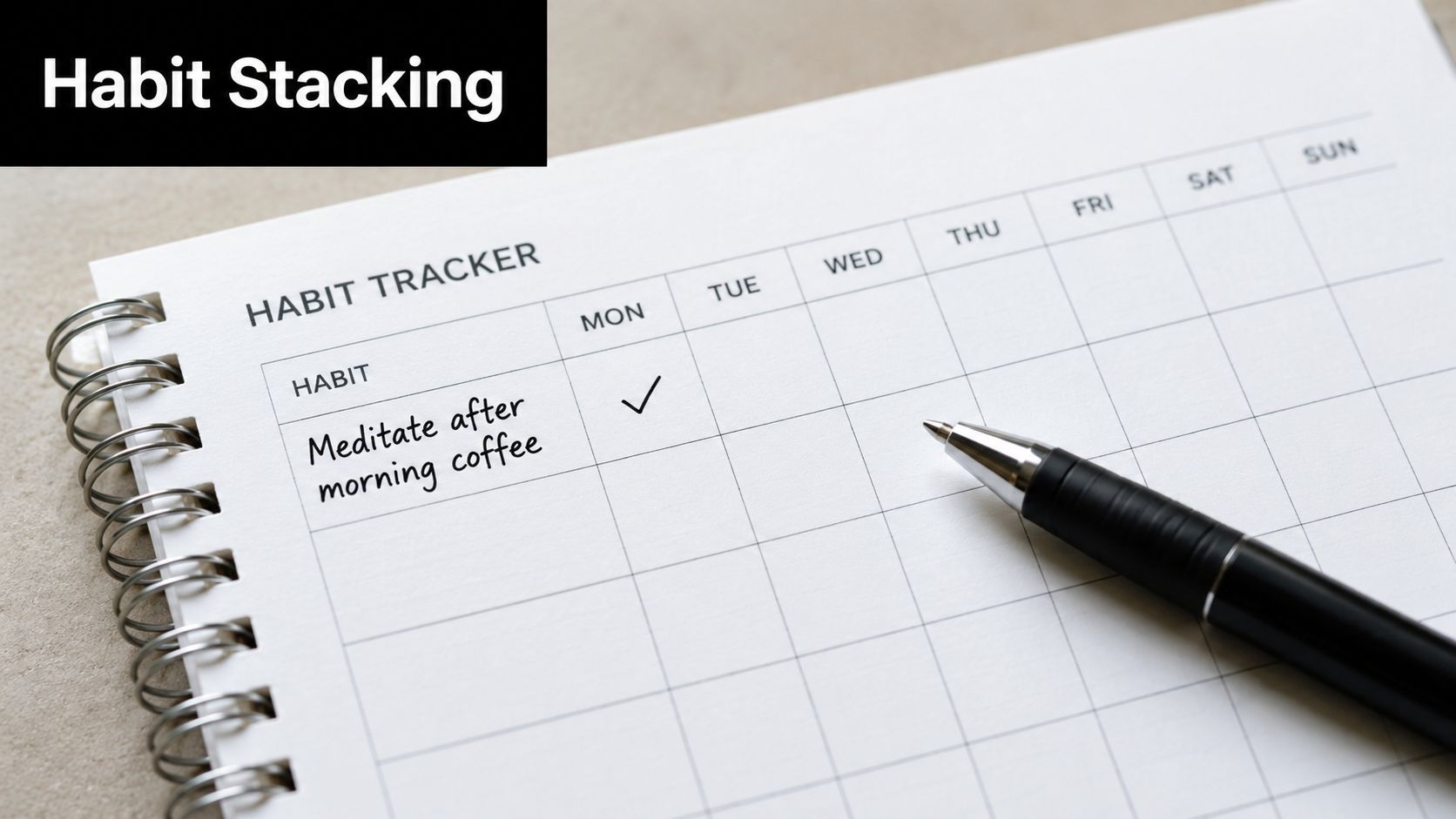
Habit products fail when they ask for too much change
A serious feasibility study for a behavior product should test achievability, not just desirability. The UK guidance makes that distinction explicit. Feasibility is about whether an idea is achievable and worthwhile under real constraints, especially when evidence is incomplete and assumptions need to be challenged rather than smoothed over. That lens matters here even without repeating the underlying source.
Habit formation products need to prove operational fit with real days. Can a user perform the habit in a crowded morning? Does the reminder arrive when it helps, not when it nags? Does the system tolerate missed days without collapsing motivation?
What a strong habit feasibility study includes
The best studies in this category usually combine lightweight prototyping, user diaries, and scenario analysis. You're not only measuring whether users check a box. You're testing whether a habit can survive travel, stress, workload spikes, and changing routines.
The signals I trust most are qualitative but concrete:
- Cue reliability: Users know when the habit should happen and what triggers it.
- Action size: The habit is small enough to complete consistently even on a bad day.
- Recovery design: Missing one session doesn't create guilt loops that cause abandonment.
A useful product in this space doesn't just track aspiration. It helps users tie milestones to routines they can sustain. That's why systems that connect goals, habits, and time awareness tend to be more durable than habit trackers that function as isolated checklists.
6-Project Feasibility Comparison
| Study / Example | Implementation Complexity 🔄 | Resource Requirements ⚡ | Expected Outcomes ⭐📊 | Ideal Use Cases | Key Advantages 💡 |
|---|---|---|---|---|---|
| SaaS Product Launch Feasibility (Slack) | High, extended internal beta, multi‑platform & integration testing | High, engineering, long beta funding, user research | ⭐⭐⭐⭐, validated PMF, organic network growth; slower revenue ramp | Early-stage productivity SaaS validating demand before scaling paid tiers | Reduced GTM risk; validated freemium-to-paid conversion; integration ecosystem |
| Mobile App Monetization (Habit‑Tracking) | Medium, pricing experiments, store compliance, A/B tests | Medium, user acquisition spend, analytics, App Store processes | ⭐⭐⭐, validated price points and subscription dynamics; higher churn risk | Consumer habit/productivity mobile apps optimizing subscription pricing | Clear price elasticity data; LTV:CAC insights; feature‑gating validation |
| AI‑Powered Coaching SaaS (WOOP) | Very High, ML models, personalization, continuous refinement | Very High, AI/ML talent, compute, privacy/compliance costs | ⭐⭐⭐⭐, higher engagement & goal completion; premium willingness‑to‑pay | Products seeking personalized daily coaching to boost retention & outcomes | Scalable personalized coaching; strong differentiation; improved retention |
| Time Tracking Integration (Toggl) | High, API design, webhooks, partner integrations & maintenance | High, engineering, partner support, integration QA | ⭐⭐⭐⭐, increased retention & LTV; ecosystem effects; ROI tracking complex | Tools aiming to embed time data into wider productivity/ecosystem workflows | Ecosystem growth; higher retention; reduced churn via connected workflows |
| OKR Implementation (Google) | Medium‑High, framework cascading, change management | Medium, training, tooling, ongoing coaching | ⭐⭐⭐⭐, improved alignment and measurable goal completion | Organizations/products aligning teams to measurable outcomes and milestones | Better alignment; measurable KRs; improved coordination and learning |
| Habit Formation & Routine Stacking (Atomic Habits) | Medium, habit UX, streaks, scheduling logic | Medium, behavior design, retention features, analytics | ⭐⭐⭐⭐, higher sustained goal completion when habits stick; requires engagement | Consumer apps focused on daily routines and incremental behavior change | Strong retention via streaks; reduced decision fatigue; compounding gains |
Your Action Plan
Across all six examples, the pattern is the same. Strong feasibility work asks sharper questions earlier. It doesn't assume market demand because the category is hot, and it doesn't assume internal readiness because the roadmap looks clean in a planning doc. It tests whether the product can work technically, commercially, operationally, and behaviorally before the expensive commitments begin.
That's also why a real feasibility study should end in decision-ready outputs, not a stack of observations. The most useful studies produce projected financial views, scenario comparisons, trade-off decisions, and a clear recommendation on whether to proceed, pause, narrow scope, or walk away. If your current document only describes the idea, you don't have a feasibility study yet. You have a concept note.
The fastest way to build your own is to identify the single riskiest assumption in each layer of the business. One for market demand. One for product behavior. One for operations. One for financial sustainability. Then design small tests that generate evidence, not opinions. For a SaaS product, that might be a constrained beta with clear usage observation. For mobile monetization, it might be feature gating and willingness-to-pay testing. For AI coaching, it might be recommendation quality reviews and scenario-based prototyping. For integrations, it might be ranking dependency by workflow value and support load.
Be honest about missing evidence. That's a mark of maturity, not weakness. The best feasibility project example doesn't pretend certainty where none exists. It documents what's known, what's unknown, how those gaps affect the decision, and what next step would reduce the biggest risk fastest.
Once the study says “yes,” the problem changes. You're no longer deciding whether the project is viable. You're deciding how to execute without losing the logic that made it viable in the first place. That's where a system like Beyond Time can fit naturally, because it translates validated goals into milestones, routines, and daily execution loops instead of leaving strategy disconnected from action. Tribble Software Private Limited is one company working in that direction through Beyond Time. If your team has already done the hard thinking and now needs structure for follow-through, that kind of bridge becomes useful. And if you're evaluating the cost of building internally versus staffing around process drag, it also helps to uncover hidden employee expenses before you commit.
If you've validated the opportunity and need a system to turn goals into milestones, routines, and daily follow-through, take a look at Tribble Software Private Limited. Beyond Time is built for people who don't just want to plan better. They want a working execution loop that keeps momentum visible day by day.
Put this into practice
Free tools that match this article.
AI Study Plan Generator
Generate a personalized study plan with proven learning techniques for exam success.
Try Study PlannerTime ManagementWeekly Schedule Template
Plan your week with a free printable weekly schedule template for goals, routines, and focus blocks.
Try Schedule TemplateFocusFocus Session Planner
Create AI-optimized focus sessions with structured work blocks and refreshing breaks.
Try Focus PlannerGoal SettingGoal Setting Worksheet
Turn a vague goal into milestones, habits, blockers, and a weekly review plan.
Try Goal WorksheetKeep exploring this topic
Beyond Time for students
See how students connect semester goals, study blocks, and routines.
Student success guide
Use Beyond Time to plan study sessions, habits, and academic goals.
Best goal tracking apps
Compare tools for goals, habits, and progress tracking.
Best habit tracker apps
Compare habit apps by use case, depth, and daily workflow.
Related Articles

How to Track Multiple Goals Without Getting Overwhelmed
Learn a proven system for managing multiple goals simultaneously without losing focus or burning out. Practical frameworks for tracking 3-5 goals at once.
Accountability Partner Guide: Achieve Goals Faster
Learn how to find, structure, and get the most from an accountability partner. Research shows accountability can boost goal achievement by up to 95%.
5-Year Plan Template: Build Your Life Roadmap Step by Step
Build your life with this step-by-step 5 year plan template. Set goals across 5 key life domains and break them into year-by-year milestones you can act on.
How to Set Life Priorities: A Framework for What Matters Most
Learn how to set priorities in life with a proven values-based framework. Discover what matters most and start building goals aligned with your life today.
Life Audit: The Complete Guide to Redesign Your Life
A life audit helps you step back, evaluate every major area of your life, and redesign it with intention. Discover how to do yours in five clear steps.
How to Stay Motivated: Science-Backed Strategies That Work
Struggling with how to stay motivated on long-term goals? Discover science-backed systems and practical strategies to build lasting motivation that sticks.