
Goal Setting for Students: A System for Academic Success
Master goal setting for students with our step-by-step system. Learn to set SMART goals, break them into daily actions, track progress, and achieve more.
You probably already have goals.
Get better grades. Stay on top of assignments. Stop cramming. Do well in exams. Maybe balance classes with work, sports, family responsibilities, or a schedule that changes every week.
The problem usually isn't ambition. It's translation. Students set a big academic goal, feel motivated for a day or two, then never convert that goal into a repeatable study system. The result is a long wish list and very little daily momentum.
Good goal setting for students works differently. A useful goal gives you direction, but a working system gives you traction. That means turning a broad target into milestones, then turning those milestones into study blocks, review habits, check-ins, and backup plans for bad weeks. That's where progress comes from.
Table of Contents
- From Vague Ideas to Crystal-Clear Objectives
- Create Your Roadmap by Breaking Goals into Milestones
- Connect Milestones to Your Daily and Weekly Routines
- Track Your Progress and Adjust Your Plan
- How to Handle Common Goal-Setting Obstacles
- Your Goal-Setting Toolkit for Lasting Success
From Vague Ideas to Crystal-Clear Objectives
Most students don't fail because they lack goals. They fail because their goals are too blurry to guide action.
“Do better in math” sounds responsible, but it doesn't tell you what to do on Tuesday at 7 p.m. “Get more disciplined” sounds motivating, but it gives you nothing to measure when your week gets messy. Vague goals create vague effort.
Research supports the practical version of this. A systematic review of higher-education goal-setting research found that goal setting is strongest when goals are specific and challenging, echoing Locke's classic findings. In the same research line, a Purdue study found that task-based goals increased the probability that a student completed at least one practice exam by more than 2 percentage points (Frontiers in Education). That matters because better academic outcomes usually start with better task completion.
Build one clear North Star
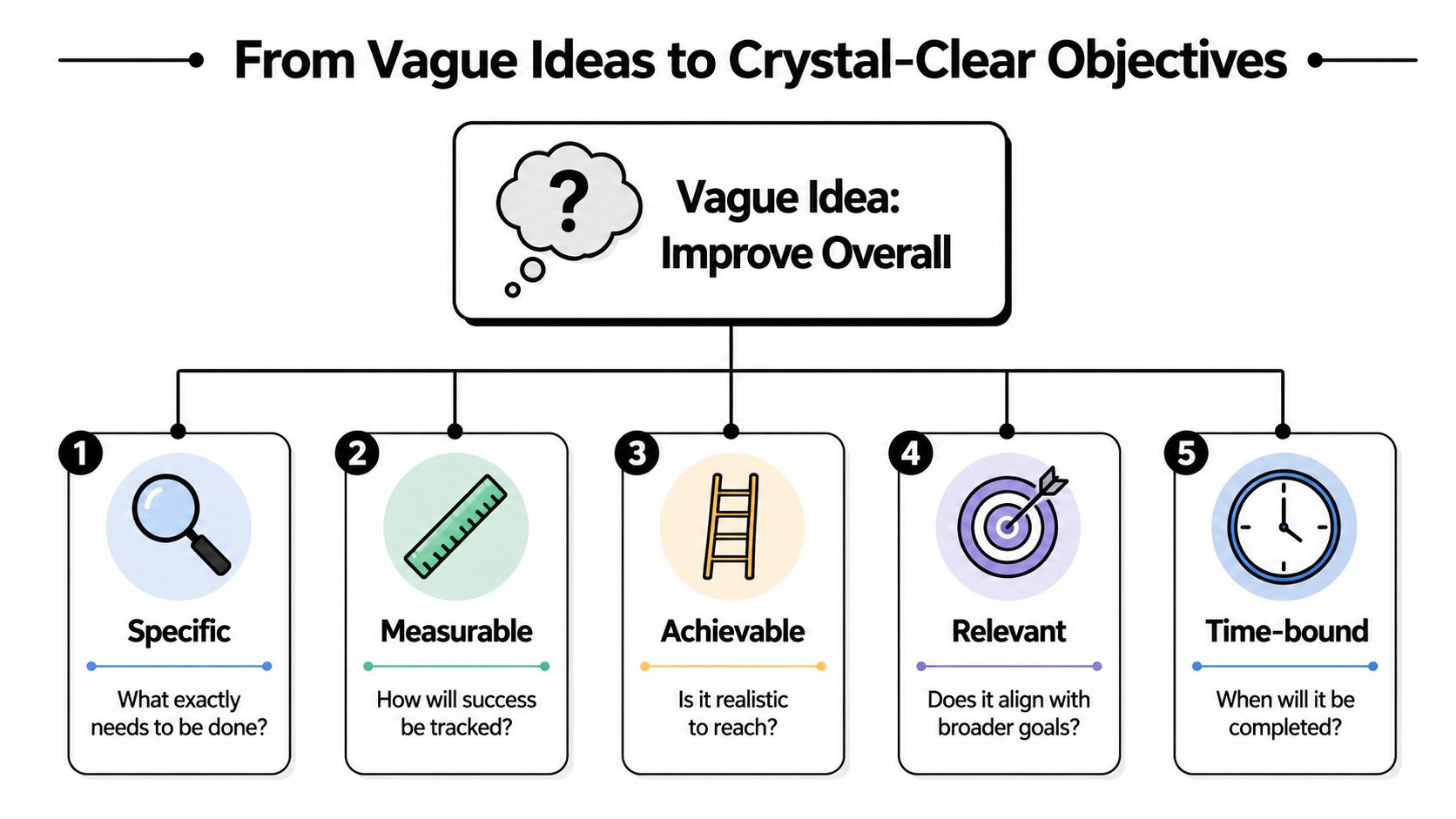
The SMART framework is useful, but many students treat it like a worksheet exercise. It works better as a filter for one semester goal that's clear enough to drive decisions.
Take this vague goal:
- Too vague: Get better at chemistry
Now tighten it:
- Specific: Achieve a final grade of 85% or higher in CHEM 101
- Measurable: Track quiz scores, practice exams completed, and tutoring attendance
- Achievable: Base the target on your current standing and available study time
- Relevant: It supports your degree plan or scholarship requirements
- Time-bound: Reach it by the end of the semester
That becomes: Achieve a final grade of 85% or higher in CHEM 101 by completing all practice exams and attending weekly tutoring through the end of the semester.
Practical rule: If your goal doesn't tell you what to do this week, it isn't finished yet.
Stress-test the goal before you commit
A strong academic goal should survive three questions:
Can you measure progress without guessing?
If not, rewrite it.Does it point to actions, not just outcomes?
“Earn an A” is incomplete on its own. “Earn an A by finishing every problem set and reviewing mistakes within 24 hours” is much stronger.Would a teacher, tutor, or study partner understand it instantly?
If they need an explanation, the wording is still fuzzy.
If you want help translating course demands into a better target, advanced syllabus mapping strategies can help you turn a syllabus, grading scheme, and exam schedule into something usable. For a broader planning model, these goal-setting frameworks are useful when you need more than a SMART template.
A clear goal does something important psychologically. It reduces negotiation. Instead of asking yourself whether you feel like studying, you ask whether today's action supports the target you already chose.
Create Your Roadmap by Breaking Goals into Milestones
A big academic goal becomes intimidating when it exists only as a final deadline.
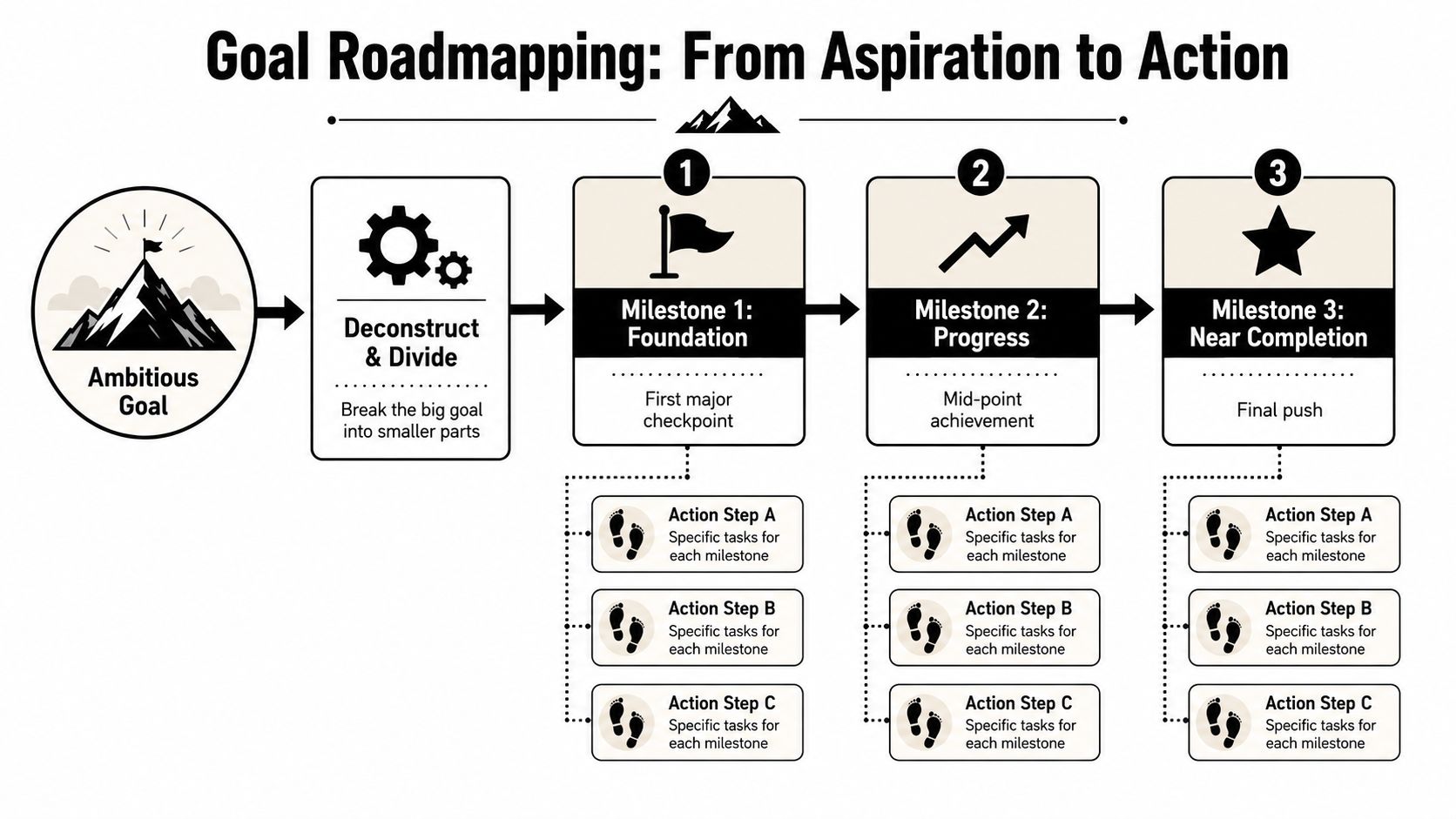
If your only target is “finish the semester strong,” your brain has nowhere to stand. You need intermediate checkpoints. That's how large goals become manageable. Not by shrinking the ambition, but by dividing the path.
Work backward from the finish line
NWEA's student-goal framework recommends keeping individual goals short-term, typically four to six weeks, with regular progress monitoring so students can adjust before the goal window closes (NWEA guidance). That advice is practical even outside a classroom system. It stops students from planning in giant, unmanageable chunks.
If your semester goal is an 85% in chemistry, don't stare at the final exam date. Reverse engineer it.
A useful sequence might look like this:
- End goal: 85% or higher in CHEM 101
- Checkpoint one: Understand foundational concepts and fix weak areas
- Checkpoint two: Perform strongly on the midterm and review mistakes
- Checkpoint three: Complete final practice under timed conditions
- Final stretch: Tighten recall, formula use, and exam pacing
This is also how strong test-prep plans work. If you're preparing for a high-stakes course or exam season, these smart AP test prep tips are helpful because they focus on structured preparation rather than last-minute effort.
Later, when you want a more formal way to think about checkpoints, this guide to examples of milestones in project management gives a good mental model. Students benefit from the same logic teams use. Big outcomes need intermediate proof that the plan is working.
A short explainer can help if you learn better visually:
Build milestones around skills, not just scores
A common mistake is setting milestones that only measure outcomes:
- Get 85 on the midterm
- Raise average grade
- Improve test performance
Those matter, but they don't tell you what capability has to improve first.
Better milestones sound like this:
- Master stoichiometry problem setup by Week 3
- Correct recurring mistakes in balancing equations by Week 4
- Complete one full practice set without notes by Week 5
- Review every missed quiz question within 48 hours
Good milestones describe the skill you're trying to build, not only the score you hope appears later.
When milestones are skill-based, bad results become easier to interpret. If a quiz goes poorly, you're not left with “I'm failing.” You can say, “I haven't yet stabilized equation setup under time pressure.” That's a fixable problem.
Connect Milestones to Your Daily and Weekly Routines
Most students lose momentum at this stage. The goal is clear. The milestones are written down. Nothing changes in daily life.
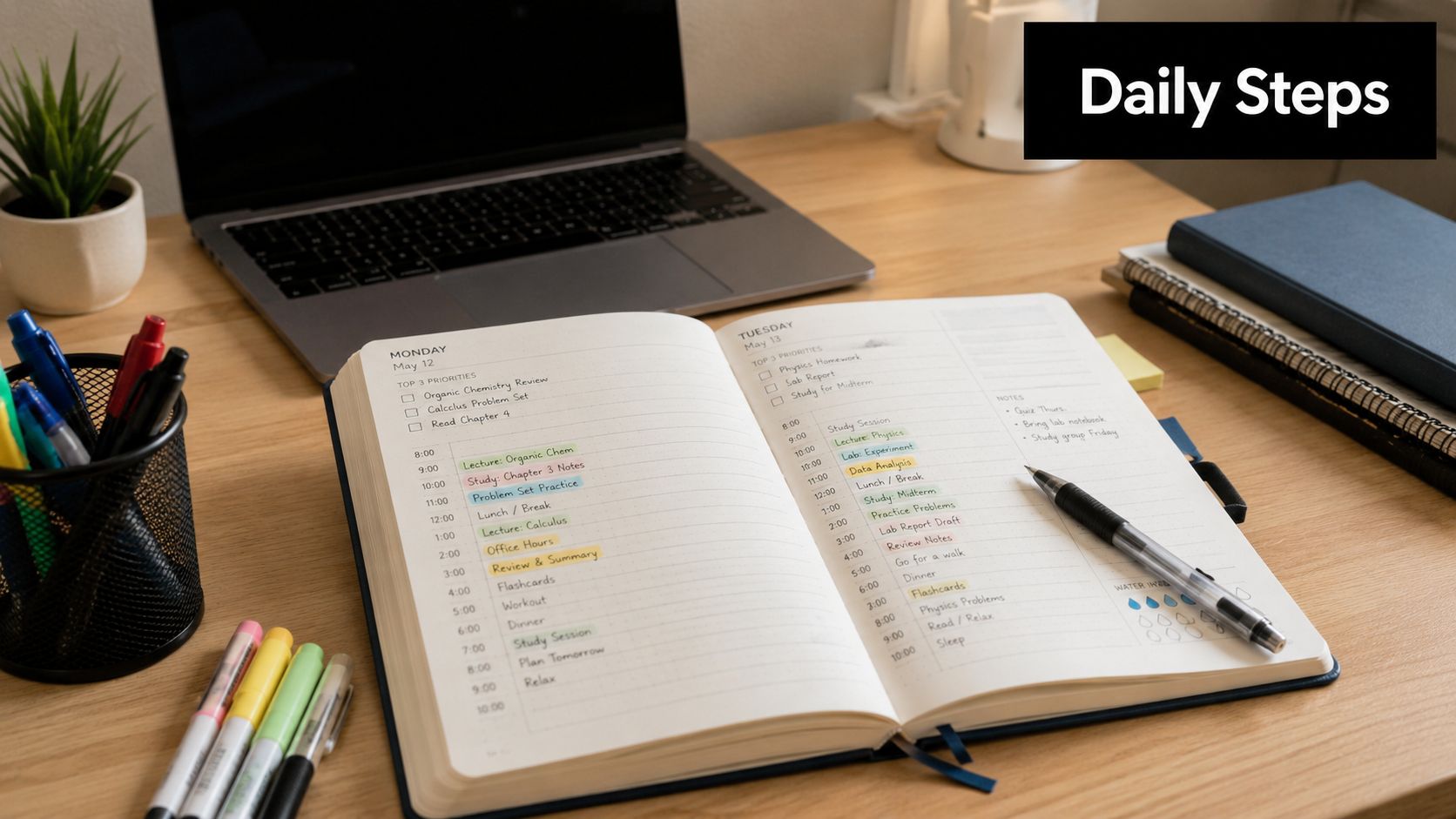
That happens because milestones don't execute themselves. Routines do. If your plan doesn't live in your calendar, study blocks, and after-class habits, it's still just intention.
Turn milestones into scheduled behaviors
Suppose your milestone is: Master stoichiometry by Week 4.
That's still too large for a normal weekday. It needs to become behavior:
- After each chemistry lecture: Review notes for 15 minutes and rewrite one confusing point
- Tuesday and Thursday: Complete 30 minutes of stoichiometry problems
- Saturday morning: Do one cumulative practice set and mark every error type
- Sunday evening: Decide what to repeat next week
Time blocking helps. Instead of saying “I'll study chemistry more,” assign it a place:
| Routine slot | Action |
|---|---|
| After class | Clean up notes and identify gaps |
| Early evening study block | Practice current topic problems |
| Weekend review block | Mixed retrieval and error review |
The goal of a routine isn't perfection. It's reducing friction. When the task already has a time and trigger, you spend less energy deciding.
Protect follow-through by narrowing your focus
Students often sabotage good systems by pursuing too many changes at once. Better grades, better sleep, more clubs, more revision, more exercise, more reading. Each goal may be valid, but the combination becomes unworkable.
Edutopia advises students to focus on only one to three goal areas per marking period to prevent burnout and improve follow-through (Edutopia framework). That's a strong rule for real life. If everything is a priority, your routine collapses under its own weight.
Try this filter:
- Primary goal area: Your most urgent academic target
- Secondary goal area: One supporting habit, such as attendance or weekly review
- Optional personal goal: Only if your schedule can absorb it
If you want a printable planning aid for mapping yearly aims into concrete actions, you can find this Kuraplan worksheet and adapt it into a weekly version.
Your routine should feel a little repetitive. That's usually a sign it's realistic.
A system beats a heroic study burst every time. Students who stay steady don't rely on motivation every day. They rely on recurring actions that still work when energy is average.
Track Your Progress and Adjust Your Plan
A goal-setting system breaks down when students only track effort emotionally.
“I studied a lot.”
“I felt behind.”
“I had a productive week.”
That kind of reflection isn't useless, but it's too fuzzy to improve your plan. You need a short review process that tells you what's working, what isn't, and what needs to change before the next week starts.
Use a simple weekly review
A Macmillan Learning study found that students who completed two or more goal-setting and reflection surveys performed significantly better, and assigning more than two surveys raised grades by an average of 3.4% to 8.4% depending on the number assigned. The same study reported that 75% of participating students agreed or strongly agreed that the surveys helped them improve as a student, and 80% agreed or strongly agreed that the surveys helped them think about their goals and learning habits in and out of class (Macmillan Learning research). The useful part isn't just the result. It's that the reflection process was lightweight.
You don't need a complicated dashboard. A 15-minute weekly review is enough if you answer real questions:
What got done?
List completed study blocks, assignments, or practice sets.Where did I get stuck?
Be specific. Low energy, unclear notes, late start, difficult topic, poor scheduling.What will I change next week?
Move a study block, reduce a target, get tutoring, or swap passive review for active practice.
If you prefer digital tools, a structured system such as progress tracking software can help you see whether your plan matches your actual behavior. The point isn't more admin. It's faster course correction.
Reflection works when it leads to a visible adjustment. Otherwise it becomes journaling without consequence.
Sample student goal breakdown
Here's what a workable plan looks like when you bring goal, milestone, and daily action together.
| Goal Area | SMART Objective | Weekly Milestone Example | Daily Action Example |
|---|---|---|---|
| Chemistry | Earn 85% or higher in CHEM 101 by completing practice exams and attending tutoring through the semester | Finish one topic review and complete one practice set this week | Review notes after class and solve practice problems for 30 minutes |
| Essay writing | Raise paper quality by submitting stronger drafts before deadlines | Complete outline and first draft by the weekly checkpoint | Write for 25 minutes after dinner and revise one paragraph the next day |
| Language study | Improve speaking confidence in class discussions this term | Practice target vocabulary and one speaking prompt this week | Spend 10 to 15 minutes reviewing terms and speaking aloud |
| Extracurricular leadership | Run club meetings with better preparation this month | Finalize agenda and delegate tasks before the next meeting | Check agenda items and send one follow-up message each afternoon |
This is the difference between a plan that sits in your notes app and a plan that changes your week.
How to Handle Common Goal-Setting Obstacles
Students often assume a broken plan means a broken person.
Miss a study block, fall behind on readings, bomb one quiz, and suddenly the story becomes “I'm not disciplined enough.” That story is wrong, and it damages follow-through more than the original setback.
Drop the all-or-nothing mindset
The fastest way to quit is to treat one bad stretch as proof that the whole system failed.
A better rule is this: missed actions are data. They tell you something about load, timing, difficulty, energy, or support. They don't tell you to stop.
When students recover well, they usually do three things:
- They shrink the next action. Instead of “catch up on everything,” they complete one page of notes, one problem set, or one revision block.
- They diagnose the bottleneck. Was the goal too large, the schedule unrealistic, or the task too vague?
- They reset quickly. They don't wait for Monday, next month, or a cleaner calendar.
Edutopia's guidance on student support highlights a major gap in most advice: the challenge often isn't creating a goal, but maintaining follow-through when time, energy, or support are limited (supporting student goal setting). That's the everyday reality for many students. A rigid plan often looks impressive and fails fast.
Build a plan for low-bandwidth weeks
If your schedule is unstable, your system has to include a reduced version of success.
Use minimum viable habits. These are actions small enough to survive tired days, commute-heavy weeks, family responsibilities, or device access issues.
Examples:
- Read one page of notes and highlight one uncertainty
- Solve two practice problems instead of a full set
- Open the assignment and draft the first sentence
- Review flashcards for one short session
- Message a classmate or teacher with one question
This approach matters for students who don't have stable conditions for ideal planning. If you work part-time, help at home, commute long distances, or share devices, you need flexible checkpoints and independent routines. A perfect planner won't solve an inconsistent week. A resilient system might.
On a hard week, protect continuity before intensity.
That one principle keeps many students moving. Momentum is easier to rebuild when you never fully disconnect from the goal.
Your Goal-Setting Toolkit for Lasting Success
Effective goal setting for students isn't a motivational exercise. It's an operating system.
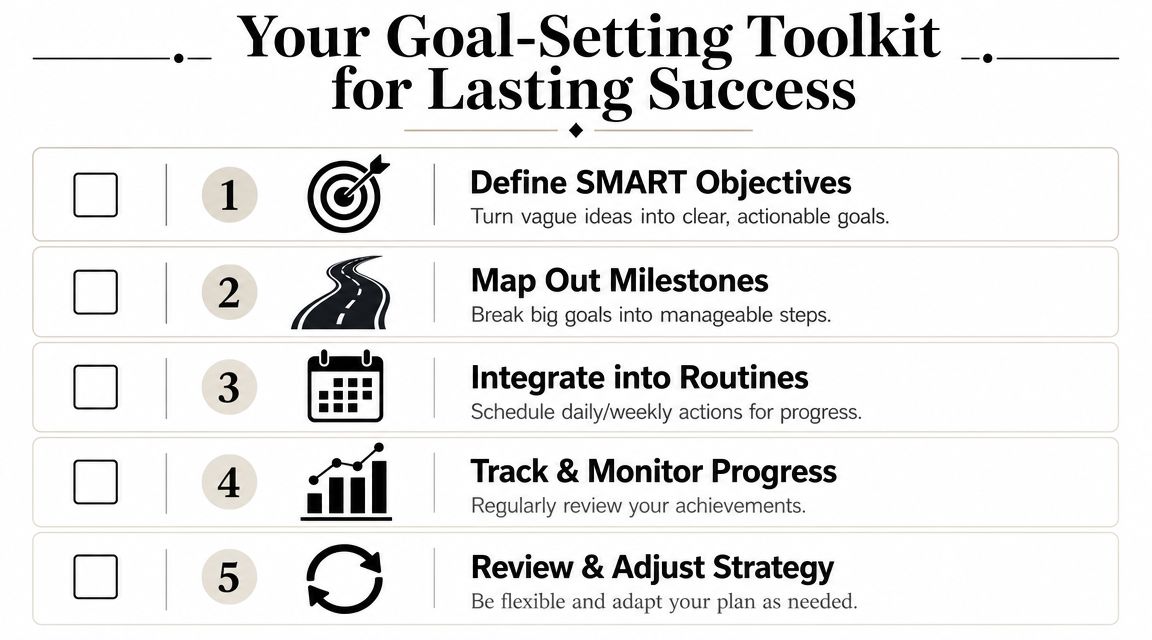
The strong version is simple to describe and harder to avoid. Pick a clear objective. Break it into short milestones. Attach those milestones to recurring routines. Review what happened. Adjust before small problems become big ones.
A working checklist you can use right away
Use this when you're setting up a new semester goal or rebuilding after a rough patch.
Define one clear objective
Write one academic target that is specific, measurable, and tied to actions.Limit active goal areas
Don't overload yourself. A narrow plan is easier to sustain than an ambitious mess.Create short milestones
Think in checkpoints that are close enough to review and adjust while they still matter.Schedule study behaviors
Put tasks into real time slots. After class, before dinner, library block, commute review, weekend recap.Run a weekly review
Ask what worked, what stalled, and what needs to change next week.Keep a reduced version for difficult weeks
Your backup plan should be small, real, and easy to restart.
One practical tool option is Beyond Time by Tribble Software Private Limited. It's an AI-powered system that turns goals into milestones, connects them to routines and habits, and tracks planned versus actual time. For students, that kind of setup can be useful when the main problem isn't choosing a goal but maintaining daily momentum across classes and changing schedules.
The deeper point is this. Students rarely need more pressure. They need more clarity. The right system removes ambiguity from the next step, and that changes how school feels. Work becomes less dramatic and more deliberate.
A good goal should make your days easier to direct, not harder to survive.
Keep going with Beyond Time
These Beyond Time tools and guides help you turn a semester goal into a daily system that actually holds.
- Goal Setting Worksheet — Write one clear, measurable goal in under five minutes.
- Goal Prioritization Matrix — Choose which goals deserve your limited study time now.
- Why Goals Fail: The Case for a Goal-First System — Understand the real reason good intentions stall out.
- Beyond Time for Academic Success — A student walkthrough of turning goals into daily momentum.
If you want help turning academic goals into milestones, routines, and daily follow-through, Tribble Software Private Limited builds tools for exactly that. Beyond Time connects goals to actionable roadmaps, habit systems, and progress tracking so you can spend less time planning in circles and more time moving.
Put this into practice
Free tools that match this article.
AI Study Plan Generator
Generate a personalized study plan with proven learning techniques for exam success.
Try Study PlannerTime ManagementWeekly Schedule Template
Plan your week with a free printable weekly schedule template for goals, routines, and focus blocks.
Try Schedule TemplateFocusFocus Session Planner
Create AI-optimized focus sessions with structured work blocks and refreshing breaks.
Try Focus PlannerGoal SettingGoal Setting Worksheet
Turn a vague goal into milestones, habits, blockers, and a weekly review plan.
Try Goal WorksheetKeep exploring this topic
Beyond Time for students
See how students connect semester goals, study blocks, and routines.
Student success guide
Use Beyond Time to plan study sessions, habits, and academic goals.
Goal setting guide
Start with the fundamentals of setting goals that turn into action.
Goal frameworks compared
Choose between SMART goals, OKRs, BHAGs, and 12-week goals.
Related Articles

10 Measurable Goals Examples for 2026
Find 10 powerful measurable goals examples for business, health, and career. Learn how to set and track SMART goals with specific metrics and routines for 2026.
Examples of Milestones in Project Management: 8 Key Types
Explore 8 examples of milestones in project management. Learn to set SMART milestones for any project, from software to personal goals, with actionable tips.
10 Personal Development Goal Examples for 2026
Discover 10 powerful personal development goal examples. Get SMART templates for career, finance, and health to start achieving your biggest goals today.

How to Track Multiple Goals Without Getting Overwhelmed
Learn a proven system for managing multiple goals simultaneously without losing focus or burning out. Practical frameworks for tracking 3-5 goals at once.
Accountability Partner Guide: Achieve Goals Faster
Learn how to find, structure, and get the most from an accountability partner. Research shows accountability can boost goal achievement by up to 95%.
5-Year Plan Template: Build Your Life Roadmap Step by Step
Build your life with this step-by-step 5 year plan template. Set goals across 5 key life domains and break them into year-by-year milestones you can act on.