10 Personal Development Goal Examples for 2026
Discover 10 powerful personal development goal examples. Get SMART templates for career, finance, and health to start achieving your biggest goals today.
Individuals often struggle with personal development not because they lack ambition, but because their goals never integrate with a typical Tuesday afternoon. “Get better at communication” sounds useful until work gets busy, energy drops, and nothing in your calendar tells you what to do next.
That gap between intention and execution is where most personal development goal examples fall apart. They give you ideas, not operating systems. Structured goals matter because people who set SMART goals are 42% more likely to achieve them, according to Qooper's guide to career development goals. The practical lesson isn't just “be specific.” It's that your goal needs a deadline, a measurement method, and a routine that survives real life.
This guide fixes that. You'll get 10 personal development goal examples you can use, each with a practical blueprint, a SMART template, and a realistic way to implement it without turning your life into a spreadsheet. If you want a broader planning layer for work growth, this career roadmap on Fluidwave is a useful companion.
Table of Contents
- 1. Building a Sustainable Daily Habit System
- 2. OKR-Based Goal Setting and Tracking
- 3. Developing Deep Work and Focus Capacity
- 4. Executive Function and Productivity System Design
- 5. Health and Fitness Goal Achievement Through Behavioral Design
- 6. Career Development and Skill Acquisition
- 7. Financial Goal Setting and Wealth Building
- 8. Learning and Knowledge Mastery Goals
- 9. Leadership Development and Influence Building
- 10. Creative and Artistic Expression Development
- 10-Point Personal Development Goals Comparison
- Your Next Move Turn These Examples into Achievements
1. Building a Sustainable Daily Habit System
Most habit plans fail because they start at the level of identity fantasy. Someone decides they're going to journal, meditate, read, stretch, meal prep, and study every day. By day six, the whole system collapses.
A sustainable habit system starts with one behavior that's small enough to survive low-motivation days. For a founder, that might be a 5-minute end-of-day review. For a student, it might be opening Anki after breakfast. For a developer, it could be 15 minutes in Cursor or VS Code before checking Slack.
Start smaller than your ambition
Consistency is the effective lever. Treat habit completion as the win, not the eventual outcome. If your goal is to become more organized, the habit might be “plan tomorrow before shutting down today.”
Practical rule: Don't add a second habit until the first one feels boring.
Use existing routines as anchors. Coffee, commute, lunch, shutting your laptop, or brushing your teeth are better triggers than motivation. If a habit has no trigger, it becomes a daily negotiation.
- Good trigger: “After I make coffee, I'll review my top priority.”
- Bad trigger: “I'll do it when I have time.”
- Good measurement: “Completed 6 days this week.”
- Bad measurement: “Felt productive.”
Copy this template
Use this when you want one of the simplest personal development goal examples to stick.
Working professional: “For the next 30 days, I'll spend 5 minutes after opening my laptop to choose my top task for the day and log completion before 6 p.m.”
Founder: “For the next 4 weeks, I'll do a 10-minute nightly review after dinner to note what moved the business forward and what to adjust tomorrow.”
Student: “For the next 21 days, I'll study one flashcard set immediately after breakfast and mark it complete in my tracker.”
If you miss a day, don't redesign the system. Restart the next day. People get stuck because they turn one miss into a story about their character.
2. OKR-Based Goal Setting and Tracking
SMART goals are excellent for precision. OKRs are better when you need ambition plus focus. The mistake people make is treating them like a corporate ritual instead of a personal operating model.
An objective gives direction. Key results prove movement. If your objective is “become a stronger operator,” the key results can't be “read three books” and “watch some videos.” Those are inputs. You need results that show changed capability.
Separate direction from proof
A product manager might set an objective like “become trusted to lead more complex launches.” Their key results could include shipping a cross-functional release, improving stakeholder communication cadence, and leading post-launch review with documented lessons. A student might use an objective like “build real fluency in data analysis,” then tie it to project completion and portfolio output.
Keep the list short. If you're juggling too many objectives, you're not focused. You're just busy in an organized format.
Broad ambition works better when it becomes a tracked structure. The trap is writing inspiring objectives with no weekly review.
Weekly reviews matter more than perfect planning. I've seen people write beautiful quarterly goals in Notion, Asana, or ClickUp and never open them again. The people who make progress check them every week and ask one blunt question: what moved this forward?
Copy this template
Professional:
Objective: Become a stronger cross-functional communicator this quarter.
Key Result 1: Lead one weekly project update with clear written decisions.
Key Result 2: Collect feedback from three stakeholders by quarter end.
Key Result 3: Deliver one project retrospective with documented improvements.
Founder:
Objective: Build a more reliable operating cadence this quarter.
Key Result 1: Run a weekly planning session every Monday.
Key Result 2: Review business priorities every Friday.
Key Result 3: Complete planned leadership work blocks each week.
Student:
Objective: Build practical machine learning ability this term.
Key Result 1: Finish one foundational course.
Key Result 2: Complete two applied projects.
Key Result 3: Publish one project summary online.
3. Developing Deep Work and Focus Capacity

If your day is chopped into messages, tabs, and meetings, focus doesn't fail because you lack discipline. It fails because your environment is designed for interruption.
Deep work is one of the highest-value personal development goal examples for knowledge workers because it improves the quality of your thinking, not just output volume. Writers need it to draft. Engineers need it to solve architecture problems. Founders need it to think beyond inbox gravity.
Protect your best hours
Start by identifying your best cognitive window. Some people think clearly at 7 a.m. Others hit their stride late afternoon. Don't copy someone else's schedule. Protect your strongest window for your hardest task.
A simple structure works well:
- Choose one focus block: Start with 45 to 90 minutes.
- Remove visible distractions: Phone away, Slack closed, browser tabs reduced.
- Define one deliverable: Draft section, solve bug, outline proposal, review dataset.
- End with a shutdown note: Write the next step before you stop.
The biggest mistake is scheduling deep work and then filling that block with “important but easy” tasks. Email triage isn't deep work. Admin cleanup isn't deep work. If the task can be interrupted without real cost, it belongs somewhere else.
A useful support here is planned-versus-actual tracking. When you compare what you intended to focus on with what you did in practice, you stop guessing about your distraction patterns.
Copy this template
Engineer: “For the next 5 workdays, I'll block 9:00 to 10:30 a.m. for uninterrupted coding on one predefined task and record whether I protected the block fully.”
Writer or creator: “For the next 4 weeks, I'll complete three distraction-free morning writing sessions each week and end each session with the next sentence or section to start.”
Manager: “For the next month, I'll reserve two weekly blocks for strategic work, with notifications off and one defined deliverable per block.”
4. Executive Function and Productivity System Design
Much productivity advice assumes you are failing because you have not found the right app. Usually, that is not the case. The issue is that your system does not reduce friction where you struggle.
Some people struggle with task initiation. Others struggle with prioritization, working memory, or transition costs between roles. A parent-founder, for example, needs more buffers and recovery margins than a solo freelancer with a clean calendar. A strong system accounts for that.
Build a system that matches your real constraints
A good personal productivity system has four parts. Capture tasks somewhere trusted. Decide what matters today. Put meaningful work on the calendar. Review often enough that the system stays alive.
The exact tools can vary. Apple Reminders, Todoist, Motion, Notion, Sunsama, a paper notebook. Tool choice matters less than behavioral clarity. If you have tasks in your inbox, notes app, Slack DMs, and your head, you don't have a system. You have leakage.
Here's a simple build:
- Capture layer: One inbox for tasks.
- Planning layer: Daily top three plus weekly priorities.
- Calendar layer: Time blocks for work that requires attention.
- Review layer: End-of-day reset and weekly cleanup.
A short explainer can help if you're rebuilding from scratch:
Copy this template
Busy professional: “For the next 30 days, I'll capture all tasks in one system, choose a daily top three by 9 a.m., and complete a 10-minute shutdown review before ending work.”
Founder with variable days: “For the next month, I'll run a weekly 90-day priority review every Sunday and block time for the most important business task before booking reactive work.”
Student: “For the next term, I'll plan assignments every Sunday, break each into next actions, and schedule study blocks directly on my calendar.”
5. Health and Fitness Goal Achievement Through Behavioral Design
Health goals break when people rely on mood. They decide they'll “start eating better” or “work out more,” then leave every decision to the hardest moment of the day.
A better approach is environmental design. Put your gym clothes where you'll see them. Pre-decide your workout days. Buy groceries that support the plan. Remove the need to negotiate with yourself at 7 p.m.
Make the healthy choice the easy choice
Workplace stress matters here. It's not abstract. Dovetail's report on personal development goals states that workplace stress costs the global economy $1 trillion annually in lost productivity, and 77% of workers report burnout affecting performance. That's one reason health and time-management goals aren't “nice to have.” They directly affect whether you can function consistently.
Effective health goals prioritize behavior. While weight, pace, physique, and lab markers are important, daily actions drive those results. One keystone habit often achieves more than a complete overhaul. Walking after lunch, lifting three times a week, or preparing tomorrow's meals tonight can change a lot.
You don't need the perfect fitness program. You need a repeatable one that still works during stressful weeks.
Copy this template
Office professional: “For the next 8 weeks, I'll walk for 20 minutes after lunch on weekdays and complete two strength sessions each week.”
Founder: “For the next 30 days, I'll train three mornings each week before checking email and prepare my weekday lunches the night before.”
Student: “For the next 6 weeks, I'll go to the gym on Monday, Wednesday, and Friday after class and log each workout before leaving.”
If you want this to last, define the minimum version in advance. On bad days, a 10-minute walk still counts. That keeps identity intact.
6. Career Development and Skill Acquisition
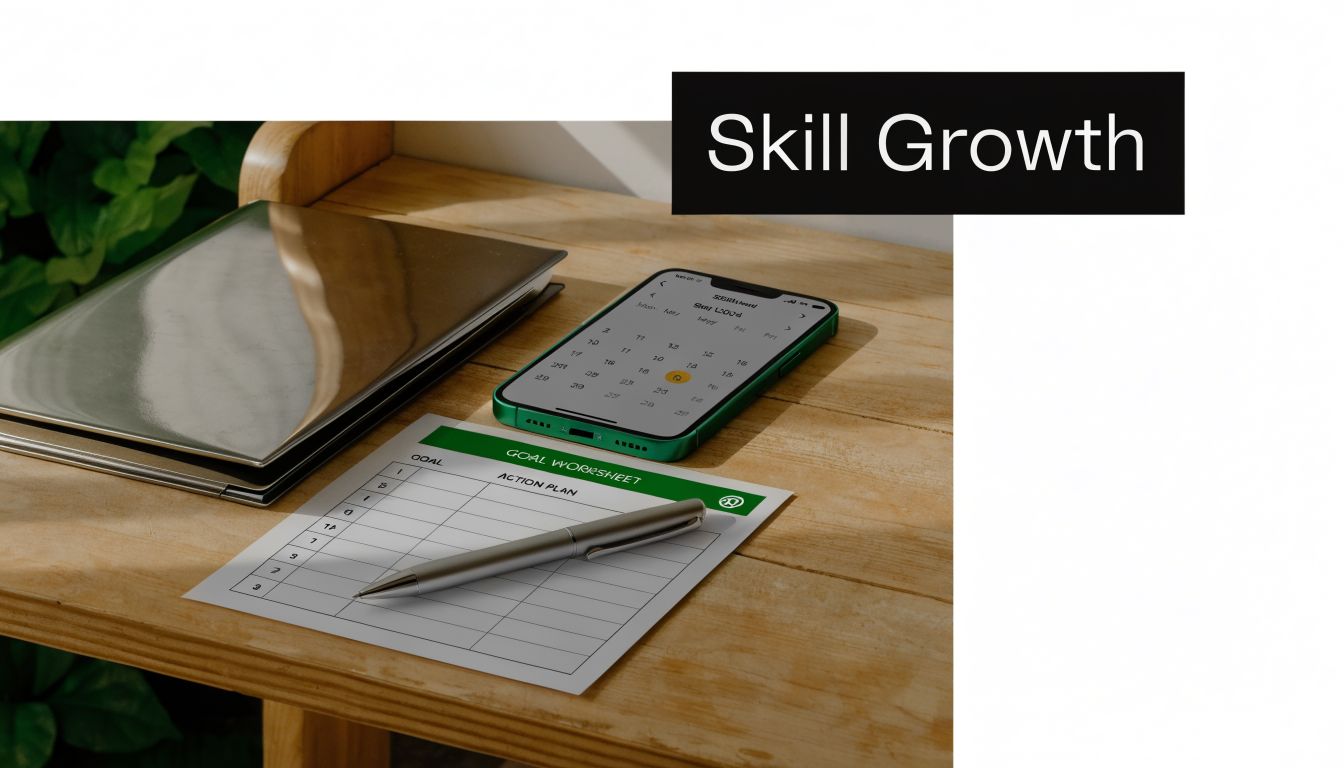
What changes a career. More content, or more proof?
Career progress usually breaks down at the transfer point between learning and use. People finish courses, save articles, and collect certificates, yet their manager, clients, or hiring panel still cannot see stronger output. Skill acquisition only counts when it shows up in decisions, communication, shipped work, or measurable ownership.
That is the standard to use for this category. Pick a skill that changes your market value, define where you will apply it, and decide how someone else will evaluate the result. Without that third part, people tend to overrate progress.
A good career goal has four parts:
- Target skill: the capability that will open better work, pay, or scope
- Work sample: a visible artifact that proves you can use the skill
- Feedback loop: a manager, mentor, peer, or client who can assess quality
- Timeline: a short deadline that forces practice before motivation fades
I have seen ambitious professionals waste months “preparing” for a move they could have tested in three weeks. If you want to move from backend engineering into product, write a spec, interview users, and present a recommendation. If you want to become a stronger manager, improve your one-on-ones, document follow-ups, and ask direct reports what changed. If you want to switch careers, build proof before you announce the switch.
Build the goal around evidence
The strongest skill goals produce something concrete. That might be a dashboard, a case study, a presentation, a repo, a pricing memo, or a process improvement that your team adopts. Evidence beats intention.
This is also where trade-offs get real. Deep skill building takes time away from reactive work, and public practice creates the risk of visible mistakes. That is still better than private study with no signal. Early, imperfect proof gives you feedback while the stakes are still manageable.
If career growth is tied to compensation or role changes, your planning should connect to money decisions too. managing personal budgets with Fintrack can help if you need to fund training, manage an income transition, or set a timeline for a role change.
Copy this template
Engineer aiming for promotion: “Within 12 weeks, I'll improve my SQL skills by building one production-ready reporting query, documenting the business logic, and reviewing the final version with a senior analyst for feedback.”
People manager: “By the end of this quarter, I'll strengthen coaching skills by using a written structure for every one-on-one, tracking agreed actions, and asking two direct reports each month what became clearer or more useful.”
Career changer: “Within 90 days, I'll complete one foundational course in my target field, publish two portfolio pieces that show applied skill, and schedule three conversations with professionals who can critique my work.”
Freelancer: “Over the next 8 weeks, I'll improve client communication by sending a clearer project brief before kickoff, using a weekly update template, and asking each client for one piece of feedback at project close.”
Keep the scope tight enough that you can finish, review, and either expand or correct course. Career development works best as a series of short proof cycles, not one vague annual intention.
7. Financial Goal Setting and Wealth Building
Financial goals are where vagueness gets expensive. “Save more” rarely changes behavior. “Transfer money automatically on the first business day of the month” does.
The strongest financial goals separate what you control from what you don't. You control savings rate, pricing, outreach, budgeting cadence, and debt payments. You don't control market returns, hiring cycles, or macro conditions.
Tie money goals to behaviors you control
If you're employed, your money system might center on automated transfers, expense review, and skill-building that increases earning power. If you're self-employed, it may focus on revenue consistency, pricing discipline, and profit review. For founders, this often overlaps with runway and salary design.
A lot of people fail here because they only track outcomes. Track behaviors too. If the outcome lags, you'll still know whether the system is working.
A useful companion for this area is managing personal budgets with Fintrack, especially if your money goals need a clearer monthly structure.
Copy this template
Employee: “For the next 6 months, I'll transfer a fixed amount to savings on payday, review spending every Sunday, and cut one recurring expense that doesn't support my priorities.”
Freelancer or consultant: “For the next quarter, I'll send proposals on a fixed weekly schedule, review profit monthly, and raise prices for new clients using a predefined threshold.”
Founder: “For the next 90 days, I'll review business cash position weekly, define acceptable spending bands, and tie discretionary expenses to current priorities.”
Don't make financial goals purely restrictive. The point isn't punishment. It's optionality.
8. Learning and Knowledge Mastery Goals
People often confuse exposure with mastery. Reading a book, watching lectures, or finishing a course can feel productive, but knowledge becomes useful only when you can retrieve it, apply it, and explain it.
This is why many personal development goal examples around “learn a new skill” underperform. They stop at study plans. Real mastery includes deliberate use.
Consumption feels productive. Creation proves it
A strong learning system usually has four stages. Build a base. Apply it in small projects. Explain it to someone else. Return to weak spots. That loop works for programming, marketing, language learning, design, research methods, and sales.
If you're learning machine learning, for example, don't stop with lecture videos. Build a tiny model, write up what failed, and compare your decisions with more experienced practitioners. If you're learning persuasion, practice it in sales calls, meeting proposals, or copy drafts.
The test for learning isn't whether you recognized the idea. It's whether you could use it without the book open.
Copy this template
Student: “Over the next 10 weeks, I'll study one topic each week, create one practice output, and write a short summary in my own words after each session.”
Knowledge worker: “For the next quarter, I'll learn one high-value domain skill, apply it to one real project, and present the result to a colleague or manager.”
Self-directed learner: “For the next 30 days, I'll read one chapter or lesson per weekday and create a note or artifact that shows how I'd apply it.”
Use spaced repetition if the field is memory-heavy. Use project work if the field is performance-heavy. Most domains need both.
9. Leadership Development and Influence Building
Leadership development isn't about sounding more confident. It's about becoming more useful in moments of uncertainty, conflict, and coordination.
A lot of emerging leaders choose the wrong goal. They focus on presence before clarity, or authority before trust. Strong leadership usually starts with better listening, clearer decisions, more honest communication, and follow-through people can rely on.
Leadership grows through feedback loops
The most effective leadership goals have outside observation built in. That can come from a mentor, manager, coach, peer group, or structured review process. In a UK case study summarized by the Institute for Employment Studies report on personal development plans, employees using competence-framed PDPs with feedback and self-reflection improved targeted competencies more than non-PDP groups. That lines up with what practitioners see every day. Leadership grows faster when reflection meets feedback.
Use specific situations for practice. Don't set “become a better leader” as a standalone goal. Set “run clearer one-on-ones,” “handle conflict earlier,” or “communicate decisions with context.”
- If you manage people: Improve one recurring management conversation.
- If you lead projects: Tighten decision-making and follow-up.
- If you influence without authority: Improve persuasion through clearer writing and stakeholder mapping.
Copy this template
New manager: “For the next 8 weeks, I'll run weekly one-on-ones with a consistent agenda, ask one coaching question before giving advice, and request feedback from each direct report at the end of the period.”
Founder: “This quarter, I'll improve team clarity by writing weekly priority updates, documenting key decisions, and reviewing what created confusion.”
Senior IC: “For the next month, I'll strengthen cross-functional influence by clarifying asks in writing before meetings and following up with decisions and owners.”
10. Creative and Artistic Expression Development

Creative goals usually die from over-importance. People attach so much identity to the output that they stop producing. They wait until they have enough time, enough certainty, enough inspiration. That wait can last years.
The fix is simple and uncomfortable. Lower the stakes and increase the reps. Volume creates skill. Skill creates quality later.
Volume before refinement
If you want to write, publish regularly. If you want to draw, sketch often. If you want to make music, finish more rough pieces. Creative growth needs output, feedback, and iteration.
This is one area where public accountability can help. A weekly blog, a small YouTube channel, a design challenge, or sharing drafts with a trusted group gives the work a rhythm. Don't chase validation too early. Chase consistency.
Here are solid starting structures:
- Writer: Publish one short post each week.
- Designer: Create one interface study each weekday.
- Musician: Record one draft idea every weekend.
- Video creator: Ship one short clip on a set schedule.
Copy this template
Writer: “For the next 12 weeks, I'll publish one short article every week and spend one session revising based on feedback or self-review.”
Designer: “For the next 30 days, I'll create one daily design study, save the best versions, and note one principle I learned from each.”
Musician or artist: “For the next 8 weeks, I'll complete one small piece every week, even if it's imperfect, and review the body of work every Sunday.”
Accept the awkward stage. Every serious creator has one.
10-Point Personal Development Goals Comparison
| Approach | 🔄 Implementation complexity | ⚡ Resource requirements | 📊 Expected outcomes | Ideal use cases | ⭐ Key advantages / 💡 Tips |
|---|---|---|---|---|---|
| Building a Sustainable Daily Habit System | Medium, setup + iterative refinement | Low daily time (2–5 min), simple trackers | Slow, compounding behavior change over weeks→months | Habit formation, micro-skills, routine anchoring | High consistency, low friction. 💡 Start with one habit and track completion. |
| OKR-Based Goal Setting and Tracking | High, methodology adoption & cadence setup | Moderate, measurement tools, coordination across teams | Measurable quarterly progress; alignment and prioritization | Teams, organizations, ambitious cross-functional projects | Drives transparency and focus. 💡 Limit to 3–5 OKRs and review weekly. |
| Developing Deep Work and Focus Capacity | Medium–High, schedule and culture protection | Moderate, uninterrupted time blocks, environment tweaks | Large-quality outputs in weeks; skill-depth gains over months | High-complexity creative/engineering tasks | Produces high-value work fewer hours. 💡 Block peak cognitive hours and ritualize. |
| Executive Function and Productivity System Design | High, personalized system design & maintenance | High, integrated tools, regular reviews, setup time | Scales execution, reduces decision fatigue quickly after adoption | Complex workflows, leaders, neurodivergent needs | Externalizes cognitive load for sustainable productivity. 💡 Fix top 3 bottlenecks first. |
| Health and Fitness Goal Achievement Through Behavioral Design | Medium, planning, measurement, environmental tweaks | Moderate, workout time, tracking, possible coaching | Visible health improvements in weeks→months (metrics-based) | Weight, strength, metabolic health, lifestyle change | Tangible, motivating progress. 💡 Pick meaningful metrics and design your environment. |
| Career Development and Skill Acquisition | Medium–High, deliberate practice plan + portfolio | Moderate–High, mentors, projects, time investment | Career shifts and earning increases over 1–2+ years | Role changes, promotions, founder skill stacks | High ROI over career span. 💡 Focus on 10x skills and build visible artifacts. |
| Financial Goal Setting and Wealth Building | Medium, planning + milestone tracking | Variable, income strategies, automation tools | Clear numeric milestones; progress visible monthly→years | Savings targets, revenue goals, debt payoff | Creates decision rules and momentum. 💡 Automate savings and track controllables. |
| Learning and Knowledge Mastery Goals | High, structured curriculum, deliberate practice | High, courses, mentors, projects, feedback loops | Deep expertise over years; capability benchmarks improve with practice | Research, technical mastery, expert roles | Produces durable expertise. 💡 Apply learning to projects and teach to solidify. |
| Leadership Development and Influence Building | High, requires feedback systems & practice | Moderate, coaching, peer groups, structured feedback | Slow, high-leverage impact on teams and org outcomes | Managers, founders, emerging executives | Multiplies impact through others. 💡 Use 360 feedback and an external coach. |
| Creative and Artistic Expression Development | Medium, output cadence + feedback integration | Low–Moderate, regular time, basic tools, community feedback | Portfolio growth and creative skill increase in months | Writers, designers, musicians, creators building audience | Builds differentiation and intrinsic satisfaction. 💡 Set output quotas and publish regularly. |
Your Next Move Turn These Examples into Achievements
What happens if you stop collecting goal ideas and build one goal into your week?
Choose one goal from this list and run it as a 30 to 90 day project. That framing matters. A goal sounds motivational. A project forces decisions about scope, schedule, and trade-offs. If you pick a habit goal, define the minimum version you can complete on low-energy days. If you pick a career goal, attach it to visible output such as a portfolio piece, presentation, certification, or documented result. If you pick a health or financial goal, set up the environment first: calendar blocks, defaults, automatic transfers, meal prep, or training sessions booked in advance.
A common mistake is treating goals as statements instead of operating systems. The written goal is only the front page. The working part is the structure behind it: trigger, next action, review rhythm, and recovery plan. Life will interrupt the plan. Work surges. Kids get sick. Travel breaks routines. Energy drops. A plan that survives those weeks is better than an ambitious plan that works only under perfect conditions.
Start with a SMART version, then push it one step further. Give it a persona, a deadline, and a delivery mechanism.
A few examples:
- Early-career professional: "For the next 8 weeks, I will improve stakeholder communication by sending a concise weekly project update every Friday by 3 p.m. to my manager and key collaborators, then asking for one piece of feedback at the end of each month."
- Busy parent rebuilding fitness: "For the next 12 weeks, I will complete three 20-minute strength workouts each week at home before breakfast on Monday, Wednesday, and Saturday, using a printed plan and tracking each session on the fridge."
- Freelancer improving finances: "For the next 90 days, I will transfer a fixed percentage of every client payment into taxes and savings within 24 hours of receiving it, and review cash flow every Sunday evening for 15 minutes."
- Student building deep work: "For the next 6 weeks, I will complete one 45-minute distraction-free study block each weekday at 4 p.m. in the library, with my phone in my bag and a written task chosen before I start."
These work because they are specific enough to execute and flexible enough to survive real life.
The next decision is ambition. A frequent cause of failure is loading five self-improvement projects into the same month. I see this often with motivated clients after a strong weekend reset. They try to fix sleep, fitness, reading, budgeting, and skill-building at once. The first difficult week breaks the plan, and they misread that as a discipline problem. It is usually a sequencing problem.
Run one primary goal. Support it with one or two maintenance habits at most.
Feedback closes the gap between intention and performance. If the goal touches leadership, communication, creative output, or career growth, ask someone to review real work, not just encourage you. A manager can comment on clarity. A coach can spot friction in your system. A training partner can increase follow-through. A friend can notice when your goal has become too vague to execute.
Tools help when they reduce friction, not when they add another layer of planning. Beyond Time turns a goal into milestones, linked routines, and daily focus blocks, which is useful for people who already know what they want but need a clearer execution path. The value is not the goal statement stored in an app. The value is seeing the next step, when to do it, and what got skipped.
Start small, but make it concrete. Copy one template from this article. Rewrite it in your own words. Put the first action on your calendar today, then schedule the review that keeps the goal alive after the first burst of motivation.
Keep going with Beyond Time
Ready to move from examples to a real plan? These Beyond Time tools and reads will get you there.
- Goal Prioritization Matrix — Find out which goal deserves your energy first.
- 30-Day Challenge Generator — Turn any personal goal into a 30-day action plan.
- Why Goals Fail — The Case for a Goal-First System — Understand the real reason most intentions never stick.
- SMART vs OKR vs BHAG: Goal Frameworks Compared — Pick the right framework for where you are right now.
Tribble Software Private Limited built Beyond Time for exactly this problem: turning a personal goal into a practical execution system. If you want AI help breaking goals into milestones, linking them to routines, tracking time in 15-minute blocks, and seeing what moved you forward, it's a strong fit for founders, professionals, students, and self-improvers who are done collecting plans and ready to follow one.
Put this into practice
Free tools that match this article.
Goal Setting Worksheet
Turn a vague goal into milestones, habits, blockers, and a weekly review plan.
Try Goal WorksheetPersonal DevelopmentPersonal Development Plan Generator
Generate a personalized development plan with quarterly milestones, skill gaps, and daily habits tailored to your goals.
Try Development PlanAssessmentLife Audit Tool
Score your life in 6 key areas and get a personalized action plan to create balance and fulfillment.
Try Life AuditGoal SettingSMART Goal Validator
Instantly validate your goals against the SMART framework and get actionable improvement suggestions.
Try SMART ValidatorKeep exploring this topic
Goal setting guide
Start with the fundamentals of setting goals that turn into action.
Goal frameworks compared
Choose between SMART goals, OKRs, BHAGs, and 12-week goals.
Life audit guide
Review the areas of life that need more attention and intention.
Personal development plan
Create a growth plan that connects identity, habits, and goals.
Related Articles
AI Accountability Partner: Smarter Goal Setting
Tired of missed goals? An AI accountability partner provides the structure & feedback you need. Explore benefits, workflows, and tools.
The Force of Habit: Master Your Autopilot for Success
Learn what the force of habit is and how to use its power. This guide explains the neuroscience and gives you evidence-based strategies to build good habits.
How to Be Efficient and Productive: A 2026 System
Stop being busy and start being efficient and productive. Learn a practical, AI-enhanced system to set goals, track progress, and build unstoppable momentum.
New Years Goals Ideas: 10 New Year's Goals Ideas for 2026
New years goals ideas - Ready for 2026? Get 10 actionable New Year's goals ideas for professionals, founders, & students. Practical steps to achieve them
8 Peer Feedback Examples: Drive Growth in 2026
Discover 8 peer feedback examples for positive, corrective, & developmental conversations. Drive results & build momentum with effective feedback in 2026.
Regain Focus and Clarity: A System for High Achievers
Stop feeling busy and start being effective. Learn a practical, evidence-backed system to build sustained focus and clarity for meaningful, measurable results.