How Many Hours in a Week? 168, and How Many Are Yours
How many hours in a week? 168. About 56 go to sleep and 112 are waking hours, or 448 fifteen-minute blocks. See where an average week goes and what is left.
There are 168 hours in a week. That is 7 days times 24 hours, or 10,080 minutes. If you sleep about 8 hours a night, roughly 56 of those hours are spent asleep and 112 are waking hours. Cut those into 15-minute blocks and you get 448 blocks to spend each week.
That is the answer to "how many hours in a week". The more useful question is how many of the 168 are actually yours. Work, sleep, meals, chores and travel take their share before you decide anything.
This guide gives you the number, the breakdown by hour, where an average week goes according to US time-use data, and a simple way to find out where your own 168 hours went.
Key takeaways
- A week is 168 hours, 10,080 minutes, or 672 fifteen-minute blocks.
- At 8 hours of sleep a night, you have 112 waking hours a week, or 448 blocks.
- In the average American week, leisure and sports take about 35 hours, more than work (about 24 hours across everyone).
- Most people are surprised by where their hours go. Writing it down for one week removes the guesswork.
How many hours are in a week?
A week has 7 days and each day has 24 hours, so a week has 7 × 24 = 168 hours. The same span in other units:
| Unit | In one week |
|---|---|
| Days | 7 |
| Hours | 168 |
| Minutes | 10,080 |
| Seconds | 604,800 |
| 15-minute blocks | 672 |
| 30-minute blocks | 336 |
The 15-minute block is the unit we use throughout this post. It is small enough to catch a lost half hour, and large enough that you can fill in a whole day in a couple of minutes. A day is 96 of them.
A year is 52 weeks plus a day, so about 8,760 hours (365 × 24). A month averages about 730 hours.
How many of the 168 hours are waking hours?
It depends on how long you sleep. The CDC says adults aged 18 to 60 need at least 7 hours of sleep a night, and that quality matters as well as quantity. Here is what the week looks like at four different amounts of sleep.
| Sleep per night | Hours asleep per week | Waking hours per week | Waking 15-minute blocks per week |
|---|---|---|---|
| 6 hours | 42 | 126 | 504 |
| 7 hours | 49 | 119 | 476 |
| 8 hours | 56 | 112 | 448 |
| 9 hours | 63 | 105 | 420 |
The 8-hour row is the one we use as a default. It gives you 16 waking hours a day, for example from 7 a.m. to 11 p.m. That is 64 blocks a day and 448 a week.
Use whichever row matches your life, and treat the 8-hour row as a starting point rather than a target. The point of the table is the shape of it: every hour of sleep you change moves 7 hours of your week. Cutting sleep to gain time is a trade, not a free gain.
See your 168 hours in one view
Beyond Time splits every hour of your week by Health, Life, Work and Sleep, and shows the share you logged.
Try Beyond Time freeWhere does an average week go?
The best public answer to this comes from the US Bureau of Labor Statistics. Its American Time Use Survey asks a national sample of people to walk through their previous day, then reports the average hours per day for the civilian population aged 15 and over. Here are the 2024 averages, multiplied by 7 to give a week.
| Activity | Hours per day | Hours per week |
|---|---|---|
| Sleeping | 9.04 | 63.3 |
| Other personal care | 0.76 | 5.3 |
| Eating and drinking | 1.24 | 8.7 |
| Household activities | 2.01 | 14.1 |
| Purchasing goods and services | 0.67 | 4.7 |
| Caring for people (in and outside the household) | 0.68 | 4.8 |
| Working and work-related activities | 3.43 | 24.0 |
| Educational activities | 0.42 | 2.9 |
| Organizational, civic and religious activities | 0.30 | 2.1 |
| Leisure and sports | 5.07 | 35.5 |
| Phone calls, mail and email | 0.18 | 1.3 |
| Other activities | 0.21 | 1.5 |
| Total | 24.01 | 168.1 |
The table adds to 24 hours a day apart from rounding. A few things to know before you compare it with your own week:
- It is an average of everyone. It includes retirees, students, people who do not work and weekend days. The 24 hours a week of work is not a typical full-time week. Full-time workers work more.
- It counts the main activity only. Watching TV while eating or checking your phone in a meeting is counted once.
- It is self-reported by diary. Participants describe the previous day in an interview, so it is reported from memory.
Still, two numbers stand out. The average person sleeps more than 9 hours a day in this survey, and has about 5 hours of leisure and sports a day. TV watching alone averages 2.6 hours a day, about 18 hours a week. More numbers like these are in where your time goes, in 10 statistics.
How many hours are left after work?
Take a typical full-time week as an example. These are illustrative numbers, not a measurement of anyone:
| Block | Hours per week |
|---|---|
| Sleep (8 hours a night) | 56 |
| Work | 40 |
| Commute (an hour a day, round trip) | 5 |
| Meals and eating | 9 |
| Getting ready and personal care | 5 |
| Chores, errands and household tasks | 19 |
| Left over | 34 |
That leaves 34 hours, or 136 blocks, for everything else: exercise, friends, family, hobbies, rest, and the goals you care about. Spread across seven days, it is under 5 hours a day.
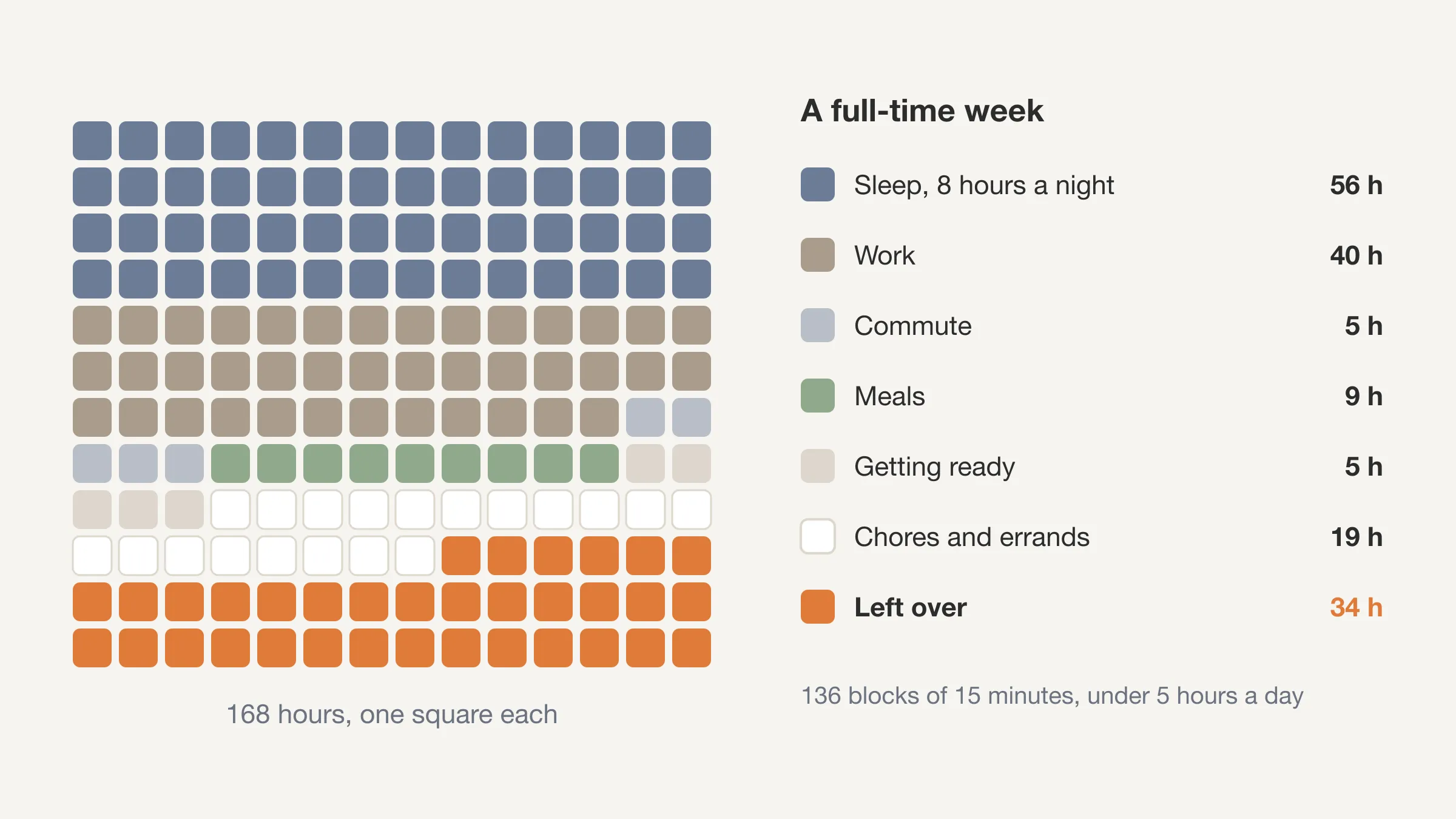
Two lessons come out of this. First, "I have no time" is partly true. A full-time job leaves around a fifth of the week as free time. Second, "I have 34 hours" is also not the whole truth, because it assumes nothing leaks. Phone checking, waiting, transitions and tasks that run long all come out of the 34.
For a framework built on this idea, see the 168-hour week framework and how to find more time in your 168 hours.
What share of the week is a 40-hour job?
A 40-hour job is 23.8% of the week's 168 hours. Measured against the 112 waking hours, it is 35.7%. Add 5 hours of commuting and the share is 40.2% of your waking time. That is why the rest of the day feels smaller than the arithmetic suggests.
What does a week of 112 waking hours look like by day?
Divide the 112 waking hours by 7 and you get 16 hours, or 64 blocks, a day. That is the unit to plan in, because a week is too big to hold in your head and an hour is too small to show a pattern.
Here is one way to read it. A 7 a.m. to 11 p.m. day is 64 blocks. If a job takes 8 hours (32 blocks), commuting takes 1 (4 blocks) and meals and getting ready take about 3 (12 blocks), the day has 16 blocks left, or 4 hours. Chores and errands come out of those 4 hours, which leaves less than most people assume.
Weekends change the picture. As an example, five weekdays with 4 free hours each and two weekend days with 10 free hours each add up to 40 free hours, and half of them sit on the weekend. If those hours go unplanned, they can disappear fast. Seeing weekdays and weekends side by side is often the first surprise a logged week gives you.
Why does a week feel shorter than 168 hours?
Because most of the hours go by without a record. You remember the meeting, the workout and the dinner. You do not remember the 20 minutes between tasks, the half hour that went on a feed, or the evening that dissolved.
This is what makes estimates wrong. If you ask yourself where last Tuesday went, you reconstruct it from the big events. The in-between blocks are invisible, and they add up. The post on planned vs. actual time goes into how far apart the two usually are.
The fix is not more discipline. It is a record. Once the hours are written down, the argument with yourself ends.
How do you see where your 168 hours go?
Pick one week and log it. You do not need a complicated system, though some people go further and track all 168 hours like Rob Dyrdek.
- Use 15-minute blocks. Hours are too coarse and minutes are too fussy. The 15-minute block method explains why this size works.
- Use four categories. Health, Life, Work and Sleep is enough to start. You can add detail later.
- Fill it in twice a day. Two minutes in the morning for yesterday's gaps, two minutes at night for today.
- Mark what you did not log. Blocks you cannot remember are data too. They tell you how much of the week you cannot account for.
- Look at the totals on day seven. Add up the hours by category and compare them with what you thought.
If you want a paper-style start, the free weekly schedule template helps you lay out the week. For a longer walk-through, read the complete guide to a time audit or time tracking for beginners.
Beyond Time does this in the app. You start your day by noting how you slept and picking one to three goals that matter. You log time as 96 blocks. You end the day by rating how health, life and work felt from 1 to 10. Then the week view shows every hour of the week split by category, the trend across days and the share you logged. The AI reflection reads the logged day and tells you what went where you meant it to, where time leaked, and one or two changes for tomorrow.
See where your week goes
Log your day in 15-minute blocks. Two minutes in the morning, two at night. Two weeks free, all features included.
Try Beyond Time freeFrequently Asked Questions
How many hours are in a week?
There are 168 hours in a week, which is 7 days times 24 hours. That equals 10,080 minutes or 672 blocks of 15 minutes.
How many waking hours are in a week?
About 112, if you sleep 8 hours a night. That is 16 waking hours a day times 7. If you sleep 7 hours you have 119 waking hours, and at 9 hours you have 105.
How many hours are in a work week?
A standard full-time work week is 40 hours, which is about 23.8% of the 168 hours in a week. Actual hours vary by job and country, so use your own number rather than the standard one.
How many hours are in a month and a year?
A year has about 8,760 hours (365 days times 24) and a month averages about 730. A week-based view helps more than a monthly one, because weeks are the size at which habits show up.
How many hours does the average American spend on leisure?
The US Bureau of Labor Statistics reports about 5.07 hours a day of leisure and sports for 2024, which is roughly 35 hours a week. TV watching is the biggest part, at about 2.6 hours a day. These are averages for the civilian population aged 15 and over.
How many hours of sleep do you need each week?
The CDC recommends at least 7 hours a night for adults aged 18 to 60, which is at least 49 hours a week. Needs vary from person to person. If you are struggling with sleep, talk to a doctor.
How many 15-minute blocks are in a week?
There are 672 blocks in a full week and 96 in a day. If you count only waking time at 16 hours a day, a week has 448 blocks.
So, how many hours are in a week?
The answer to how many hours in a week is 168. About 112 of them are waking hours, and roughly a fifth of a full-time worker's week is left once work, sleep and chores are covered. Those are the numbers on paper.
The numbers that matter are the ones from your own week. Your time is limited, so see where it goes. Log seven days in 15-minute blocks, then compare the totals with what you assumed. Start with Beyond Time or the free weekly schedule template.
Sources: US Bureau of Labor Statistics, American Time Use Survey 2024 results, published June 26, 2025. CDC, About Sleep. Weekly figures are the survey's daily averages multiplied by 7.
Put this into practice
Free tools that match this article.
Time Blocking Template
Map your day into focused time blocks with a free printable time blocking template.
Try Time BlockingTime ManagementWeekly Schedule Template
Plan your week with a free printable weekly schedule template for goals, routines, and focus blocks.
Try Schedule TemplateRoutine BuildingNight Routine Planner
Create a realistic night routine checklist for better sleep and a smoother tomorrow.
Try Night RoutineTime LeftWeeks Left in the Year
How many weeks are left in the year? A live countdown of weeks, days, weekends and waking hours.
Try Weeks LeftKeep exploring this topic
Time blocking guide
Turn priorities into protected calendar blocks.
Morning routine template
Build a practical morning routine around energy and focus.
15-minute time blocks
Plan and review your day with more realistic precision.
Evening routine ideas
Wind down in a way that supports sleep and tomorrow’s goals.
Related Articles
Rob Dyrdek Life Spreadsheet: What Is Known and a Copy
The Rob Dyrdek life spreadsheet is mostly told in interviews. See what is documented, build a 168-hour sheet today, and learn when an app is easier to use.

Time Tracking for Beginners: How to Start Without Burning Out
New to time tracking? This beginner-friendly guide shows you how to start tracking your time simply, sustainably, and without overwhelming yourself.

How to Do a Time Audit: The Complete Step-by-Step Guide
Learn exactly how to do a time audit with our proven 7-step method. Track where your hours actually go, find hidden time sinks, and reclaim your time.
168 Hours: How to Find More Time Than You Think
You have 168 hours every week. Learn where they actually go and how to reclaim hidden pockets of time for goals that matter most to you. Templates and.

The 15-Minute Time Block Method: Why Precision Beats Estimation
Stop guessing where your time goes. The 15-minute block method reveals exactly how you spend each day and helps you plan with surgical accuracy.

How Many Minutes in a Week? 10,080, and Where They Go
How many minutes in a week? 10,080, or 6,720 waking minutes at 8 hours of sleep. See the minutes in each activity for an average week and how many are left.