
Waking Hours: How Many You Get a Day, Week and Year
Waking hours are the hours you are awake: 16 a day, 112 a week and about 5,840 a year at 8 hours of sleep. See where they go and how many you can call yours.
Waking hours are the hours you are awake. If you sleep 8 hours a night, you have 16 waking hours a day, 112 a week and about 5,840 a year. In 15-minute blocks, that is 64 a day and 448 a week.
Those numbers are the real size of your time. A week has 168 hours, but you only live in 112 of them. Everything you want to do, and everything you have to do, has to fit there.
This guide covers how many waking hours you have at different amounts of sleep, where an average waking hour goes, how many you can call your own, and how many are left this year. On November 20, 2026, the answer to the last one is 656 waking hours.
Key takeaways
- At 8 hours of sleep: 16 waking hours a day, 112 a week, about 5,840 a year.
- A 7 a.m. to 11 p.m. day is 64 fifteen-minute blocks. A week is 448.
- In the average American day, about a third of waking time goes to leisure and about a fifth to work.
- On November 20, 2026, there are 41 days left in the year, or 656 waking hours.
What are waking hours?
Waking hours are the part of the 24-hour day when you are not asleep. It is the time you can spend on work, family, food, movement, rest and everything else.
The term is useful because it removes the hours you cannot spend. When you plan a week, "168 hours" overstates what you have. A better starting point is the waking part: 168 minus your sleep. We cover the 168 in how many hours in a week, and the 10,080 minutes behind it.
Waking hours are not the same as productive hours. They include meals, chores, commuting, scrolling and doing nothing. They are simply the hours you are awake.
How many waking hours are in a day, week and year?
It depends on how long you sleep. The CDC says adults aged 18 to 60 need at least 7 hours a night, and that quality matters too. Here is how the numbers change.
| Sleep per night | Waking hours a day | Waking hours a week | Waking hours a year | 15-minute blocks a day |
|---|---|---|---|---|
| 6 hours | 18 | 126 | 6,570 | 72 |
| 7 hours | 17 | 119 | 6,205 | 68 |
| 8 hours | 16 | 112 | 5,840 | 64 |
| 9 hours | 15 | 105 | 5,475 | 60 |
A few notes on the table:
- The year column uses 365 days. In a leap year, add one day of waking time (16 hours at 8 hours of sleep), for 5,856.
- A month is about 487 waking hours at 8 hours of sleep (5,840 ÷ 12).
- A year of waking hours is 243 days. That is 5,840 hours divided by 24. You sleep for the other 122.
One hour of sleep is worth 365 waking hours a year, or 15 full days. That is why it is worth thinking about sleep as part of your time budget, not as the cost of it. If you want earlier hours rather than fewer hours of sleep, see how to wake up at 5am without cutting your sleep.
See the waking time you have left
Beyond Time shows waking time left today and this week on the Today screen, then helps you see where it went.
Try Beyond Time freeHow many waking hours does a person have in a lifetime?
Roughly, 16 hours a day over 80 years is 467,200 waking hours. That figure is a simplification, because babies and young children sleep far more than adults. It is meant to give you a sense of scale, not an exact count.
If you prefer weeks as your unit, we explain how they add up in how many weeks in a year.
Where does the average waking hour go?
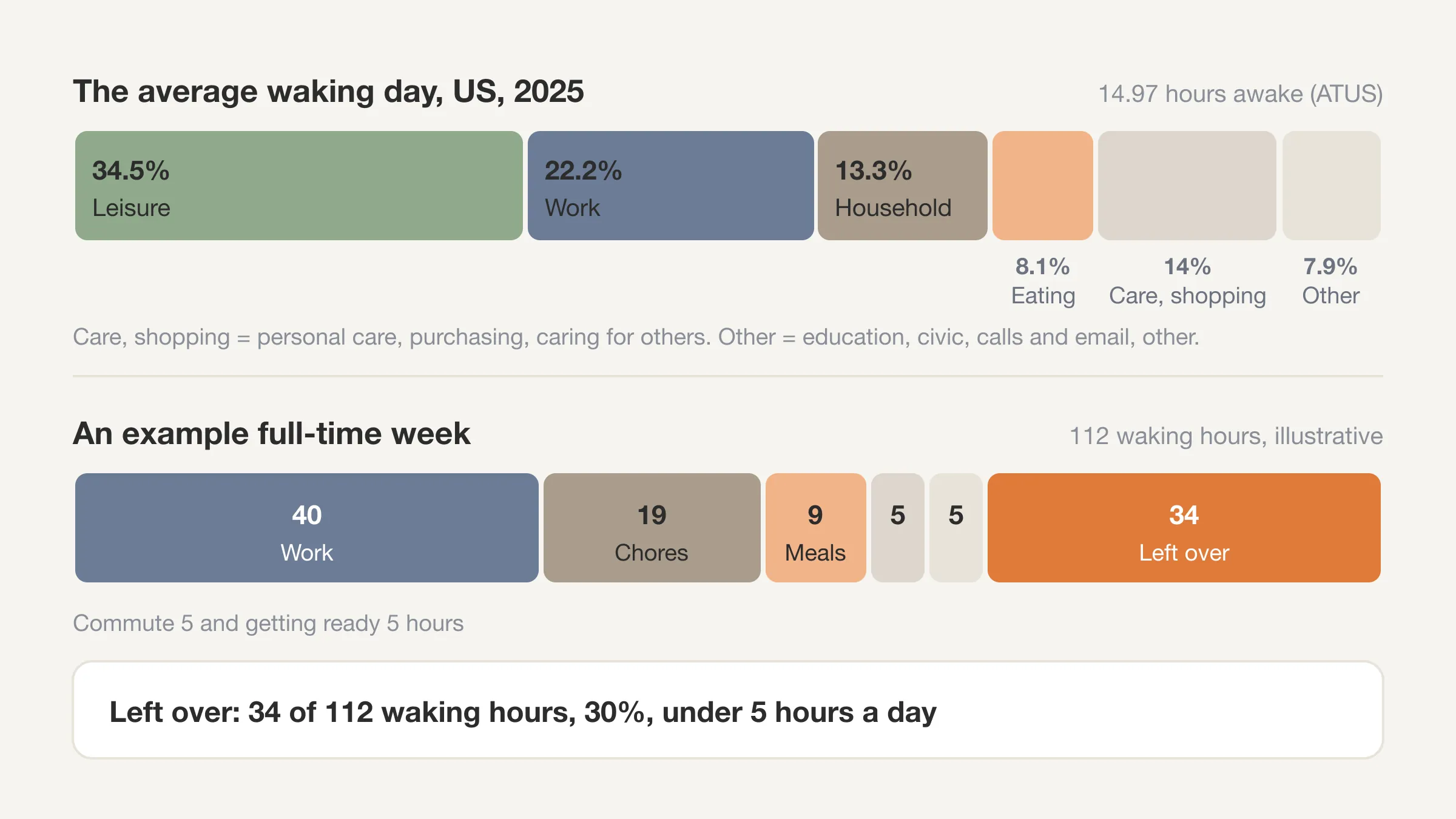
The most reliable public answer comes from the US Bureau of Labor Statistics. Its American Time Use Survey reports average hours per day for everyone aged 15 and over. The latest results are for 2025 and were published in June 2026. In that survey, sleeping averages 9.03 hours a day, which leaves 14.97 waking hours.
Here is where those waking hours go.
| Activity | Hours per day | Share of waking time | Minutes in an average waking hour |
|---|---|---|---|
| Leisure and sports | 5.16 | 34.5% | 21 |
| Working and work-related activities | 3.32 | 22.2% | 13 |
| Household activities | 1.99 | 13.3% | 8 |
| Eating and drinking | 1.21 | 8.1% | 5 |
| Other personal care | 0.77 | 5.1% | 3 |
| Purchasing goods and services | 0.69 | 4.6% | 3 |
| Caring for others | 0.64 | 4.3% | 3 |
| Educational activities | 0.44 | 2.9% | 2 |
| Organizational, civic and religious activities | 0.28 | 1.9% | 1 |
| Other activities | 0.27 | 1.8% | 1 |
| Phone calls, mail and email | 0.19 | 1.3% | 1 |
Minutes are rounded, so they add to slightly more than 60.
Read the table as an average of everyone, not a description of you. It includes retirees, students, people who do not work, and weekends. It also counts only the main activity at any moment, so watching TV while eating is counted once.
Three things are worth noticing:
- Leisure is the biggest category. The average person has over 5 hours a day of leisure and sports. TV is the largest part, at 2.61 hours a day.
- Work is smaller than people expect. At 3.32 hours a day it is an average over everyone aged 15 and over, including people who do not work and days off. Full-time workers work more hours on days they work.
- Maintenance is large. Household activities, eating, shopping and personal care together take about 4.7 hours a day. Few people plan for this.
How many of your waking hours are truly yours?
Fewer than the leisure line suggests. Leisure in the survey includes TV, socializing, games and rest, and some of it is tired time after a long day. It is not all time you chose.
A better way is to work from your own week. Here is an illustrative full-time week, using the same example as our post on hours in a week. These are example numbers, not data:
| Block | Hours per week |
|---|---|
| Waking hours (8 hours of sleep) | 112 |
| Work | 40 |
| Commute | 5 |
| Meals | 9 |
| Getting ready and personal care | 5 |
| Chores and errands | 19 |
| Left over | 34 |
That leaves 34 of 112 waking hours, or 30%, or about 136 blocks. Across seven days it is under 5 hours a day.
Your own numbers will differ. Someone in school, caring for a child, or working shifts has a different shape. But the method works for anyone: start from waking hours, subtract what is fixed, and look at what remains. The remainder is the part you can actually decide about, and it is a smaller number than 112. A life plan with weekly costs starts from that number.
How many waking hours are left this year?
On November 20, 2026, there are 41 days left in the year. At 16 waking hours a day, that is 656 waking hours, or 2,624 fifteen-minute blocks. It is a little under 6 weeks (5.9).
Here is the countdown for each Friday to the end of the year, counted in days after that date:
| Date | Days left | Waking hours left | 15-minute blocks left |
|---|---|---|---|
| Nov 20 | 41 | 656 | 2,624 |
| Nov 27 | 34 | 544 | 2,176 |
| Dec 4 | 27 | 432 | 1,728 |
| Dec 11 | 20 | 320 | 1,280 |
| Dec 18 | 13 | 208 | 832 |
| Dec 25 | 6 | 96 | 384 |
Thanksgiving is next Thursday, November 26, and December 25 is a Friday. Holiday weeks tend to feel the shortest and often get the least planning, so it is worth deciding what you want from them before they arrive.
You can get the same numbers for any date with the free weeks left in the year counter. It shows weeks, days, weekends, workdays, waking hours and 15-minute blocks left. For the week-based view, see how many weeks in a year, including why 2026 has 53 ISO weeks.
How do you see where your waking hours go?
Counting the hours is easy. Knowing what happened in them is not. Most of us can name the big events of a day and lose the rest. A short log fixes that.
- Use 15-minute blocks. A day is 64 waking blocks, or 960 of its 1,440 minutes. Small enough to catch a lost half hour, large enough to fill in quickly. See the 15-minute time block method.
- Log in two short sittings. Two minutes in the morning to fill what you can remember from yesterday, two minutes at night for today.
- Mark the gaps. Blocks you cannot account for are data. A "not logged" block tells you how much of the day got away.
- Add up the categories. Health, Life, Work and Sleep is enough to start.
- Compare with your plan. The gap between where you meant the hours to go and where they went is the most useful number a log gives you.
Beyond Time is built around this loop. The Today screen shows the waking time you have left today and this week, and draws the day as 15-minute blocks. You log time as you go, and passed gaps your recent days agree on can be filled in with one tap. At the end of the day the AI reflection reads the log and tells you what went where you meant it to, where time leaked and how often, and one or two changes for tomorrow. Widgets for the Home Screen and Lock Screen keep the time left in view.
If you would rather start on paper, our time audit guide walks through a one-week version.
See where your waking hours go
Log your day in 15-minute blocks. Two minutes in the morning, two at night. Two weeks free, all features included.
Try Beyond Time freeFrequently Asked Questions
How many waking hours are in a day?
If you sleep 8 hours, you have 16 waking hours in a day. That is 64 blocks of 15 minutes. At 7 hours of sleep you have 17 waking hours, and at 9 hours you have 15.
How many waking hours are in a week?
At 8 hours of sleep, there are 112 waking hours in a week, which is 448 fifteen-minute blocks. With 7 hours of sleep it is 119, and with 9 hours it is 105.
How many waking hours are in a year?
About 5,840 at 8 hours of sleep, which is 16 hours times 365 days. In a leap year it is 5,856. With 7 hours of sleep it is 6,205 hours, and with 9 hours it is 5,475.
How many hours of sleep does an adult need?
The CDC lists at least 7 hours a night for adults aged 18 to 60. Needs vary by person and by stage of life. If you often sleep far less than you need, or feel unrefreshed, talk to a doctor.
Do waking hours include work?
Yes. Waking hours include everything you do while awake: work, commuting, meals, chores, caring for others and rest. They are a measure of time you are awake, not of time you are productive.
How many waking hours are in a month?
A month has about 487 waking hours on average at 8 hours of sleep, which is 5,840 divided by 12. A 30-day month has 480 and a 31-day month has 496.
What is a typical waking day?
A common example is 7 a.m. to 11 p.m., which is 16 hours and 64 blocks of 15 minutes. Your own window depends on when you wake and when you go to bed. Use the real times, because every hour of sleep you move changes your waking time by an hour.
So, how many waking hours do you have?
At 8 hours of sleep you have 16 waking hours a day, 112 a week and about 5,840 a year. Today, with 41 days left in 2026, you have 656. Once you take out work, meals and chores, only part of that is yours to choose.
Your time is limited. The best way to use it well is to see where it goes. Log one day in 15-minute blocks with Beyond Time, then look at the gap between your plan and your day.
Sources: US Bureau of Labor Statistics, American Time Use Survey, 2025 annual averages (Table 1). CDC, About Sleep. Waking-hour figures are computed from the sleep amounts shown.
Put this into practice
Free tools that match this article.
Night Routine Planner
Create a realistic night routine checklist for better sleep and a smoother tomorrow.
Try Night RoutineRoutine BuildingMorning Routine Generator
Design your ideal morning routine with AI-powered suggestions based on proven practices.
Try Morning RoutineHabit BuildingHabit Tracker Template
Create a free printable habit tracker template — weekly or monthly. Customize your habits and download a clean PDF in seconds.
Try Habit TrackerGoal SettingGoal Setting Worksheet
Turn a vague goal into milestones, habits, blockers, and a weekly review plan.
Try Goal WorksheetKeep exploring this topic
Related Articles

Journal Prompts: 87 Questions Sorted by Mood and Purpose
87 journal prompts sorted by mood and purpose, from stress and gratitude to goals and time, plus a two-minute nightly version for days when you have no energy.

How Many Weeks Until Christmas? 5 Weeks and 5 Days
How many weeks until Christmas? On 15 November 2026 it is 40 days, or 5 weeks and 5 days. See how to count from any date and what fits before 25 December.

How Many Days Left in the Year? 48 After 13 Nov 2026
How many days are left in the year? 48 after 13 November 2026, 49 counting today. See the workdays, weekends and waking hours in them and how to count any date.

How Many Weeks in a Year? 52, Plus a Day (2026 Has 53)
How many weeks in a year? 52 weeks plus 1 day (2 in a leap year). ISO calendars count 52 or 53, and 2026 has 53. See the math, the tables and what is left.

How Many Minutes in a Week? 10,080, and Where They Go
How many minutes in a week? 10,080, or 6,720 waking minutes at 8 hours of sleep. See the minutes in each activity for an average week and how many are left.

Bucket List Ideas: 100 Ideas Grouped by Theme and Lead Time
100 bucket list ideas grouped by theme and tagged by lead time: now, this year, or years ahead. Count the weeks you have, then pick ten. Start your list today.