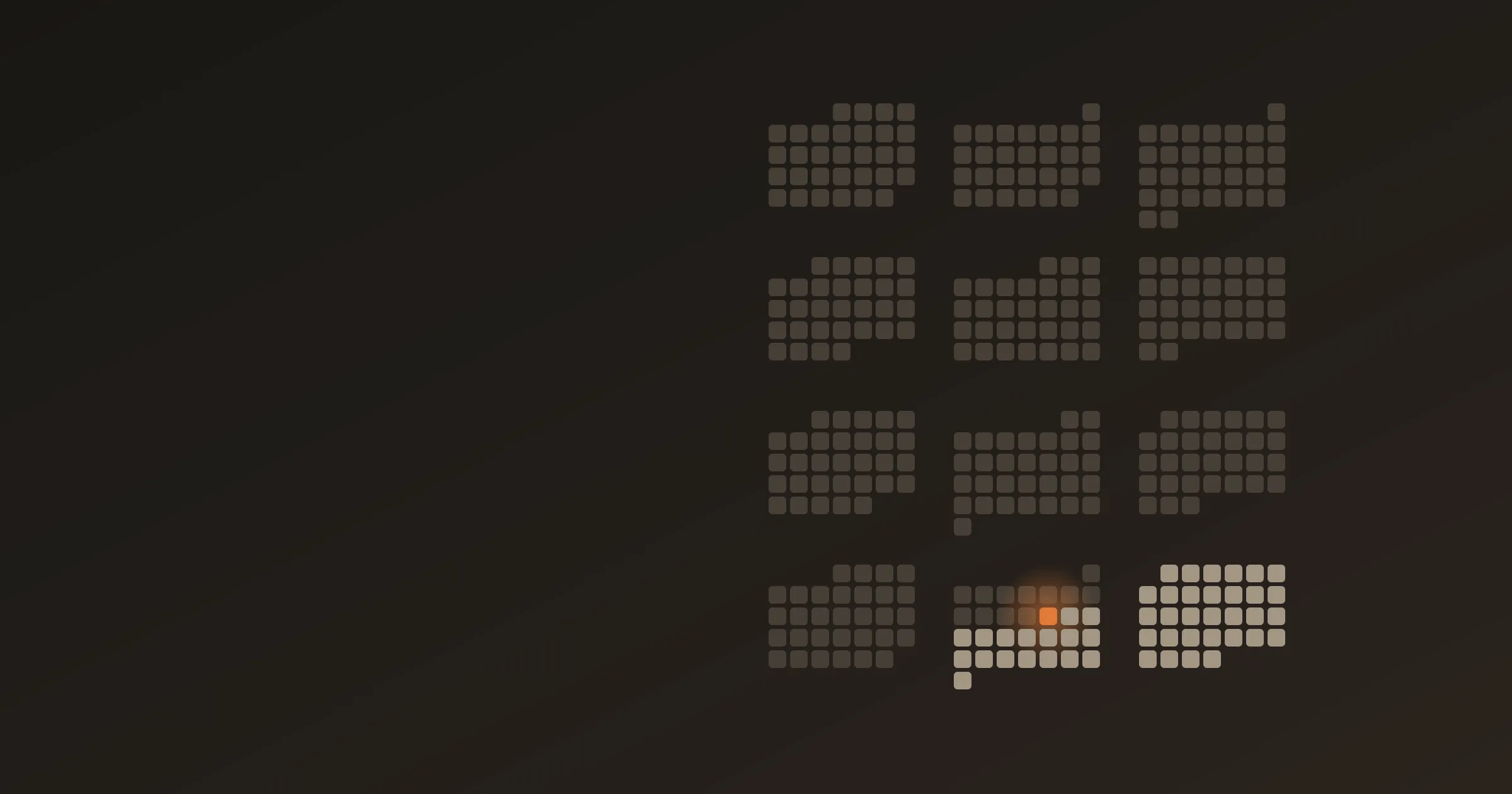
How Many Days Left in the Year? 48 After 13 Nov 2026
How many days are left in the year? 48 after 13 November 2026, 49 counting today. See the workdays, weekends and waking hours in them and how to count any date.
How many days are left in the year? On Friday, November 13, 2026, there are 48 days left until December 31. If you count today as a day you still get to use, it is 49 days, which is exactly seven weeks.
Those 49 days contain 35 weekdays and 14 weekend days. They also hold about 784 waking hours, or 3,136 fifteen-minute blocks. This post shows how to count the days left on any date, then turns the count into something you can plan with.
Key takeaways
- On 13 November 2026 there are 48 days left in the year, or 49 counting today (exactly 7 weeks).
- Those days hold 35 weekdays, 14 weekend days and about 784 waking hours at 16 waking hours a day.
- Any date works the same way: 365 minus the day of the year (366 in a leap year).
- The count is only useful if you know where the hours go. A one-week log answers that.
How many days are left in 2026?
The answer depends on whether you count today. Here is the count for the publish date of this post.
| How you count | Days left | Weeks |
|---|---|---|
| After today (Nov 14 to Dec 31) | 48 | 6 weeks and 6 days |
| Including today (Nov 13 to Dec 31) | 49 | 7 weeks |
Most "days left" counters use the first number. If you are planning, use the second. Today is not over, and you can still spend part of it.
November 13 is day 317 of 2026. A normal year has 365 days, so 365 minus 317 leaves 48. The year ends on a Thursday, December 31.
How many days are left on other dates?
The count shrinks fast near the end of the year. Here are a few dates worth knowing, all computed from day-of-year numbers.
| Date | Day of year | Days left after that day |
|---|---|---|
| Fri, Nov 13 | 317 | 48 |
| Thu, Nov 26 (Thanksgiving) | 330 | 35 |
| Tue, Dec 1 | 335 | 30 |
| Tue, Dec 15 | 349 | 16 |
| Thu, Dec 24 | 358 | 7 |
| Fri, Dec 25 | 359 | 6 |
On December 1 you have 30 days left. That is a convenient number for a 30-day plan. It is also the moment most people notice the year is nearly gone.
How do you count the days left in any year?
You need two numbers: how many days the year has, and which day of the year you are on. Subtract.
- Find the day of the year. Add the days in all the full months before this one, then add the date. For November 13, that is 304 days in January through October, plus 13, which gives 317.
- Know the year length. 365 in a normal year, 366 in a leap year. 2026 is a normal year.
- Subtract. 365 minus 317 is 48 days left after today.
The days in each month before November are: January 31, February 28 (29 in a leap year), March 31, April 30, May 31, June 30, July 31, August 31, September 30, October 31. They add up to 304 in a normal year, and 305 in a leap year.
A spreadsheet does this in one line. If today's date is in cell A1, the formula =DATE(YEAR(A1),12,31)-A1 returns the days left after today. Add 1 if you want to count today.
See the time you have left
Beyond Time's Today screen shows the waking time left in your day and week, so the number is in front of you without a calculator.
Try Beyond Time freeHow many weekends and workdays are left in 2026?
Days are not equal. A Saturday and a Tuesday hold the same number of hours, but most people spend them very differently. So split the 49 days.
| Type of day (Nov 13 to Dec 31, counting today) | Count |
|---|---|
| Weekdays (Mon to Fri) | 35 |
| Saturdays | 7 |
| Sundays | 7 |
| Weekend days total | 14 |
There are seven weekends left, starting this Saturday, November 14. The last one is December 26 and 27. A whole year holds 52 weekends, so these seven are the last eighth or so of them.
How many workdays are left in the year?
There are 35 weekdays left, counting today. That is a calendar count, not your work calendar. Two U.S. federal holidays fall inside the window: Thanksgiving on Thursday, November 26, and Christmas Day on Friday, December 25. Take those out and you get 33 weekdays that many U.S. employees with standard holidays would work.
Your own number will differ. Subtract your own vacation days, company holidays and any days you already know are blocked. Then count the rest. The answer is usually smaller than people expect.
Why does the weekend count matter?
Weekends are where most people place the things they say matter: family, projects, trips, rest. Seven weekends is a small, countable number. If there are three things you want to do on a weekend before the year ends, you can see that you have room for them, but not for much more. A fall bucket list is a good place to pick them from.
How many waking hours are left in 2026?
Days are a calendar unit. Hours you can use are fewer. A common planning assumption is a waking day of 16 hours, 7 am to 11 pm, with about 8 hours for sleep. Your own hours will differ, but this keeps the math simple.
| Measure (49 days including today) | Amount |
|---|---|
| Total hours | 1,176 |
| Sleep at 8 hours a day | 392 |
| Waking hours at 16 a day | 784 |
| Fifteen-minute waking blocks | 3,136 |
A 16-hour waking day is 64 blocks of 15 minutes. Over 49 days that is 3,136. If you are reading this at 3 pm, today is already partly spent, so the real number is a little lower.
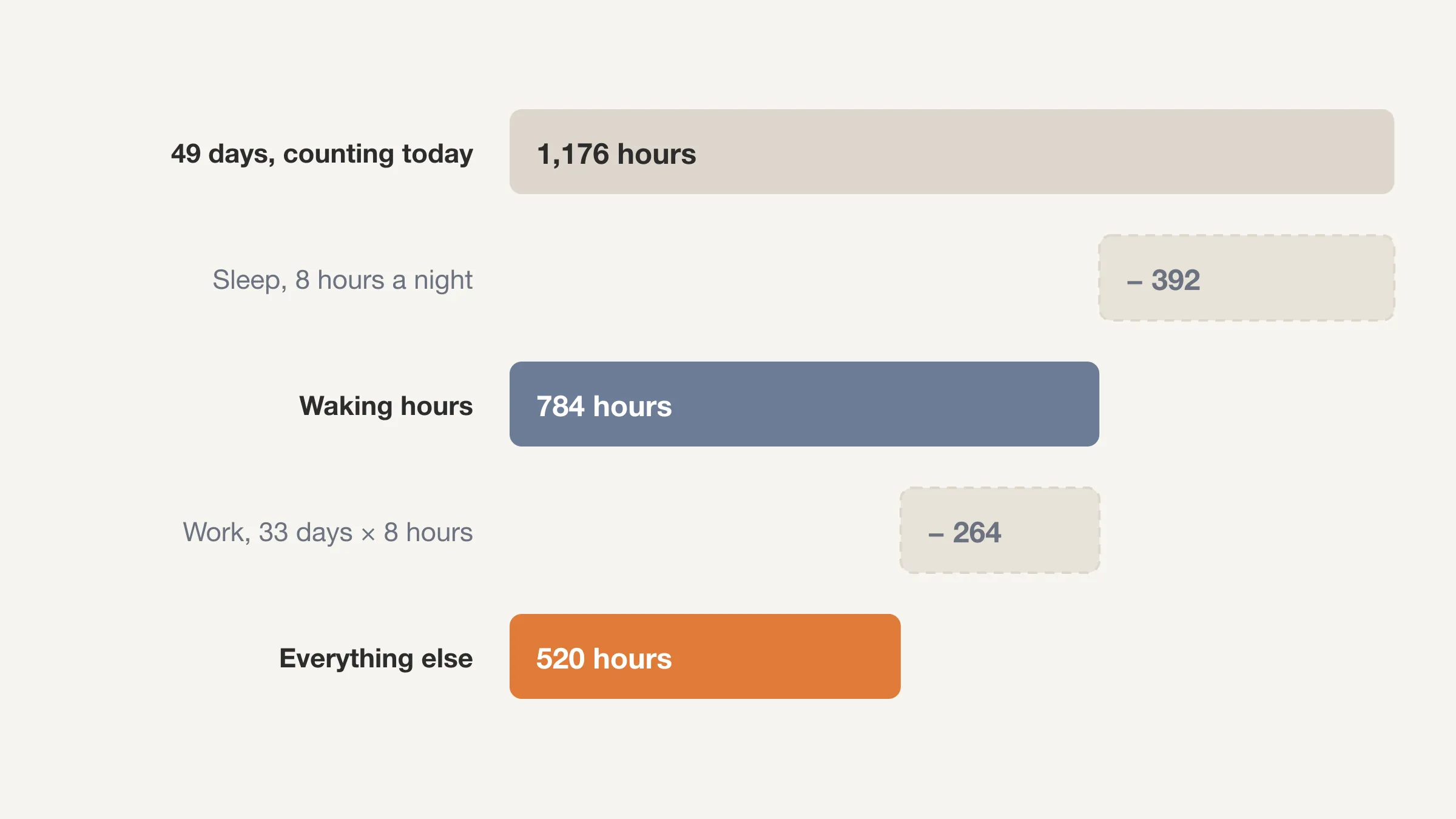
Now take work out. This is an example, not a rule. A full-time worker on 33 standard workdays, at 8 hours of work each, uses 264 of those hours. That leaves 520 waking hours for everything else: commuting, meals, chores, family, exercise, friends, screens, rest and whatever you meant to do. That is still a lot of time. It is also a number you can spend on purpose.
For the week-level version of this math, see how many hours are in a week. There are 168 in total, about 112 of them awake. Counted in minutes, the same week is 10,080, which how many minutes are in a week breaks down.
What actually fits in seven weeks?
Seven weeks is long enough to finish something real and short enough that you cannot waste a week without noticing. Here is what small, steady time buys over 49 days.
- 30 minutes a day adds up to 24.5 hours. That is a short book, a course module or a steady start on a project.
- 2 hours a week over 7 weeks is 14 hours. That is one focused weekend project.
- 3 workouts a week over 7 weeks is 21 sessions.
- One 15-minute block a day is 12.25 hours. It is the smallest unit that still adds up to something.
The point is not to fill every hour. It is to see that small amounts, repeated, are larger than they feel. A goal that needs 30 minutes a day is cheap. A goal that needs 3 hours a day is not, and it is better to learn that now than on December 28.
Compare the size of the goal to the size of the time. If your list for the year's end needs 800 hours and you have 520 free, something has to go. That is not a failure. It is the useful part of counting. The same sizing idea works over a longer stretch in the 12-week year, which plans in quarters instead of a full year.
Why does knowing the days left not tell you enough?
A number of days is the limit. It does not tell you how the days go. Most people can say how many days are left. Few can say where the last seven days went.
That is the gap. You have 784 waking hours, but a plan for 784 hours and the reality of 784 hours rarely match. Time disappears in small pieces: a 20-minute scroll, a meeting that ran over, a stretch of the afternoon you cannot account for. Small amounts like these are easy to miss and add up.
The Bureau of Labor Statistics measures this at national scale. In the American Time Use Survey results for 2025, the average American spent about 5.2 hours a day on leisure and sports, and watching TV was the largest part of that at about 2.6 hours. Those are averages across a country, not a judgment of anyone. Your day is different. What matters is that your own number is knowable if you write it down.
Source
U.S. Bureau of Labor Statistics, American Time Use Survey, 2025 results: leisure and sports averaged about 5.2 hours per day, with television about 2.6 hours of that.
How do you see where the days go?
Log the day in 15-minute blocks. Each block is one choice: what you were doing for those 15 minutes. It takes about two minutes in the morning and two at night. After a week you have 448 waking blocks to look at, and the patterns are hard to argue with.
The 15-minute time block method explains why this size works. For a practical starting point, see time tracking for beginners.
How can you use the days left in 2026?
Counting is only the first step. Here is a simple way to use the number this week.
- Write the number. 49 days, 7 weekends, 33 workdays, about 520 free waking hours if you work a standard schedule. Use your own numbers.
- Pick one or two things. What would you be glad you finished or started by December 31? Two is enough. Five is a wish list.
- Size them in hours. Estimate the hours each needs. Divide by the weeks left. If it needs 6 hours a week and you have 2 free, adjust the goal, not your sleep.
- Log one week. See what the days really hold. Compare it with what you assumed. The difference is the most useful number in the exercise. It is the idea behind the planned versus actual gap.
- Change one thing. Not ten. One block a day, moved on purpose.
Count the weeks, then the hours
The free counter shows the weeks, days, weekends, workdays, waking hours and 15-minute blocks left in the year.
Open the weeks left counterHow does Beyond Time help with this?
Beyond Time puts the number where you will see it. The Today screen shows the waking time left today and this week, and the day is drawn as 96 fifteen-minute blocks. You log a block by picking it and choosing what you were doing. Blocks you have not logged show as gaps. If your recent days agree on a pattern, Fill from your usual fills the passed gaps in one tap.
At night, the AI reflection reads the logged day. It tells you what went where you meant it to, where time leaked, and one or two changes worth making. Home Screen and Lock Screen widgets can show time left today or the days left in the year.
You do not need the app to do this. A paper grid works. The app only makes the two minutes a day shorter.
Frequently Asked Questions
How many days are left in the year 2026?
On November 13, 2026 there are 48 days left after today, and 49 if you count today. The year ends on Thursday, December 31, 2026. Subtract the day of the year, 317 for November 13, from 365.
How many weeks are left in 2026?
On November 13, 2026 there are 7 weeks left if you count today (49 days), or 6 weeks and 6 days after today (48 days). For a full breakdown of weeks, see how many weeks are in a year.
How many workdays are left in 2026?
There are 35 weekdays left from November 13 through December 31, counting today. If you remove Thanksgiving (November 26) and Christmas Day (December 25), that is 33 workdays. Subtract your own vacation and company holidays for your number.
How many weekends are left in 2026?
There are 7 weekends left, from November 14 and 15 through December 26 and 27. That is 14 weekend days. Each weekend holds 32 waking hours at 16 hours a day, for 224 in total.
How do I calculate days left in the year in Excel or Google Sheets?
Use =DATE(YEAR(A1),12,31)-A1, where A1 holds a date. It returns the days left after that date. Add 1 to include the day itself. The same formula works in both Excel and Google Sheets.
How many days are left in a leap year?
A leap year has 366 days, so subtract the day of the year from 366. Leap years add February 29. 2026 is not a leap year. The next one is 2028.
How many waking hours are left in the year?
At 16 waking hours a day, multiply your days left by 16. On November 13, 2026, that is 49 days times 16, or 784 hours. This is a planning assumption. Use your own sleep length for a closer figure.
Seven weeks, counted
The answer to how many days are left in the year is 48 after November 13, 2026, or 49 counting today. That is seven weeks, about 784 waking hours, and 3,136 blocks of 15 minutes.
Your time is limited. The count is the start. The next step is to see where it goes. Log one week, look at the gap between your plan and your days, and change one thing. If you want help, Beyond Time shows the time left on Today and the 15-minute log shows the rest.
Put this into practice
Free tools that match this article.
Goal Setting Worksheet
Turn a vague goal into milestones, habits, blockers, and a weekly review plan.
Try Goal WorksheetTime ManagementWeekly Schedule Template
Plan your week with a free printable weekly schedule template for goals, routines, and focus blocks.
Try Schedule TemplateHabit BuildingHabit Tracker Template
Create a free printable habit tracker template — weekly or monthly. Customize your habits and download a clean PDF in seconds.
Try Habit TrackerTime ManagementTime Blocking Template
Map your day into focused time blocks with a free printable time blocking template.
Try Time BlockingRelated Articles
How Many Weeks in a Year? 52, Plus a Day (2026 Has 53)
How many weeks in a year? 52 weeks plus 1 day (2 in a leap year). ISO calendars count 52 or 53, and 2026 has 53. See the math, the tables and what is left.

How Many Minutes in a Week? 10,080, and Where They Go
How many minutes in a week? 10,080, or 6,720 waking minutes at 8 hours of sleep. See the minutes in each activity for an average week and how many are left.

Bucket List Ideas: 100 Ideas Grouped by Theme and Lead Time
100 bucket list ideas grouped by theme and tagged by lead time: now, this year, or years ahead. Count the weeks you have, then pick ten. Start your list today.

How to Stop Doomscrolling: 9 Practical Fixes That Work
How to stop doomscrolling: add friction, swap in better habits and check your Screen Time against a real log of your day. Nine fixes, with sources. Try one.

Life Plan Template: A One-Page Plan With Weekly Costs
A free life plan template you can copy: eight areas of life, one outcome each, and a weekly time cost so your plan fits the 112 waking hours you really have.
How Many Work Weeks in a Year? 52 Minus Your Time Off
How many work weeks in a year? 52 on paper, usually 46 to 50 after holidays and leave. See the table by days off, 2026's count and the weeks left this year.