How Many Weekends in a Year? 52, and 31 Left in 2026
How many weekends in a year? 52 in most years, and 2026 has 52. See the counts by year, how many weekends are left today and how to make each one count.
There are 52 weekends in a year. A normal year has 365 days, which is 52 weeks plus one extra day, so it holds 52 Saturdays and 52 Sundays and 104 weekend days. A few years have 53 Saturdays or 53 Sundays, but 2026 is not one of them.
Today is Friday, 29 May 2026. The first weekend of 2026 was 3 and 4 January. This weekend, 30 and 31 May, is the 22nd. That leaves 31 weekends in 2026, counting this one. The rest of this guide shows the counts by year, how to work out any date and how to make those 31 count.
Key takeaways
- A year has 52 weekends most of the time. 2026 has 52, and so do 2027, 2029 and 2030.
- On 29 May 2026, 21 weekends are behind you and 31 are left, including this one.
- Each weekend holds 32 waking hours. Thirty-one weekends hold 992.
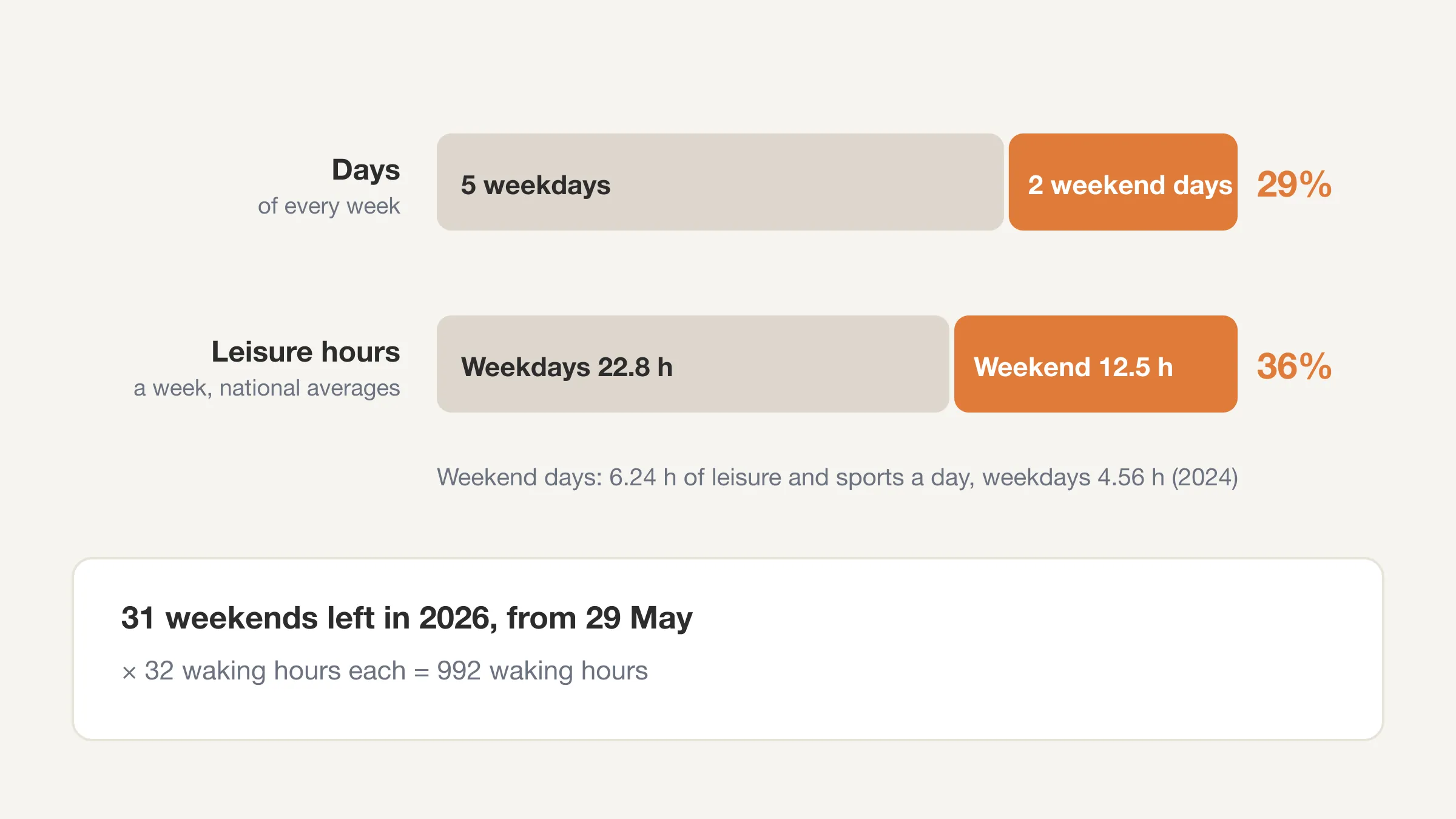
- Weekend days are 29 percent of the days but hold about 36 percent of leisure time at national averages.
How many weekends are there in a year?
A year has 365 days. Divide by 7 and you get 52 weeks and 1 day. In a leap year you get 52 weeks and 2 days. That leftover day or two decides whether the year has an extra Saturday or Sunday.
The number of weekends depends on how you count one. This post counts a weekend as a Saturday and Sunday pair. The simple answer is:
- 52 weekends in a typical year
- 104 weekend days (52 Saturdays plus 52 Sundays)
- 53 weekends in some years, when the extra day or two falls on a weekend
The reason is plain arithmetic. 52 weeks is 364 days. The one or two extra days take the weekday of January 1 and, in a leap year, the day after it. If January 1 is a Saturday, you get a 53rd Saturday. If it is a Sunday, you get a 53rd Sunday.
Which years have 53 weekends?
Check the weekday of January 1 and the year length.
| Year | Days | Jan 1 | Saturdays | Sundays | Weekend days | Weekends |
|---|---|---|---|---|---|---|
| 2022 | 365 | Saturday | 53 | 52 | 105 | 53 |
| 2023 | 365 | Sunday | 52 | 53 | 105 | 53 |
| 2024 | 366 | Monday | 52 | 52 | 104 | 52 |
| 2025 | 365 | Wednesday | 52 | 52 | 104 | 52 |
| 2026 | 365 | Thursday | 52 | 52 | 104 | 52 |
| 2027 | 365 | Friday | 52 | 52 | 104 | 52 |
| 2028 | 366 | Saturday | 53 | 53 | 106 | 53 |
| 2029 | 365 | Monday | 52 | 52 | 104 | 52 |
| 2030 | 365 | Tuesday | 52 | 52 | 104 | 52 |
Here "weekends" counts any weekend that has at least one day in that calendar year. In 2022 the 53rd weekend is a lone Saturday on 31 December. In 2023 it is a lone Sunday on 1 January, the end of a weekend that began in 2022. 2028 is the one year in this range with 53 full Saturday-and-Sunday pairs, because it starts on a Saturday and is a leap year.
2026 begins on a Thursday, so it has an extra Thursday and nothing special for weekends.
How many weekends are left in 2026?
Today is Friday, 29 May 2026, so the next weekend is tomorrow. From there:
- Weekends behind you: 21, from 3 and 4 January through Memorial Day weekend on 23 to 25 May.
- Weekends left, including this one: 31, from 30 and 31 May to 26 and 27 December.
- Check: 21 plus 31 is 52.
Here is how the remaining weekends spread by month.
| Month | Weekends left |
|---|---|
| May (30 to 31) | 1 |
| June | 4 |
| July | 4 |
| August | 5 |
| September | 4 |
| October | 5 |
| November | 4 |
| December | 4 |
| Total | 31 |
To count weekends left from any date, count the Saturdays between that date and 31 December. If the date falls on a Sunday, add that day's weekend as the first one, since it is still in progress.
How many long weekends are left in 2026?
Federal holidays in the US stretch some weekends to three days. The dates below come from the US Office of Personnel Management's federal holiday list.
| Weekend | Holiday | Days from today |
|---|---|---|
| 19 to 21 June | Juneteenth (Friday) | 21 |
| 3 to 5 July | Independence Day, observed Friday because 4 July is a Saturday | 35 |
| 5 to 7 September | Labor Day (Monday) | 101 |
| 10 to 12 October | Columbus Day (Monday) | 136 |
| 25 to 27 December | Christmas Day (Friday) | 210 |
Thanksgiving falls on Thursday, 26 November. Many people take the Friday as well, which makes a four-day weekend if you do. Veterans Day on Wednesday, 11 November does not create a long weekend.
That is five three-day weekends left in 2026, plus a possible fourth day at Thanksgiving. A three-day weekend holds 48 waking hours instead of 32. Decide early what each one is for, because they fill up quickly. June, July and August alone hold 13 of the 31 weekends, which is why counting down to summer is worth doing early.
See where your weekends go
Log your day in 15-minute blocks. Two minutes in the morning, two at night.
Try Beyond Time freeHow many hours are in a weekend?
A weekend is 48 hours. Subtract sleep and you have about 32 waking hours at a 16-hour waking day, which is 128 fifteen-minute blocks.
Across the year, the weekend math looks like this:
| Measure | 52 weekends | 31 weekends (left in 2026) |
|---|---|---|
| Weekend days | 104 | 62 |
| Total hours | 2,496 | 1,488 |
| Waking hours (16 a day) | 1,664 | 992 |
| 15-minute waking blocks | 6,656 | 3,968 |
Weekend days are two of seven, or about 29 percent, of every year's days and of its 5,840 waking hours. If you want the full weekly picture, our guide on how many hours are in a week breaks 168 hours into sleep, work and what is left.
What do people actually do on weekends?
The American Time Use Survey, run by the US Bureau of Labor Statistics, asks people to account for a full day. The 2024 results, released in June 2025, report averages for people age 15 and over. Weekends and holidays differ from weekdays like this:
| Activity (hours per day) | Weekdays | Weekends and holidays |
|---|---|---|
| Sleeping | 8.80 | 9.59 |
| Leisure and sports | 4.56 | 6.24 |
| Household activities | 1.87 | 2.35 |
The survey also reports that people spent 56 minutes a day socializing and communicating on weekend days, compared with 26 minutes on weekdays. And while 80 percent of employed people worked on an average weekday, 30 percent worked on an average weekend day.
Do the math on leisure. Two weekend days at 6.24 hours plus five weekdays at 4.56 hours is 35 hours of leisure a week. The weekend share is 12.48 hours, or about 36 percent, from just 29 percent of the days. These are national averages, and the weekend figure includes holidays, so treat the number as a rough guide rather than a measurement of you.
Why do weekends feel like they disappear?
Weekdays have structure. A job, school or a commute gives each hour a label. Weekends often have none, so the hours blur together and memory stores them as "a weekend" rather than as specific blocks.
This is the same effect we describe in why time goes by so fast. Days that look alike compress in memory. An ordinary Saturday blends into the last ten Saturdays.
There is a second problem. Weekend hours are the most flexible, so they are the first to be absorbed by errands, chores and open-ended phone time. None of those are bad. The issue is that they take hours you never decided to give them.
How can you make the next weekend count?
Start small and make it specific.
- Pick one anchor for each weekend. One thing that makes it feel like a weekend and not a long Monday: a hike, a long meal, a project, a visit.
- Put it on a block. Choose when it will happen, not just that it will. A Saturday morning from 9:00 to 12:00 is twelve blocks.
- Leave the rest open on purpose. Not every hour needs a plan. Rest is a use of time too.
- Check how it went on Sunday night. Look at where the 32 hours went. If three of them leaked into somewhere you did not choose, you have a fact to work with, not a feeling.
The free weekly schedule template is a good place to sketch the plan, and the time blocking template works for a single Saturday.
In Beyond Time, you open Start your day on Saturday morning to note how you slept and pick one to three goals. Log time shows the day as 96 fifteen-minute blocks where you tap what you were doing, and any block you skip appears as Not logged. On Sunday evening, See your week shows every hour split across Health, Life, Work and Sleep, and the AI reflection points out where time leaked and what to change next weekend. For a pen-and-paper start, use the daily time log template. A Sunday review pairs well with a weekly time review.
Make the next weekend visible
Log it in 15-minute blocks and see where the 32 hours went. Two weeks free, everything unlocked.
Try Beyond Time freeFrequently Asked Questions
How many weekends are in a year?
There are 52 weekends in a typical year, made of 52 Saturdays and 52 Sundays, or 104 weekend days. A year with 53 Saturdays or 53 Sundays has a 53rd weekend, as 2022, 2023 and 2028 do.
How many weekends are in 2026?
2026 has 52 weekends, with 52 Saturdays and 52 Sundays. It starts on a Thursday, so the extra day in the year is a Thursday and does not add a weekend.
How many weekends are left in 2026?
On 29 May 2026 there are 31 weekends left, counting 30 and 31 May. That is 992 waking hours at 16 hours a day.
How many weekend days are in a year?
A typical year has 104 weekend days. A year with an extra Saturday or Sunday has 105, and 2028 has 106 because it is a leap year that starts on a Saturday.
How many long weekends are left in 2026?
There are five three-day weekends left after 29 May: Juneteenth, Independence Day (observed on Friday, 3 July), Labor Day, Columbus Day and Christmas. Thanksgiving becomes a four-day weekend if you take the Friday.
How many hours are in a weekend?
A weekend has 48 hours, of which about 32 are waking hours at 16 a day. That is 128 fifteen-minute blocks.
The answer: 52 weekends, and 31 left to use
There are 52 weekends in a year, and 31 are left in 2026 as of today. Each holds about 32 waking hours, so the 31 hold 992.
Your time is limited, and weekends are the most flexible part of it. Choose one anchor for the next one, give it a block and look back on Sunday night to see where the rest went. Seeing where it goes is what turns weekends from a blur into something you can count.
Put this into practice
Free tools that match this article.
Goal Setting Worksheet
Turn a vague goal into milestones, habits, blockers, and a weekly review plan.
Try Goal WorksheetTime ManagementWeekly Schedule Template
Plan your week with a free printable weekly schedule template for goals, routines, and focus blocks.
Try Schedule TemplateHabit BuildingHabit Tracker Template
Create a free printable habit tracker template — weekly or monthly. Customize your habits and download a clean PDF in seconds.
Try Habit TrackerTime ManagementTime Blocking Template
Map your day into focused time blocks with a free printable time blocking template.
Try Time BlockingRelated Articles
How Many Minutes in a Week? 10,080, and Where They Go
How many minutes in a week? 10,080, or 6,720 waking minutes at 8 hours of sleep. See the minutes in each activity for an average week and how many are left.

Bucket List Ideas: 100 Ideas Grouped by Theme and Lead Time
100 bucket list ideas grouped by theme and tagged by lead time: now, this year, or years ahead. Count the weeks you have, then pick ten. Start your list today.
How to Stop Doomscrolling: 9 Practical Fixes That Work
How to stop doomscrolling: add friction, swap in better habits and check your Screen Time against a real log of your day. Nine fixes, with sources. Try one.
Life Plan Template: A One-Page Plan With Weekly Costs
A free life plan template you can copy: eight areas of life, one outcome each, and a weekly time cost so your plan fits the 112 waking hours you really have.
How Many Work Weeks in a Year? 52 Minus Your Time Off
How many work weeks in a year? 52 on paper, usually 46 to 50 after holidays and leave. See the table by days off, 2026's count and the weeks left this year.

Second Brain Method Explained: CODE, PARA and Who It Suits
A second brain is a trusted place outside your head for notes and ideas. See how Tiago Forte's CODE and PARA work, who it suits, and what notes can't tell you.