Why Does Time Go By So Fast? 5 Reasons and How to Slow It
Why does time go by so fast? Routine compresses memory and novelty stretches it. Learn what shapes time perception and how to make your days feel longer.
Why does time go by so fast? Mostly because similar days leave few distinct memories. When a week is made of the same commute, the same desk and the same evening, your brain stores it as one blur. Looking back, there is little to count, so the time feels short.
That is the short answer. The longer one has two parts: how time feels while it passes, and how long it feels afterward. They are different things, and most of the "where did the year go" feeling comes from the second.
The good news is that this is not a fixed fact about adulthood. You can change what your days leave behind. This guide explains what psychologists have proposed, and gives you practical ways to make weeks feel longer and more recallable.
Key takeaways
- Time feels fast in hindsight when days are alike, because routine produces few memorable moments.
- Novelty, attention and distinct days make time feel longer when you look back on it.
- Your time is limited, so it is worth knowing where it goes: a simple log turns each day into something you can recall.
- You do not need a vacation to slow things down. Small changes to one day a week help.
What is time perception?
Time perception is your brain's sense of how long things take. It is not a clock. It is built from attention, emotion and memory, which is why the same hour can feel endless in a waiting room and brief with a friend.
Psychologists usually separate two kinds:
- Prospective time: how long something feels as you live it. If you keep checking the clock, a boring hour drags.
- Retrospective time: how long a stretch feels when you look back. This depends on how much you remember from it.
These two often disagree. A holiday can fly by while you are on it and still feel long in memory. A dull month can crawl by in the moment and shrink to almost nothing afterward. When people say "this year went so fast," they are mostly describing retrospective time.
Why does time seem to speed up as you get older?
There is no single settled answer. Researchers have proposed several explanations that probably work together.
The proportional idea
One long-standing idea, usually traced to the nineteenth-century French philosopher Paul Janet, is that a year feels shorter as it becomes a smaller share of your life. At 10, a year is a tenth of everything you have lived. At 40, it is a fortieth. The same twelve months carry less weight in comparison.
This is intuitive and it does match how many people describe their experience. But it is a description more than an explanation, and it cannot explain why some adult years feel long and others vanish.
Fewer firsts
Childhood and early adulthood are full of firsts: first school day, first job, first city, first apartment. Each is new, so each is stored with more detail. Later years tend to contain fewer firsts and more repeats.
Psychologist and broadcaster Claudia Hammond, in her 2012 book Time Warped, ties this to memory. Her view is that novel experiences are remembered more richly, and that memory is how we judge the length of the past. She finds the proportional idea above unconvincing on its own. Fewer vivid memories means a shorter-feeling stretch. Treat this as a well-argued proposal rather than a proven law. A summary of her argument is on The Marginalian.
Autopilot
The more you can do without thinking, the less attention you give it. A commute you have driven a thousand times may leave no memory at all of the drive. Hours you spend on autopilot are not remembered, so they do not seem to have happened.
What is the holiday paradox?
The holiday paradox is the gap between how a trip feels while you are on it and how long it feels afterward. On a week away, days feel quick because you are absorbed. Later the trip feels long, because it was packed with new places, people and small decisions that you can still recall.
The reverse also holds. A week at home with the same routine can feel slow at the time and leave almost nothing behind.
This is the most useful idea in the whole topic, because it points to a lever you control. You cannot stop the clock. You can change how many distinct moments a week contains.
| Kind of week | How it feels at the time | How it feels in memory |
|---|---|---|
| Same routine, five days alike | Ordinary, often busy | Short, blurred |
| A trip with new places each day | Quick, absorbing | Long, detailed |
| A week of waiting or boredom | Slow | Very short |
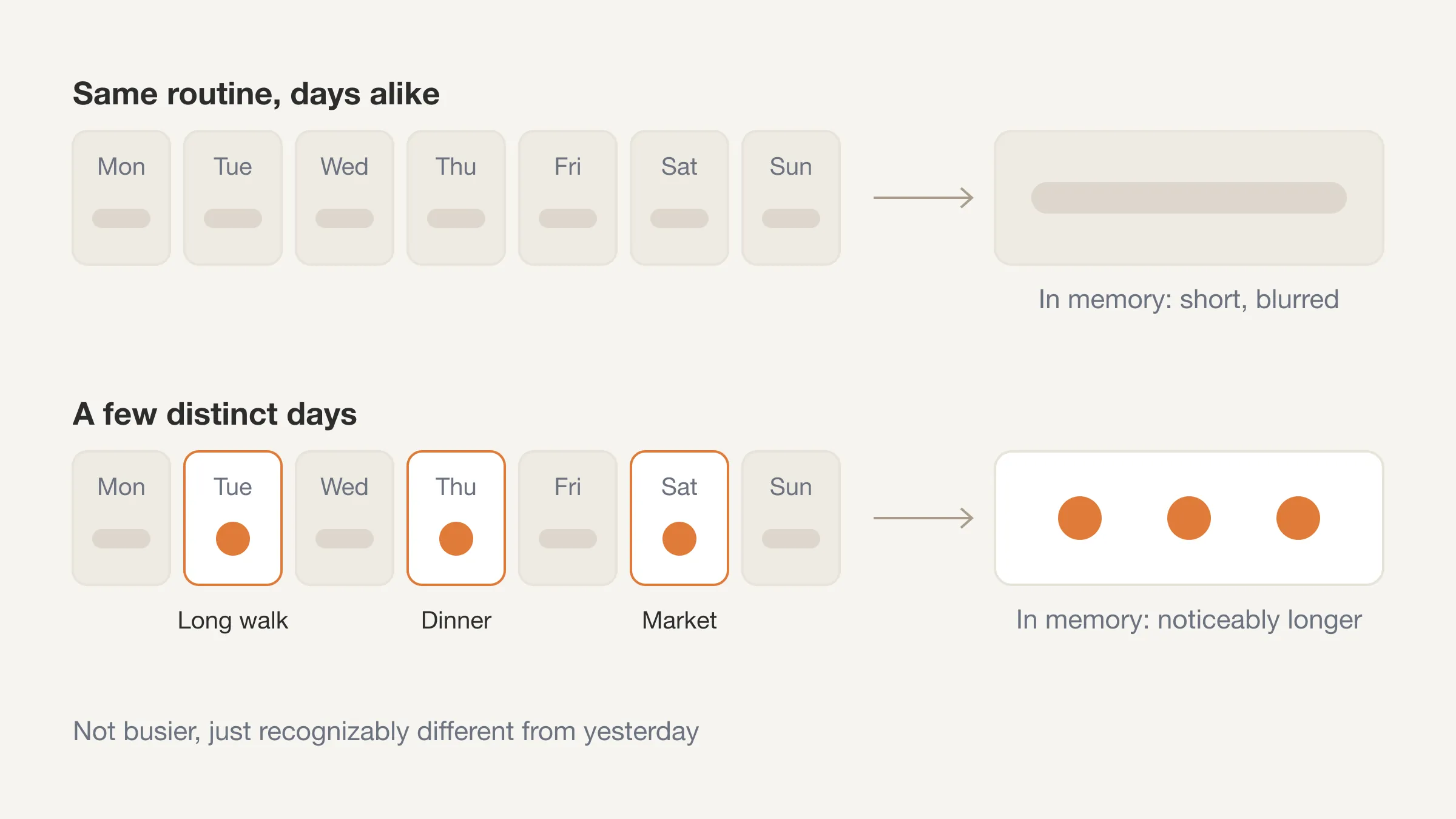
| A week with a few distinct events | Normal | Noticeably longer |
Why do some days drag while the year flies?
Because the two kinds of time are measured by different things. A boring day drags in the moment because you are paying attention to the passing of time itself. The same day vanishes later because nothing in it was worth storing.
Many people live in exactly this pattern. Individual days feel long, with the clock slow on Wednesday afternoon, while the year feels like a few weeks. The cause is the same: sameness. Slow in the moment, fast in memory.
See where today goes
Log your day in 15-minute blocks. Two minutes in the morning, two at night. Beyond Time turns every day into something you can recall.
Try Beyond Time freeHow can you make time slow down?
You cannot literally slow time. You can change what a day leaves behind and how much of it you were present for. Five approaches work with the way memory actually behaves.
1. Add one new thing a week
Novelty does not need a plane ticket. Walk a different route. Try a place you have never eaten. Take a class for one evening. Visit a part of your own city you have never been to. One genuinely new experience per week gives memory something to hold on to.
2. Make days distinct from each other
Blurred weeks come from identical days. Give each day a different anchor: Tuesday is the long walk, Thursday is dinner with a friend, Saturday morning is the market. The point is not to be busier. It is to be recognizably different from yesterday.
3. Pay attention on purpose
Attention is what gets stored. Choose one ordinary activity a day, such as lunch, a walk or a conversation, and do only that. No phone, no podcast. You will remember it, and that one memory is a small anchor in the day.
4. Notice the end of the day
Take two minutes at night to ask what happened. Not what you did well or badly, just what happened. Recalling the day while it is fresh gives you a better chance of keeping it than letting it fade.
5. Keep a record you can look back on
A written record does what memory cannot. Next month you will not recall most of today. A log does. We cover that in the next section.
How does logging your day help?
A daily log turns a blurred day into a list of specific things that happened. That does two jobs at once. It makes the day easier to recall, and it shows you what the day actually contained.
Here is how it works with 15-minute blocks. A waking day from 7 am to 11 pm has 64 blocks of 15 minutes. Across a week that is 448 blocks. If you log each block with a category, you end up with a record of your week that is a few lines long but covers every waking hour.
Three things tend to happen once you try it:
- You find the gaps. Blocks you cannot account for stand out. "Not logged" is information: those are the hours that drifted by.
- Weeks stop looking alike. When you can see the detail, Tuesday and Thursday turn out to be different after all.
- Looking back works. A month later you can open a week and recall it. That makes a year feel like fifty-two distinct weeks rather than one.
In Beyond Time you start your day by noting how you slept and picking the one to three goals that matter. You log time in 15-minute blocks, choosing from routines grouped as Health, Life, Work and Sleep. In the evening you end your day by rating how health, life and work felt from 1 to 10. Then you can see your week, with every hour split by category, and read an AI reflection on what went where you meant it to and where time leaked.
You do not need an app to try the idea. A paper grid works. For a method and the reasoning behind the block size, see the 15-minute time block method. To go further, a full time audit walks through a week of logging.
Does knowing your time is limited make it feel faster?
It can, if the thought arrives as vague dread. It should not, if it arrives as a number. There is a real difference between "life is short" and "this week has 112 waking hours and I know roughly where they go."
Vague awareness of limited time tends to produce a low-level pressure. Specific awareness gives you something to act on. A day with 64 blocks is small enough to see in full. A year is not, which is why it feels like it slipped away.
Two framings help:
- Shrink the unit. Instead of "where did the year go," ask "where did Tuesday go." Days are short enough to recall and fix.
- Count what you have. A week is 168 hours, roughly a third of it sleep. Our guide to how to find more time in your 168 hours shows that math in detail.
The aim is not to feel urgent. It is to be accurate. Slower-feeling time is mostly a side effect of days you actually notice.
Is there a speed at which time is "supposed" to feel?
No. There is no correct pace, and time speeding up with age is a common experience, not a problem. Some people also notice that time feels faster when they are busy, stressed or looking at screens for long stretches. If the feeling is accompanied by persistent worry or low mood, or if it interferes with daily life, it is reasonable to talk to a doctor or mental health professional. This article is general information and not medical advice.
If your concern is mainly "my days blur together," that is something you can work on yourself, with the steps above.
What does a slower-feeling week look like in practice?
Take a typical weekday as an example. Suppose you wake at 7, work from 9 to 5, and are home by 6. Without a log, the evening disappears: dinner, phone, television, bed. Lights out by 11 and the day is gone.
Now suppose you do three small things. At lunch, you walk somewhere you do not usually go. In the evening, you cook something you have never made, and you take 15 minutes without a screen afterward. At night you spend two minutes logging the day.
Those three changes are small, but they give the day three specific memories. Do this once a week and you have fifty-two weeks that each contain something distinct.
Pair it with a night routine that protects your sleep, since a rested day is easier to pay attention to. Our night routine guide is a starting point.
Make this week recallable
Start your day, log time in 15-minute blocks, end your day, then see your week. Free for two weeks with everything unlocked.
Download Beyond TimeFrequently Asked Questions
Why does time go by so fast as you get older?
Time feels faster because later years hold fewer new experiences, so they leave fewer distinct memories. A year is also a smaller part of your life at 40 than at 10. Researchers have offered several explanations, and none is a settled law.
Why does time go by so fast when you are having fun?
Because you are absorbed, you stop monitoring the clock. Prospective time shrinks when attention is elsewhere. Afterward, a fun and varied stretch often feels long in memory, which is the holiday paradox.
How do you make time slow down?
You cannot slow the clock, but you can make time feel longer in hindsight. Add one new thing a week, make days different from each other, give one activity your full attention and keep a short daily record.
Why do the weeks feel like they pass so quickly?
Weeks feel quick when their days are alike. If Monday to Friday follow the same pattern, memory stores a single template instead of five days. Logging the day in 15-minute blocks makes each one distinct.
Is it normal to feel like time is passing too fast?
Yes, it is a very common experience. If it comes with constant worry, panic or low mood, or if it interferes with your daily life, talk to a doctor or mental health professional.
Does tracking your time make it go slower?
Tracking does not change the clock, but it gives you a record of what each day contained. That makes the days easier to recall, and recalled days feel longer than forgotten ones.
The short answer to "why does time go by so fast"
Time goes by so fast when your days are alike, your attention is elsewhere and nothing marks one week from the next. Routine compresses memory. Novelty, attention and a record of the day stretch it.
Your time is limited. The most useful response is not to panic about it but to see where it goes. Start with one day: 64 waking blocks, two minutes to check in, two minutes to close. Then look at the week.
If you want a place to begin, Beyond Time lets you log your day and see your week. If you would rather start on paper, the time blocking template and the weekly schedule template are free. For a gentler way to start, read time tracking for beginners.
Put this into practice
Free tools that match this article.
Weekly Schedule Template
Plan your week with a free printable weekly schedule template for goals, routines, and focus blocks.
Try Schedule TemplateRoutine BuildingNight Routine Planner
Create a realistic night routine checklist for better sleep and a smoother tomorrow.
Try Night RoutineTime ManagementTime Blocking Template
Map your day into focused time blocks with a free printable time blocking template.
Try Time BlockingRoutine BuildingMorning Routine Generator
Design your ideal morning routine with AI-powered suggestions based on proven practices.
Try Morning RoutineKeep exploring this topic
Time blocking guide
Turn priorities into protected calendar blocks.
Morning routine template
Build a practical morning routine around energy and focus.
15-minute time blocks
Plan and review your day with more realistic precision.
Evening routine ideas
Wind down in a way that supports sleep and tomorrow’s goals.
Related Articles

How Many Minutes in a Week? 10,080, and Where They Go
How many minutes in a week? 10,080, or 6,720 waking minutes at 8 hours of sleep. See the minutes in each activity for an average week and how many are left.

Bucket List Ideas: 100 Ideas Grouped by Theme and Lead Time
100 bucket list ideas grouped by theme and tagged by lead time: now, this year, or years ahead. Count the weeks you have, then pick ten. Start your list today.

How to Stop Doomscrolling: 9 Practical Fixes That Work
How to stop doomscrolling: add friction, swap in better habits and check your Screen Time against a real log of your day. Nine fixes, with sources. Try one.

Life Plan Template: A One-Page Plan With Weekly Costs
A free life plan template you can copy: eight areas of life, one outcome each, and a weekly time cost so your plan fits the 112 waking hours you really have.
How Many Work Weeks in a Year? 52 Minus Your Time Off
How many work weeks in a year? 52 on paper, usually 46 to 50 after holidays and leave. See the table by days off, 2026's count and the weeks left this year.

Second Brain Method Explained: CODE, PARA and Who It Suits
A second brain is a trusted place outside your head for notes and ideas. See how Tiago Forte's CODE and PARA work, who it suits, and what notes can't tell you.