Journal Prompts: 87 Questions Sorted by Mood and Purpose
87 journal prompts sorted by mood and purpose, from stress and gratitude to goals and time, plus a two-minute nightly version for days when you have no energy.
Good journal prompts are specific questions that are easy to answer in five minutes. Below are 87 journal prompts, grouped by mood and purpose so you can find the right one when you are stressed, stuck, grateful, planning or just tired. There is also a two-minute nightly version for days when even one prompt feels like too much.
You do not need to answer them all, and you should not try. Pick one, set a timer and write until it ends. If you are new to the habit, start with how to journal in five minutes and come back here when you want something to write about.
Key takeaways
- Pick one prompt per sitting. Five minutes on one question beats a page of vague writing.
- Match the prompt to the mood. Stress, a stuck project and a good day each call for different questions.
- The two-minute nightly set, three questions plus one line, works on your worst days.
- Prompts are a writing habit, not a treatment. If worry or low mood is heavy or lasts, talk to a doctor or mental health professional.
How do you use journal prompts?
Choose one prompt, write for five minutes and stop. Treat the list as a menu. If a question makes you feel something, even mild irritation, that is a good sign it is worth answering.
A few ground rules make prompts work better:
- Answer the question as asked. "What did I avoid today?" has a concrete answer. Write the concrete answer before you reflect on it.
- Be specific. Names, places, times and numbers beat adjectives. "A call with my manager at 2 pm left me tense for an hour" tells you more than "work was stressful."
- Skip the ones that do not fit. If a prompt feels forced, move on. There are plenty.
- Write badly. Spelling and style do not matter. Nobody grades a journal.
- Notice repeats. If the same prompt keeps pulling the same answer, that is information about your life.
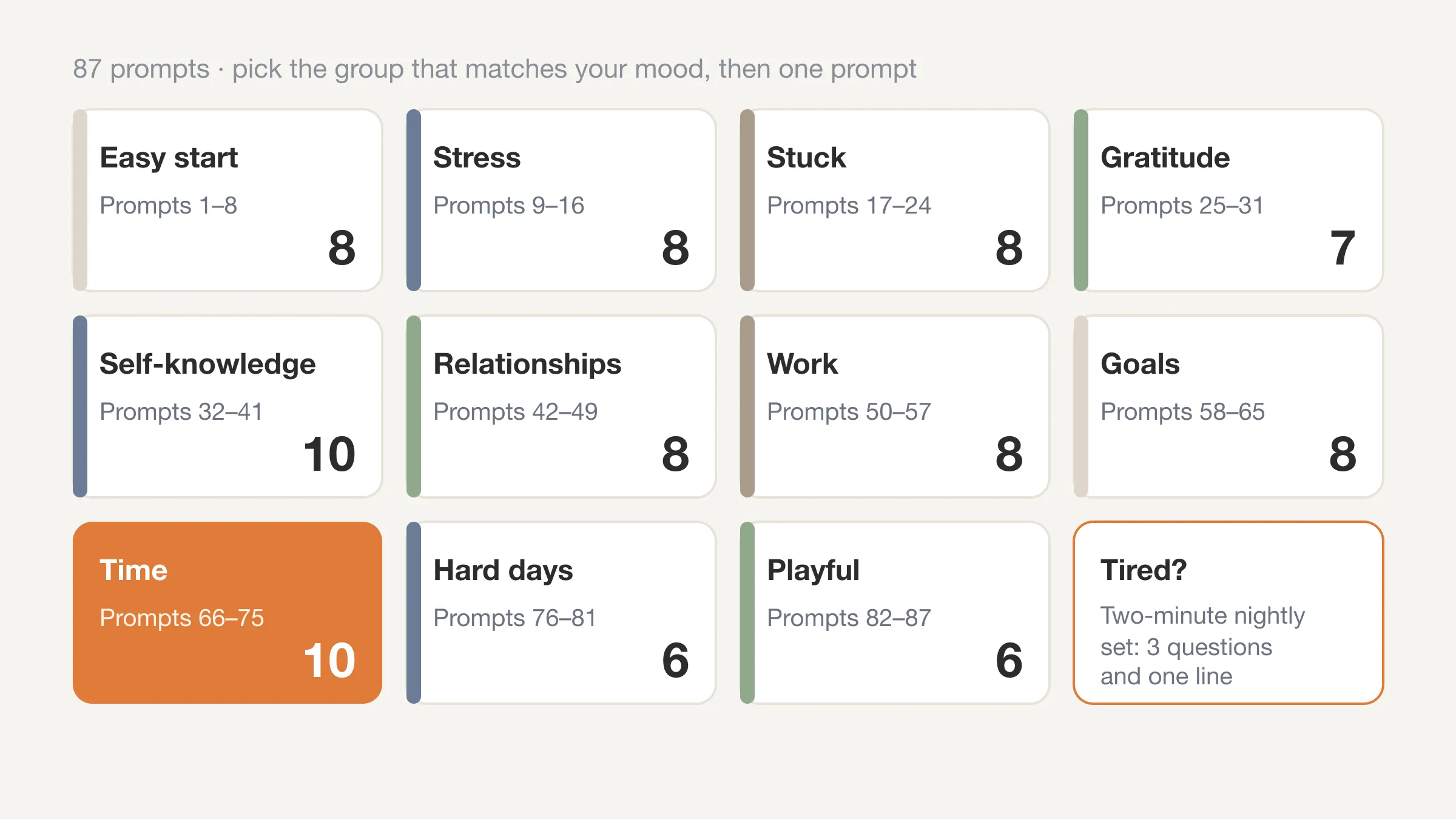
Pick a prompt by mood. If you are not sure, start with the first group.
What are easy journal prompts for beginners?
These are low-stakes questions you can answer in a few sentences. They work when you do not know where to start.
- What happened today that I want to remember?
- What was the best ten minutes of my day, and what was I doing?
- What did I eat, hear or see today that I noticed?
- What am I looking forward to this week?
- What is on my mind right now, in plain words?
- What did I do today that I did not plan to do?
- What would make tomorrow a little easier?
- If I described today to a friend in three sentences, what would I say?
What are journal prompts for stress and overwhelm?
When your head is full, the goal is to get things onto the page and sorted, not to solve everything. These prompts separate what you can act on from what you cannot.
- What is the loudest worry in my head right now? Write it as one sentence.
- What exactly is the worst realistic outcome, and how likely is it?
- What part of this is in my control, and what part is not?
- What is one small action I could take in the next 24 hours?
- What would I tell a friend who came to me with this exact worry?
- What have I handled before that felt this hard?
- What do I need right now: rest, help, information, a decision or a break?
- Which of today's tasks could wait until later this week with no real cost?
There is some evidence that writing about worries can help in the moment. In a well-known 2011 study published in Science, Ramirez and Beilock had ninth graders write about their thoughts and feelings about an upcoming biology final for 10 minutes right before it. Those students scored better than a comparison group who wrote about something else, and the gain was largest for students who were highly anxious about tests. The authors suggest that worries use up mental working space and that writing them down may free some of it. It is one study in one setting, so treat it as encouraging, not as a promise.
If the same worry keeps returning no matter what you write, change the question from "why is this happening?" to "what is one small thing I can do about it?" If that does not help, it is a good reason to talk to someone.
What are journal prompts for when you feel stuck?
Feeling stuck often means a decision is waiting or a task is bigger than it looks. These prompts help you find which.
- What am I avoiding, and what do I imagine will happen if I start?
- What is the smallest version of this task I could do in 15 minutes?
- What do I already know about this problem that I keep forgetting?
- If I had to decide today, what would I choose?
- What am I waiting for, and is it coming?
- What would I do if I were not afraid of looking foolish?
- Who could help me with this, and what is the smallest thing I could ask?
- What did I stop doing recently that I miss?
What are gratitude and good-day journal prompts?
Gratitude prompts work best when they are specific. "My family" is vague. "My sister sending that photo at lunch" is a real moment.
- What are three small things that went well today?
- Who did something kind for me recently, and have I told them?
- What ordinary thing in my life would I miss if it disappeared?
- What did my body let me do today?
- What is something I get to do this week that I once hoped for?
- What part of my routine do I actually enjoy?
- What made me laugh, even a little, in the last few days?
What are journal prompts for self-knowledge?
These questions take longer. They are best on a quiet weekend morning, not at the end of a long day.
- When do I feel most like myself?
- What do I do when nobody is watching?
- What do I keep saying yes to that I want to say no to?
- What do I envy in other people, and what does it say about what I want?
- What was I doing the last time I lost track of time?
- What do I believe about myself that I have never checked?
- Which of my habits would I be glad to see in someone I love?
- What would my ideal ordinary Tuesday look like?
- What is something I changed my mind about in the last year?
- What am I proud of that I have not told anyone?
What are journal prompts about relationships?
Relationship prompts are less about what other people did and more about what you want and what you notice.
- Who gave me energy this week, and who drained it?
- What conversation am I putting off, and what is the first sentence?
- What do I wish someone knew about me?
- Who have I not talked to in a while that I think about?
- When did I last feel truly listened to?
- How do I want to show up for the people close to me this month?
- What is something I appreciate about a person I find difficult?
- What boundary do I need, and what would it sound like?
What are journal prompts for work and purpose?
Work takes a large share of waking hours, so it deserves its own questions. Use these on a Friday afternoon or a Sunday evening.
- What part of my work this week was worth the time?
- What task do I keep carrying from one week to the next?
- When did I do my best work recently, and what was around me?
- What would I stop doing if I could?
- What skill am I building, and what is one step this week?
- Whose work do I admire, and what exactly do I admire?
- If my job disappeared tomorrow, what would I miss, and what would I not?
- What does "enough" look like for this week?
What are journal prompts for goals and the year ahead?
Goal prompts are most useful when they ask about time, not just intention. A goal without hours behind it is a wish.
- What is the one thing I most want to finish before the year ends?
- Which goals on my list did I actually spend time on this month?
- How many hours a week does my main goal really need, and where would they come from?
- What would I be glad to have started a year from now?
- What am I doing out of habit that no longer serves a goal?
- Which small habit, if it ran daily, would matter most?
- What is the next visible step, and when exactly will I take it?
- What would make me feel the year was well spent, even if nothing dramatic happens?
On 19 November 2026 there are 42 days left in the year, or 43 counting today. That is six weeks. If you want to use that window well, the last weeks of the year guide helps you pick what is worth finishing, and the days left in the year post shows how to count them. The free weeks left in the year counter gives you the number for any date.
See how many weeks you have left
Weeks, weekends, workdays and waking hours left in the year, in one free counter.
Open the weeks-left counterWhat are journal prompts about time and attention?
These are the questions most people never ask, and the answers are often the most useful. They work especially well alongside a short log of your days.
- Where did most of my time go yesterday, and was that where I wanted it to go?
- Which hour this week felt the most wasted, and what would have made it better?
- What did I do mostly out of habit this week, such as scrolling or checking messages?
- What am I busy with that is not important?
- What is important that I have not made time for?
- If I had two free hours tomorrow, what would I do with them?
- What do I wish I had more time for, and what am I spending that time on instead?
- Which part of my day feels rushed, and which feels empty?
- How many hours this week did I spend on things that matter to me?
- What one change to my schedule would I notice most?
A good way to answer these is to look at the facts first. A daily time log shows what the day contained in 15-minute blocks, and the prompts then ask what you make of it. A day has 96 blocks, and a typical waking day from 7 am to 11 pm has 64. Seeing your own 64 laid out usually changes the answer to "where did the time go?" from a guess into a list.
What are journal prompts for hard days and letting go?
Hard days need gentler prompts. Some of these are about acceptance, not fixing.
- What happened, in plain facts, without judgment?
- What am I feeling, and where do I feel it in my body?
- What would be enough for today?
- What am I holding on to that I could set down for now?
- What do I need to forgive myself for, and can I do it in one sentence?
- What small kind thing can I do for myself in the next hour?
If a hard stretch lasts, and you feel low or anxious most days, a journal is not enough on its own. See the last section for when to reach out.
What are playful and creative journal prompts?
Not every journal needs to be serious. These are for a lighter day.
- Describe your day as the plot of a short film.
- What would a stranger guess about me from my desk or bag?
- Write a letter to yourself one year from now.
- What is a small adventure I could have within an hour of home?
- If today had a theme song, what would it be, and why?
- Make a list of ten things you could do on a free Saturday, with no rules.
If prompt 87 leaves you short of ideas, borrow some from these hobbies sorted by weekly time or a seasonal fall bucket list.
What is a two-minute nightly journal?
A two-minute nightly journal is three questions and one line. It is for the nights when you are tired, busy or out of ideas. It takes about as long as brushing your teeth, and it still leaves a record.
Answer these in a sentence each:
- What did I do today? One or two things, in plain words.
- What went well? Anything, however small.
- What is one thing for tomorrow? One thing, not a list.
Then add one line if you want: how the day felt, or something you do not want to forget.
If you use Beyond Time, the End your day step covers the same ground in a few taps. You rate how health, life and work felt from 1 to 10 and add a line if you want. The numbers build into a trend across the week. The AI reflection then reads your logged day and shows what went where you meant it to, where time leaked and one or two changes for tomorrow. You can also do this on paper. The app only makes it faster.
Two minutes at night, two in the morning
Log the day in 15-minute blocks, rate it 1 to 10 and add a line. Two weeks free, all features included.
Try Beyond Time freeHow do you pick the right prompt each day?
If you are unsure, use the table below.
| If you feel... | Try these prompts | Section |
|---|---|---|
| Tired or low on energy | The two-minute nightly set | Nightly version |
| Anxious or wound up | 9 to 16 | Stress and overwhelm |
| Stuck on a task or decision | 17 to 24 | Feeling stuck |
| Content or thankful | 25 to 31 | Gratitude |
| Curious about yourself | 32 to 41 | Self-knowledge |
| Tense about someone | 42 to 49 | Relationships |
| Restless about work | 50 to 57 | Work and purpose |
| Planning ahead | 58 to 65 | Goals and the year ahead |
| Wondering where the week went | 66 to 75 | Time and attention |
| Having a hard day | 76 to 81 | Hard days |
| Playful | 82 to 87 | Playful |
Rotate through the groups over a few weeks. If a prompt pulls a long answer, keep a note of it. Those are the ones to return to.
When should you talk to a professional?
Journal prompts are a way to notice and organize your thoughts. They are not therapy. This is general information, not medical advice.
Consider talking to a doctor or mental health professional if low mood, worry or hopelessness lasts most of the day for two weeks or more, if it affects your sleep, work or relationships, or if writing keeps pulling you into dark thoughts instead of easing them. If you are thinking about harming yourself, in the United States call or text 988 to reach the 988 Suicide and Crisis Lifeline, free and open 24 hours a day. In an emergency call 911 or your local emergency number. For more on feelings about time, see time anxiety.
Frequently Asked Questions
What are good journal prompts for beginners?
Start with simple, factual questions such as "What happened today that I want to remember?" or "What was the best ten minutes of my day?" They have concrete answers and take only a few minutes. Prompts 1 to 8 above are written for this.
How many journal prompts should I answer at a time?
One is enough. Pick a single prompt, set a five-minute timer and write until it ends. Answering several at once tends to produce shallow answers, and it makes the habit feel like homework.
How long should I spend on a journal prompt?
Five minutes is a good default. Use two minutes on tired nights with the nightly set, and up to 15 or 20 minutes for the longer self-knowledge questions when you have a quiet morning.
Can journal prompts help with anxiety?
They can help you name and sort worries, and some people find that writing eases them in the moment. Evidence is limited and varies by person, and prompts are not a treatment. If anxiety is constant or affects daily life, talk to a health professional.
What are good journal prompts for the end of the year?
Try the goals and time groups: what you want to finish, which goals got real hours, and what would make the year feel well spent. On 19 November 2026 there are 43 days left, counting today, so choose one or two things rather than a long list.
Should I use prompts every day?
You can, but you do not have to. Many people use prompts three or four days a week and free-write or log on the others. Keep a minimum version for bad days so the habit never fully stops.
How is journaling different from keeping a time log?
A journal records how a day felt and what you thought. A time log records what the day contained, block by block. They answer different questions, and together they explain a day better than either one alone.
Journal prompts, in short
The best journal prompts are specific, answerable in five minutes and matched to your mood. Use the groups above, pick one question a sitting, and keep the two-minute nightly set for tired days. Your time is limited, and a few minutes of honest writing is a good way to see where it goes.
See where it goes
Log your day in 15-minute blocks, then let the AI reflection show where time leaked and one or two changes for tomorrow.
Try Beyond Time freePut this into practice
Free tools that match this article.
Goal Setting Worksheet
Turn a vague goal into milestones, habits, blockers, and a weekly review plan.
Try Goal WorksheetTime ManagementWeekly Schedule Template
Plan your week with a free printable weekly schedule template for goals, routines, and focus blocks.
Try Schedule TemplateRoutine BuildingNight Routine Planner
Create a realistic night routine checklist for better sleep and a smoother tomorrow.
Try Night RoutineTime ManagementTime Blocking Template
Map your day into focused time blocks with a free printable time blocking template.
Try Time BlockingKeep exploring this topic
Goal setting guide
Start with the fundamentals of setting goals that turn into action.
Time blocking guide
Turn priorities into protected calendar blocks.
Morning routine template
Build a practical morning routine around energy and focus.
Goal frameworks compared
Choose between SMART goals, OKRs, BHAGs, and 12-week goals.
Related Articles
How Many Weeks Until Christmas? 5 Weeks and 5 Days
How many weeks until Christmas? On 15 November 2026 it is 40 days, or 5 weeks and 5 days. See how to count from any date and what fits before 25 December.
How Many Days Left in the Year? 48 After 13 Nov 2026
How many days are left in the year? 48 after 13 November 2026, 49 counting today. See the workdays, weekends and waking hours in them and how to count any date.
How Many Weeks in a Year? 52, Plus a Day (2026 Has 53)
How many weeks in a year? 52 weeks plus 1 day (2 in a leap year). ISO calendars count 52 or 53, and 2026 has 53. See the math, the tables and what is left.

How Many Minutes in a Week? 10,080, and Where They Go
How many minutes in a week? 10,080, or 6,720 waking minutes at 8 hours of sleep. See the minutes in each activity for an average week and how many are left.

Bucket List Ideas: 100 Ideas Grouped by Theme and Lead Time
100 bucket list ideas grouped by theme and tagged by lead time: now, this year, or years ahead. Count the weeks you have, then pick ten. Start your list today.

How to Stop Doomscrolling: 9 Practical Fixes That Work
How to stop doomscrolling: add friction, swap in better habits and check your Screen Time against a real log of your day. Nine fixes, with sources. Try one.