
How to Make the Most of the End of the Year (44 Days)
How to make the most of the end of the year: you have 44 days left on 18 November. Pick one or two things to finish, protect the holidays and see where it goes.
To make the most of the end of the year, start with the number: on 18 November 2026 you have 44 days left, counting today. That is six weeks and two days, or 704 waking hours at 16 a day. It is enough to finish one or two things that matter, and not enough to finish everything on your list.
Most year-end advice tells you to push harder. This post argues for the opposite: pick less, size it to the hours you really have, protect the holiday weeks and look at where your time goes so the last six weeks do not blur past.
You do not need a new system for this. You need a count, a short list and a way to check on yourself halfway.
Key takeaways
- 18 November to 31 December 2026 is 44 days, 32 of them weekdays and 12 of them weekend days.
- Choose one or two things to finish. Everything else gets parked or dropped on purpose.
- The two holiday weeks shrink your real hours. Plan around them instead of pretending they are normal.
- Log one week in 15-minute blocks to see what you actually have to work with.
How many days are left in the year?
On Wednesday 18 November 2026 there are 43 days after today and 44 counting today, ending Thursday 31 December. The arithmetic: 13 days left in November, including today, plus 31 in December.
Here is the same stretch broken down.
| What is left | Count |
|---|---|
| Days (counting today) | 44 |
| Weeks | 6 and 2 days |
| Weekdays | 32 |
| Weekend days | 12 (six weekends) |
| Waking hours at 16 a day | 704 |
| Waking 15-minute blocks at 64 a day | 2,816 |
The waking numbers assume a day from 7 am to 11 pm. Change them to fit your own sleep. If you want to run the count for any other date, our post on how many days are left in the year shows how, and the free weeks left in the year counter does it for you.
Why do the last weeks feel so short?
Part of it is arithmetic, and part of it is calendar. Two holidays fall in this stretch: Thanksgiving on Thursday 26 November and Christmas on Friday 25 December. Many people also travel, host or take time off around them, so the weeks around those dates do not behave like normal weeks.
The other part is attention. When a year ends, every unfinished thing becomes visible at once. That is useful if you act on it and tiring if you just feel it.
What is worth finishing before the year ends?
Not everything on your list deserves your last six weeks. Sort what is open into three piles before you do anything else.
- Finish. Things that are close to done, or that matter enough to be worth the hours. This pile should be small.
- Park. Good things that can wait until January without harm. Write down the first step so restarting costs nothing.
- Drop. Things you have been carrying out of guilt or habit. Delete them, and let that be fine.
The finish pile is the one that matters. Two items is a good limit. Three starts to be a stretch given the holiday weeks. If you have ten, you have not sorted yet.
How do you choose between candidates?
Ask three questions of each item in the finish pile:
- Will I be glad on 1 January that this is done? If you cannot picture the feeling, it probably is not important.
- Does it need me, or just time? Things that only need hours are easy to schedule. Things that need a decision or another person need an earlier start.
- What does it cost if I do not finish? Some deadlines are real. Many are self-imposed.
If the answers do not separate your candidates, our goal prioritization matrix gives you a quick way to rank them. For a deeper look at what matters, the guide to setting life priorities can help.
How much can you realistically fit into six weeks?
Size it in hours. This is where most year-end plans fall apart: the wish is vague and the hours are invisible.
Take an illustrative example. Say you want to finish a project that needs about 20 hours of focused work. Spread over the five full weeks between 23 November and 27 December, that is four hours a week. Two hours on two weekday mornings fits inside most weeks. Squeezed into the last three days of December, it does not.
That is the point of sizing. A goal either has a weekly budget that fits your real week or it does not. Our guide to why plans fail and how to close the gap covers the habit of checking a plan against reality before you start.
What do the six weeks look like?
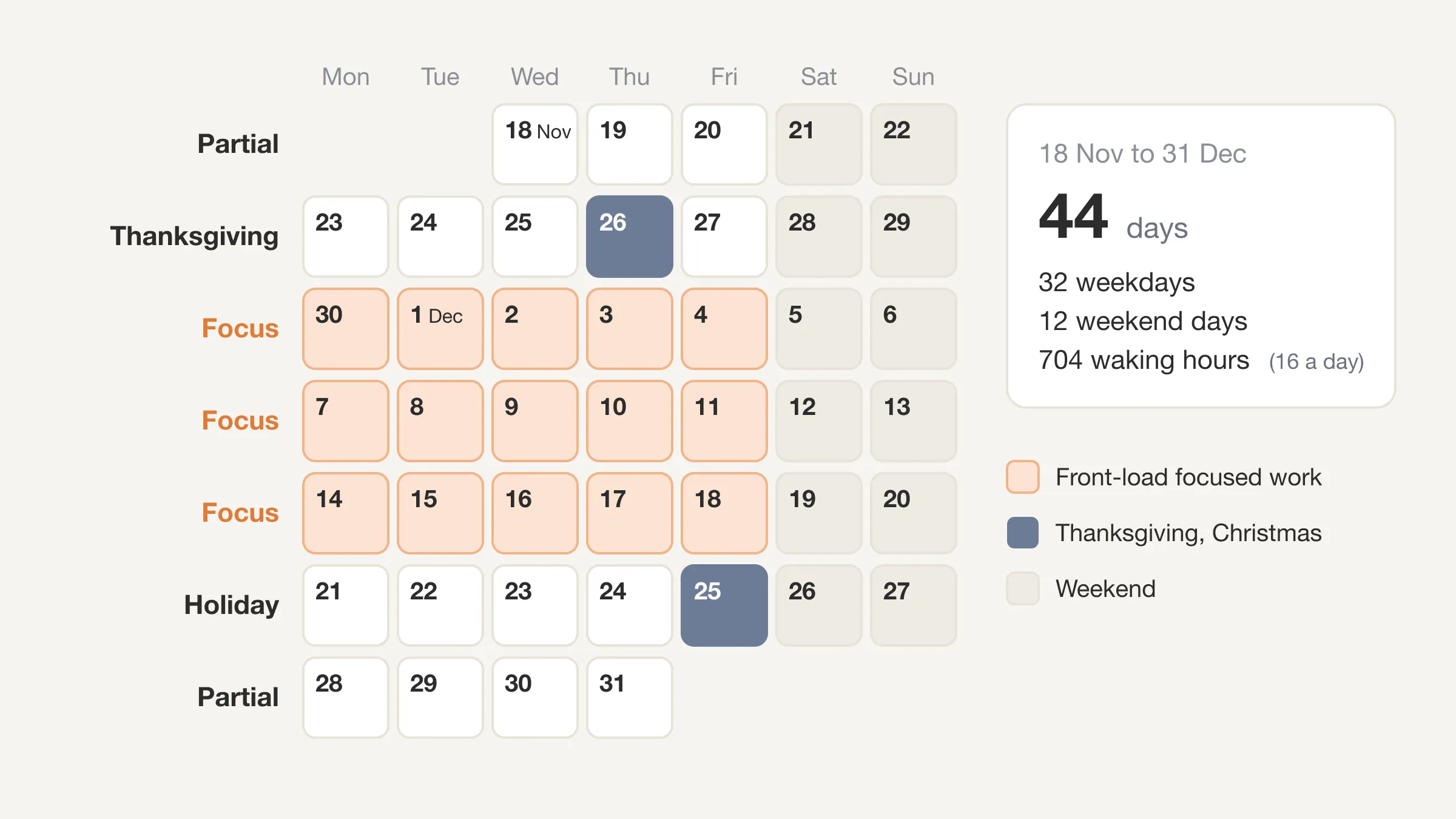
Here is how the remaining days fall, week by week. Weeks run Monday to Sunday.
| Week | Dates | Days | Weekdays |
|---|---|---|---|
| Partial | 18 to 22 Nov | 5 | 3 |
| Thanksgiving week | 23 to 29 Nov | 7 | 5 |
| Full | 30 Nov to 6 Dec | 7 | 5 |
| Full | 7 to 13 Dec | 7 | 5 |
| Full | 14 to 20 Dec | 7 | 5 |
| Holiday week | 21 to 27 Dec | 7 | 5 |
| Partial | 28 to 31 Dec | 4 | 4 |
The weekday count is 32, but treat it as a ceiling. If you are off for Thanksgiving and 25 December, it falls to 30. If you also take 24 and 31 December, it is 28. Those numbers depend on your employer, so use your own calendar. The same holiday arithmetic is why real work hours in a year come in under the usual 2,080.
See your time left, then see where it goes
Beyond Time shows the waking time left today and this week, and the 15-minute log shows where it went.
Try Beyond Time freeHow do you protect the holiday weeks?
Holiday weeks vanish faster than any others, mostly because nobody decides what they are for. Make the decision early.
For each of the two holiday weeks, write one sentence about what it is for. "Rest and family." "Travel." "Finish the report on the 21st, then off." A one-line purpose is enough to keep the week from dissolving. If rest is the purpose, a low-cost hobby to try can make the time feel like yours.
Then do three things:
- Front-load the finish pile. Put the work that needs real focus into the weeks of 30 November and 7 and 14 December, while schedules are still normal.
- Block the time off. Put holidays on your calendar the way you would a meeting, so they are not eaten by small requests.
- Leave slack. Plan for about 70 percent of the hours you have, not all of them. Delays and travel arrive anyway.
For a closer look at the planning side, our guide to the 12-week year explains why shorter planning windows work. Our quarter planner helps you lay out a short stretch like this one.
How do you see where your time goes before it is gone?
The simplest way to find out what you have is to look at one ordinary week. Log it in 15-minute blocks, and the gaps and leaks show up in a way that estimating never does.
A day has 96 fifteen-minute blocks, about 64 of them awake. Each block gets a label: Health, Life, Work or Sleep. Blocks you cannot recall stay marked as not logged. After a week you can answer two questions that matter for the next six: how many hours do I really have for the finish pile, and where do my hours leak? Once you know, a few productivity tips that hold up help you plug the biggest leak.
Our 15-minute time block method explains why this size works. For a first look, our guide to the time audit walks through one week step by step. If you want the weekly total in hours, see how many hours are in a week.
How does Beyond Time help here?
Beyond Time puts the count on the Today screen: the waking time left today and this week. When you log your blocks, passed gaps that your recent days agree on can be filled in with one tap, which keeps the log from becoming a chore. Home Screen and Lock Screen widgets can show the same numbers without opening the app.
At the end of the day, the AI reflection reads the logged day. It tells you what went where you meant it to, where time leaked, and one or two changes worth making tomorrow. It does not decide for you. It shows you the gap.
What should you do this week?
Keep it small. Here is a plan that fits in about half an hour.
- Count. Write down the days left and the number of weekdays you will actually work.
- Sort. Put each open item in Finish, Park or Drop. Keep Finish to two.
- Size. Turn each finish item into hours per week. If it does not fit, shrink it or move it to Park.
- Protect. Name what each holiday week is for and block it.
- Log. Record the next seven days in 15-minute blocks, then compare with your sizing.
On the next Sunday, spend 15 minutes looking back. Our guide to weekly reviews and the Sunday reset show a simple way to run one.
On finishing strong
You do not have to end the year in a sprint. A calm six weeks in which one or two things get done and the holidays stay yours is a better result than a frantic push. If the year was hard, finishing less and resting more is also a reasonable plan.
What if the year did not go as planned?
Many people look at the year-end list and feel behind. A few thoughts that help.
First, a missed plan is information. If a goal did not move, ask whether it was too big for your hours or simply not important enough. Both answers are useful. Our post on why New Year's resolutions fail explains the sizing problem in more detail.
Second, you do not have to rescue the year. You only have to decide how to spend the next 44 days. Starting from the days you have, not the ones you wish you had, is a better place to plan from.
Third, if you want a structured look back, our annual review template and life audit guide are good next steps once the year closes.
Make the last 44 days count
Log your day in 15-minute blocks and see where the hours go. Two minutes in the morning, two at night.
Try Beyond Time freeFrequently Asked Questions
How do I make the most of the end of the year?
Pick one or two things worth finishing, size them in hours per week, protect the holiday weeks and log one week to see what you really have. Trying to do everything in the last six weeks usually means doing nothing well.
How many days are left in 2026 on 18 November?
There are 44 days left including 18 November and 43 days after it, ending on 31 December. That is six weeks and two days, with 32 weekdays and 12 weekend days.
How many waking hours are left in the year?
At 16 waking hours a day, 44 days is 704 waking hours on 18 November 2026, or 2,816 fifteen-minute blocks. Adjust for your own sleep. If you sleep 8 hours, 16 is the right number.
Should I set new goals for the end of the year?
Usually not. Six weeks is short and includes two holiday periods, so it fits finishing better than starting. Use the time to close one or two open items, then plan the new year from a clear list.
How do I finish the year without burning out?
Plan for about 70 percent of your available hours, front-load focused work before the holiday weeks and block time off like any other commitment. Rest is part of a good plan, not a reward for finishing it.
What is the best way to review the year?
Set aside one sitting once the year closes. Look at what you finished, where your time went and what you want to carry forward. A logged record of your weeks makes this easier because you are reading facts instead of recalling impressions.
The last weeks of the year, in short
To make the most of the end of the year, count what is left, finish one or two things that matter, protect the holiday weeks and look at one real week of your time before you commit. On 18 November that is 44 days and 704 waking hours.
Your time is limited. See where it goes, and the last six weeks of 2026 become something you chose rather than something that happened to you.
Put this into practice
Free tools that match this article.
Weeks Left in the Year
How many weeks are left in the year? A live countdown of weeks, days, weekends and waking hours.
Try Weeks LeftTime ManagementTime Blocking Template
Map your day into focused time blocks with a free printable time blocking template.
Try Time BlockingPlanning90-Day Quarter Planner
Create a comprehensive 90-day plan with AI-powered goal setting and milestone tracking.
Try Quarter PlannerGoal SettingGoal Setting Worksheet
Turn a vague goal into milestones, habits, blockers, and a weekly review plan.
Try Goal WorksheetRelated Articles

Quality Time: What It Means and How to Make More of It
Quality time is undivided attention shared with someone. See what counts, 25 ideas by relationship, and how to check how much quality time you really had.

Digital Minimalism: A Gentle 30-Day Declutter That Sticks
Digital minimalism means using technology only where it serves what you value. Try a gentle 30-day declutter, then measure the hours that came back. Start here.
Slow Productivity: Cal Newport's Ideas and How to Use Them
Slow productivity means doing fewer things at a natural pace with high quality. Here is Cal Newport's idea in plain words, and how to check your hours.
Quarter Life Crisis: Signs, Causes and a Way Through It
A quarter life crisis is a stretch of doubt about career, relationships and direction in your 20s or early 30s. Learn the signs, causes and a way through it.

How to Romanticize Your Life: 15 Small Ways to Start Today
How to romanticize your life without spending money: 15 small rituals, a one-week experiment, and a way to see which hours were worth savoring. Start today.

Four Thousand Weeks: Lessons and How to Use Them
Four Thousand Weeks by Oliver Burkeman, summarized in plain words, with the math of how many of your weeks are gone and what to do with the rest. Start here.