
How Many Work Hours in a Year? 2,080, and Why Fewer
How many work hours in a year? 2,080 at 40 hours for 52 weeks. After 2026's holidays and leave it is closer to 1,900. See the table and what it means for you.
There are 2,080 work hours in a year if you work 40 hours a week for 52 weeks. It is the number payroll uses to turn an hourly wage into a salary. It is also an upper limit. Once you take out holidays and time off, a full-time schedule comes to about 1,800 to 2,000 hours a year.
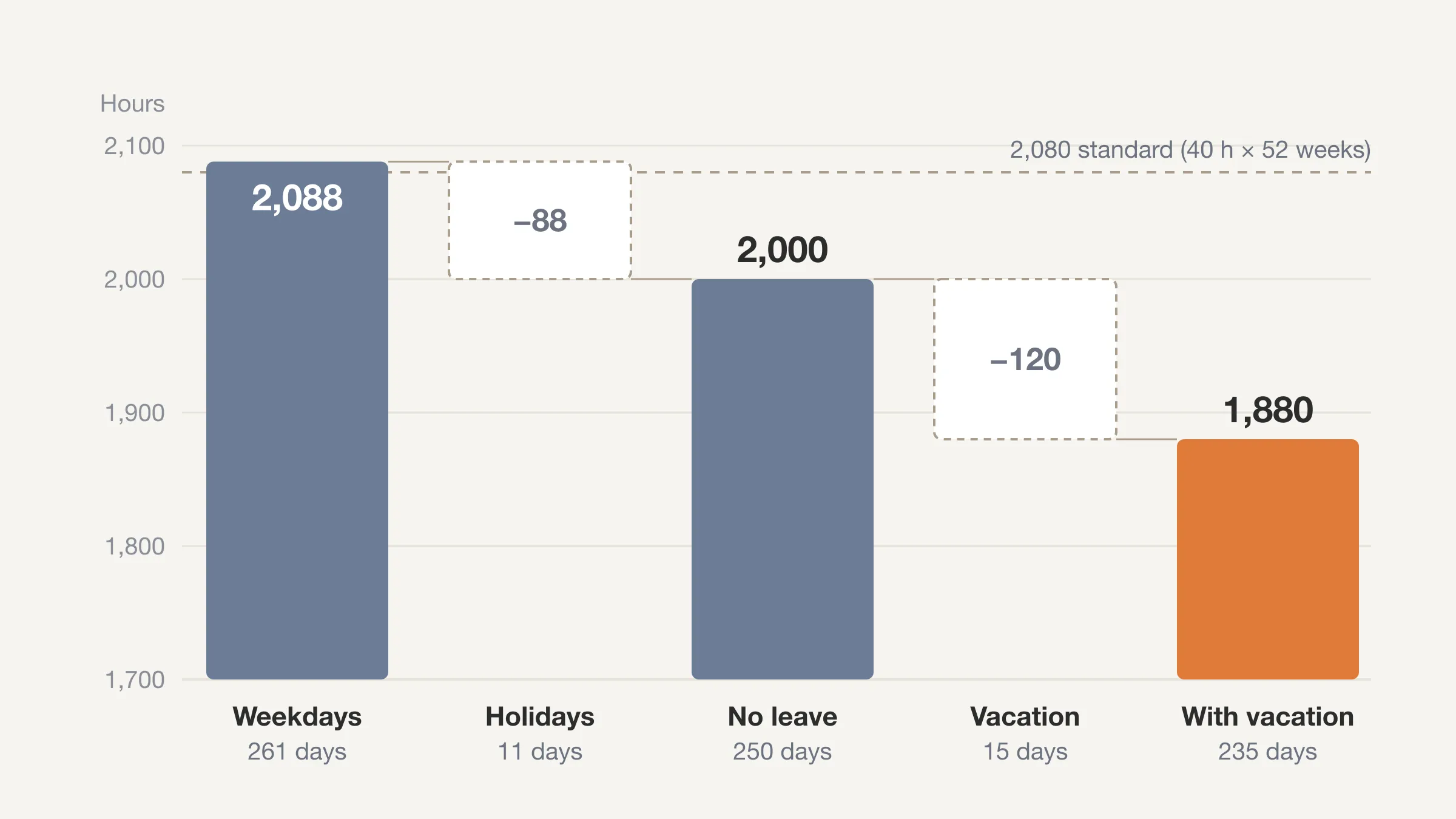
In 2026 the math is specific. The year has 261 weekdays, which is 2,088 hours at 8 hours a day. Subtract the 11 US federal holidays and you get 2,000 hours. Subtract 15 days of vacation and you get 1,880.
It is 1 October, so the useful version is the one that is left. This post gives the standard number, a table of what changes it, what the US time-use survey says people actually work, and how many of your work hours are still ahead this year.
Key takeaways
- The standard figure is 2,080 work hours a year (40 hours times 52 weeks).
- In 2026, 261 weekdays minus 11 federal holidays leaves 250 workdays, or 2,000 hours. Vacation and sick days take it lower.
- On 1 October 2026, 62 workdays (496 hours) are left in the year, after the holidays on 12 October, 11 November, 26 November and 25 December.
- Work hours are about a third of your waking time. The other two thirds are the part nobody counts.
How many work hours are in a year?
The standard answer is 2,080. It comes from 40 hours a week times 52 weeks. A year is actually 52 weeks and 1 day (52 weeks and 2 days in a leap year), so the exact figure for 365 days is about 2,086, but payroll rounds to 2,080.
The same answer for other common schedules:
| Schedule | Hours a week | Hours in a 52-week year |
|---|---|---|
| Part-time (4 hours, 5 days) | 20 | 1,040 |
| Four 8-hour days | 32 | 1,664 |
| 35-hour week | 35 | 1,820 |
| 37.5-hour week | 37.5 | 1,950 |
| Standard | 40 | 2,080 |
| 45-hour week | 45 | 2,340 |
| 50-hour week | 50 | 2,600 |
These are the hours you are scheduled to work if you take no time off. Almost nobody works all 52 weeks. The next table shows what happens when you account for the year you really have.
How many work hours are in 2026?
Count the weekdays in 2026 and you get 261. The year starts on a Thursday and has 365 days, so it has 52 full weeks plus one extra Thursday. At 8 hours a day that is 2,088 hours.
Now take out the days off. The US Office of Personnel Management lists 11 federal holidays in 2026, all of them on weekdays (Independence Day falls on a Saturday, so the observed day is Friday, July 3). Private employers set their own holidays, and many give fewer. Use this as a guide.
| Time off, in addition to the 11 federal holidays | Workdays | Work hours (8-hour days) | Work weeks |
|---|---|---|---|
| None | 250 | 2,000 | 50.0 |
| 10 vacation days | 240 | 1,920 | 48.0 |
| 15 vacation days | 235 | 1,880 | 47.0 |
| 20 vacation days | 230 | 1,840 | 46.0 |
| 25 vacation days | 225 | 1,800 | 45.0 |
Every sick day, personal day and week of leave comes out of these numbers too. Someone with 15 vacation days and 5 sick days works about 1,840 hours in 2026.
If you do not get paid holidays, your own number is higher, and your pay is too. The point of the table is the range: the year you actually work is roughly 1,800 to 2,000 hours, not 2,080.
See where your hours go
Beyond Time splits every hour of your week into Health, Life, Work and Sleep, so you can see what work really takes.
Try Beyond Time freeHow much paid time off do workers actually get?
It varies, and it is not guaranteed. The US Bureau of Labor Statistics' Employee Benefits release for March 2026 reports that 80% of private industry workers had access to paid vacation and 81% had access to paid holidays. That leaves roughly one in five without either.
For the number of days, the BLS's March 2024 release gives averages by employer size. At small employers (1 to 99 workers), paid vacation averaged 10 days after one year of service and 14 days after five years. At large employers (500 or more), it averaged 14 days after one year and 18 days after five. These are averages for workers who have the benefit.
So the 10, 15 and 20 vacation days in the table are realistic, and the 2,080 is a ceiling. The US Department of Labor's Fair Labor Standards Act page describes the overtime rule, which applies after 40 hours in a workweek. It does not set a number of vacation days. That is left to employers.
What do people actually work in a year?
The BLS American Time Use Survey asks people to describe their previous day. In the 2025 results, full-time workers worked an average of 8.07 hours on the days they worked, and 70.0% of them worked on an average day, counting weekends and holidays.
A rough annual figure from that: 8.07 hours times 70.0% of 365 days is about 2,060 hours. That is our own arithmetic, not a figure BLS publishes, and it is a rough guide only. It includes weekend work, and it ignores that some of the full-time workers surveyed were on leave.
What it suggests is that the hours worked can be close to the 2,080 standard even after time off. The reason is simple: the days people work run longer than 8 hours, and some of the work happens on weekends. The standard number tells you what a contract says. The survey tells you what the diary says. If those longer days are the real cost, slow productivity makes the case for doing fewer things at a natural pace.
What share of the year is work?
It helps to put work hours next to the other hours in a year. A year has 8,760 hours (365 times 24). Take 8 hours of sleep a night and 5,840 are waking hours (16 times 365).
| Work hours | Share of 8,760 | Share of 5,840 waking hours |
|---|---|---|
| 2,080 | 23.7% | 35.6% |
| 2,000 | 22.8% | 34.2% |
| 1,880 | 21.5% | 32.2% |
| 1,800 | 20.5% | 30.8% |
Work takes about a third of your waking time. That is large, and it is also only a third. The other two thirds, roughly 3,800 to 4,000 waking hours a year, go to commuting, meals, chores, family, exercise, rest and everything else. That is the part most people cannot account for.
If you want the long version, see how many hours are in a year and how many hours are in a month. A month is about 4.35 weeks, not 4, which is why a month of work averages about 173 hours rather than 160.
How many work hours are left in 2026?
Today is 1 October 2026. There are 92 days left in the year, counting today. Here is how that breaks down.
| From 1 October to 31 December 2026 | Count |
|---|---|
| Calendar days | 92 |
| Weekdays | 66 |
| Federal holidays on a weekday (12 Oct, 11 Nov, 26 Nov, 25 Dec) | 4 |
| Workdays left | 62 |
| Work hours left (8-hour days) | 496 |
| Workdays already behind you this year (after holidays) | 188 |
If you work standard 8-hour days, 496 work hours remain. That is about 12.4 work weeks of the 13.1 weeks left on the calendar. Take out any vacation days you plan to use, and the number is lower.
Three quarters of the year's workdays are behind you (188 of 250). Whatever you meant to finish this year has about 62 working days left to get done. Counting it that way is useful because it is concrete. You can look at a project and ask how many of the 62 it needs.
How do you convert hourly pay to annual pay?
Multiply the hourly rate by 2,080. That is the standard conversion, and it assumes you are paid for holidays and paid leave. The second column shows something less common: your pay divided by the hours you actually work, if that is about 1,880.
| Hourly rate | Annual pay (2,080 hours) | Pay per hour actually worked (1,880 hours) |
|---|---|---|
| $15 | $31,200 | $16.60 |
| $20 | $41,600 | $22.13 |
| $25 | $52,000 | $27.66 |
| $30 | $62,400 | $33.19 |
| $40 | $83,200 | $44.26 |
| $50 | $104,000 | $55.32 |
| $75 | $156,000 | $82.98 |
The second column is not what you are paid. It is how much each worked hour earns once you count the paid time off. If your pay for the year is the same, every worked hour is worth about 11% more than the hourly rate suggests. It also means each hour you work beyond the standard is worth less than it looks if you are on a salary.
How do you find out how many hours you really work?
Log them. A year of work is a sum of ordinary weeks, and one logged week is more reliable than an estimate.
- Use 15-minute blocks. A day has 96. Mark each block as Work, Health, Life or Sleep. The 15-minute block method explains why this size is enough.
- Include the edges. The commute, the email at 10 p.m. and the Sunday call are Work blocks if you were working.
- Fill it in twice a day. Two minutes in the morning and two at night.
- Add it up after a week. Multiply by 52, then by about 0.9 for time off, and compare with the 1,880 or 2,080 you assumed.
The daily time log template gives you a table to copy, and how many hours are in a work week shows what a 40-hour week leaves you.
Beyond Time does this on your phone. You start your day by scoring your sleep and picking one to three goals that matter. You log time as 96 blocks, grouped by Health, Life, Work and Sleep. You end the day by rating how health, life and work felt from 1 to 10. The week view splits every hour by category and shows how much you logged, and the AI reflection tells you what went where you meant it to, where time leaked and one or two changes for tomorrow.
Frequently Asked Questions
How many work hours are in a year?
There are 2,080 work hours in a year if you work 40 hours a week for 52 weeks. After holidays and vacation, a full-time schedule comes to about 1,800 to 2,000 hours.
How many work hours are in a year in 2026?
There are 261 weekdays in 2026, or 2,088 hours at 8 hours a day. Subtract the 11 federal holidays and you get 250 workdays, or 2,000 hours. Vacation and sick days reduce it further.
How many working days are in a year?
A year has 260 or 261 weekdays, depending on the year. In 2026 it is 261. After 11 federal holidays that is 250 working days, and each vacation day takes one more away.
How many work hours are in a month?
On average, 173 hours, which is 2,080 divided by 12. In a given month it ranges from about 160 to 184 hours depending on weekdays and holidays.
How many hours is a full-time job per year?
A full-time job at 40 hours a week is 2,080 hours a year if you count the paid holidays and leave. If you count only the hours you actually work, it is less, usually 1,800 to 2,000.
How do I convert my hourly wage to an annual salary?
Multiply your hourly wage by 2,080. For example, $25 an hour is $52,000 a year. If you work fewer hours or unpaid weeks, multiply by your own hours instead.
How many work hours are left in 2026?
On 1 October 2026 there are 62 workdays left, or 496 hours at 8 hours a day, after the four weekday federal holidays still ahead. Subtract any vacation days you plan to take.
So, how many work hours are in a year?
The answer to how many work hours in a year is 2,080, and in 2026 it is closer to 1,800 to 2,000 once the year's real holidays and leave are taken out. Work takes about a third of your waking time. The rest is the part worth looking at.
Your time is limited, so see where it goes. Log a week in 15-minute blocks, add up the Work blocks, and see how it compares with 40. Start with Beyond Time.
Sources: OPM, 2026 federal holidays. BLS, Employee Benefits in the United States, March 2026 and March 2024. BLS, American Time Use Survey 2025, Table 4. US Department of Labor, Wages and the Fair Labor Standards Act. The annual estimate of about 2,060 hours is our own arithmetic from the survey figures.
Put this into practice
Free tools that match this article.
Goal Setting Worksheet
Turn a vague goal into milestones, habits, blockers, and a weekly review plan.
Try Goal WorksheetTime ManagementWeekly Schedule Template
Plan your week with a free printable weekly schedule template for goals, routines, and focus blocks.
Try Schedule TemplateHabit BuildingHabit Tracker Template
Create a free printable habit tracker template — weekly or monthly. Customize your habits and download a clean PDF in seconds.
Try Habit TrackerTime ManagementTime Blocking Template
Map your day into focused time blocks with a free printable time blocking template.
Try Time BlockingRelated Articles

How Many Minutes in a Week? 10,080, and Where They Go
How many minutes in a week? 10,080, or 6,720 waking minutes at 8 hours of sleep. See the minutes in each activity for an average week and how many are left.

Bucket List Ideas: 100 Ideas Grouped by Theme and Lead Time
100 bucket list ideas grouped by theme and tagged by lead time: now, this year, or years ahead. Count the weeks you have, then pick ten. Start your list today.

How to Stop Doomscrolling: 9 Practical Fixes That Work
How to stop doomscrolling: add friction, swap in better habits and check your Screen Time against a real log of your day. Nine fixes, with sources. Try one.

Life Plan Template: A One-Page Plan With Weekly Costs
A free life plan template you can copy: eight areas of life, one outcome each, and a weekly time cost so your plan fits the 112 waking hours you really have.
How Many Work Weeks in a Year? 52 Minus Your Time Off
How many work weeks in a year? 52 on paper, usually 46 to 50 after holidays and leave. See the table by days off, 2026's count and the weeks left this year.

Second Brain Method Explained: CODE, PARA and Who It Suits
A second brain is a trusted place outside your head for notes and ideas. See how Tiago Forte's CODE and PARA work, who it suits, and what notes can't tell you.