How Many Weeks in a Month? About 4.35, Not Exactly 4
How many weeks in a month? About 4.35 on average, or 4 weeks and 2 to 3 days. See every month of 2026, why February is special and why pay and rent drift apart.
A month is about 4.35 weeks on average. A year has 365 days, which is 52.14 weeks, and dividing that by 12 months gives 4.345. In practice a month is 4 weeks plus 2 or 3 days, or exactly 4 weeks in a non-leap February.
That is why "4 weeks in a month" works for rough math and fails for anything exact. The leftover 2 to 3 days are the reason you sometimes get three paychecks in a month, and why a monthly goal and a weekly habit never quite line up. This guide gives you the number, a month-by-month table for 2026, and a way to plan in weeks instead of months.
Key takeaways
- The average month is 4.35 weeks (30.42 days divided by 7).
- 28 days is exactly 4 weeks. 30 days is 4.29 weeks. 31 days is 4.43 weeks.
- Twelve "4-week months" cover only 48 weeks. A year has 52, so four weeks are left over.
- The extra days are why pay periods, rent and habits drift apart. Planning in weeks avoids it.
How many weeks are in a month?
A week has 7 days. Months have 28, 29, 30 or 31 days. So the number of weeks depends on the month:
| Days in the month | Weeks | As weeks and days |
|---|---|---|
| 28 (February) | 4.00 | 4 weeks |
| 29 (February, leap year) | 4.14 | 4 weeks and 1 day |
| 30 | 4.29 | 4 weeks and 2 days |
| 31 | 4.43 | 4 weeks and 3 days |
The average across a year is 365 divided by 12, or 30.42 days. Divide that by 7 and you get 4.345 weeks. In a leap year the average is 366 divided by 12, or 30.5 days, which is 4.36 weeks.
Round it however suits the job. Use 4 for a lazy estimate, 4.3 for a budget and 4.345 if you are converting a weekly number into a monthly one.
How many weeks are in each month of 2026?
Here is every month of 2026, with the days, the weeks and the leftover days after four full weeks.
| Month | Days | Weeks | Left over after 4 weeks |
|---|---|---|---|
| January | 31 | 4.43 | 3 days |
| February | 28 | 4.00 | 0 days |
| March | 31 | 4.43 | 3 days |
| April | 30 | 4.29 | 2 days |
| May | 31 | 4.43 | 3 days |
| June | 30 | 4.29 | 2 days |
| July | 31 | 4.43 | 3 days |
| August | 31 | 4.43 | 3 days |
| September | 30 | 4.29 | 2 days |
| October | 31 | 4.43 | 3 days |
| November | 30 | 4.29 | 2 days |
| December | 31 | 4.43 | 3 days |
| Year | 365 | 52.14 | 29 days |
Add up the leftover days and you get 29. That is the gap between 12 months of 4 weeks (48 weeks, or 336 days) and the 365 days of the year. It is also 4 weeks and 1 day.
As a worked example, today is 4 August 2026, a Tuesday. August has 31 days, and 27 days remain after today. That is 3.86 weeks. For the whole year, 149 days remain after today, which is 21.3 weeks before 2027 starts.
What about February?
February is the one month that behaves. In a normal year it has exactly 28 days, which is exactly 4 weeks. It is the only month that can fit four full weeks with nothing left over.
In a leap year, February has 29 days, so it is 4 weeks and 1 day. The next leap year is 2028. If you want the reason leap years exist and the rule for them, see how many days are in a year.
One useful side effect: February is a clean month to try something. Four weeks, the same weekdays repeated four times, and no spillover. If you want to test a new routine or a logging habit, it is the shortest month that still gives you four of every weekday.
Plan in weeks, see it in blocks
Beyond Time splits every hour of your week by Health, Life, Work and Sleep. See the week, not just the month.
Try Beyond Time freeWhy don't paychecks and rent line up with weeks?
Because rent is monthly and pay often isn't. Rent follows the calendar, so it comes 12 times a year. Pay follows the week, so it comes 26 or 52 times. The numbers don't divide evenly.
| How you are paid | Payments per year | What happens |
|---|---|---|
| Weekly | 52 | Four months a year have an extra payment (5 instead of 4) |
| Every two weeks | 26 | Two months a year have three payments instead of two |
| Twice a month (for example the 1st and 15th) | 24 | Always two a month, so it always lines up |
| Monthly | 12 | One a month, so it lines up |
Take 2026 as an example. If you are paid every Friday, there are five Fridays in January, May, July and October, so those four months pay five times. If you are paid every two weeks and your first payday was Friday 2 January, you get three paychecks in January and July. Your own months will differ, because they depend on which date your first payday fell.
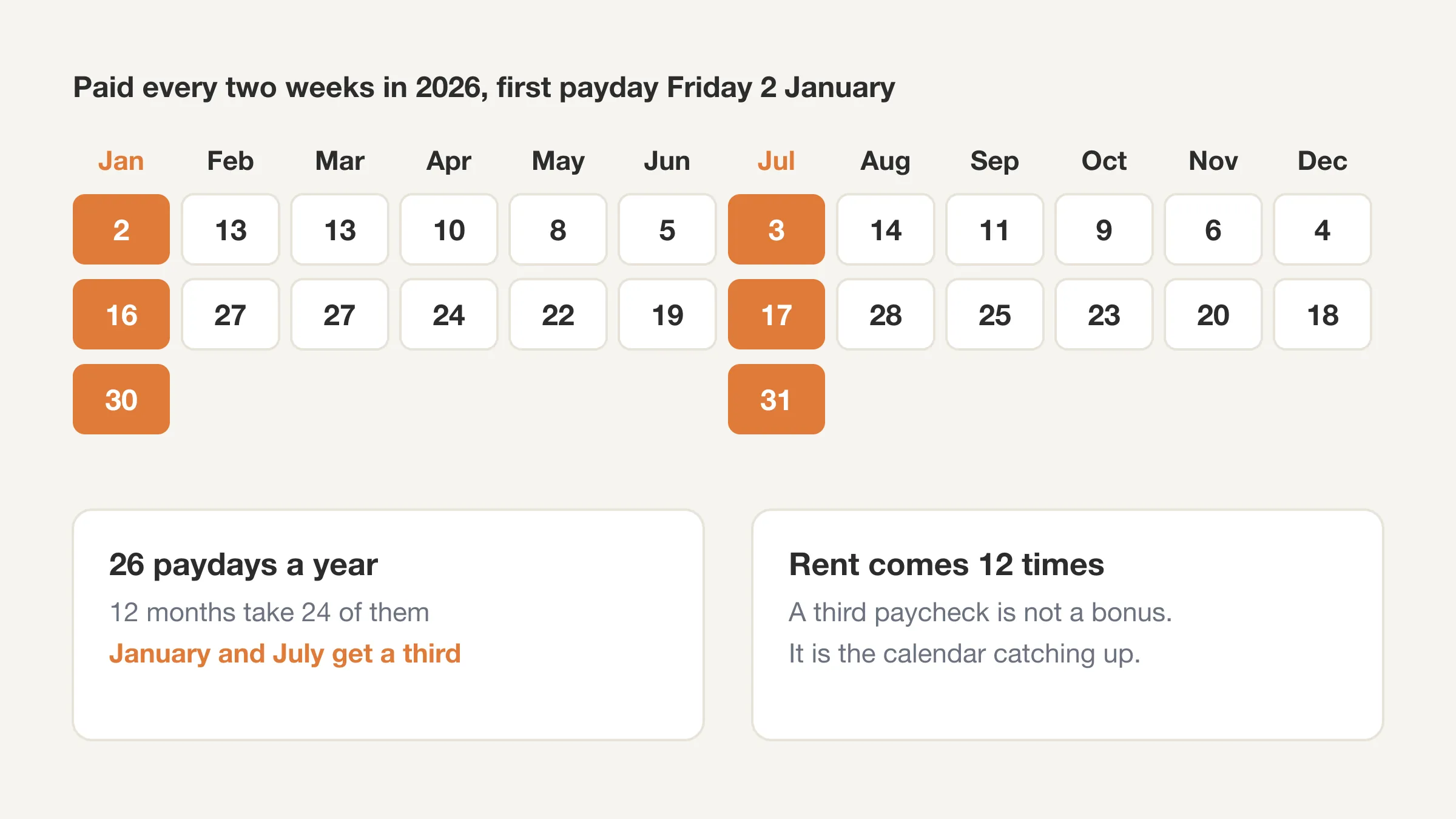
This matters for planning because a month with an extra paycheck is not extra income. It is the calendar catching up. If you treat those months as a bonus and spend them, the budget breaks in the months with only two.
The same drift shows up in time. A monthly goal, such as "read for 20 hours this month", is built from a month that is 4.29 to 4.43 weeks long. That is a small difference, and it still means the same weekly effort gives you slightly different totals each month.
How many hours is a month in weeks?
Convert the 4.345 weeks into hours and you have the monthly version of the week:
| Measure | Per week | Per average month (4.345 weeks) |
|---|---|---|
| All hours | 168 | about 730 |
| Waking hours (16 a day) | 112 | about 487 |
| Full-time work (40 hours) | 40 | about 174 |
| 15-minute waking blocks | 448 | about 1,947 |
A year is 52.14 weeks, so these are the weekly figures times 4.345. They are averages, and a given month will be a little higher or lower. For the hour counts for the whole year, see how many hours are in a year. For the week itself, see how many hours are in a week.
Notice what the table says about a month. Take away full-time work and about 313 waking hours remain. That is a lot, and it is also less than it looks, because meals, chores, errands and travel all come out of those 313 hours.
Is it better to plan in weeks or months?
For most people, weeks. A month is too long to feel and too uneven to compare. A week is the shortest span that repeats your whole routine: the same workdays, the same weekend, the same chores.
Three practical reasons:
- Weeks are even. Every week has 7 days, so this week compares fairly with last week. Months of 28 and 31 days don't.
- Habits live in weeks. A habit that happens three times a week is easy to track. "About 13 times a month" is not.
- Review is easier. A weekly look back takes ten minutes. A monthly one is a pile of things you've forgotten. The Sunday reset is one way to do it.
Use months for money and deadlines, and weeks for effort. Long projects with monthly deadlines, such as planning a thesis, go better when the months are turned into weekly targets. A rough rule: convert a monthly target into a weekly one by dividing by 4.35, then check it against the hours you actually have.
If you want a place to lay a week out, the free weekly schedule template is a start. The hourly planner goes further.
How do you see where your weeks go?
A calendar tells you what you planned. A log tells you what happened. Here is a light way to do it:
- Log in 15-minute blocks. A day is 96 of them, and a waking day is 64.
- Use four categories. Health, Life, Work and Sleep.
- Check in twice a day. Two minutes in the morning for yesterday's gaps, two at night for today.
- Review each week. Add up the hours by category and compare them with what you intended.
That is how Beyond Time works. You start your day by noting how you slept and picking one to three goals. You log time as 96 blocks and end the day by rating how health, life and work felt from 1 to 10. The week view shows every hour of the week by category and the share you logged, and the AI reflection reads the logged day: what went where you meant it to, where time leaked, one or two changes for tomorrow.
For the method behind it, read the 15-minute time block method.
See your week, not just your month
Log one week in 15-minute blocks and see where the hours went. Two weeks free, all features included.
Try Beyond Time freeFrequently Asked Questions
How many weeks are in a month?
There are about 4.35 weeks in an average month. A month with 30 days has 4.29 weeks, one with 31 days has 4.43, and February has exactly 4 in a non-leap year.
Is a month 4 weeks?
Only February in a non-leap year is exactly 4 weeks. Every other month is 4 weeks plus 1 to 3 days, which is why 4 weeks is a rough estimate.
How many weeks are in a year?
A year has 52.14 weeks, which is 365 days divided by 7. That is 52 full weeks plus 1 extra day, or 2 in a leap year.
How many weeks are in 3 months?
About 13 weeks, or 13.04 using the 4.345 average. The exact number depends on which months: January to March is 90 days, or 12.86 weeks, in a normal year.
How many weeks are in 6 months?
About 26 weeks. A half year is 182.5 days on average, which is 26.07 weeks.
Why do some months have three paychecks?
Because pay periods are counted in weeks and months aren't. With a payday every two weeks there are 26 a year, so two months get three. With a weekly payday there are 52, so four months get five.
How many weeks are in February?
Exactly 4 weeks in a normal year (28 days) and 4 weeks and 1 day in a leap year (29 days).
So, how many weeks are in a month?
The answer to how many weeks are in a month is about 4.35, or 4 weeks plus 2 or 3 days. Four is fine for a rough guess, and wrong enough to cause drift over a year.
Your time is limited. Weeks are the size at which it becomes visible. Log one week in 15-minute blocks, then compare it with what you planned. Start with Beyond Time or the free weekly schedule template.
Put this into practice
Free tools that match this article.
Goal Setting Worksheet
Turn a vague goal into milestones, habits, blockers, and a weekly review plan.
Try Goal WorksheetTime ManagementWeekly Schedule Template
Plan your week with a free printable weekly schedule template for goals, routines, and focus blocks.
Try Schedule TemplateHabit BuildingHabit Tracker Template
Create a free printable habit tracker template — weekly or monthly. Customize your habits and download a clean PDF in seconds.
Try Habit TrackerTime ManagementTime Blocking Template
Map your day into focused time blocks with a free printable time blocking template.
Try Time BlockingRelated Articles

How Many Minutes in a Week? 10,080, and Where They Go
How many minutes in a week? 10,080, or 6,720 waking minutes at 8 hours of sleep. See the minutes in each activity for an average week and how many are left.

Bucket List Ideas: 100 Ideas Grouped by Theme and Lead Time
100 bucket list ideas grouped by theme and tagged by lead time: now, this year, or years ahead. Count the weeks you have, then pick ten. Start your list today.

How to Stop Doomscrolling: 9 Practical Fixes That Work
How to stop doomscrolling: add friction, swap in better habits and check your Screen Time against a real log of your day. Nine fixes, with sources. Try one.

Life Plan Template: A One-Page Plan With Weekly Costs
A free life plan template you can copy: eight areas of life, one outcome each, and a weekly time cost so your plan fits the 112 waking hours you really have.
How Many Work Weeks in a Year? 52 Minus Your Time Off
How many work weeks in a year? 52 on paper, usually 46 to 50 after holidays and leave. See the table by days off, 2026's count and the weeks left this year.

Second Brain Method Explained: CODE, PARA and Who It Suits
A second brain is a trusted place outside your head for notes and ideas. See how Tiago Forte's CODE and PARA work, who it suits, and what notes can't tell you.