
How to Stop Overthinking: 8 Practical Techniques to Try
How to stop overthinking: notice the loop, write it down, set a worry window, shrink the problem and take one small action. General information, with sources.
To stop overthinking, first notice that you are looping, then change what you are doing with the thought. Write it down, give it a set time later, ask what one small action would help, or move your attention somewhere physical. None of these ends a worry for good. Each one interrupts the loop long enough for you to do something other than think.
This guide covers eight practical techniques, what the research says about each, and how seeing where your hours go can make the loops smaller. It is general information, not medical advice, and it ends with when to talk to a professional.
Key takeaways
- Overthinking is repetitive thinking about the past or future that does not lead to a decision or an action.
- The fix is rarely more thinking. Writing, scheduling, shrinking the problem and acting small break the loop.
- Some techniques here have solid support, some have mixed evidence. Each section says which.
- If worry or low mood is constant, affects sleep, work or relationships, or lasts two weeks or more, talk to a doctor or mental health professional.
What is overthinking?
Overthinking is going over the same thoughts again and again without getting closer to an answer. It is not a medical term. Psychologists use more specific words for its two main forms.
- Rumination looks backward. You replay a conversation, a mistake or a feeling and ask why it happened.
- Worry looks forward. You run through what could go wrong and how you would cope.
Both feel like problem solving, which is why they are hard to stop. The difference is the outcome. Problem solving ends in a choice or a step. Overthinking ends in tiredness and, usually, the same thought tomorrow.
A well-known 2008 review of rumination research, by Susan Nolen-Hoeksema, Blair Wisco and Sonja Lyubomirsky, described it as linked to worse mood, more negative thinking, weaker problem solving and less goal-directed action. In other words, the thing that feels productive often works against you. You can read the review abstract in Perspectives on Psychological Science.
Occasional overthinking is normal. Before a big decision or after a hard day, most people do it. It becomes a problem when it takes up large parts of your day or night, or when it starts to cost you sleep and attention.
Why do you overthink?
There is no single cause, and this is general information, not a diagnosis. Some common drivers:
- Wanting certainty. If you can just think it through once more, maybe you will find the safe choice. Often there is no safe choice to find.
- Thinking feels like doing. Worrying about a deadline feels like progress on it. It is not.
- Unfinished business. Open loops, unanswered messages and half-made decisions keep pulling attention back.
- Tiredness and low sleep. A tired mind loops more easily. Our post on how sleep affects your goals goes into why.
- Idle gaps. The loops often start in empty moments: lying in bed, in the shower, on a commute. Unstructured time has room for them.
- A vague sense of time slipping. When days feel unaccounted for, it is easy to fill the space with "I should have" and "what if." Time anxiety often feeds overthinking this way, and in your twenties it can turn into a quarter-life crisis.
Notice which of these sounds like you. The right technique depends partly on the driver.
How do you stop overthinking? Eight techniques to try
Try one or two for a week before judging them. Most take under ten minutes.
1. Notice the loop and name it
Name what is happening. "I'm ruminating about the meeting" is different from "I'm a failure." Naming creates a small gap between you and the thought, and it reminds you that a thought is something you are having, not a fact.
Try a short phrase: "Looping again." Then pick one of the techniques below instead of continuing. The point is to catch it earlier, not to never do it.
2. Write it down
Get the thought out of your head and onto a page. Writing turns a spinning loop into a finite list. You can see how many worries there really are, which are repeats and which need action.
There is research behind this. In a study published in Science in 2011, Ramirez and Beilock asked ninth graders to write about their thoughts and feelings about an upcoming biology final for 10 minutes, right before it. Those students scored better than a comparison group who wrote about something else, and the gain was largest for students who were highly anxious about tests. The authors suggest that worries take up working memory and writing them out frees some of it. See the abstract in Science. It is one study of an exam situation, so it is encouraging, not a guarantee.
Expressive writing more broadly has been studied for decades, with small average effects and mixed results. If you want a starting point, read our guide on how to journal and the list of journal prompts sorted by mood, including a set for stress.
A simple version:
- Set a timer for five minutes.
- Write every thought that is circling, without editing.
- Underline the one thing, if any, you can act on this week.
- Close the page.
3. Schedule a worry window
Postpone worrying to a set time instead of trying to suppress it. When a worry shows up during the day, jot a few words and tell yourself it will get your full attention at, say, 6:30 pm. At that time, sit down for up to 15 or 20 minutes and go through the list.
The method is known as worry postponement or stimulus control. It was described by Thomas Borkovec and colleagues in 1983 and has been studied since. A 2024 randomized trial in Clinical Psychology in Europe describes the earlier evidence: effects on worry have appeared mainly in non-clinical samples such as children and psychology students, while preliminary work with people diagnosed with generalized anxiety disorder did not support it. That trial itself, a two-session version tested on people with generalized anxiety disorder or hypochondriasis, found lower worry in the anxiety group than in a waitlist group. It was a small study of a guided intervention, so treat the evidence as mixed. The method may help with everyday worry. It is not a substitute for treatment of an anxiety disorder.
How to try it:
- Pick the same time and place each day, and not right before bed.
- Keep a note on your phone for "worry list" during the day.
- At the window, read the list. Cross off anything that has resolved or no longer matters. For each remaining item, write one next action or "nothing to do."
- When the window ends, stop. If a worry comes back, add it to tomorrow's list.
You may find that by 6:30 pm some of the list no longer feels urgent.
4. Sort what you control from what you do not
Split the worry into the part you can influence and the part you cannot. Draw two columns. Put "I can do something about this" on the left and "I can't" on the right.
Left column items get an action and a date. Right column items get a different treatment: you cannot solve them, so the work is to let them take up less room. That might mean a conversation, a walk, a decision to check the news less, or simply writing "not mine to fix today."
This is not about forcing positivity. Some things really are out of your hands. The goal is to stop spending effort where it cannot buy anything.
5. Shrink the problem to one 15-minute action
Replace "figure it out" with "do the next small thing." Overthinking often protects you from a task that feels too large. The loop is easier than the first step, which is also how procrastination keeps a task waiting.
Ask: what is the smallest action that moves this forward, and could I do it in 15 minutes? Send the one-line email. Open the document and write the heading. Look up the opening hours. Make the call.
Fifteen minutes is a useful size because it is long enough to start something and short enough that you cannot talk yourself out of it. If you want a structure for this, the 15-minute time block method is built around it. If you are stuck on a bigger goal, see how to set goals when you feel stuck.
6. Talk to yourself like a friend, or by name
Put some distance between you and the thought. One way is to ask what you would say to a friend in the same position. Another is to describe your situation using your own name or "you" instead of "I."
Psychologist Ethan Kross and colleagues tested the second idea in a set of studies published in 2014 in the Journal of Personality and Social Psychology. They reported that using your own name or non-first-person pronouns while thinking through a problem increases self-distancing, and they tested what that does to stress in situations such as giving a speech and making a first impression. See the paper. Small experiments like this do not cover every kind of worry, so treat it as a technique to try.
Example: instead of "Why did I say that? I'm so embarrassed," try "Sam, you said something awkward in a meeting. It happens. What is one thing to do about it?" Replace Sam with your name.
7. Change channels: move your body or your attention
Interrupt the loop with something that takes real attention. A short walk, a shower, tidying a drawer, a phone call, a game with someone, a recipe you have to concentrate on. The best choices use your hands or your senses, so the mind has less room to replay.
This idea has a long history in the "response styles" research by Nolen-Hoeksema, which proposes that active distraction can ease low mood while rumination prolongs it. The later evidence is mixed, and distraction works best as a short break from a loop, not as a way of avoiding things forever. Come back to the problem later with a plan from the techniques above.
8. Set a deadline for decisions
Many loops are decisions without a due date. Should you take the job, send the message, make the purchase? Without a deadline, your mind keeps reopening the question.
Give the decision a date and a rule:
- Date: "I will decide by Friday at 5 pm."
- Information: "I need two facts: the salary range and the commute time. I will find them by Wednesday."
- Rule: "If both are fine, I say yes. If either is a no, I decline."
Then stop thinking about it until the date. When it arrives, choose, and accept that "good enough" is usually the best available. Our post on perfectionists and getting things done covers this trap in more depth.
See where the hours actually went
Log the day in 15-minute blocks. Two minutes in the morning, two at night. Facts calm a lot of what-ifs.
Try Beyond Time freeHow does seeing your time help with overthinking?
Facts are smaller than fears. A lot of overthinking is about time: "I never get anything done," "I wasted the whole weekend," "I'm falling behind." These feel huge because they are vague.
A log makes them specific. Take a typical evening as an example. From 7 pm to 11 pm there are 16 fifteen-minute blocks. If, on the log, six of them are looping and scrolling and ten went to dinner, a call with a friend and a show you liked, the story changes. It was not a wasted evening. It was a mostly fine evening with a leak you can name and size. If the leak is mostly the feed, these fixes to stop doomscrolling target it directly.
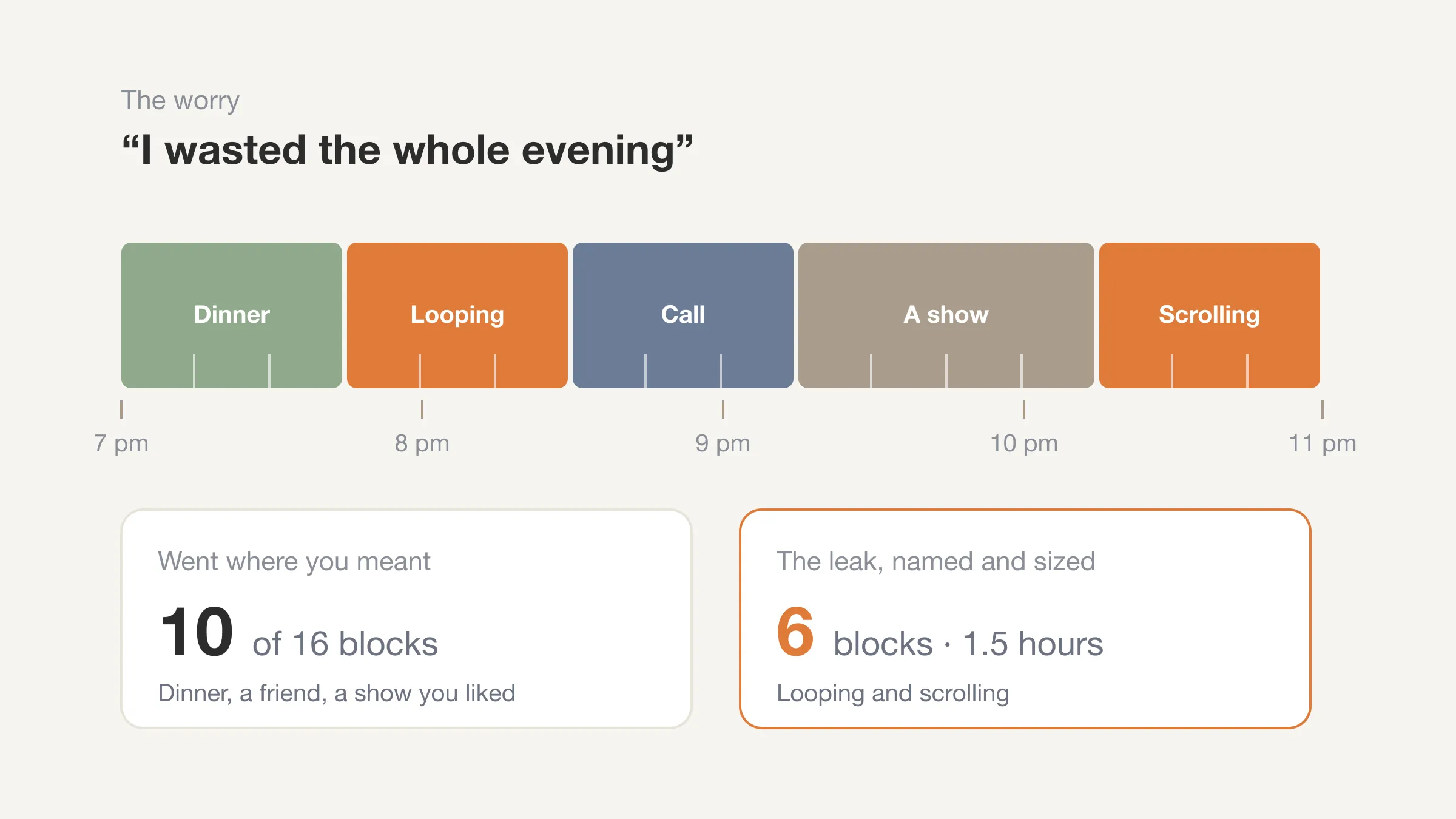
This is the idea behind Beyond Time: your time is limited, and seeing where it goes replaces vague dread with specific numbers. You log the day in 15-minute blocks, and blocks you skipped show up as "Not logged," so gaps are visible. At the end of the day, you rate how health, life and work felt from 1 to 10 and add a line if you want. The AI reflection then reads the logged day and shows what went where you meant it to, where time leaked and one or two changes for tomorrow. It does not judge you and it is not therapy. It just gives you something real to think about instead of a loop.
A paper version works too. Start with our daily time log template. If you want to put numbers on the hours you have, waking hours explains the math, and on 23 November 2026 there are 38 days left in the year, 39 counting today. The weeks left in the year counter shows the rest. The point of the number is not pressure. It is to remind you that the time is real, it is yours, and a worry about last week cannot use it.
Do you need more than self-help techniques?
Sometimes, yes. The tips above are for everyday overthinking. They are not a substitute for care. This is general information, not medical advice or a diagnosis.
Talk to a doctor or mental health professional if:
- worry or low mood lasts most of the day, nearly every day, for two weeks or more
- the thinking affects your sleep, work, studies or relationships
- you avoid things you want or need to do because of it
- you use alcohol or other substances to quiet it
- you feel hopeless or have thoughts of harming yourself
The U.S. National Institute of Mental Health advises talking to a health care provider if symptoms do not improve with self-care or get worse, and seeking professional help for severe symptoms that last two weeks or more. See NIMH: Do I need help?. A primary care provider can refer you to a psychologist, psychiatrist or clinical social worker.
If you are thinking about suicide or self-harm, in the United States call or text 988 to reach the 988 Suicide and Crisis Lifeline, free and open 24 hours a day, or chat at 988lifeline.org. In a life-threatening emergency, call 911. Outside the U.S., contact your local emergency number or crisis service.
Frequently Asked Questions
What is the fastest way to stop overthinking?
Write the thought down for five minutes, then choose one small action or a time later to come back to it. This interrupts the loop right away. It will not end the worry for good, but it gives you a way out of the spiral.
Why can't I stop overthinking at night?
At night there are fewer distractions, so unfinished thoughts get louder, and tiredness makes loops easier to fall into. Try a brain dump earlier in the evening, a worry window before dinner, and a fixed note by the bed for anything new. If sleep problems last, talk to a doctor.
Is overthinking a mental illness?
No, overthinking is not a diagnosis. It is a common habit of thought. It can be a feature of conditions such as anxiety or depression, so if it is constant or affects your daily life, a health professional can help work out what is going on.
Does journaling help with overthinking?
It can help many people sort and shrink what is circling in their heads, and one study found that ninth graders who wrote about exam worries for 10 minutes beforehand scored better. Evidence on journaling in general is mixed with small average effects. It is a useful tool, not a treatment.
How does scheduled worry time work?
You set a daily 15 to 20 minute window for worrying, jot down worries during the day without engaging with them and go through the list at the set time. Studies suggest it may reduce everyday worry, mostly in non-clinical samples, and the evidence in diagnosed anxiety is mixed.
How do I stop overthinking a decision?
Give it a deadline, list the two or three facts you need, find them and decide by the date. Choose the option that is good enough, because extra thinking rarely adds much after you have the key facts.
When should I see a professional about overthinking?
See a doctor or mental health professional if the thinking lasts most days for two weeks or more, affects sleep, work or relationships, or comes with hopelessness. In the U.S., you can call or text 988 at any time if you are in crisis.
How to stop overthinking, in short
To stop overthinking, name the loop, write it out, give it a set time, separate what you can control and take one small action in the next 15 minutes. Seeing where your hours actually went turns vague dread into numbers you can work with. Your time is limited, and a worry about yesterday cannot spend it for you. If the thoughts will not ease, that is a good reason to talk to a professional, not a failure.
See where it goes
Log your day, rate it 1 to 10 and let the AI reflection point to one or two changes for tomorrow. Two weeks free.
Try Beyond Time freePut this into practice
Free tools that match this article.
Goal Setting Worksheet
Turn a vague goal into milestones, habits, blockers, and a weekly review plan.
Try Goal WorksheetTime ManagementWeekly Schedule Template
Plan your week with a free printable weekly schedule template for goals, routines, and focus blocks.
Try Schedule TemplateHabit BuildingHabit Tracker Template
Create a free printable habit tracker template — weekly or monthly. Customize your habits and download a clean PDF in seconds.
Try Habit TrackerTime ManagementTime Blocking Template
Map your day into focused time blocks with a free printable time blocking template.
Try Time BlockingRelated Articles

Waking Hours: How Many You Get a Day, Week and Year
Waking hours are the hours you are awake: 16 a day, 112 a week and about 5,840 a year at 8 hours of sleep. See where they go and how many you can call yours.
Journal Prompts: 87 Questions Sorted by Mood and Purpose
87 journal prompts sorted by mood and purpose, from stress and gratitude to goals and time, plus a two-minute nightly version for days when you have no energy.
How Many Weeks Until Christmas? 5 Weeks and 5 Days
How many weeks until Christmas? On 15 November 2026 it is 40 days, or 5 weeks and 5 days. See how to count from any date and what fits before 25 December.
How Many Days Left in the Year? 48 After 13 Nov 2026
How many days are left in the year? 48 after 13 November 2026, 49 counting today. See the workdays, weekends and waking hours in them and how to count any date.

How Many Weeks in a Year? 52, Plus a Day (2026 Has 53)
How many weeks in a year? 52 weeks plus 1 day (2 in a leap year). ISO calendars count 52 or 53, and 2026 has 53. See the math, the tables and what is left.
How Many Minutes in a Week? 10,080, and Where They Go
How many minutes in a week? 10,080, or 6,720 waking minutes at 8 hours of sleep. See the minutes in each activity for an average week and how many are left.