
How Many Minutes in a Week? 10,080, and Where They Go
How many minutes in a week? 10,080, or 6,720 waking minutes at 8 hours of sleep. See the minutes in each activity for an average week and how many are left.
There are 10,080 minutes in a week. That is 7 days times 24 hours times 60 minutes. If you sleep 8 hours a night, 6,720 of them are waking minutes. Cut the week into 15-minute blocks and you get 672 in total, or 448 while you are awake.
That is the answer to "how many minutes in a week". It is a big number, and it hides something useful: you spend minutes in chunks, and most of the chunks are not chosen. Sleep, work, meals and chores use most of the 10,080 before you decide anything.
This post gives you the number in other units, the minutes an average week spends on each activity, how many waking minutes are left in this week, and a way to see where yours went.
Key takeaways
- A week has 10,080 minutes, 168 hours, or 672 fifteen-minute blocks.
- At 8 hours of sleep a night, 6,720 minutes (448 blocks) are waking time.
- In an average American week, leisure and sports take about 2,170 minutes, more than work (about 1,390 across everyone).
- Logging your day takes about 4 minutes a day, or 28 minutes a week. That is 0.3% of the week.
How many minutes are in a week?
A week has 7 days, each with 24 hours of 60 minutes. So 7 × 24 × 60 = 10,080 minutes. The same span in other units:
| Unit | In one week |
|---|---|
| Days | 7 |
| Hours | 168 |
| Minutes | 10,080 |
| Seconds | 604,800 |
| 15-minute blocks | 672 |
| 5-minute blocks | 2,016 |
A day has 1,440 minutes, as covered in how many minutes are in a day, and 86,400 seconds. The hour version is in how many hours are in a week.
Minutes are a good unit for one reason: they are small enough that nothing disappears into rounding. A quick call, a walk and a late scroll all show up. The week is a better frame than the day, because most habits repeat on a weekly cycle.
How many waking minutes are in a week?
It depends on sleep. The week has 10,080 minutes whatever you do. What changes is how many are awake.
| Sleep per night | Minutes asleep per week | Waking minutes per week | Waking 15-minute blocks |
|---|---|---|---|
| 6 hours | 2,520 | 7,560 | 504 |
| 7 hours | 2,940 | 7,140 | 476 |
| 8 hours | 3,360 | 6,720 | 448 |
| 9 hours | 3,780 | 6,300 | 420 |
The 8-hour row is the default we use. It means a 16-hour waking day, for example from 7 a.m. to 11 p.m., which is 960 minutes or 64 blocks a day. Use the row that matches your life. The CDC says adults aged 18 to 60 need at least 7 hours of sleep a night, so cutting below that for extra minutes is a trade, not a gain. If you wake up at 5am, the window moves earlier, but the sleep math stays the same.
See your 10,080 minutes in one view
Beyond Time splits every hour of your week by Health, Life, Work and Sleep, and shows the share you logged.
Try Beyond Time freeWhere do the minutes in an average week go?
The best public answer is the US Bureau of Labor Statistics' American Time Use Survey. It asks a national sample of people to describe the previous day and reports averages for everyone aged 15 and over. The table below uses the 2025 results (published June 2026), multiplied by 7 days and 60 minutes.
| Activity | Hours per day | Minutes per week | Share of the week |
|---|---|---|---|
| Sleeping | 9.03 | 3,793 | 37.6% |
| Other personal care | 0.77 | 323 | 3.2% |
| Eating and drinking | 1.21 | 508 | 5.0% |
| Household activities | 1.99 | 836 | 8.3% |
| Purchasing goods and services | 0.69 | 290 | 2.9% |
| Caring for and helping others | 0.64 | 269 | 2.7% |
| Working and work-related activities | 3.32 | 1,394 | 13.8% |
| Educational activities | 0.44 | 185 | 1.8% |
| Organizational, civic and religious activities | 0.28 | 118 | 1.2% |
| Leisure and sports | 5.16 | 2,167 | 21.5% |
| Phone calls, mail and email | 0.19 | 80 | 0.8% |
| Other activities | 0.27 | 113 | 1.1% |
| Total | 23.99 | 10,076 |
Caring combines caring for household members (0.49 hours a day) and for people outside the household (0.15). The total is 4 minutes short of 10,080 because the survey figures are rounded.
Before comparing it with your own week, keep three things in mind:
- It is an average of everyone. It includes retirees, students, people who do not work and weekend days. The 1,394 minutes of work is not a full-time week. A full-time week is 2,400 minutes at 40 hours.
- It counts the main activity only. Eating while watching TV is counted once.
- It comes from a diary interview. People describe yesterday from memory.
Still, one line stands out. The average person has about 2,170 minutes of leisure and sports a week, and television alone takes about 2.6 hours a day, or around 1,100 minutes a week. That is more than 18 hours a week.
How many minutes does a full-time job take?
A standard 40-hour work week is 2,400 minutes. That is 23.8% of the 10,080 and 35.7% of the 6,720 waking minutes. Add a commute and getting ready and the number grows. More on that in how many hours are in a work week. Over a year, the same 40 hours come to 2,080 work hours before time off.
Here is an illustrative full-time week in minutes. These are example numbers, not a measurement of anyone:
| Block | Hours | Minutes per week |
|---|---|---|
| Sleep (8 hours a night) | 56 | 3,360 |
| Work | 40 | 2,400 |
| Commute (an hour a day, round trip) | 5 | 300 |
| Meals | 9 | 540 |
| Getting ready and personal care | 5 | 300 |
| Chores, errands and household tasks | 19 | 1,140 |
| Left over | 34 | 2,040 |
That leaves 2,040 minutes, or 136 blocks, for everything else. It is about 20% of the week. Phone checking, waiting and tasks that run long all come out of it, which is why the true number is smaller. The same math over a year is in how many work weeks are in a year.
How many minutes are left in this week?
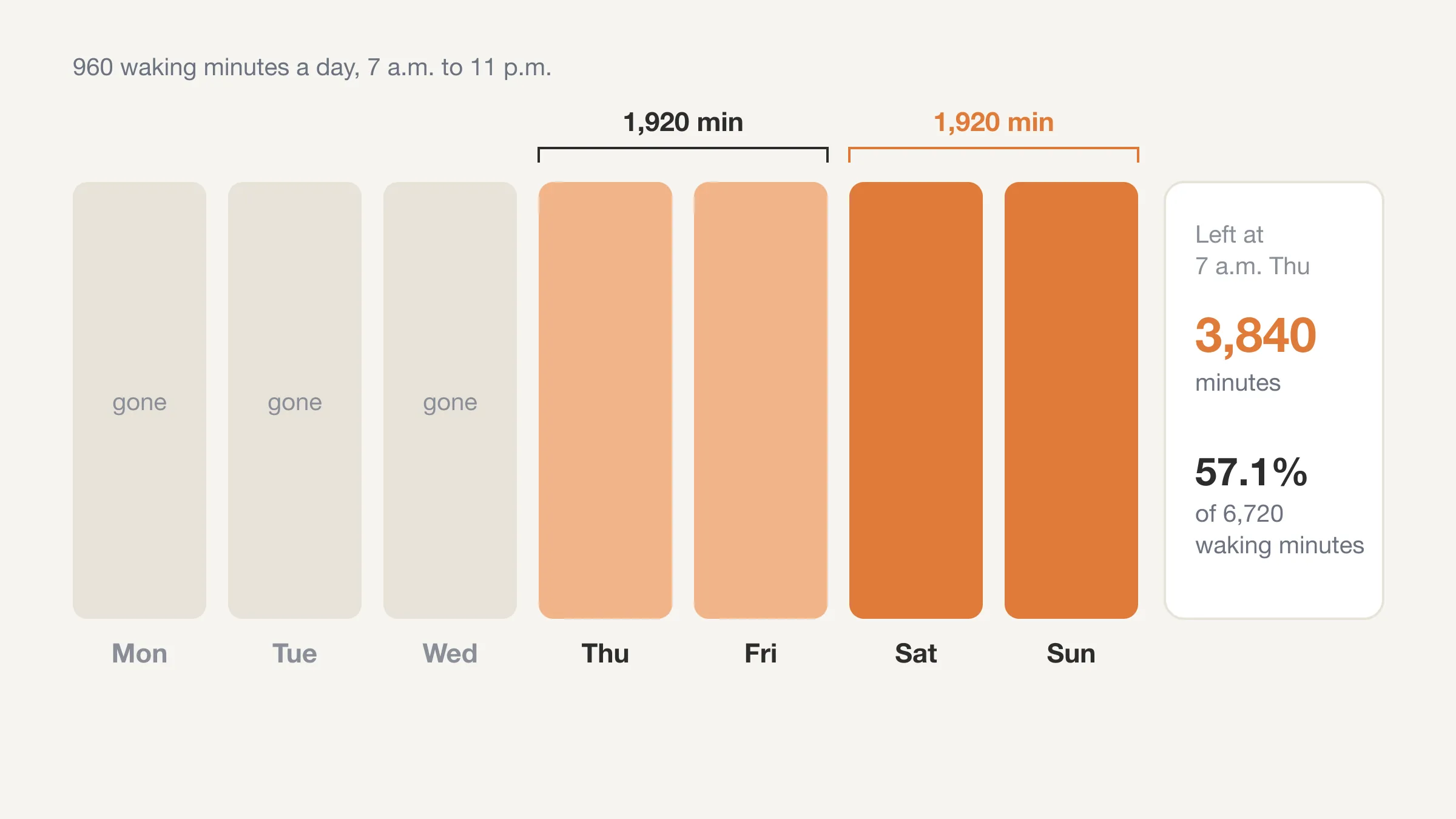
Today is Thursday, 5 November 2026. Take a week that runs Monday to Sunday and a waking day of 7 a.m. to 11 p.m. At 7 a.m. on Thursday, the waking time left in the week is Thursday, Friday, Saturday and Sunday: 4 days of 16 waking hours.
| Waking time left at 7 a.m. Thursday | Amount |
|---|---|
| Hours | 64 |
| Minutes | 3,840 |
| 15-minute blocks | 256 |
| Share of the 6,720 waking minutes | 57.1% |
That is more than half of the week's waking time, and it is also a number you can plan with. Thursday and Friday use 1,920 of those minutes. The weekend is the other 1,920, and it is the part you can still spend on purpose.
Beyond Time shows this number for you. The Time left card on the Today screen shows how much waking time is left today and this week, and the day appears as 96 blocks you can fill in. Widgets for the Home Screen and Lock Screen show the same thing without opening the app, including a week view with hour rows colored by where they went. For the year, the free weeks left in the year counter shows weeks, days, weekends, workdays, waking hours and 15-minute blocks.
Why do minutes help more than hours?
An hour feels like one thing. A minute shows what is inside it. When you log a day in minutes, you can see that a "one-hour lunch" was 35 minutes of eating and 25 of scrolling, or that an "afternoon of focus" was 90 minutes of work and two 20-minute detours.
Fifteen minutes is the unit that holds up. It is small enough to catch a lost half hour. It is large enough that you can fill in a day in about two minutes. The 15-minute block method explains why this size works better than minute-by-minute tracking, which turns into a job of its own.
The cost of logging is small. Two minutes in the morning and two at night is 4 minutes a day, or 28 minutes a week. That is 0.28% of the 10,080 minutes. If you learn something about the other 99.7%, it is cheap.
How do you see where your 10,080 minutes went?
Pick one week and log it.
- Use 15-minute blocks. There are 96 in a day. Each one is a single choice: pick a block, pick what you were doing.
- Use four categories. Health, Life, Work and Sleep is enough. Detail can come later.
- Log twice a day. In the morning, fill in gaps from yesterday. At night, log today.
- Mark what you could not remember. Blocks marked not logged are data. They show how much of the week you cannot account for. Your recent days often agree on the gaps, and Fill from your usual can log those in one tap.
- Add it up on day seven. Compare the minutes in each category with what you thought.
If you prefer paper, the daily time log template gives you a table to copy. Beyond Time does it in the app. You start your day by scoring your sleep and picking one to three goals, log time as blocks, and end the day by rating health, life and work from 1 to 10. Then the AI reflection reads the logged day: what went where you meant it to, where time leaked and how often, and one or two changes for tomorrow.
See where your week goes
Log your day in 15-minute blocks. Two minutes in the morning, two at night. Two weeks free, all features included.
Try Beyond Time freeFrequently Asked Questions
How many minutes are in a week?
There are 10,080 minutes in a week. That is 7 days times 24 hours times 60 minutes, or 168 hours.
How many waking minutes are in a week?
At 8 hours of sleep a night, there are 6,720 waking minutes in a week. At 7 hours it is 7,140, and at 9 hours it is 6,300.
How many minutes are in a work week?
A standard 40-hour work week is 2,400 minutes, or 23.8% of the 10,080 minutes in a week. Your own number depends on your hours.
How many seconds are in a week?
There are 604,800 seconds in a week. That is 10,080 minutes times 60.
How many 15-minute blocks are in a week?
There are 672 blocks in a week and 96 in a day. Counting only waking time at 16 hours a day, a week has 448 blocks.
How many minutes are in a week of leisure for the average American?
The American Time Use Survey 2025 results show about 5.16 hours a day of leisure and sports, which is roughly 2,167 minutes a week. TV watching is the biggest part, at about 2.6 hours a day.
How many minutes are in a month?
A month averages about 43,800 minutes (about 730 hours). It ranges from 40,320 minutes in a 28-day February to 44,640 in a 31-day month. See how many hours are in a month for the table.
So, how many minutes are in a week?
The answer to how many minutes in a week is 10,080, and 6,720 of them are waking time at 8 hours of sleep. Work, sleep, meals and chores take most of them before you decide anything. The ones that remain are yours.
Your time is limited, so see where it goes. Log one week in 15-minute blocks and compare the minutes in each category with your guess. Start with Beyond Time, or see how much of this year is left with the weeks left counter.
Sources: US Bureau of Labor Statistics, American Time Use Survey 2025 results, Table 1, published June 2026. CDC, About Sleep. Weekly minutes are the survey's daily averages multiplied by 7 and 60.
Put this into practice
Free tools that match this article.
Night Routine Planner
Create a realistic night routine checklist for better sleep and a smoother tomorrow.
Try Night RoutineRoutine BuildingMorning Routine Generator
Design your ideal morning routine with AI-powered suggestions based on proven practices.
Try Morning RoutineHabit BuildingHabit Tracker Template
Create a free printable habit tracker template — weekly or monthly. Customize your habits and download a clean PDF in seconds.
Try Habit TrackerGoal SettingGoal Setting Worksheet
Turn a vague goal into milestones, habits, blockers, and a weekly review plan.
Try Goal WorksheetKeep exploring this topic
Morning routine template
Build a practical morning routine around energy and focus.
Evening routine ideas
Wind down in a way that supports sleep and tomorrow’s goals.
Guide articles
Explore more guide articles from the Beyond Time blog.
how many minutes in a week
Read more articles tagged how many minutes in a week.
Related Articles

Bucket List Ideas: 100 Ideas Grouped by Theme and Lead Time
100 bucket list ideas grouped by theme and tagged by lead time: now, this year, or years ahead. Count the weeks you have, then pick ten. Start your list today.

How to Stop Doomscrolling: 9 Practical Fixes That Work
How to stop doomscrolling: add friction, swap in better habits and check your Screen Time against a real log of your day. Nine fixes, with sources. Try one.

Life Plan Template: A One-Page Plan With Weekly Costs
A free life plan template you can copy: eight areas of life, one outcome each, and a weekly time cost so your plan fits the 112 waking hours you really have.

How Many Work Weeks in a Year? 52 Minus Your Time Off
How many work weeks in a year? 52 on paper, usually 46 to 50 after holidays and leave. See the table by days off, 2026's count and the weeks left this year.

Second Brain Method Explained: CODE, PARA and Who It Suits
A second brain is a trusted place outside your head for notes and ideas. See how Tiago Forte's CODE and PARA work, who it suits, and what notes can't tell you.
How to Journal: Start in 5 Minutes With Any Format
Learn how to journal in five minutes a day: pick a format, a time and a first line. Includes seven formats, starter prompts and ways to make the habit stick.