How Many Seconds in a Day? 86,400, and Where Yours Go
How many seconds in a day? 86,400. See the count per hour, week and year, how leap seconds fit in, and what a day looks like as 96 blocks. See where yours go.
There are 86,400 seconds in a day. That is 24 hours times 60 minutes times 60 seconds. Every day on the calendar has that many, with one rare exception that we cover below.
It is a big number, which is the point. A day feels short, yet it holds 86,400 chances to do something. Yet about a third of them are spent asleep, and most of the rest are spoken for before you choose anything. This guide gives you the count per hour, week and year, explains leap seconds in plain terms, and turns the 86,400 into a unit you can actually plan with.
Key takeaways
- A day is 86,400 seconds, 1,440 minutes or 24 hours.
- A week is 604,800 seconds. A year is 31,536,000 (31,622,400 in a leap year).
- A leap second is a rare, one-second addition to the clock. It makes one day 86,401 seconds long. The last one was in December 2016.
- Cut into 15-minute blocks, a day is 96 blocks of 900 seconds each, and a 16-hour waking day is 64 blocks.
How many seconds are in a day?
A day has 24 hours. An hour has 60 minutes and a minute has 60 seconds. So:
24 × 60 × 60 = 86,400 seconds
That is the same as 1,440 minutes. If you only remember one thing, remember that the day holds 1,440 minutes and each minute holds 60 seconds.
Half a day is 43,200 seconds. A quarter of a day, six hours, is 21,600 seconds. A standard 8-hour workday is 28,800 seconds, exactly a third of the day.
How many seconds are in an hour, a week and a year?
Here are the common conversions in one table.
| Span | Seconds |
|---|---|
| 1 minute | 60 |
| 15 minutes (one block) | 900 |
| 1 hour | 3,600 |
| 8 hours | 28,800 |
| 16 hours (a waking day) | 57,600 |
| 1 day | 86,400 |
| 1 week | 604,800 |
| 30-day month | 2,592,000 |
| 31-day month | 2,678,400 |
| 365-day year | 31,536,000 |
| 366-day year (leap year) | 31,622,400 |
A leap year has one extra day, which adds 86,400 seconds. That is a calendar leap year, not a leap second. The two are different things, and the next section explains why.
For the same table in hours instead of seconds, see how many hours are in a year. For the day count and why leap years exist, see how many days are in a year.
See where today's seconds go
Log your day in 15-minute blocks. Two minutes in the morning, two at night. Two weeks free, all features included.
Try Beyond Time freeIs every day exactly 86,400 seconds?
Almost. On the clock, nearly every day is exactly 86,400 seconds. The exception is a day that contains a leap second, which has 86,401.
To see why leap seconds exist, you need two ways of measuring time:
- Atomic time. The second is defined by an atom, not by the sky. The SI second is fixed by assigning the cesium-133 atom's transition frequency the exact value of 9,192,631,770 hertz, according to the National Institute of Standards and Technology. Atomic clocks keep this second steady.
- Earth time. A day was once defined by one turn of the Earth. But Earth's rotation is not perfectly regular. It speeds up and slows down by tiny amounts, and over long periods the day has been getting slightly longer.
Civil time, called Coordinated Universal Time or UTC, runs on atomic seconds but is kept close to the Earth's rotation. When the two drift apart, a second is added to UTC to close the gap.
What is a leap second?
A leap second is one extra second added to the last minute of a day, usually 30 June or 31 December. That minute then has 61 seconds, and the clock reads 23:59:60 before it rolls over to midnight.
The facts, in short:
- They are rare and unpredictable. Earth's rotation can't be forecast far ahead, so leap seconds were announced only about six months before they happened.
- There have been 27 so far. The first was on 30 June 1972. The most recent was on 31 December 2016, and none has been added since. Every one of them added a second.
- They are being phased out. In November 2022 the General Conference on Weights and Measures decided that the allowed gap between UTC and Earth's rotation would be widened in or before 2035. That is how the world plans to stop adding them. The conference gave as reasons that computer and satellite systems handle leap seconds in different, uncoordinated ways, and that Earth's rotation might one day call for a negative leap second, which has never been tried. The text is Resolution 4 of the 27th CGPM.
For everyday life this changes nothing. Your phone, your calendar and your alarm all treat the day as 86,400 seconds. A leap second matters to the people who keep clocks and networks in sync, not to anyone planning a day.
How many of the 86,400 seconds are yours?
Not all of them. Take a typical day as an example (these are illustrative numbers, not a measurement of anyone):
| Block | Hours | Seconds |
|---|---|---|
| Sleep | 8 | 28,800 |
| Waking day | 16 | 57,600 |
Sleep takes a third of the 86,400. That leaves 57,600 waking seconds, or 960 minutes. Work, commuting, meals, chores and getting ready come out of that before you decide how to spend the rest.
If a full-time job takes 8 hours and the commute takes one, you have used 32,400 seconds. Meals and getting ready might take another 3 hours, which is 10,800 seconds. What remains is roughly 14,400 seconds, or 4 hours, for exercise, friends, family, hobbies and your goals.
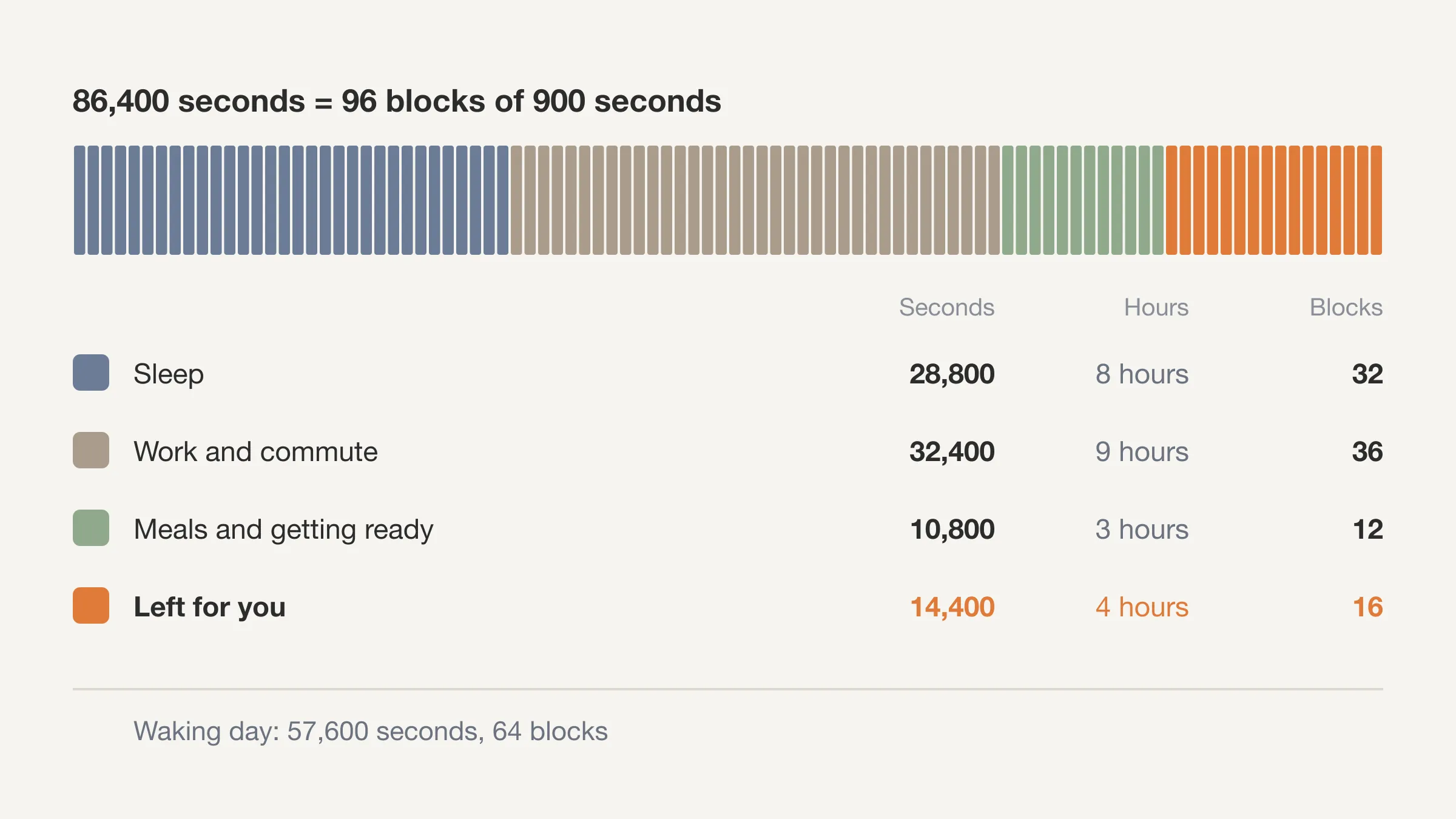
Four hours is a lot of seconds. It is also very easy to lose, one phone check at a time. For a week-sized version of the same math, see how many hours are in a week.
What does 86,400 seconds look like in 96 blocks?
Seconds are too small to plan with. A day of 86,400 of them can't be held in your head, and nobody can log 86,400 of anything.
The useful size is the 15-minute block. It is 900 seconds. A day is 96 of them. If you wake at 7 a.m. and sleep at 11 p.m., your waking day is 64 blocks.
That is a number you can picture. A row of 64 boxes is something you can look at, fill in and add up. Eight boxes are two hours. Four boxes are an hour. A meeting that ran long, a commute and a half hour lost between tasks each show up as boxes.
The 15-minute time block method explains why this size works better than hours (too coarse) or minutes (too fussy).
How many seconds are left in the year?
Seconds are a good way to feel a quantity, though not a way to run a life. As an example, on 23 July 2026 there are 161 full days after today before the new year starts on 1 January 2027. That is 161 × 86,400 = 13,910,400 seconds.
The same stretch is 3,864 hours or 15,456 fifteen-minute blocks of the full day. If you count only a 16-hour waking day, it is 161 × 64 = 10,304 waking blocks.
Those are just three ways of saying that the rest of 2026 is a finite, countable thing. The number itself does not tell you what to do. Seeing where yesterday's blocks went does.
How do you see where your seconds go?
You can't log 86,400 seconds, but you can log 96 blocks. Here is the simplest version.
- Use 15-minute blocks. It is the largest unit that still catches a lost half hour.
- Use four categories. Health, Life, Work and Sleep is enough to start.
- Fill it in twice a day. Two minutes in the morning for yesterday's gaps and two at night for today.
- Leave the unknowns marked. Blocks you can't remember are data. They show how much of the day you can't account for.
- Add it up at the end of the week. Compare the totals with what you assumed.
If you would like a paper version first, use the time blocking template or the daily time log template. To go deeper, read how to do a time audit.
Beyond Time does this in the app. You start your day by noting how you slept and picking one to three goals. You log time as 96 blocks, with routines grouped into Health, Life, Work and Sleep, and blocks you skipped show up as not logged. You end the day by rating how health, life and work felt from 1 to 10. The week view splits every hour by category, and the AI reflection reads the logged day: what went where you meant it to, where time leaked, and one or two changes for tomorrow.
Turn 86,400 seconds into 96 blocks
Beyond Time shows where each day went and what to change tomorrow. Two weeks free, all features included.
Try Beyond Time freeFrequently Asked Questions
How many seconds are in a day?
There are 86,400 seconds in a day, which is 24 hours times 60 minutes times 60 seconds. It equals 1,440 minutes.
How many seconds are in an hour?
There are 3,600 seconds in an hour, which is 60 minutes times 60 seconds. Eight hours is 28,800 seconds.
How many seconds are in a week?
There are 604,800 seconds in a week, which is 7 days times 86,400 seconds. That is 10,080 minutes or 168 hours.
How many seconds are in a year?
There are 31,536,000 seconds in a 365-day year and 31,622,400 in a 366-day leap year. The extra 86,400 in a leap year comes from the added calendar day.
Does a leap second change how many seconds are in a day?
Yes, but only for the single day that contains one. That day has 86,401 seconds. There have been 27 leap seconds since 1972, and the last was on 31 December 2016.
How many seconds are in a waking day?
A 16-hour waking day has 57,600 seconds. That is 960 minutes, or 64 fifteen-minute blocks.
How many 15-minute blocks are in a day?
There are 96 blocks in a day, each one 900 seconds long. A 16-hour waking day has 64 blocks.
So, how many seconds are in a day?
The answer to how many seconds are in a day is 86,400. About 28,800 of them go to sleep, which leaves 57,600 waking seconds, or 64 blocks of 15 minutes.
Your time is limited. Seeing where it goes is the useful part. Log one day in 15-minute blocks, then compare it with what you thought happened. Start with Beyond Time or the free time blocking template.
Sources: NIST, SI Units: Time for the definition of the second. BIPM, Resolution 4 of the 27th CGPM (2022) for the decision on leap seconds. The count of 27 leap seconds since 1972, the last on 31 December 2016, is from Wikipedia's leap second article, which cites the International Earth Rotation and Reference Systems Service. All other figures are our own arithmetic.
Put this into practice
Free tools that match this article.
Goal Setting Worksheet
Turn a vague goal into milestones, habits, blockers, and a weekly review plan.
Try Goal WorksheetTime ManagementWeekly Schedule Template
Plan your week with a free printable weekly schedule template for goals, routines, and focus blocks.
Try Schedule TemplateHabit BuildingHabit Tracker Template
Create a free printable habit tracker template — weekly or monthly. Customize your habits and download a clean PDF in seconds.
Try Habit TrackerTime ManagementTime Blocking Template
Map your day into focused time blocks with a free printable time blocking template.
Try Time BlockingRelated Articles

How Many Minutes in a Week? 10,080, and Where They Go
How many minutes in a week? 10,080, or 6,720 waking minutes at 8 hours of sleep. See the minutes in each activity for an average week and how many are left.

Bucket List Ideas: 100 Ideas Grouped by Theme and Lead Time
100 bucket list ideas grouped by theme and tagged by lead time: now, this year, or years ahead. Count the weeks you have, then pick ten. Start your list today.

How to Stop Doomscrolling: 9 Practical Fixes That Work
How to stop doomscrolling: add friction, swap in better habits and check your Screen Time against a real log of your day. Nine fixes, with sources. Try one.

Life Plan Template: A One-Page Plan With Weekly Costs
A free life plan template you can copy: eight areas of life, one outcome each, and a weekly time cost so your plan fits the 112 waking hours you really have.
How Many Work Weeks in a Year? 52 Minus Your Time Off
How many work weeks in a year? 52 on paper, usually 46 to 50 after holidays and leave. See the table by days off, 2026's count and the weeks left this year.

Second Brain Method Explained: CODE, PARA and Who It Suits
A second brain is a trusted place outside your head for notes and ideas. See how Tiago Forte's CODE and PARA work, who it suits, and what notes can't tell you.