How Many Hours in a Year? 8,760, and Where They Go
How many hours in a year? 8,760, or 8,784 in a leap year. See waking hours, work hours and how many hours of 2026 are left on 2 July, and where they go.
A year has 8,760 hours. That is 365 days times 24 hours. In a leap year, which has 366 days, it is 8,784 hours. 2026 is not a leap year, so it has 8,760.
Today is Thursday, 2 July 2026, and the year is at its halfway point. 182 days have passed and 183 remain, counting today. That leaves 4,392 hours, of which about 2,928 are waking hours. This guide breaks the 8,760 down, shows where an average year goes and explains how to see where yours is going.
Key takeaways
- A year has 8,760 hours (8,784 in a leap year), 525,600 minutes and 35,040 fifteen-minute blocks.
- About 5,840 of those hours are waking hours at 16 a day.
- On 2 July 2026, 4,392 hours remain, including today. About 2,928 are waking hours.
- Take out 8 hours of sleep a night and a 40-hour work week, and roughly 3,760 hours are left for everything else.
How many hours are in a year?
The answer depends on whether it is a leap year.
| Year type | Days | Hours | Minutes |
|---|---|---|---|
| Common year (2026, 2027) | 365 | 8,760 | 525,600 |
| Leap year (2024, 2028) | 366 | 8,784 | 527,040 |
The last leap year was 2024, and the next is 2028. The extra day adds 24 hours, which is why a leap year has 8,784.
You will sometimes see 8,766 hours quoted. That is the average length of a calendar year over the long run, 365.25 days times 24, used for averages like astronomy. For planning your own year, use 8,760 or 8,784.
How many hours, minutes and blocks are in a year?
Here is the same year in every unit you might need.
| Unit | In a common year |
|---|---|
| Days | 365 |
| Weeks | 52.14 (52 weeks and 1 day) |
| Hours | 8,760 |
| Minutes | 525,600 |
| Seconds | 31,536,000 |
| 15-minute blocks | 35,040 |
| Average month | 730 hours |
| Average quarter | 2,190 hours |
A day has 96 blocks of 15 minutes, which is why a year has 35,040. Blocks are the unit used by the 15-minute time block method. They are small enough to show the shape of a day and big enough to log without effort.
If you want the weekly version of this math, how many hours are in a week covers the 168 hours that repeat 52 times.
How many waking hours are in a year?
Not every hour is yours to spend. For planning, a common convention is a 16-hour waking day, for example 7 am to 11 pm. That gives:
- 5,840 waking hours in a common year (365 times 16)
- 5,856 waking hours in a leap year
- 23,360 waking blocks in a common year
The other 2,920 hours are sleep at 8 hours a night. The CDC recommends that adults get at least 7 hours of sleep, which would add up to 2,555 hours a year. The US Bureau of Labor Statistics measures actual behavior in its American Time Use Survey. In the 2024 results, people age 15 and over averaged 9.04 hours a day of sleeping, which includes teenagers and older adults. At that rate the waking day is nearer 15 hours.
So 5,840 is a round planning number, not a measurement of you. Change the 16 to suit your own day.
How many working hours are in a year?
The usual convention is 2,080 hours: 40 hours a week for 52 weeks. It is a ceiling more than a count. Paid holidays and leave reduce it, and overtime raises it. In 2026 there are 261 weekdays, which at 8 hours is 2,088 before any time off. The other 104 days are the 52 weekends of the year.
The ATUS gives a sense of how long a working day really is. On days they worked, full-time employed people averaged 8.1 hours. On weekdays they worked, they averaged 8.4 hours.
At 2,080 hours, work is about 24 percent of a year's 8,760 hours, and about 36 percent of the 5,840 waking ones. That is the single largest block most adults can name. For the arithmetic of a single week, see our 168-hour week framework.
See where your hours go
Log your day in 15-minute blocks. Two minutes in the morning, two at night.
Try Beyond Time freeWhat are the hours left in 2026?
On Thursday, 2 July 2026, the year is at its midpoint. 182 days have gone and 183 are left, counting today.
| Left in 2026 (from the start of 2 July) | Amount |
|---|---|
| Days | 183 |
| Total hours | 4,392 |
| Waking hours (16 a day) | 2,928 |
| 15-minute waking blocks | 11,712 |
| Full weeks | 26 weeks and 1 day |
4,392 hours is 50.1 percent of the year, because a common year's midpoint sits at noon on 2 July. If you are reading this later in the day, subtract the hours that have passed.
To work out the hours left on any date, count the days left including today and multiply by 24. For waking hours, multiply by 16.
Half a year is a good time to ask a simple question. Of the 4,368 hours that have gone, how many went where you meant them to? Most people can't answer, because the days blur. We explore why in why time goes by so fast.
Where do the hours in a year go?
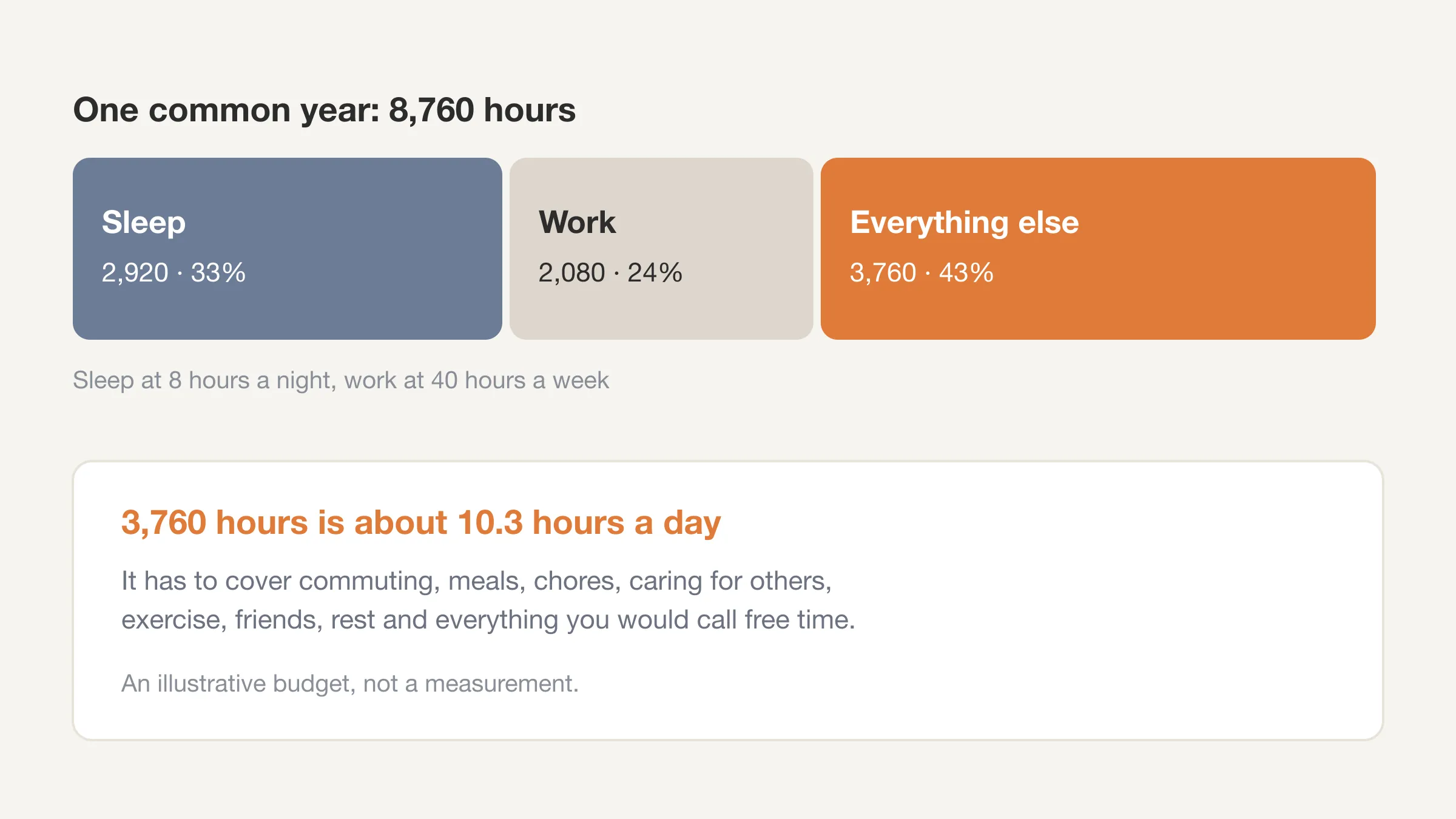
Here is an illustrative budget for one common year. It is an example, not a measurement.
| Use | Hours | Share of the year |
|---|---|---|
| Sleep at 8 hours a night | 2,920 | 33% |
| Work at 40 hours a week | 2,080 | 24% |
| Everything else | 3,760 | 43% |
That last row is about 10.3 hours a day, on average. It has to cover commuting, meals, chores, caring for others, exercise, friends, rest and everything you would call free time.
The ATUS shows how those everyday hours tend to split. Applied to a 365-day year, the 2024 national averages for people age 15 and over work out to:
| Activity | Hours per day | Hours per year |
|---|---|---|
| Sleeping | 9.04 | about 3,300 |
| Leisure and sports | 5.07 | about 1,850 |
| Household activities | 2.01 | about 734 |
These are population averages and they overlap with the budget above, so they will not match your year. They do show something useful: leisure and sports come to under 2,000 hours a year for the average person. That is a lot, and it is also a number you can name.
How can you see where your hours go?
A budget tells you what a year could hold. A log tells you what it did hold. The difference between the two is the most useful number you can have.
The method is simple. Log your day in 15-minute blocks and look at the total after a week. In Beyond Time, you open Start your day to note how you slept and pick one to three goals that matter today. Log time shows the day as 96 blocks, and you pick what you were doing for each. Routines sit under Health, Life, Work and Sleep, and the blocks you skip show up as Not logged. End your day asks you to rate how health, life and work felt from 1 to 10.
After a few days, See your week splits every hour by category and shows the trend across days. The AI reflection then reads the logged day and tells you what went where you meant it to, where time leaked and one or two changes worth trying.
If you would rather start with paper, our daily time log template is a copyable grid. The free time blocking template helps you plan the week you are about to log.
The idea of a limited number of weeks is also the heart of Four Thousand Weeks. It is easier to feel when you see this week's hours than when you picture a lifetime.
Start the second half of 2026 with a clear view
Start your day, log time, end your day. Two weeks free, everything unlocked.
Try Beyond Time freeFrequently Asked Questions
How many hours are in a year?
A common year has 8,760 hours, which is 365 days times 24. A leap year has 8,784 hours because it has 366 days.
How many hours are in a leap year?
A leap year has 8,784 hours, which is 366 days times 24. The next leap year is 2028.
How many waking hours are in a year?
At 16 waking hours a day, a common year has 5,840 waking hours and a leap year has 5,856. This is a planning convention, and your own number depends on how much you sleep.
How many working hours are in a year?
The usual convention is 2,080 hours, from 40 hours a week for 52 weeks. Holidays, leave and overtime change the real number.
How many minutes are in a year?
A common year has 525,600 minutes, which is 8,760 hours times 60. A leap year has 527,040 minutes.
How many hours are left in 2026?
On 2 July 2026 there are 4,392 hours left, counting the whole of today. That is 183 days, and about 2,928 of the hours are waking hours at 16 a day.
The answer: 8,760 hours, and half of 2026 is left
A year has 8,760 hours, or 8,784 in a leap year. About 5,840 are waking hours, and about 2,080 go to work if you work 40 hours a week. On 2 July 2026 you have 4,392 hours left.
Your time is limited, so it is worth knowing where it goes. Log a normal week in 15-minute blocks, then compare it to what you meant to do. The gap between the two is where you can make changes that count.
Put this into practice
Free tools that match this article.
Goal Setting Worksheet
Turn a vague goal into milestones, habits, blockers, and a weekly review plan.
Try Goal WorksheetTime ManagementWeekly Schedule Template
Plan your week with a free printable weekly schedule template for goals, routines, and focus blocks.
Try Schedule TemplateHabit BuildingHabit Tracker Template
Create a free printable habit tracker template — weekly or monthly. Customize your habits and download a clean PDF in seconds.
Try Habit TrackerTime ManagementTime Blocking Template
Map your day into focused time blocks with a free printable time blocking template.
Try Time BlockingRelated Articles

How Many Minutes in a Week? 10,080, and Where They Go
How many minutes in a week? 10,080, or 6,720 waking minutes at 8 hours of sleep. See the minutes in each activity for an average week and how many are left.

Bucket List Ideas: 100 Ideas Grouped by Theme and Lead Time
100 bucket list ideas grouped by theme and tagged by lead time: now, this year, or years ahead. Count the weeks you have, then pick ten. Start your list today.

How to Stop Doomscrolling: 9 Practical Fixes That Work
How to stop doomscrolling: add friction, swap in better habits and check your Screen Time against a real log of your day. Nine fixes, with sources. Try one.

Life Plan Template: A One-Page Plan With Weekly Costs
A free life plan template you can copy: eight areas of life, one outcome each, and a weekly time cost so your plan fits the 112 waking hours you really have.
How Many Work Weeks in a Year? 52 Minus Your Time Off
How many work weeks in a year? 52 on paper, usually 46 to 50 after holidays and leave. See the table by days off, 2026's count and the weeks left this year.

Second Brain Method Explained: CODE, PARA and Who It Suits
A second brain is a trusted place outside your head for notes and ideas. See how Tiago Forte's CODE and PARA work, who it suits, and what notes can't tell you.