End of Day Routine: A Two-Minute Way to Close Your Day
An end of day routine can take two minutes: fill the gaps in your log, rate the day, write one line for tomorrow. Here is the routine and why it works.
An end of day routine is a short, repeatable set of steps that tells your mind the day is finished. The version that takes two minutes has three parts: fill the gaps in what you did, rate how the day felt, and write one line about tomorrow.
Most advice on this topic is about work shutdown or a long evening wind-down. This one is smaller on purpose. A routine you do in two minutes gets done on the tired days too, and the tired days are the ones that need closing most.
On 25 November 2026 there are 36 days left in the year after today (see the weeks left in the year counter for the rest of the math). That is about five weeks, and each of them is made of days that either got closed or quietly blurred into the next one. This guide shows you how to close them.
Key takeaways
- Two minutes is enough: fill the gaps, rate the day, write one line for tomorrow.
- Making a specific plan for unfinished things can quiet them. Open loops do not have to be finished to stop nagging; they have to be written down with a next step.
- A closed day is also a logged day. Seven closings give you a week you can actually read.
- Do the shortest version on bad days. A thirty-second close beats a perfect routine you skip.
What is an end of day routine?
An end of day routine is a fixed sequence you run at roughly the same time every evening to mark the day as done. It has an order, a time limit and a clear last step. When you reach that step, you are finished, and what you didn't get to is parked somewhere safe.
It differs from an evening routine in what it is for. An evening routine shapes the hours before sleep: lights, food, screens, winding down. An end of day routine closes the record of the day. The two fit together. Close the day first, then wind down.
It also differs from a daily planner. A planner looks forward. This looks back for ninety seconds and forward for thirty. Together that is 120 of the 86,400 seconds in a day.
Who is it for?
Anyone whose day does not end by itself. If you work from home, if your phone holds both your messages and your hobbies, or if your evenings often drift into "one more thing", a deliberate close gives the day an edge it would not otherwise have.
Why does closing the day matter?
Two lines of research give reasons, and one popular claim needs a caveat.
Unfinished goals can be quieted by a plan. In a 2011 paper in the Journal of Personality and Social Psychology, Masicampo and Baumeister ran several studies on what happens when people have a goal they have not fulfilled. Their finding: letting people make a specific plan for the goal removed the mental interference that unfulfilled goals normally cause. The goal did not need to be completed. It needed a plan with a when and a how. That is the logic of the "one line about tomorrow" step.
Writing before bed can shorten the time it takes to fall asleep. A 2018 study from Baylor University, published in the Journal of Experimental Psychology: General (Scullin and colleagues), had 57 young adults spend five minutes before lights-out writing either a to-do list for the coming days or a list of what they had already done. Those who wrote the to-do list fell asleep about nine minutes faster, as measured in a sleep lab. It was a small lab study of healthy adults aged 18 to 30. Treat it as a hint, not a treatment. If you struggle with sleep over weeks, talk to a doctor.
The Zeigarnik effect, with a caveat. You will often read that unfinished tasks stay in your memory better than finished ones, called the Zeigarnik effect after the psychologist Bluma Zeigarnik. A 2025 meta-analysis by Ghibellini and Meier in Humanities and Social Sciences Communications found that this memory advantage is not reliable across studies, while the urge to go back and resume an interrupted task looks more general. So don't build your evening on the claim that your brain holds on to loose ends by default. Build it on the plan-making result above, which is better supported.
What all of this adds up to is modest and practical. Writing down the next step is cheap. It might calm the evening. It certainly makes tomorrow easier to start.
What goes in a two-minute end of day routine?
Four steps, in this order. The first is the one that costs the most time, and it is why the day should be logged as you go, not rebuilt from memory.
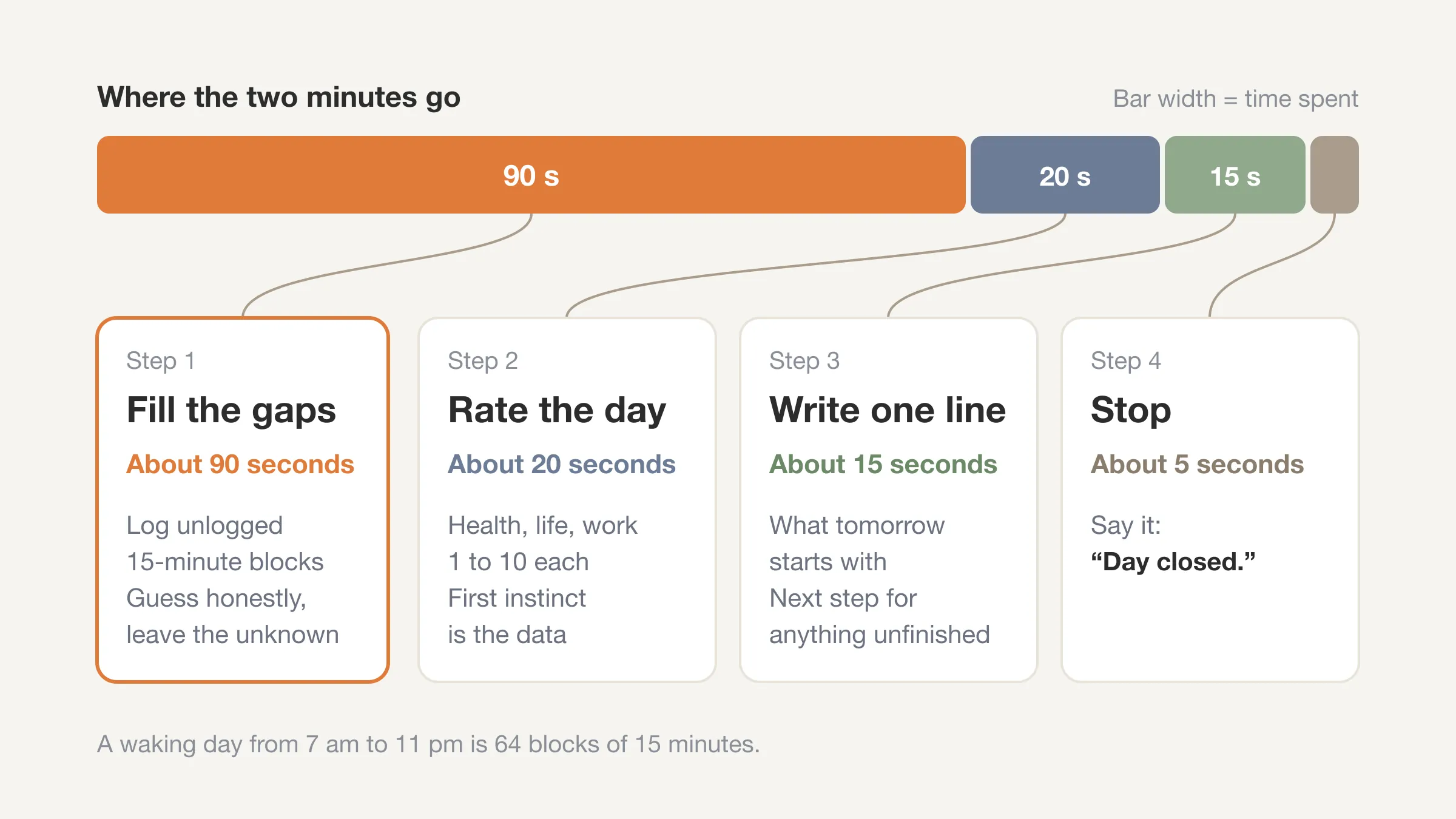
Step 1: Fill the gaps (about 90 seconds)
Open the day and look for blocks you have not accounted for. In Beyond Time, a day is 96 fifteen-minute blocks, and anything you did not log shows up as "not logged". Those are your gaps.
Fill what you can recall with confidence. For the rest, take your best honest guess or leave the block unlogged. An unlogged block is information too: it tells you which part of the day left no trace.
If your recent days agree on what usually happens at a certain time, Fill from your usual can log those passed gaps in one tap. It is a shortcut for the predictable stretches such as a commute or a regular lunch, so your two minutes go to the part of the day that was different.
A waking day from 7 am to 11 pm is 16 hours, or 64 blocks.
Step 2: Rate the day (about 20 seconds)
Give three quick scores from 1 to 10: how your health, your life (people, home, play) and your work felt today. Beyond Time's End your day step asks for exactly these. Don't think hard. First instinct is the data.
A 1 to 10 scale is crude, and that is useful. A single number is quick to give and easy to compare. Over a week, the three lines show you which area keeps dipping, which is rarely the one you would have guessed.
Step 3: Write one line (about 15 seconds)
One sentence, optional but recommended. It can be what stood out, or what tomorrow begins with. A few shapes that work:
- "Tomorrow, first block: the draft, before email."
- "Skipped the walk. Rain. Tomorrow at lunch."
- "Good day. Long call with a friend gave me energy."
If something is unfinished, this is where you give it a specific next step, in the spirit of the plan-making research above. "Finish report" is a loose end. "Tomorrow 9:00 to 10:30, finish section 3" is a plan.
Step 4: Stop (about 5 seconds)
Say or think a closing phrase. It sounds silly and it works as a boundary. "Day closed." If a late thought turns up afterwards, add it to tomorrow's line and stop again.
Close today in two minutes
Log the day in 15-minute blocks, rate it, add a line. Two minutes in the morning, two at night.
Try Beyond Time freeHow does a good routine look in practice?
Here is an illustrative evening, not a real person's. Take a typical weekday.
It is 9:40 pm. The phone is already on the counter. The routine starts with the log. Eleven blocks are not logged, mostly from mid-afternoon. Five of them were a meeting that ran long. Three were a stretch you can't account for at all, which you mark as "scrolling, probably". Three were lunch and a walk, which Fill from your usual covers.
Ratings: health 6, life 7, work 5. The work score is low because the planned writing block disappeared into the meeting.
The line: "Writing block moved to 9:00 tomorrow. Meeting invite declined for Thursday."
Total time: a little under two minutes. What you have now is not a diary entry. It is a record of where the afternoon went, a clear reason for the low work score and a specific start for tomorrow.
How is this different from a shutdown ritual?
The shutdown ritual is the best-known cousin. Cal Newport describes it in Deep Work as a fixed end-of-workday sequence that finishes with a phrase, so work thoughts stop after the day's work ends. The idea in short: check the open loops, make sure each has a place, and then declare work over.
An end of day routine borrows that structure and widens the scope. It covers the whole day, not only work. It adds the look backward at what actually happened and a rating that is not about productivity. And it is short.
If you already have a work shutdown, keep it. Add the two-minute close after it, once your work is done and you can look at the rest of the evening.
When should I do it, and where?
At the same time and in the same place, as far as your life allows. A simple trick is to attach the routine to something you already do, so you don't have to remember it. Three attachments work well:
- After dinner, before the evening starts. Good if your evenings are social or busy.
- When you plug in your phone. Good because the phone is already in your hand.
- Right after your work shutdown. Good if you work from home and need a hard edge.
Avoid the last thing before sleep in bed if your phone usually leads to scrolling. Closing the day should come before the screen starts pulling at you, not after. If you are shifting to an earlier wake-up time, move the close earlier too, so it never eats into sleep.
If your days run late or irregularly, tie it to an event, not a clock time. "After the kids are down" is a better anchor than 9:30 pm.
What if I'm exhausted or I missed a few days?
Use the ladder. Each rung is a complete routine.
| Energy tonight | What you do | Time |
|---|---|---|
| Full | Fill the gaps, rate health/life/work, write a line | 2 minutes |
| Low | Rate the day and write a line, leave gaps | 45 seconds |
| Empty | One number for the day, nothing else | 10 seconds |
A missed day is not a reset. Don't try to rebuild three days of 15-minute blocks from memory. Fill what you remember, let the rest stay "not logged", and carry on from tonight. The unlogged blocks are honest. Perfect logs matter less than a log you keep.
Within a few days you will know which blocks are easy to reconstruct. Meals, commutes, meetings in your calendar and sleep are usually recoverable. Unstructured evening time is the first to vanish. That is a finding about your evenings, not a failure of your routine.
What do seven closings tell you?
A single closed day is a small relief. Seven are a dataset. At the end of the week, look at three things:
- The ratings. Which of health, life and work was lowest most days? Is there one day that dragged the others?
- The unlogged blocks. Where in the day do they cluster? If it is always 2 to 4 pm, or always after 9 pm, that is where your attention leaks.
- The lines. Read the seven sentences in order. They often contain the same sentence twice.
From here, the natural next step is a weekly look at the whole picture. The Sunday reset and the complete guide to weekly reviews cover how to do it.
You also get something sneaky and useful: a log of how many of your waking hours you actually accounted for. A week has 112 waking hours on a 7 am to 11 pm clock. If you logged 80 of them, the other 32 are your first area of curiosity. For the math on how many hours a week really contains, see how many hours are in a week, and for the waking portion, waking hours explained.
Can AI help close the day?
It can do the part that is hard to do tired: reading the day back to you. Beyond Time's AI reflection reads the logged day and tells you what went where you meant it to, where time leaked and how often, and one or two changes worth making for tomorrow. It is a summary of your own data. It does not know what you felt. The ratings and your line cover that.
The order matters. Log first, then read the reflection. If you reflect on a day you only half remember, the reflection will only be half true. If your goals live in Claude, a daily OKR review with Claude fits right after the close.
A copyable end of day checklist
Paste this into your notes app, or keep it on a card.
END OF DAY (2 minutes)

1. Gaps      Fill the unlogged blocks. Guess honestly. Leave the unknown.
2. Rate      Health __/10   Life __/10   Work __/10
3. One line  Tomorrow starts with: ______________________
             Unfinished, next step: ____________________
4. Stop      "Day closed."
If you prefer paper, the same four lines fit on a sticky note. Pair it with a daily time log template so the gaps have somewhere to live, and see the night routine planner if you want to design the hours after the close.
Make the close effortless
Beyond Time shows the gaps, takes your three ratings and reads the day back to you.
Start your free trialWhat are common mistakes?
- Making it long. If it takes ten minutes, you will skip it by Thursday. Cut steps, not days.
- Using it as a verdict. The ratings describe the day. They don't grade you. A 4 is a data point.
- Planning tomorrow in detail. One line. If you need a full plan, that is a job for your morning routine.
- Doing it after a screen binge. Do it before.
- Skipping the gaps because they sting. The gaps are the part with the information.
Frequently Asked Questions
How long should an end of day routine take?
Two minutes is enough for most people, and ten seconds is enough on a bad night. The routine works because it is short enough to repeat. Add steps only if you keep doing it for a few weeks and want more.
What should I do at the end of the day to be more productive tomorrow?
Write one specific line about what tomorrow starts with. Naming the first task and when you will do it gives you a ready start. Making a specific plan for unfinished goals is also what the Masicampo and Baumeister research found reduces their mental pull.
Does an end of day routine help you sleep?
It may help a little, but it is not a sleep treatment. A small 2018 lab study found that five minutes of writing a to-do list before bed shortened the time to fall asleep by about nine minutes in young adults. If trouble sleeping lasts for weeks, talk to a doctor.
What is the difference between an end of day routine and a shutdown ritual?
A shutdown ritual closes your work. An end of day routine closes the whole day, including how it felt and where the hours went. You can use both: shut down work first, then run the two-minute close.
What if I forget to log during the day?
Reconstruct what you can from your calendar, messages and meals, and leave the rest as not logged. Don't try to be perfect. A rough log you keep for months teaches you more than an exact log you abandon in a week.
Should I do it at night or at the end of the workday?
Do it when your day actually ends. For many people that is the evening. If work ends at a clear time, a short work shutdown at that point plus the full close in the evening is a good split.
The short version
An end of day routine is two minutes: fill the gaps, rate health, life and work, write one line for tomorrow, and stop. It closes the record of the day, gives loose ends a next step and turns seven ordinary evenings into a week you can read.
Your time is limited. The simplest way to respect that is to see where it went, one day at a time. Tonight, try the checklist above. Tomorrow, read the one line you wrote and start there.
Put this into practice
Free tools that match this article.
Night Routine Planner
Create a realistic night routine checklist for better sleep and a smoother tomorrow.
Try Night RoutineRoutine BuildingMorning Routine Generator
Design your ideal morning routine with AI-powered suggestions based on proven practices.
Try Morning RoutineHabit BuildingHabit Tracker Template
Create a free printable habit tracker template — weekly or monthly. Customize your habits and download a clean PDF in seconds.
Try Habit TrackerGoal SettingGoal Setting Worksheet
Turn a vague goal into milestones, habits, blockers, and a weekly review plan.
Try Goal WorksheetKeep exploring this topic
Related Articles
How to Stop Overthinking: 8 Practical Techniques to Try
How to stop overthinking: notice the loop, write it down, set a worry window, shrink the problem and take one small action. General information, with sources.
Waking Hours: How Many You Get a Day, Week and Year
Waking hours are the hours you are awake: 16 a day, 112 a week and about 5,840 a year at 8 hours of sleep. See where they go and how many you can call yours.
Journal Prompts: 87 Questions Sorted by Mood and Purpose
87 journal prompts sorted by mood and purpose, from stress and gratitude to goals and time, plus a two-minute nightly version for days when you have no energy.
How Many Weeks Until Christmas? 5 Weeks and 5 Days
How many weeks until Christmas? On 15 November 2026 it is 40 days, or 5 weeks and 5 days. See how to count from any date and what fits before 25 December.
How Many Days Left in the Year? 48 After 13 Nov 2026
How many days are left in the year? 48 after 13 November 2026, 49 counting today. See the workdays, weekends and waking hours in them and how to count any date.
How Many Weeks in a Year? 52, Plus a Day (2026 Has 53)
How many weeks in a year? 52 weeks plus 1 day (2 in a leap year). ISO calendars count 52 or 53, and 2026 has 53. See the math, the tables and what is left.