How Many Weeks in a Year? 52, Plus a Day (2026 Has 53)
How many weeks in a year? 52 weeks plus 1 day (2 in a leap year). ISO calendars count 52 or 53, and 2026 has 53. See the math, the tables and what is left.
A year has 52 weeks and 1 extra day. In a leap year it is 52 weeks and 2 extra days. That makes 52.14 weeks in a normal year and 52.29 weeks in a leap year. If you number the weeks of a year with the international ISO 8601 rule, a year has either 52 or 53 numbered weeks, and 2026 has 53.
So the short answer to "how many weeks in a year" is 52, and the honest answer is "52 and a bit". The bit matters. It is why your birthday lands on a different weekday each year, and why some years get a 53rd week.
Today is November 11, 2026. There are 50 days left in the year, which is 7 weeks and 1 day. The rest of this guide shows how to get any of these numbers yourself, and what to do with them.
Key takeaways
- A common year is 365 days: 52 weeks + 1 day. A leap year is 366 days: 52 weeks + 2 days.
- ISO 8601 weeks start on Monday, and week 1 is the week that contains January 4. A year has 52 or 53 of them.
- 2026 has 53 ISO weeks. The next 53-week years are 2032 and 2037. 2027 has 52.
- On November 11, 2026, there are 7 weeks and 1 day left, about 800 waking hours.
How many weeks are in a year, exactly?
A week is 7 days. A common year is 365 days. Divide and you get 52 with 1 day left over: 52 × 7 = 364, and 365 − 364 = 1.
| Year type | Days | Weeks (decimal) | Whole weeks + extra days |
|---|---|---|---|
| Common year | 365 | 52.14 | 52 weeks + 1 day |
| Leap year | 366 | 52.29 | 52 weeks + 2 days |
| Average Gregorian year | 365.2425 | 52.1775 | 52 weeks + about 1.24 days |
The leap-year rule explains the third row. Over a 400-year cycle there are 97 leap years, so the average year is 365.2425 days long. That is 52.1775 weeks.
The leftover day is why the calendar shifts. Because 365 is not a multiple of 7, every date moves forward one weekday each year, and two weekdays after a leap day. January 1 was a Thursday in 2026. It is a Friday in 2027 and a Saturday in 2028.
See your weeks left, on one page
The free counter shows weeks, days, weekends, workdays, waking hours and 15-minute blocks left in the year.
Open the weeks left counterWhy do ISO calendars say 52 or 53 weeks?
Whole weeks do not divide evenly into years, so every system that numbers weeks has to decide what to do with the leftover days. The most widely used rule is ISO 8601, the international date standard. According to the ISO week date entry on Wikipedia, it works like this:
- Weeks run Monday to Sunday.
- Week 1 is the week that contains the year's first Thursday. Put another way, it is the week that contains January 4.
- Every week belongs to the year that holds its Thursday.
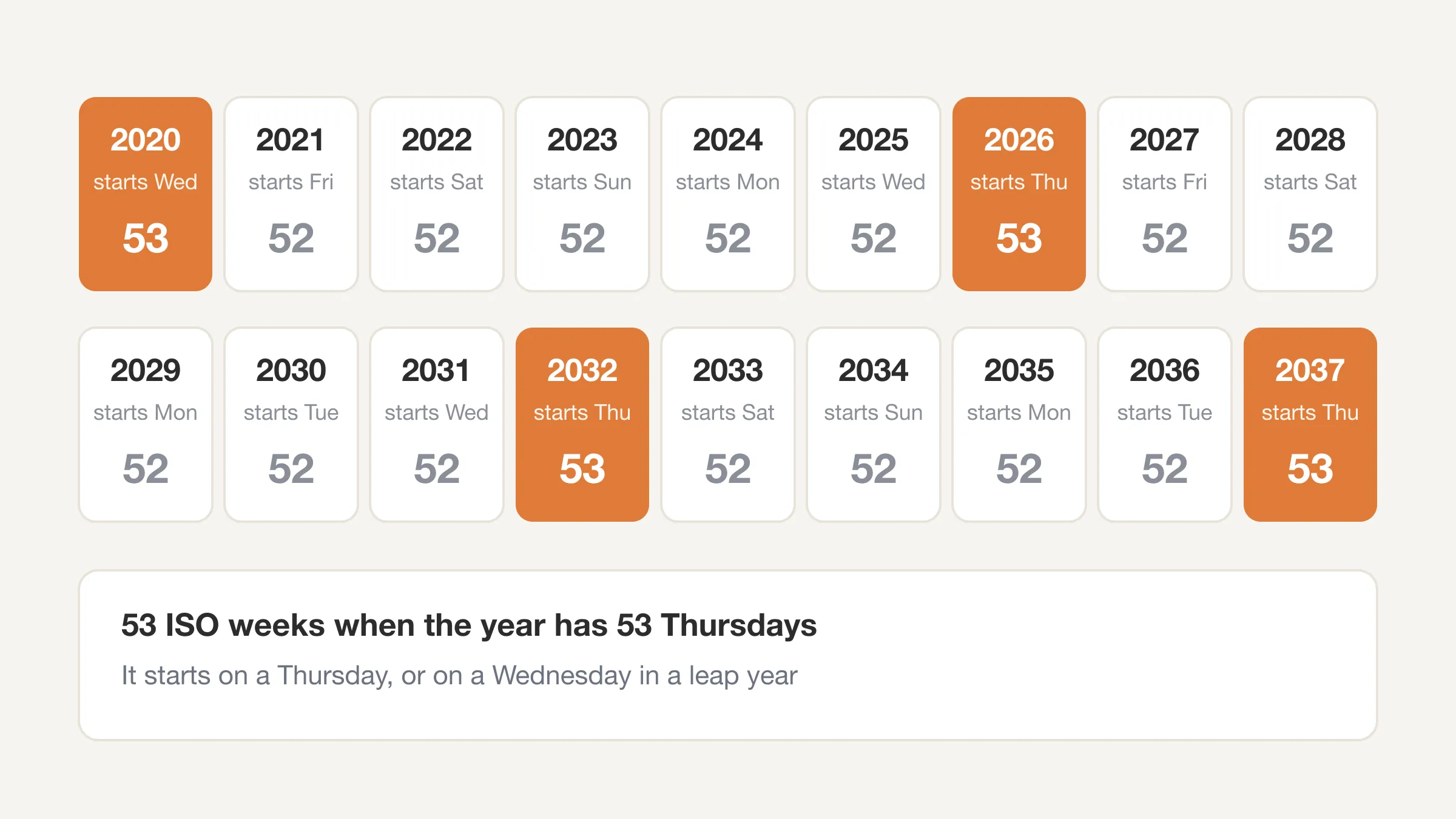
That last point is the easiest way to think about it. Each ISO week has exactly one Thursday, so a year has as many ISO weeks as it has Thursdays. Most years have 52 Thursdays. A year that has 53 Thursdays has 53 weeks.
A common year has 52 Thursdays plus 1 extra day. If that extra day is a Thursday, the year gets 53. In 2026 January 1 is a Thursday, so December 31 is also a Thursday, and the count is 53.
A leap year has 2 extra days, so it reaches 53 Thursdays when either of them is a Thursday. That happens when January 1 falls on a Wednesday or a Thursday. (2032 starts on a Thursday and is a leap year, so it has 53 weeks too.)
One side effect surprises people. Because week 1 can start in late December, January 1 can sit in week 52 or 53 of the previous year. In 2027, January 1 is a Friday, and it still belongs to ISO week 53 of 2026. Week 1 of 2027 begins on Monday, January 4.
What about the other way of counting weeks?
The ISO system is the predominant one worldwide, but it is not the only one. The US convention runs Sunday to Saturday and counts the week that contains January 1 as week 1, which leaves partial weeks at the start and end of the year. Its week numbers can differ from ISO's by a week or so. Neither is wrong. They answer different questions.
If you need a number for payroll, a project plan or a spreadsheet, check which system it uses. If you want to know how much time you have, count days and divide by 7.
Which years have 53 weeks?
Roughly one year in every 5.6. In each 400-year Gregorian cycle, 71 years have 53 ISO weeks, according to the same Wikipedia entry. The gap between them is usually 5 or 6 years, and occasionally 7 around century years that skip a leap day.
| Year | Starts on | Days | ISO weeks |
|---|---|---|---|
| 2020 | Wednesday | 366 | 53 |
| 2021 | Friday | 365 | 52 |
| 2022 | Saturday | 365 | 52 |
| 2023 | Sunday | 365 | 52 |
| 2024 | Monday | 366 | 52 |
| 2025 | Wednesday | 365 | 52 |
| 2026 | Thursday | 365 | 53 |
| 2027 | Friday | 365 | 52 |
| 2028 | Saturday | 366 | 52 |
| 2029 | Monday | 365 | 52 |
| 2030 | Tuesday | 365 | 52 |
| 2031 | Wednesday | 365 | 52 |
| 2032 | Thursday | 366 | 53 |
| 2033 | Saturday | 365 | 52 |
| 2034 | Sunday | 365 | 52 |
| 2035 | Monday | 365 | 52 |
| 2036 | Tuesday | 366 | 52 |
| 2037 | Thursday | 365 | 53 |
A 53-week ISO year spans 371 days (53 × 7), so it borrows days from its neighbors. ISO week 1 of 2026 started on Monday, December 29, 2025. ISO week 53 of 2026 runs from Monday, December 28, 2026 to Sunday, January 3, 2027.
How many weeks are left in 2026?
On November 11, 2026, the math is simple. Today is day 315 of a 365-day year. That means 314 days are behind you (44 weeks and 6 days, or 86% of the year) and 50 days remain after today.
- 50 days = 7 weeks and 1 day (7.14 weeks), not counting today.
- Counting today, it is 51 days, or 7.29 weeks.
- By ISO numbering, today is in week 46. Weeks 47 to 53 are still ahead, which is 7 more.
Here is the countdown for each Wednesday from now to the end of the year, counted in days after that date:
| Date | Days left | Weeks left | Waking hours left (at 16 a day) |
|---|---|---|---|
| Nov 11 | 50 | 7.1 | 800 |
| Nov 18 | 43 | 6.1 | 688 |
| Nov 25 | 36 | 5.1 | 576 |
| Dec 2 | 29 | 4.1 | 464 |
| Dec 9 | 22 | 3.1 | 352 |
| Dec 16 | 15 | 2.1 | 240 |
| Dec 23 | 8 | 1.1 | 128 |
| Dec 30 | 1 | 0.1 | 16 |
The 16 waking hours a day is an assumption: a 7 a.m. to 11 p.m. day, with eight hours for sleep. Use your own numbers. We break that down in how many hours in a week.
How do you count the weeks left from any date?
- Count the days from tomorrow to December 31.
- Divide by 7.
- The whole number is full weeks. The remainder is days.
For 2026, the count from tomorrow to December 31 is 365 − (day of the year). A date that is day 315 leaves 50. You can look up the day of the year with a calendar, or skip the sums and use the weeks left in the year counter.
What week number is it? Key dates in 2026
People search "what week is it" almost as often as they search the count. Here are ISO week numbers for dates people tend to plan around.
| Date | Weekday | ISO week |
|---|---|---|
| January 1, 2026 | Thursday | 1 |
| March 1, 2026 | Sunday | 9 |
| June 30, 2026 | Tuesday | 27 |
| September 7, 2026 | Monday | 37 |
| November 11, 2026 | Wednesday | 46 |
| November 26, 2026 | Thursday | 48 |
| December 25, 2026 | Friday | 52 |
| December 31, 2026 | Thursday | 53 |
| January 1, 2027 | Friday | 53 (of 2026) |
| January 4, 2027 | Monday | 1 (of 2027) |
Notice the last three rows. If a form asks for a year and a week number in January, make sure you pair them correctly. January 1, 2027 is in week 53 of ISO year 2026, not week 1 of 2027.
How many weeks are in a month, a quarter or a life?
The same division works for any span of time.
- A month: 52.14 ÷ 12 gives about 4.35 weeks on average. Months are 4.0 to 4.4 weeks long, which is why "four weeks a month" quietly loses you about four weeks a year (12 × 4 = 48, not 52).
- A quarter: 52 ÷ 4 = 13 weeks. That is the idea behind the 12-week year: treat 12 weeks as the plan and use the 13th to review and reset.
- A decade: 10 years is about 522 weeks, the span of a 10-year plan.
- A life: 80 years is about 4,174 weeks. 90 years is about 4,696. Four thousand weeks is 76.7 years.
That last figure is the title of Oliver Burkeman's book Four Thousand Weeks, which uses a rough lifespan in weeks to make a point about choosing what to do with a short span. We summarize its ideas in four thousand weeks lessons. The useful move is not to feel alarmed by the total. It is to notice that a week is a unit you can actually see. A bucket list grouped by lead time is one way to decide what some of those weeks are for.
How many of those 52 weeks are really yours?
Counting weeks is easy. Knowing what is in them is the hard part. Start with the hours.
- A year has about 8,760 hours (365 × 24).
- If you sleep 8 hours a night, you are awake about 5,840 of them. That is 16 waking hours a day, or 112 a week.
- A year of weekdays is 261 days in 2026 and in 2027. Everything else is weekend.
Here is what that looks like in the unit Beyond Time uses. A waking day from 7 a.m. to 11 p.m. is 64 blocks of 15 minutes. A week is 448 blocks. A year is 23,360.
Those numbers are the ceiling. Work, commuting, meals, chores and sleep that runs long take their share before your own priorities do. The 168 hours guide walks through finding the rest.
An example of what a week is made of
Take a typical full-time week as an illustration: 56 hours of sleep, 40 of work, and about 30 for meals, errands and chores. That leaves roughly 42 hours that are yours. Your numbers will differ. The point is that the 52 weeks you started with shrink to something smaller before you plan anything.
What do you do with a number like 7.1 weeks?
A countdown on its own can feel like a nudge, or a weight. It does neither on its own. What helps is turning it into a picture of where the weeks actually went and what you want from the ones that remain. If the count weighs on you in your twenties, the post on a quarter life crisis is a gentler place to start.
Here is a simple way to do that.
- Pick the unit. Weeks are the right size. A day is too small to see a pattern, and a year is too large to feel.
- Log one week. Write down what you did in each 15-minute block, even roughly. Our time audit guide shows the method.
- Compare the log to the plan. The gap between where you meant the week to go and where it went is the useful number.
- Change one thing next week. One change is enough. Trying to rebuild a week at once rarely sticks.
This is what Beyond Time does. The Today screen shows your waking time left today and this week. You log the day in 15-minute blocks, two minutes in the morning and two at night, and the AI reflection reads the logged day: what went where you meant it to, where time leaked, and one or two changes worth making. Home Screen and Lock Screen widgets can keep the days left in the year in view.
See where this week goes
Log your day in 15-minute blocks. Two minutes in the morning, two at night.
Try Beyond Time freeFrequently Asked Questions
How many weeks are in a year?
A year has 52 weeks and 1 extra day, or 52 weeks and 2 days in a leap year. As decimals, that is 52.14 weeks in a common year and 52.29 in a leap year. If you use ISO week numbering, a year has 52 or 53 numbered weeks.
How many weeks are in 2026?
2026 has 52 weeks and 1 day, and it has 53 ISO weeks. January 1 and December 31 are both Thursdays, so the year has 53 Thursdays. ISO week 1 starts on December 29, 2025, and week 53 ends on January 3, 2027.
How many weeks are left in 2026?
On November 11, 2026, there are 7 weeks and 1 day left (50 days after today). Counting today it is 51 days. By ISO numbering, today is in week 46, and weeks 47 to 53 are still to come.
Why do some years have 53 weeks?
Because 52 × 7 = 364, and a year has 365 or 366 days. The leftover days add up until a year contains 53 Thursdays, which makes it a 53-week year under ISO 8601. About 71 out of every 400 years work this way, and the next ones are 2032 and 2037.
How many weeks are in a month?
A month averages about 4.35 weeks. Most months are 4 weeks and a few days, which is why 12 months of 4 weeks (48) falls four weeks short of the 52 in a year.
How many weeks are in a quarter?
A quarter is 13 weeks, since 52 ÷ 4 = 13. The actual length varies by a few days depending on which months it covers.
How many work weeks are in a year?
Counting weekdays only, 2026 has 261 weekdays, which is about 52 work weeks of 5 days. Your actual number depends on holidays, vacation and your employer, so subtract those from 261 and divide by 5.
Count your weeks, then count what happened in them
Beyond Time shows waking time left today and this week, then helps you see where it went.
Get Beyond TimeSo, how many weeks are in a year?
The answer to how many weeks in a year is 52 weeks and a day, and by ISO numbering it is 52 or 53 weeks. 2026 has 53, 2027 has 52, and today the year has 7 weeks and 1 day left.
Your time is limited. The count is only the first half of the answer. The second half is where those weeks go. Start with one: log this week in 15-minute blocks, and look at what it shows. The weeks left counter will keep the number honest while you do.
Sources: ISO week date, Wikipedia. Dates and counts were computed for the 2026 calendar.
Put this into practice
Free tools that match this article.
Goal Setting Worksheet
Turn a vague goal into milestones, habits, blockers, and a weekly review plan.
Try Goal WorksheetTime ManagementWeekly Schedule Template
Plan your week with a free printable weekly schedule template for goals, routines, and focus blocks.
Try Schedule TemplateHabit BuildingHabit Tracker Template
Create a free printable habit tracker template — weekly or monthly. Customize your habits and download a clean PDF in seconds.
Try Habit TrackerTime ManagementTime Blocking Template
Map your day into focused time blocks with a free printable time blocking template.
Try Time BlockingRelated Articles
How Many Weeks in a Month? About 4.35, Not Exactly 4
How many weeks in a month? About 4.35 on average, or 4 weeks and 2 to 3 days. See every month of 2026, why February is special and why pay and rent drift apart.

How Many Minutes in a Week? 10,080, and Where They Go
How many minutes in a week? 10,080, or 6,720 waking minutes at 8 hours of sleep. See the minutes in each activity for an average week and how many are left.

Bucket List Ideas: 100 Ideas Grouped by Theme and Lead Time
100 bucket list ideas grouped by theme and tagged by lead time: now, this year, or years ahead. Count the weeks you have, then pick ten. Start your list today.

How to Stop Doomscrolling: 9 Practical Fixes That Work
How to stop doomscrolling: add friction, swap in better habits and check your Screen Time against a real log of your day. Nine fixes, with sources. Try one.
Life Plan Template: A One-Page Plan With Weekly Costs
A free life plan template you can copy: eight areas of life, one outcome each, and a weekly time cost so your plan fits the 112 waking hours you really have.
How Many Work Weeks in a Year? 52 Minus Your Time Off
How many work weeks in a year? 52 on paper, usually 46 to 50 after holidays and leave. See the table by days off, 2026's count and the weeks left this year.