10 Year Plan: A Simple Template for Your Next 520 Weeks
A 10 year plan is about 520 weeks. Use this copyable template to set a vision, work back to this week, and see what each goal costs in hours. Start today.
A 10 year plan covers about 520 weeks, or 522 counting from today. If you start on 24 September 2026, it ends on 24 September 2036, which is 3,653 days later (the span includes three leap days). That is the whole canvas. A good plan is not a prediction of those weeks. It is a short document that says where you want to be, what has to be true along the way, and what you will do this week.
Most 10-year plans fail for one reason: they stay at the level of vision. They describe a life and never touch a calendar. This guide gives you a template that works backward from the vision to the next seven days, and a way to price each goal in hours so you know what you are really agreeing to.
Key takeaways
- A 10-year plan is roughly 522 weeks, or about 58,000 waking hours at 16 waking hours a day.
- Plan in layers: a 10-year vision, 3-year milestones, a 1-year focus, one quarter, one week.
- Price every goal in hours per week. One hour a week for ten years is about 520 hours.
- The plan is only real once it has a first block on this week's calendar.
What is a 10 year plan?
A 10 year plan is a written description of the life you are aiming at a decade from now, broken into steps small enough to act on. It sits between a dream and a to-do list. A dream says "I want to be healthy and do work I respect." A to-do list says "book the dentist." A 10-year plan connects them.
It usually has five parts:
- A vision for each area of your life that matters to you.
- Three-year milestones that show the vision is getting closer.
- A one-year focus that picks the one or two things worth your effort this year.
- A quarter, which is 13 weeks of specific work.
- A first week, with real blocks of time attached.
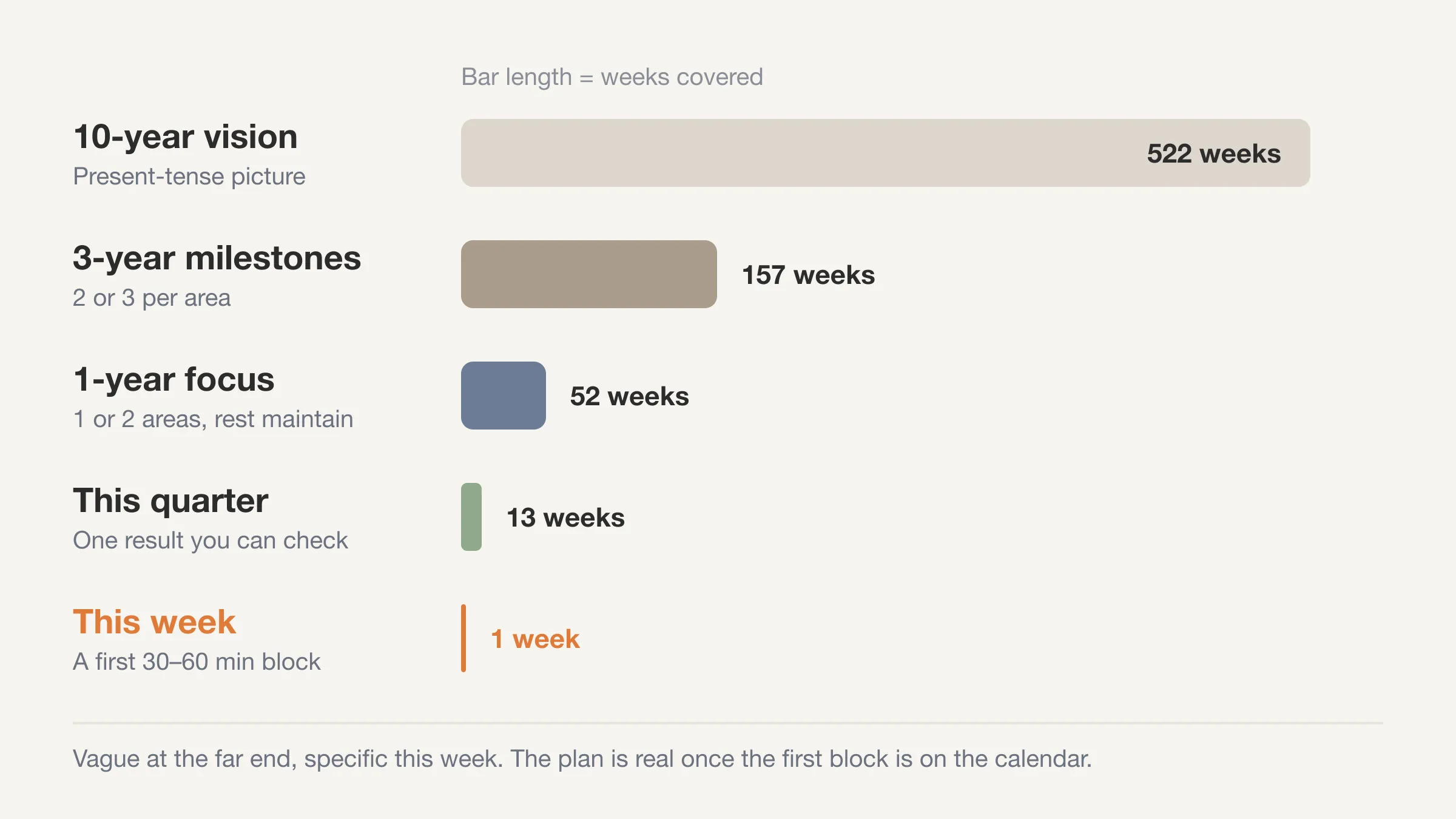
If you have already done a shorter version, the 5-year plan template uses the same structure at half the length. Ten years just asks you to be less specific at the far end and more honest about the near end.
How many weeks are in a 10 year plan?
Roughly 522. Here is the same decade measured in the units that matter for planning, starting from 24 September 2026.
| Span | Days | Weeks (approx.) |
|---|---|---|
| 1 year | 365 | 52 |
| 3 years | 1,096 | 157 |
| 5 years | 1,826 | 261 |
| 10 years | 3,653 | 522 |
Now the part that makes the number real. If you are awake 16 hours a day, ten years holds about 58,448 waking hours, which is 233,792 fifteen-minute blocks. A week holds 112 waking hours and 448 of those blocks.
That is a lot of time. It is also finite, and most of it is already spoken for by work, sleep, meals and the other things that repeat every week. The plan decides who gets the rest. For a longer look at how a week splits, see how many hours are in a week.
Why plan ten years ahead when everything changes?
Because the plan is a direction, not a forecast. You will not guess the job, the city or the year-seven curveball. You can decide what you want more of: health you can rely on, work you are proud of, people you see often, money that stops being a worry.
A ten-year horizon does three useful things:
- It makes small habits look like what they are. An hour a week sounds like nothing. Across a decade it is about 520 hours.
- It filters goals. Something that matters in a month and not in three years can wait.
- It gives you permission to skip. If a thing does not fit the ten-year picture, you can say no without drama.
What it should not do is lock you in. Treat the plan as a draft you revise every year. If you want a rhythm for that, an annual review is the natural moment.
How do you build a 10 year plan step by step?
Set aside about 90 minutes. Use paper or a note. Work in this order, because each step makes the next one easier.
Step 1: Choose your areas
Pick five to eight areas of life. A common set is health, relationships, work, money, learning, home and rest. If you are unsure what to include, how to set life priorities walks through the choice, and the life audit shows where you stand today.
Step 2: Write the ten-year picture for each area
Write one or two sentences in the present tense, as if it is September 2036. "I run three times a week and my back no longer hurts." "I work four days a week on things I chose." Be concrete about what a normal week looks like, not about trophies.
Step 3: Work backward to three years
Ask: what would have to be true in September 2029 for the ten-year picture to be on track? This is where you find the real work. Two or three milestones per area is plenty.
Step 4: Pick the one-year focus
You cannot move every area at once. Choose one or two areas to push this year and set the others to "maintain." The next 52 weeks are a budget. Spend them on purpose. If your focus area is a skill or trait you want to grow, a personal development plan turns it into a year of concrete steps.
Step 5: Turn the year into a quarter
From the one-year focus, pick the first 13 weeks. Write a result you could check on the last day, not a wish. If you are unsure whether 13 weeks is the right unit, see how quarterly and monthly planning compare. If your goals tend to blur, the 12-week year is a good model for this layer.
Step 6: Put the first block on this week
This is the step most people skip. Open this week and find one block of 30 to 60 minutes you can protect for the first action. Not a vague "work on it." A named block at a named time.
See where this week actually goes
Log your day in 15-minute blocks and see how many hours your plan has to work with. Two minutes in the morning, two at night.
Try Beyond Time freeWhat does a 10 year plan template look like?
Copy this into a note or document and fill it in. Keep each line short. If you cannot fit it on one page, you have written an essay, not a plan.
10-YEAR PLAN
Start date: ____________      End date: ____________
Weeks in this plan: ______    (about 522 for ten years)

1. AREAS (pick 5 to 8)
   health / relationships / work / money / learning / home / rest / ______

2. TEN-YEAR PICTURE (present tense, one or two sentences per area)
   Health:         ______________________________________
   Relationships:  ______________________________________
   Work:           ______________________________________
   Money:          ______________________________________
   Learning:       ______________________________________

3. THREE-YEAR MILESTONES (2 or 3 per area; the date is the end of year 3)
   Area: ________   By ________ :  ______________________
   Area: ________   By ________ :  ______________________

4. THIS YEAR'S FOCUS (1 or 2 areas; everything else is "maintain")
   Focus area: ________   One result by the end of the year: ____________
   Maintain: ____________________________

5. THIS QUARTER (13 weeks)
   Result I can check on the last day: ______________________
   Hours per week I am giving it:      ______
   Hours per week I will stop giving to: ______  (what moves out?)

6. THIS WEEK
   First block: day ______  time ______  length ______  action ______________
   Review date (same day each week): ____________

7. YEARLY REVIEW
   Date I will redo this page: ____________
Two lines in that template deserve a note. "Hours per week I am giving it" forces you to put a number on the goal. "What moves out?" forces the trade, because a week has 112 waking hours and nothing new fits unless something leaves.
What does each goal cost in hours?
Pricing goals in hours is the single most useful addition you can make. The arithmetic is simple: hours per week times 52 weeks, times ten years.
| Hours per week | Per year | Over 10 years | Share of your 112 waking hours |
|---|---|---|---|
| 1 | 52 | 520 | 0.9% |
| 3 | 156 | 1,560 | 2.7% |
| 5 | 260 | 2,600 | 4.5% |
| 10 | 520 | 5,200 | 8.9% |
Use the table as a reality check. If your plan has six areas and each wants five hours a week, that is 30 hours on top of everything else. Where do those 30 hours come from? If the answer is "I'll find the time," the plan has a hole.
Small amounts compound in your favor, too. Three hours a week is under 3% of your waking time and it adds up to roughly 1,560 hours over the decade. That is why the plan favors steady, modest weekly costs over heroic bursts. For more on this idea, see how a 168-hour week gets divided.
What does a filled-in example look like?
This is an illustration, not a prescription. Imagine someone with a full-time job who wants to pick three areas.
| Area | Ten-year picture | Year-3 milestone | Weekly cost |
|---|---|---|---|
| Health | Exercises three times a week, sleeps well, no recurring back pain | Has trained at least 3 times a week for a full year | 4 hours |
| Work | Works on a craft they chose, with room to say no | Has moved into a role with more control over their projects | 3 hours of deliberate skill-building |
| Relationships | Sees close friends monthly and family weekly | Two standing monthly dates that survive busy seasons | 5 hours |
The weekly cost column adds up to 12 hours, which is about 10.7% of 112 waking hours. That is large but possible if you know where it comes from. Maybe two hours come out of evening screen time and three out of weekend drift. Without that line, the plan is a list of intentions.
Notice what is missing: money, learning, home. The plan says "maintain" for those, which means no new project. A plan that says yes to everything says nothing.
How do you connect the plan to your actual week?
By checking it against what you really do. The plan says where you want your hours to go. A time log says where they went. The difference between the two is the number that tells you whether the plan is real.
Here is a simple way to run that check:
- Log one normal week in 15-minute blocks. Beyond Time does this as a two-minute habit: you pick a block and say what you were doing.
- Count the hours that landed in the areas your plan names.
- Compare the count with the weekly cost you wrote in the template.
- Adjust one thing. Move a block, drop a commitment, or lower the target to something you can actually keep.
If you have never done this, how to do a time audit explains it in more detail, and the daily time log template gives you a page to start with. The 15-minute block method explains why that grain works.
When you log in Beyond Time, you can see your week as hours split by Health, Life, Work and Sleep, and the share of blocks you logged. The AI reflection then reads the logged day and points to where time leaked and one or two changes worth making. That is the gap between plan and week, spelled out.
How often should you revisit a 10 year plan?
On three schedules, each with a different job.
- Weekly (15 minutes): look at next week's first blocks. Did last week's happen? If not, why? A short Sunday routine is a natural home for this check.
- Quarterly (1 hour): check the 13-week result and choose the next one.
- Yearly (90 minutes): redo the page above. Update the picture, move milestones, and change what you maintain.
Do not rewrite the ten-year picture every month. Rewrite the blocks. The picture should only change when you have learned something real about what you want.
Put the first block on your calendar
Beyond Time shows your week in hours by category so your plan meets your real schedule. Free for two weeks, everything unlocked.
Try Beyond Time freeWhat if your 10 year plan feels fake?
That usually means one of three things.
The picture is borrowed. You wrote what sounds good, not what you want. Reread each line and ask whether you would be disappointed if it came true. If not, replace it. If the doubt runs deeper than the page, it may be part of a quarter life crisis, and that is worth naming before you plan around it.
The steps are too far away. If your first action is two years out, you have a wish. Shorten the first milestone until there is something to do this week.
The hours do not exist. This is the most common reason. The weekly cost of your goals is larger than the free time you have. Either cut a goal, move an existing commitment, or accept a longer timeline.
A plan that feels fake is not a failed plan. It is feedback. Fix the weakest of those three and try again.
If your goals are still unclear, the 5-year plan generator can give you a first draft to react to. Editing a draft is often easier than starting from a blank page.
Frequently Asked Questions
How many weeks are in a 10 year plan?
About 522. From 24 September 2026 to 24 September 2036 there are 3,653 days, which is 521 weeks plus six days. The count includes three leap days (in 2028, 2032 and 2036).
How do I write a 10 year plan?
Write a ten-year picture for five to eight areas of life, work backward to three-year milestones, choose a one-year focus, set a 13-week result, and put a first block on this week. Use the template above and keep it to one page.
Is a 10 year plan realistic?
Yes, if you treat it as a direction rather than a promise. You cannot predict ten years, but you can decide what you want more of and review the plan every year. The near-term layers (the quarter and the week) carry the real accountability.
What should I put in a 10 year plan?
Include your areas of life, a short present-tense picture for each, three-year milestones, this year's focus, this quarter's result, and a first week with blocks. Add an hours-per-week cost to each goal so the plan matches your real time.
What is the difference between a 5 year plan and a 10 year plan?
A 10-year plan is vaguer at the far end and just as specific this week. A 5-year plan has more detail across the middle years, while a 10-year plan puts more weight on direction and on the first year.
How often should I update my 10 year plan?
Review the first blocks weekly, the quarterly result every 13 weeks, and the whole page once a year. Change the ten-year picture only when you have learned something real about what you want.
Your next 520 weeks, starting this one
A 10 year plan is about 520 weeks written on one page: a vision, three-year milestones, a one-year focus, a quarter, and a first block on this week. The page matters less than the pricing. Know what each goal costs in hours, and check that against where your time went last week.
Your time is limited. See where it goes, then plan the next block. If you want to start with the seeing part, Beyond Time logs your day in 15-minute blocks, and the life audit tool gives you a quick read on where you stand today.
Put this into practice
Free tools that match this article.
Goal Setting Worksheet
Turn a vague goal into milestones, habits, blockers, and a weekly review plan.
Try Goal WorksheetGoal SettingSMART Goal Validator
Instantly validate your goals against the SMART framework and get actionable improvement suggestions.
Try SMART ValidatorGoal SettingAI Milestone Generator
Turn your biggest goals into an actionable step-by-step plan in seconds with AI.
Try Milestone GeneratorGoal SettingOKR Generator
Transform any aspiration into a structured OKR with measurable key results in seconds.
Try OKR GeneratorKeep exploring this topic
Related Articles

Bucket List Ideas: 100 Ideas Grouped by Theme and Lead Time
100 bucket list ideas grouped by theme and tagged by lead time: now, this year, or years ahead. Count the weeks you have, then pick ten. Start your list today.

Life Plan Template: A One-Page Plan With Weekly Costs
A free life plan template you can copy: eight areas of life, one outcome each, and a weekly time cost so your plan fits the 112 waking hours you really have.

How Many Minutes in a Week? 10,080, and Where They Go
How many minutes in a week? 10,080, or 6,720 waking minutes at 8 hours of sleep. See the minutes in each activity for an average week and how many are left.

How to Stop Doomscrolling: 9 Practical Fixes That Work
How to stop doomscrolling: add friction, swap in better habits and check your Screen Time against a real log of your day. Nine fixes, with sources. Try one.

How Many Work Weeks in a Year? 52 Minus Your Time Off
How many work weeks in a year? 52 on paper, usually 46 to 50 after holidays and leave. See the table by days off, 2026's count and the weeks left this year.

Second Brain Method Explained: CODE, PARA and Who It Suits
A second brain is a trusted place outside your head for notes and ideas. See how Tiago Forte's CODE and PARA work, who it suits, and what notes can't tell you.