
Life Plan Template: A One-Page Plan With Weekly Costs
A free life plan template you can copy: eight areas of life, one outcome each, and a weekly time cost so your plan fits the 112 waking hours you really have.
A life plan template should fit on one page and answer one question for each area of your life: what does a good year look like, and what will it cost you each week? Most templates stop at the first half. They ask for goals and leave the hours out, which is why so many plans look good in October and collapse by February.
The template below has eight areas and a "cost per week" column. A normal week has 168 hours, about 56 of them asleep, which leaves 112 waking hours to share between everything you care about. Fill in the page, add up the cost column, and you will know within ten minutes whether the plan fits the week you actually have.
Key takeaways
- A usable life plan has eight areas or fewer, one outcome per area, and a weekly time cost.
- You have about 112 waking hours a week. The cost column must add up to less than what is left after work and essentials.
- Choose one or two areas to push this year. Mark the rest "maintain."
- Check the plan against a logged week, not a guess.
What is a life plan template?
A life plan template is a structured page where you describe what you want from each part of your life, pick the outcomes that matter this year, and decide how much time each one gets. It is the shorter, more practical cousin of a 10-year plan, and broader than a personal development plan, which zooms in on skills and growth. Where a ten-year plan sets the direction, a life plan is the page you actually use every few weeks.
Good templates share three traits:
- They are bounded. Eight areas, one outcome each. If you list thirty goals, nothing gets done.
- They are dated. There is a start and an end, usually a year.
- They are priced. Every outcome has a number of hours per week next to it.
The third trait is the one most plans miss. Without it, goals compete silently for the same hours, and the loudest one wins.
What are the eight areas of a life plan?
Use these as a starting set. Rename them if they do not fit you. If you want help deciding what matters, how to set life priorities is a good companion.
| Area | What it covers |
|---|---|
| Health | Sleep, movement, food, medical care, mental health |
| Relationships | Partner, family, friends, community |
| Work | Job, craft, business, career growth |
| Money | Income, saving, debt, planning, admin |
| Learning | Skills, reading, courses, projects that stretch you |
| Home | Where you live, chores, errands, the things that keep life running |
| Rest and play | Hobbies, fun, downtime, travel |
| Meaning | Values, contribution, faith, reflection, giving back |
You do not need to hit every area hard. You need to look at each one and decide on purpose whether it is a focus or a "maintain" this year. For a view across all of them at once, the life audit gives you a starting score.
How do you fill in a life plan?
Work through it in four passes. Allow about 45 minutes the first time.
Pass 1: Describe a good year in each area
Write one sentence in the present tense, as if it is the end of the year. "I sleep seven hours on most nights and have a doctor's appointment booked." Avoid trophies. Describe how the area feels and looks day to day.
Pass 2: Pick one outcome per area
An outcome is something you can check on the last day of the year. "Run a 10K" works. "Get fitter" does not. If you cannot say how you would know it happened, rewrite it.
Pass 3: Price each outcome
Estimate the hours per week the outcome needs. Be honest, not heroic. If an outcome needs 4 hours a week and you currently give it 1, write 4 and note the gap of 3 hours. That gap is where you will have to take time from somewhere else.
Pass 4: Pick the focus
Circle the one or two areas that get extra effort this year. Mark everything else "maintain" and keep its cost near what it is now. This is the pass that makes the plan work, because it keeps you from asking for more hours than a week contains.
Find out what a week really holds
Log your day in 15-minute blocks and see your week by category. Two minutes in the morning, two at night.
Try Beyond Time freeCopy this life plan template
Paste this into a note, document or notebook. Keep the plan to one page.
LIFE PLAN
Year: ____________     Review dates: ____________  ____________  ____________

WEEK BUDGET
Waking hours per week (16 a day x 7):  112
Already spoken for each week:
  Work (including commute):            ______
  Meals, chores, errands:              ______
  Other fixed commitments:             ______
Hours left to plan with:               ______   (112 minus the lines above)

AREA PLAN
Area            | A good year looks like | One outcome (checkable)  | Focus or maintain | Hours / week now | Hours / week needed | Gap
Health          |                        |                          |                   |                  |                     |
Relationships   |                        |                          |                   |                  |                     |
Work            |                        |                          |                   |                  |                     |
Money           |                        |                          |                   |                  |                     |
Learning        |                        |                          |                   |                  |                     |
Home            |                        |                          |                   |                  |                     |
Rest and play   |                        |                          |                   |                  |                     |
Meaning         |                        |                          |                   |                  |                     |

TOTALS
Sum of "Hours / week needed" (discretionary areas): ______
Hours left to plan with:                              ______
Over or under:                                        ______   (if over, cut or move something)

FIRST MOVES
1. This week's first block: day ______ time ______ length ______ for ______________
2. What I will stop or shrink to make room: ______________________
3. Date of my first check against a logged week: ______________

NOTES FOR NEXT REVIEW
______________________________________________
Two rows deserve extra attention: Hours / week now and Gap. The "now" column should come from a logged week, not from memory. If you cannot fill it in, that is the signal to log for a week first.
What does the weekly cost column look like?
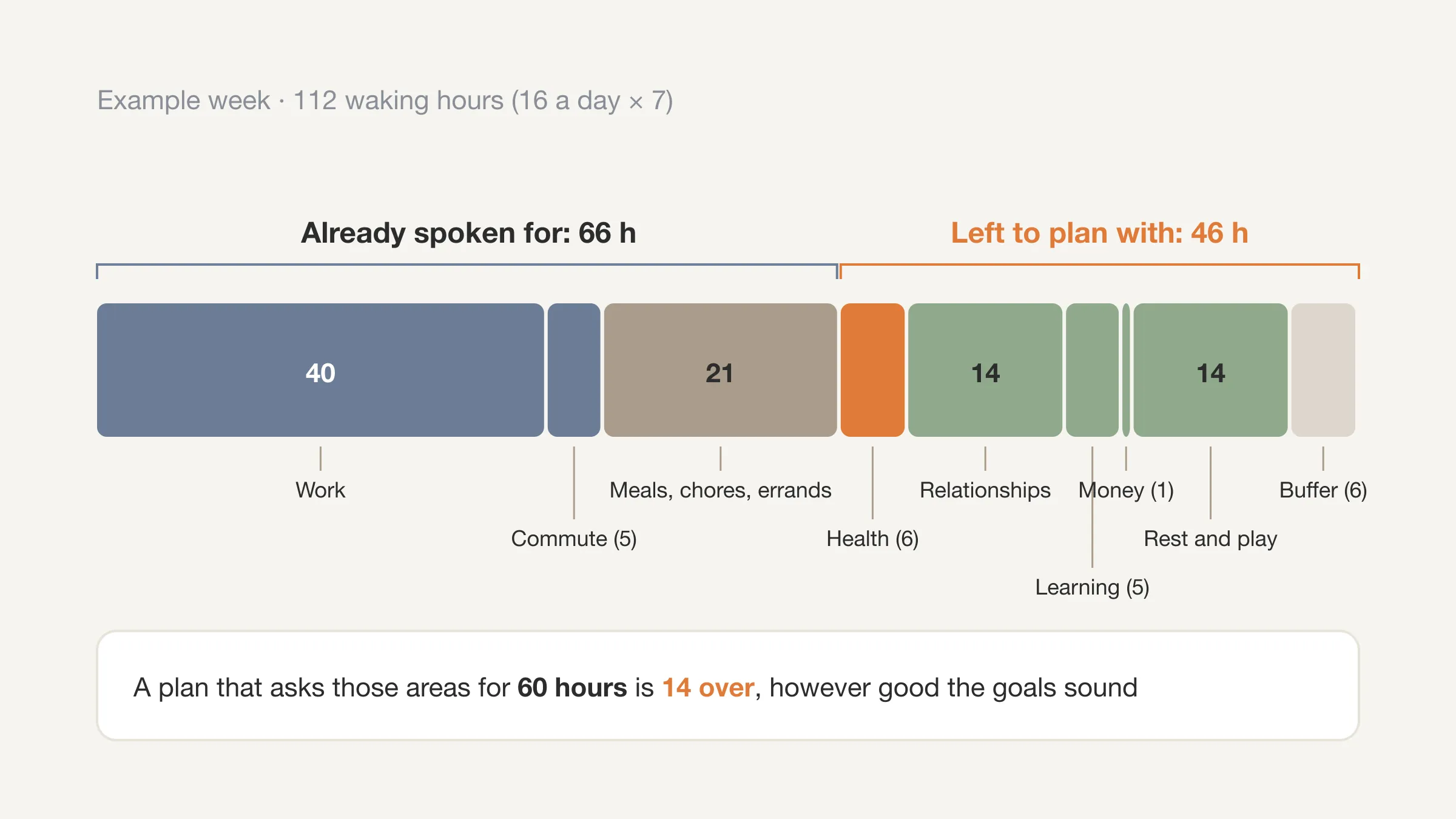
Here is an illustration of how a budget might look. The numbers are an example, not an average or a recommendation. Your week will differ.
| Category | Hours per week | Share of 112 waking hours | Hours per year (52 weeks) |
|---|---|---|---|
| Work | 40 | 35.7% | 2,080 |
| Commute | 5 | 4.5% | 260 |
| Meals, chores, errands | 21 | 18.8% | 1,092 |
| Health | 6 | 5.4% | 312 |
| Relationships | 14 | 12.5% | 728 |
| Learning | 5 | 4.5% | 260 |
| Money admin | 1 | 0.9% | 52 |
| Rest and play | 14 | 12.5% | 728 |
| Buffer for the unplanned | 6 | 5.4% | 312 |
| Total | 112 | 100% | 5,824 |
In this example, work, commute and daily upkeep already take 66 hours of the 112. That leaves 46 hours to share among health, relationships, learning, money, rest and a buffer. A plan that asks for 60 hours from those areas has an arithmetic problem, no matter how good the goals sound. If you run your own business, the solopreneur's 40-hour weekly system shows one way to keep the work row from growing.
Two habits make the column more honest:
- Leave a buffer. Weeks do not go to plan. Six hours of slack is not wasted time, it is what keeps the other blocks from being sacrificed.
- Count in blocks. Eight hours a week is 32 fifteen-minute blocks. Seeing it as blocks makes it easier to find them in the calendar. Rob Dyrdek's life spreadsheet takes the same idea further and accounts for every hour of the week.
What does a filled-in row look like?
A row is easier to understand with real words in it. Here are two rows from an example plan, followed by the one-line version of each outcome.
| Area | A good year looks like | One outcome | Focus or maintain | Hours/week now | Hours/week needed | Gap |
|---|---|---|---|---|---|---|
| Health | Steady energy, sleeps most nights, moves regularly | Walk or train three times a week, every week from March | Focus | 2 | 5 | +3 |
| Money | No surprises, a small buffer | Set up an automatic monthly transfer and review spending each quarter | Maintain | 0.5 | 1 | +0.5 |
The health row is a focus, so it takes the three extra hours. Those 3 hours are 12 fifteen-minute blocks, and they have to come from somewhere, such as evening screen time. The money row is a maintain row, so it only asks for a small, fixed block.
Notice that both outcomes are things you can check. "Walk or train three times a week" can be counted. "Be healthier" cannot. If you cannot count an outcome, it will drift, and so will the hours behind it.
How do you decide what to cut?
When the cost column adds up to more than you have, you have three options. You cannot ignore the math.
- Lower the target. Aim for two workouts a week, not four. A smaller version you keep beats a bigger one you drop.
- Move something out. Another commitment, a standing meeting, or an hour of scrolling can give up its place.
- Stretch the timeline. Learning a language in six months needs more hours a week than learning it in two years.
If you want a framework for the trade-off, work-life balance goal setting walks through how to decide among competing areas. The 168-hour week framework shows how to look at the week as a whole.
Be suspicious of any plan where everything fits easily. Usually it means the costs are too low, not that you found free time.
How do you check the plan against your real week?
Log a week and compare. A plan is a statement of intent. A time log is a statement of fact. The gap between them is the useful number.
- Log seven days. In Beyond Time you pick a block and say what you were doing. Routines are grouped into Health, Life, Work and Sleep, and blocks you skipped show as "not logged." A paper page works too; the daily time log template gives you one, and the hourly planner or a one-page daily planner works well if you plan ahead.
- Total each area. See your week view: every hour split by category, with the share you logged.
- Fill in "Hours / week now." Use the totals, not your memory.
- Look at the gap. Where is your plan asking for hours that do not exist? Where are hours going to something your plan does not mention?
The AI reflection in Beyond Time reads the logged day. It tells you what went where you meant it to, where time leaked, and one or two changes worth making for tomorrow. It is a fast way to see a gap you would otherwise take weeks to notice. If you want the full method, see how to do a time audit.
For a quick first read before you log anything, the free life audit tool scores six areas (work, health, sleep, relationships, finances and personal growth) from your answers. Treat the scores as a starting question, not a verdict.
How often should you review a life plan?
Three times a year is enough for the full page, with a short weekly look in between.
- Weekly (10 minutes): look at next week. Is the first block for each focus area on the calendar?
- Every 4 months: check one outcome per focus area and update "Hours / week now" from a logged week.
- Once a year: rewrite the page. Use the annual review to look back before you look forward.
Do not rebuild the plan each time. Edit the numbers. If the same row is wrong three reviews in a row, the outcome is wrong, not you.
See your week by category
Beyond Time splits every hour of your week into Health, Life, Work and Sleep, and shows what you did not log. Free for two weeks.
Try Beyond Time freeFrequently Asked Questions
What should a life plan template include?
It should include your areas of life, a short description of a good year in each, one checkable outcome per area, a focus-or-maintain choice, and the weekly hours each outcome costs. The template above adds a week budget so you can see whether the total fits.
How do I make a life plan?
Describe a good year in each of eight areas, pick one outcome each, price it in hours per week, and choose one or two areas as the focus. Then add up the hours and compare them with the time left after work and essentials. Plan on one page.
How many hours do I have to plan with each week?
A week has 168 hours. At eight hours of sleep a night, about 112 remain. Subtract work, commuting, meals, chores and other fixed commitments to find what is left to plan with. In the example above, that was 46 hours.
What is the difference between a life plan and a 10 year plan?
A 10-year plan sets direction over about 522 weeks. A life plan covers one year across all areas with weekly costs, so you can use it day to day. Many people keep both and revise the life plan more often.
How often should I update my life plan?
Look at the next week every week, check the plan against a logged week every four months, and rewrite it once a year. Edit the numbers between reviews rather than starting over.
What if my plan needs more hours than I have?
Lower a target, move something else out, or stretch the timeline. Those are the only three options. Adding hours to the week is not one of them, so the plan has to change.
Fit the plan to the week you have
A life plan template works when it ends with a number: the hours per week each outcome costs, added up and checked against the roughly 112 waking hours you have. Fill in the page, choose a focus, and compare it with one logged week.
Your time is limited. See where it goes before you decide where it should. Beyond Time logs your day in 15-minute blocks, and the free life audit is a way to start thinking about each area.
Put this into practice
Free tools that match this article.
Weekly Schedule Template
Plan your week with a free printable weekly schedule template for goals, routines, and focus blocks.
Try Schedule TemplateTime ManagementTime Blocking Template
Map your day into focused time blocks with a free printable time blocking template.
Try Time BlockingTime ManagementWeekly Schedule Optimizer
Generate an optimized weekly schedule with AI-powered time blocking for maximum productivity.
Try Schedule OptimizerFocusFocus Session Planner
Create AI-optimized focus sessions with structured work blocks and refreshing breaks.
Try Focus PlannerKeep exploring this topic
Time blocking guide
Turn priorities into protected calendar blocks.
15-minute time blocks
Plan and review your day with more realistic precision.
Life audit guide
Review the areas of life that need more attention and intention.
Personal development plan
Create a growth plan that connects identity, habits, and goals.
Related Articles

Bucket List Ideas: 100 Ideas Grouped by Theme and Lead Time
100 bucket list ideas grouped by theme and tagged by lead time: now, this year, or years ahead. Count the weeks you have, then pick ten. Start your list today.
10 Year Plan: A Simple Template for Your Next 520 Weeks
A 10 year plan is about 520 weeks. Use this copyable template to set a vision, work back to this week, and see what each goal costs in hours. Start today.

How Many Minutes in a Week? 10,080, and Where They Go
How many minutes in a week? 10,080, or 6,720 waking minutes at 8 hours of sleep. See the minutes in each activity for an average week and how many are left.

How to Stop Doomscrolling: 9 Practical Fixes That Work
How to stop doomscrolling: add friction, swap in better habits and check your Screen Time against a real log of your day. Nine fixes, with sources. Try one.

How Many Work Weeks in a Year? 52 Minus Your Time Off
How many work weeks in a year? 52 on paper, usually 46 to 50 after holidays and leave. See the table by days off, 2026's count and the weeks left this year.

Second Brain Method Explained: CODE, PARA and Who It Suits
A second brain is a trusted place outside your head for notes and ideas. See how Tiago Forte's CODE and PARA work, who it suits, and what notes can't tell you.