
Bucket List Ideas: 100 Ideas Grouped by Theme and Lead Time
100 bucket list ideas grouped by theme and tagged by lead time: now, this year, or years ahead. Count the weeks you have, then pick ten. Start your list today.
The best bucket list ideas are the ones you can actually schedule. This post has 100 of them, grouped by theme (adventure, travel, learning, creative, body, people, giving, money, small wonders). Each is tagged by lead time: now, this year, or years, because some things take an afternoon and some take a decade of setup.
That last part is the one most bucket lists miss. Today is 29 October 2026. There are 63 days left in this year (64 counting today), which is 9 weeks and 9 weekends. Some ideas fit in that. Others need training, savings or a date on a calendar that you cannot move. Seeing which is which is the difference between a list and a plan.
Key takeaways
- A list of 100 is a menu. Pick about 10, and give each one a date or a start month.
- Tag every idea by lead time. Now ideas need hours. This year ideas need weeks. Years ideas need a start today.
- If you are 45 and count to 80, you have about 1,826 weeks. That is a lot of weeks, and a small number of weekends, summers and big trips.
- The ideas that get lost are the ones with a fixed date or a body that needs training. Start with those.
How many weeks do you have to work with?
A bucket list is a time budget, so start with the number. The table below counts the weeks between each age and 80. Eighty is a round number for the arithmetic, not a forecast about your life. Change it if you like.
| Your age | Years to 80 | Weeks to 80 | Summers to 80 |
|---|---|---|---|
| 25 | 55 | 2,870 | 55 |
| 35 | 45 | 2,348 | 45 |
| 45 | 35 | 1,826 | 35 |
| 55 | 25 | 1,304 | 25 |
| 65 | 15 | 783 | 15 |
Weeks use 365.25 days a year divided by 7, which is 52.18 weeks.
A few things to notice. The week count feels large and the summer count feels small, and both are true. A big trip that needs a summer week can be done 25 times at most if you are 55. A thing that needs a decade of training has fewer starts than you think.
The same arithmetic works at a small scale. From today, 29 October, there are:
- 63 days left in 2026 (64 counting today)
- 9 weekends (nine Saturdays and nine Sundays)
- 9 weeks, with 1 day to spare
- 52 weekends in 2027, a number you can plan with
If you want a deeper look at this idea, the post on lessons from Four Thousand Weeks explains why choosing what to leave out is the whole point of a finite life.
Start from the weeks you really have
Log your day in 15-minute blocks. Two minutes in the morning, two at night. See where the hours go before you plan the big ones.
Try Beyond Time freeHow should you use a list of 100 ideas?
Read it once, fast. Mark only the ideas that make something move in your chest, whether excitement or a small pang. Ignore the ones you think you should want.
Then tag what you marked by lead time.
- Now means it can be done in the next few weeks with a normal schedule. It needs hours, not preparation.
- This year means it needs planning, savings or a block of time off. Weeks, not years.
- Years means it needs training, a large budget, a fixed date or a long build-up. If you do not start, it will not happen.
You will notice that most of your marks are in the middle group. That is normal. The "years" group is the one to look at first, because it is the one that quietly closes.
What are 100 bucket list ideas worth considering?
Adventure and outdoors
- Sleep under the stars far from city lights (now). A sleeping bag and a clear night.
- Hike a multi-day trail with a pack (this year). Start with two nights.
- Climb a mountain you can see from home (this year).
- See the northern lights (this year). It needs dark skies, the right season and some flexibility, so allow a few spare nights.
- Go whale watching (this year). Check the season for your area.
- Learn to ski or snowboard (this year). Lessons make the first day much better.
- Snorkel or scuba dive on a reef (this year). Get certified for diving at home first.
- Stay a night in a mountain hut or a lighthouse (this year).
- Ride a long-distance bike route over several days (this year).
- Paddle a river over several days (this year).
- Ride in a hot air balloon (this year).
- Walk a long pilgrimage route, such as one of the camino paths in Spain (years). It needs weeks of leave and some fitness.
- Visit every national park in your country (years). One a year is a lifetime plan.
Travel
- Take a solo trip (this year). Even three days counts.
- Visit a country where you cannot read the signs (this year).
- Cross a continent by train (years). Long routes need leave and a flexible budget.
- See a total solar eclipse from inside the path of totality (years). The next one is on 2 August 2027, crossing southern Spain, North Africa and Egypt, which is 277 days from today, or nearly 40 weeks. After that, the date is fixed by the sky.
- Live abroad for a month (years). Work remotely or take a sabbatical.
- Visit the town your family came from (this year). Ask relatives first.
- See the place on the poster you have wanted to see since you were young (years).
- Spend a week somewhere with no itinerary (this year).
- Set foot on all seven continents (years). Antarctica is the one that needs money and lead time.
- Take a road trip across your country (this year).
- Go on a safari (years). Book far ahead and choose the season.
- Stay one night somewhere you cannot afford (this year). One good night, not a week.
- Go to a festival in another country (this year).
Learning and skills
- Learn a language well enough to have a real conversation (years). A year of steady practice is a fair target.
- Learn an instrument well enough to play one song for others (this year).
- Learn to swim well, or better (now). Adult lessons exist everywhere.
- Learn ten dishes by heart (now). Cook one a week.
- Learn to code something you will use (this year).
- Learn first aid and CPR (now). It takes an afternoon and helps in a real emergency.
- Learn to sail (this year).
- Learn to dance (this year). A partner or a class, either one.
- Take a class at a local college just for fun (this year).
- Learn to draw (this year). Start with ten minutes a day.
- Learn to fix things around your home (now). Start with the thing that is broken.
- Learn to ride a motorcycle or drive a manual car (this year).
- Learn the constellations (now). Five is enough to start.
Creative
- Write a short story (now). 3,000 words is a real finish.
- Write a book (years). A first draft takes sustained hours, so start with a weekly slot.
- Paint a portrait (this year).
- Make a short film on your phone (this year).
- Start a garden (this year). Spring is the time to start, so plan it now.
- Build a piece of furniture (this year).
- Record a song (this year).
- Keep a journal for a whole year (years). A line a day is enough.
- Take one photo a day for a year (years).
- Make a family cookbook (this year). Collect the recipes before they are lost.
- Perform on stage once, at an open mic or a talent night (this year).
Body and mind
- Run a 5K (now). A couple of months of gradual training is a common plan.
- Run a marathon (years). Popular beginner plans run roughly 16 to 20 weeks, and well-known races often fill months ahead.
- Do a pull-up (this year).
- Swim a mile (this year).
- Complete a triathlon (years).
- Spend a day in silence (now).
- Go on a meditation retreat (this year).
- Sleep a full night, every night, for 30 days (now).
- Get a full health check-up (now). The one that you have been putting off.
- Walk every day for a month (now).
- Take a weekly yoga or movement class for a year (years).
- Give something up for 30 days (now). Choose one that you will notice.
People and relationships
- Write a letter to someone who changed your life (now). Send it.
- Host a big dinner (now).
- Reconnect with an old friend (now).
- Record a parent's or grandparent's stories (now). Time matters here more than anywhere else on the list.
- Take a trip with your parents or siblings (this year).
- Repair a strained relationship (now). One honest message is a start.
- Hold a weekly dinner with friends for a year (years). A standing date beats a good intention.
- Plan a surprise party (this year).
- Mentor someone (this year).
- Take each of your children on a trip alone with you (this year).
- Write a letter to your future self or your kids, to open in ten years (now).
- Take a weekly walk with a partner or friend for a month (now).
Giving and meaning
- Volunteer regularly for a year (this year). Weekly beats occasional.
- Donate blood (now).
- Plant a tree (now).
- Teach someone a skill you have (now).
- Give a gift anonymously (now).
- Join a volunteer build or a cleanup (this year).
- Start a small, automatic giving fund (years).
- Write a will and a letter of wishes (now). For specifics, talk to a qualified professional.
- Run a fundraiser for something you care about (this year).
- Start a tradition that outlasts you, like an annual dinner or a family trip (years).
- Support someone's education (years).
Work and money
- Pay off a debt (years).
- Build an emergency fund (this year).
- Start a side project (this year).
- Ask for the role or the project you actually want (this year).
- Take a sabbatical (years). It needs savings and a conversation with your employer.
- Decide what "enough" means for you (now). Write a number.
- Learn the basics of investing (now). General reading only, not advice. A licensed professional can look at your situation.
- Move toward work you would do for free (years).
Small wonders
- Watch a sunrise from start to finish (now).
- Watch a meteor shower (now). Pick a clear night away from lights.
- Eat at a restaurant alone (now).
- Dance in your kitchen (now).
- Swim in a lake (now). Check local safety first.
- Read a classic (now).
- Visit a place from your childhood (now).
Put the list on the calendar
Beyond Time shows every hour of your week split into Health, Life and Work, with the gaps marked. Plan the big ones from the hours you really have.
Start your two-week free trialWhich bucket list ideas need years of lead time?
These are the ones to look at first. A "now" idea can wait for a free Saturday. A "years" idea cannot, because it needs a start today to finish later. They tend to fall into five groups.
| Why it takes years | Examples from the list |
|---|---|
| Your body has to be trained | Marathon, triathlon, multi-day trail, pilgrimage walk |
| Money has to be saved | Safari, seven continents, sabbatical, paying off a debt |
| The date is fixed | The total solar eclipse on 2 August 2027, festivals, race entries |
| A skill has to be built | A language, a book, an instrument, a year of a daily habit |
| The people are time-limited | Stories from parents and grandparents, trips with family |
The last row is the one most people regret. A skill can wait, and a trip can be rescheduled, but the chance to ask a grandparent a question is not on a flexible schedule. If a person is on your list, move that item to the top.
For each "years" idea, write down the first step and the first date. Not the finish, the start. "Open a savings account for the safari fund by Friday." "Sign up for a 5K in the spring." "Email Dad about a weekend to record his stories." A start date turns it into a plan.
The eclipse is a good example. As of today, 2 August 2027 is 277 days away, nearly 40 weeks. The path runs from the Atlantic across the Strait of Gibraltar, through North Africa and Egypt and on across Arabia. If you wanted to go, you would need to choose a country, book travel and lodging in advance, and keep the date free. Nearly 40 weeks is plenty of time to plan, and very little time to wait.
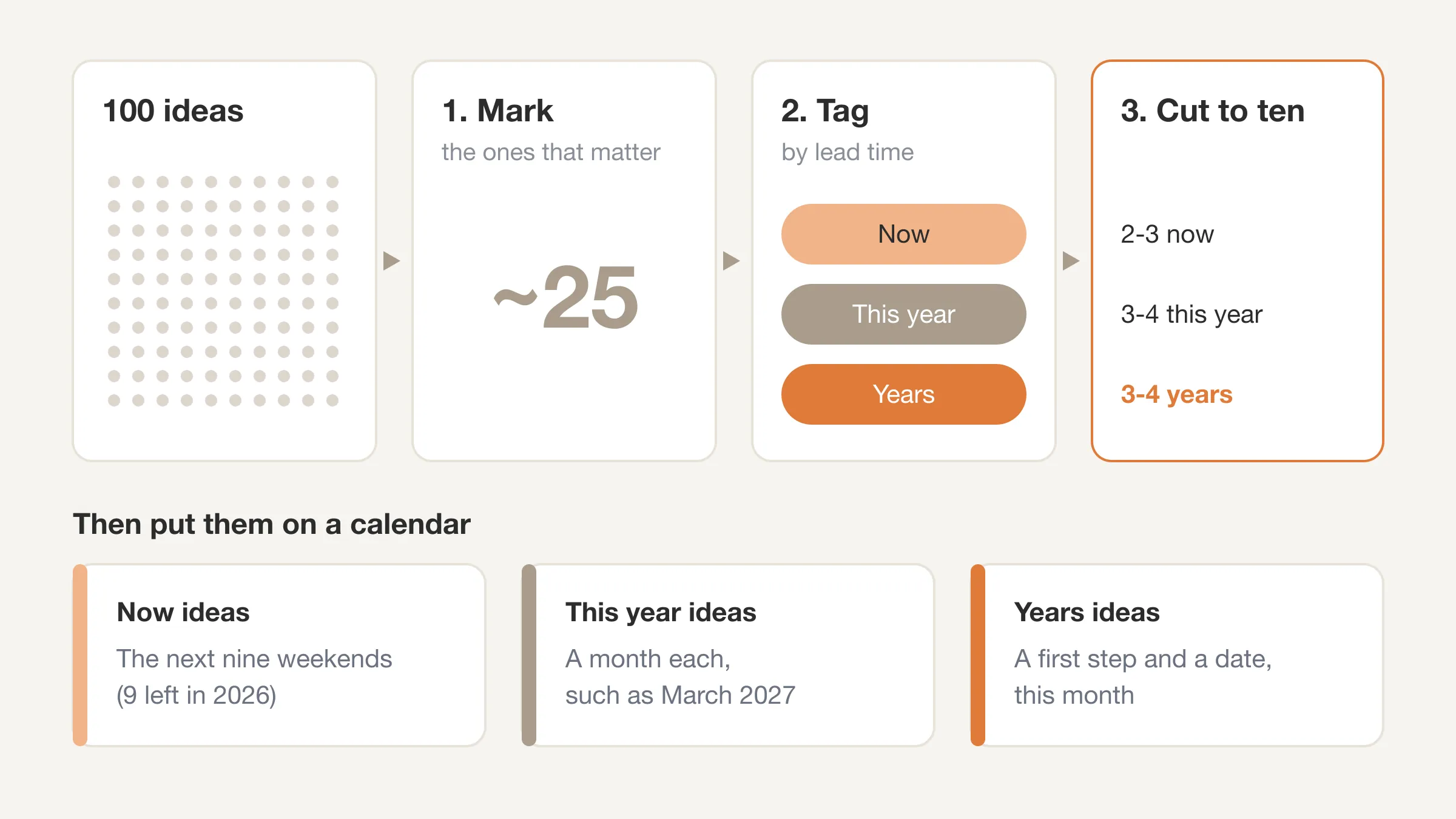
How do you turn 100 ideas into ten?
Use three passes.
- Mark the ones that matter. Not the impressive ones. Aim for 25.
- Tag each with its lead time, as above. Now, this year, or years.
- Cut to ten. Keep three or four "years" ideas, three or four "this year" ideas and two or three "now" ideas.
That mix matters. If you keep only "now" ideas, you will do them all and still feel as if nothing big happened. If you keep only "years" ideas, none will feel real. The mix gives you a quick win and a long project.
Then put them on a calendar.
- Now ideas go on the next nine weekends (there are 9 left in 2026).
- This year ideas get a month, such as "March 2027".
- Years ideas get a first step this month.
If you want a place to hold them, the life plan template lays out a plan by area, and the 10-year plan post shows how to split a decade into a few goals. For shorter horizons, there are lists of personal goals examples, and the 5-year plan template covers the middle ground. To check that your priorities are the right ones to begin with, the life audit guide is a good start.
For smaller seasonal lists, see the summer bucket list, the fall bucket list and a list of hobbies to try.
Where will the hours come from?
Most bucket lists fail because of hours, not desire. A bucket list item is a block of time with a name on it, and your week is already full of blocks with other names.
The test is simple. Log a normal week in 15-minute blocks. A daily time log is enough, and it takes about two minutes in the morning and two at night. At the end, you will see the hours that go to work, sleep, errands and the gaps you cannot account for.
Those gaps matter. A marathon plan needs 4 or 5 hours a week. A language needs a few hours. A book needs a steady weekly slot. If your log shows six free hours a week, you can afford one of those, not all three. That is a useful limit, and it is the same choice that 168 hours in a week forces on everyone.
Put the big ones in the calendar in advance, using the time-blocking template or the weekly schedule template. Then check the log again a month later. If the block was kept, the idea is real. If it was not, the idea needs fewer hours or a different slot.
Frequently Asked Questions
What are good bucket list ideas?
Good ideas are ones you would be glad to have done, not ones that look good. The lists above group 100 of them by theme and tag each by lead time, so you can see which can be done now and which need years of setup.
How many things should be on a bucket list?
About 10 is a workable number for a plan, even if you keep a longer list of ideas. Ten gives you a mix of quick, medium and long items, and you can date each one.
How do I start a bucket list?
Read a list like this one, mark the ideas that matter, and tag each as now, this year, or years. Then pick ten and put a first step and a date on each.
Which bucket list items should I do first?
Start with items that have a deadline: a fixed date, a body that needs training, a loved one's time, or savings. These do not wait. "Now" items can be done any free Saturday.
How do I find time for a bucket list?
Log a normal week in 15-minute blocks and look at the gaps. Most people find a few hours that were not chosen. Give those hours to your top item, in the same slot each week.
How many weeks do I have left?
It depends on the age you choose to count to. Using 80 as an arithmetic example, a 45-year-old has about 1,826 weeks and 35 summers. It is not a forecast, just a way to make the number real.
Is a bucket list morbid?
No. It is a way of looking at your time with a clear head. A list of things you would like to do is about living, and a deadline is just a reason to start.
Your time is limited. See where it goes.
Log the day in 15-minute blocks, end it with a quick rating, and let the AI reflection show where your time went and what to change tomorrow.
Try Beyond Time freePick ten bucket list ideas, then see where the hours go
A good bucket list is a short, dated plan drawn from a long list of ideas. Use the 100 above to find what matters, tag each by lead time, and begin with the ones that cannot wait: the trained body, the saved money, the fixed date, the person who is not getting younger.
Your time is limited. A week of logging shows where it goes, so you can move the hours toward the ten things you picked. The next step is small. Choose one, write the first date, and then check the week.
Sources: Wikipedia, Solar eclipse of August 2, 2027 (path of totality from the Atlantic through the Strait of Gibraltar and North Africa to Egypt). Week, day and weekend counts are computed from the calendar for 29 October 2026, and the weeks-to-80 table uses 365.25 days a year. Training-plan lengths are commonly cited ranges, not measured data.
Put this into practice
Free tools that match this article.
Weekly Schedule Template
Plan your week with a free printable weekly schedule template for goals, routines, and focus blocks.
Try Schedule TemplateTime ManagementTime Blocking Template
Map your day into focused time blocks with a free printable time blocking template.
Try Time BlockingTime ManagementWeekly Schedule Optimizer
Generate an optimized weekly schedule with AI-powered time blocking for maximum productivity.
Try Schedule OptimizerFocusFocus Session Planner
Create AI-optimized focus sessions with structured work blocks and refreshing breaks.
Try Focus PlannerRelated Articles
Life Plan Template: A One-Page Plan With Weekly Costs
A free life plan template you can copy: eight areas of life, one outcome each, and a weekly time cost so your plan fits the 112 waking hours you really have.
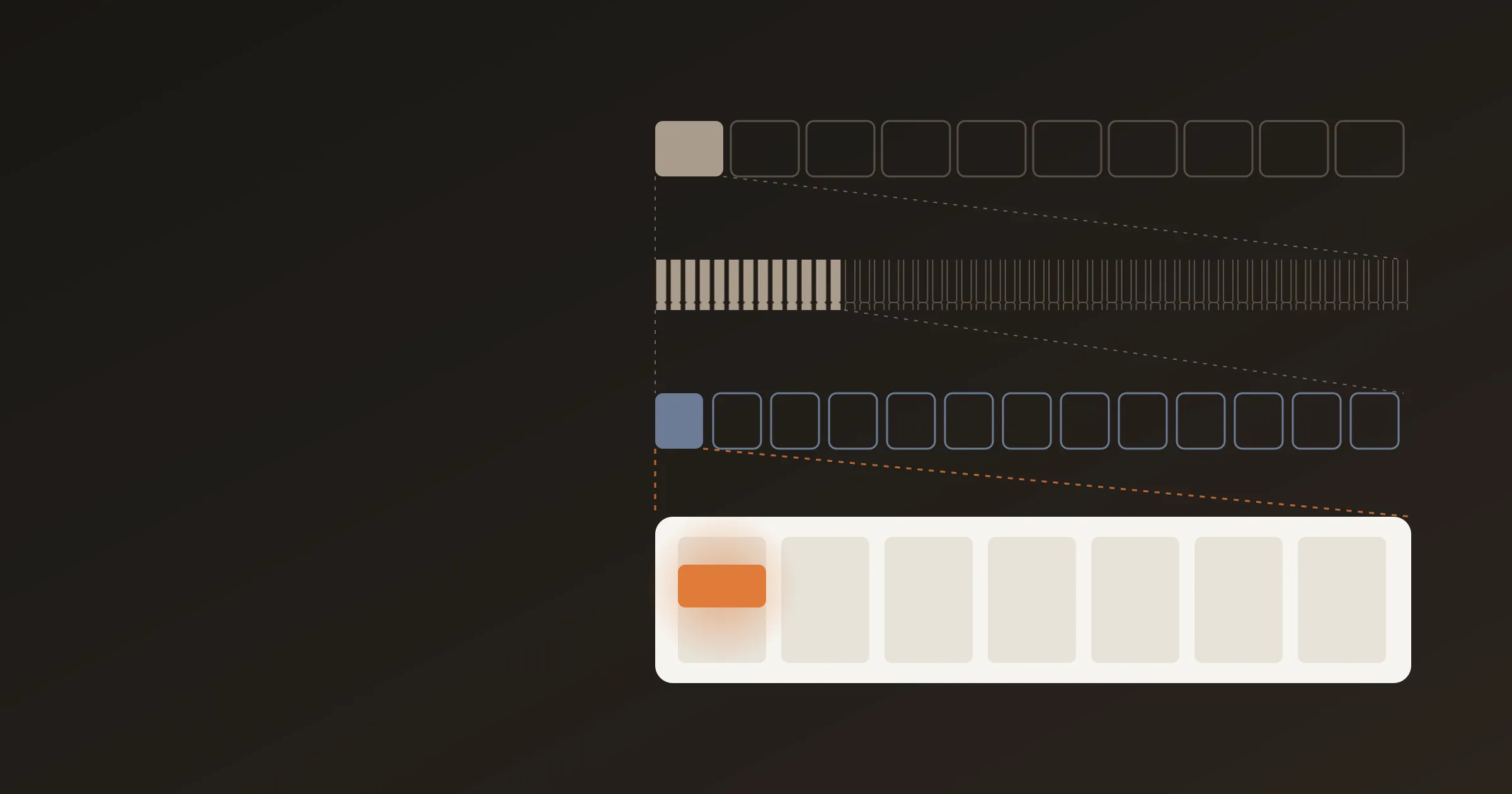
10 Year Plan: A Simple Template for Your Next 520 Weeks
A 10 year plan is about 520 weeks. Use this copyable template to set a vision, work back to this week, and see what each goal costs in hours. Start today.
How Many Minutes in a Week? 10,080, and Where They Go
How many minutes in a week? 10,080, or 6,720 waking minutes at 8 hours of sleep. See the minutes in each activity for an average week and how many are left.

How to Stop Doomscrolling: 9 Practical Fixes That Work
How to stop doomscrolling: add friction, swap in better habits and check your Screen Time against a real log of your day. Nine fixes, with sources. Try one.

How Many Work Weeks in a Year? 52 Minus Your Time Off
How many work weeks in a year? 52 on paper, usually 46 to 50 after holidays and leave. See the table by days off, 2026's count and the weeks left this year.

Second Brain Method Explained: CODE, PARA and Who It Suits
A second brain is a trusted place outside your head for notes and ideas. See how Tiago Forte's CODE and PARA work, who it suits, and what notes can't tell you.