Summer Bucket List: 60+ Ideas for the 13 Weekends You Have
A summer bucket list with 60+ ideas sorted by time: an evening, a day, a weekend, a week. Pick the few that fit your 13 weekends. Start your list tonight.
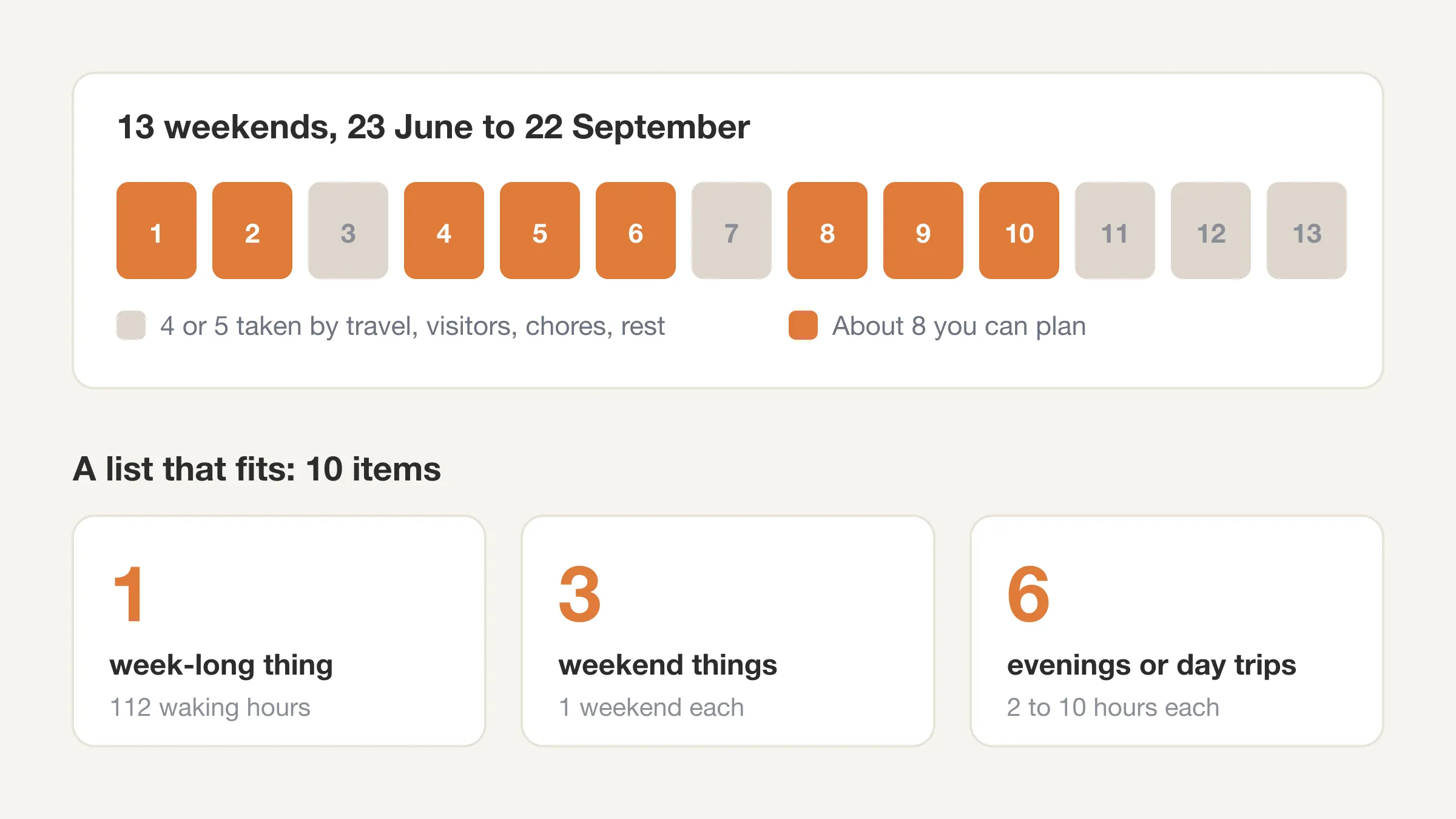
A good summer bucket list is short enough to finish. Summer has about 13 weekends in it, and today, 23 June, there are exactly 13 left before the September equinox. That is room for 8 to 12 things you care about, not 60.
So this list has more than 60 ideas on purpose, and the job is to cut it. Each idea is sorted by the time it costs (an evening, a day, a weekend, a week or more) and tagged free, low, mid or high for money. Pick by the hours you really have, not the hours you hope to find.
Key takeaways
- From 23 June to 22 September there are 92 days and 13 full weekends. That is about 1,472 waking hours, or 5,888 fifteen-minute blocks.
- Weekends hold only about 416 of those waking hours. Weekday evenings add about 264 more, if you protect four free hours on each of the 66.
- A realistic list mixes sizes: 1 to 2 big things, 3 to 4 weekend things, and the rest as evenings and day trips.
- Log one normal week first. The hours you thought were free are rarely as free as they look.
How much summer do you actually have?
Seasons can be counted two ways. Meteorologists count summer as 1 June to 31 August: 92 days, or 13.1 weeks. Astronomers count it from the June solstice (21 June, 2026, at 08:25 UT, per this table) to the September equinox on 22 September in US time zones (The Old Farmer's Almanac gives about 8 pm Eastern). Both come to about 13 weeks.
Here is what is left on 23 June 2026, a Tuesday, counting through 22 September:
| What | Count |
|---|---|
| Days | 92 |
| Full weeks | 13 (and one day) |
| Saturdays and Sundays | 13 weekends (26 days) |
| Weekdays | 66 |
| Waking hours at 16 a day (7 am to 11 pm) | 1,472 |
| Fifteen-minute waking blocks (64 a day) | 5,888 |
| Waking hours on weekends | 416 |
| Weekday evenings, if 4 hours are free (an example) | 264 |
If you use the meteorological definition from 23 June, you have 70 days and 10 weekends before 31 August, so the number depends on how late you let summer run. September counts if you let it.
The number to hold onto is 13. Not 92 days, which feels endless, but 13 Saturdays. Most bucket-list items that matter need a chunk of one. Across the whole year there are only 52 weekends, and a quarter of them fall in summer.
See where this week actually goes
Log your day in 15-minute blocks. Two minutes in the morning, two at night. Then pick your summer from the hours that are real.
Try Beyond Time freeHow do you choose what goes on a summer bucket list?
Most lists fail the same way. They are written in June, full of weekend-sized dreams, and then the weekends go to errands, family plans and rest. By August the list is a small guilt object on the fridge.
A few rules fix most of this.
- Count the weekends, then halve them. Of 13 weekends, expect 4 or 5 to be taken already (travel, weddings, visitors, chores, being tired). That leaves 8 you can plan.
- Mix the sizes. One week-long or multi-day thing, three or four weekend things, and the rest as evenings and half days. Evenings are the one slot you can use dozens of times.
- Write the cost in hours next to each item. "Camping" is not an item. "Camping, Saturday to Sunday, 20 hours with driving" is.
- Put a date on the big ones now. If a trip does not have a weekend assigned by the first week of July, it will probably slide to next year.
- Leave 3 weekends empty. Rest is not a failure to use summer. It is part of what summer is for.
If the word "bucket list" feels heavy, think of this as a menu. You are not trying to order everything. You are choosing the meals.
Which summer bucket list ideas fit into an evening?
An evening gives you two to three hours between dinner and dark. You have about 66 weekday evenings this summer, so these are the ideas that can be done again and again. They are also the cheapest.
Free and nearly free evenings
- Watch the sunset somewhere new. Pick a hill, a pier, a rooftop or a parking-garage top deck. (Free)
- Take a long walk after dinner with no destination. (Free)
- Have a picnic dinner in a park. Carry what is already in the fridge. (Free)
- Stargaze. Drive 20 minutes from the city lights and look up for an hour. (Free)
- Run through a sprinkler or swim in a lake or river that is safe for swimming. Check local guidance first. (Free)
- Eat dinner outside every night for a week. (Free)
- Read a whole book on the porch, one evening at a time. (Free to low)
- Call someone you have been meaning to call. A walk and a phone call is a complete evening. (Free)
- Do an evening bike ride on a route you have never taken. (Free)
- Host a no-effort backyard dinner. Everyone brings one thing. (Low)
Low-cost evenings
- Watch an outdoor movie in a park, or on a bedsheet in your own backyard. (Free to low)
- Go to a local free concert or farmers market. (Free to low)
- Make ice cream or popsicles at home. (Low)
- Try a new restaurant, but one with a patio. (Mid)
- Play mini golf, or go to a batting cage. (Low)
- Take a sunset paddle on a rented kayak or paddleboard. (Low to mid)
- Go to a minor league or local ball game. (Low to mid)
- Have a bonfire, where it is allowed, and make s'mores. (Low)
- Stay up for fireflies. Early summer, near fields or damp ground. (Free)
- Learn to cook one new summer dish a week, like grilled peaches or a cold noodle salad. (Low)
- Learn a new card or board game on the porch. (Free to low)
- Write three postcards or letters by hand and mail them. (Low)
That is 22 evening ideas. If you did even 8 of them, you would use roughly 24 hours, which is about 96 blocks. Not much time for a summer that feels full.
Which ideas work for a day trip or half day?
A day trip needs 4 to 10 hours including travel. You have 26 weekend days, so a day trip uses one of the 13 weekends only partly. You can often fit a day trip on a Saturday and keep Sunday for yourself.
- Spend a day at the beach or a lake. Bring a book and nothing else. (Low)
- Hike a trail you have never done. Pick one with water or a view at the end. (Free)
- Pick your own fruit. Berries early in the summer, peaches later. (Low)
- Visit a farm stand and cook with what you buy. (Low)
- Go to a county or state fair. (Low to mid)
- Take a ferry ride just because it is there. (Low)
- Tour a small local museum or historic site you drive past. (Low)
- Go tubing, rafting or kayaking down a river. (Mid)
- Try a day of surfing, paddleboarding or sailing lessons. (Mid)
- Ride a rollercoaster, or a waterpark all day. (Mid)
- Visit a nearby town that you have never walked around. (Free to low)
- Take a long, slow food crawl through one neighborhood. (Mid)
- Go to a drive-in or a rooftop movie. (Low to mid)
- Do a pottery, glassblowing or painting class for a half day. (Mid)
- Spend a day volunteering, like a river cleanup or a community garden. (Free)
- Visit a lighthouse, a cave or a waterfall within a two-hour drive. (Low)
- Go bird-watching at dawn, then have breakfast out. (Free to low)
- Go to a food truck rally or night market. (Low to mid)
What fits into a weekend?
A weekend trip takes one of your 13. If you pick three or four, you have taken a bit under a third of the summer, and that is plenty. Do the booking in June, not July.
- Camp for a night or two. Even a car-camping site close to home counts. (Low to mid)
- Do a two-day hike with a night in a hut or tent. (Low to mid)
- Go to a music festival. (Mid to high)
- Rent a cabin or a lake house with friends. (Mid)
- Take a road trip to a city you have never visited. (Mid)
- Visit family you do not see enough, and plan one real activity, not just the visit. (Low to mid)
- Go to a national or state park and see it at dawn, before the crowds. (Low)
- Do a weekend of sailing or a houseboat. (Mid to high)
- Go to a small-town festival or a regional food event. (Low to mid)
- Take a weekend fishing trip. (Low to mid)
- Do a cycling overnight. Ride to a town 40 miles away, sleep, ride back. (Low to mid)
- Host a reunion, or a weekend with old friends. (Low to mid)
- Do a digital-free weekend. Phone off from Friday night to Sunday night. (Free)
- Do a weekend language or craft workshop. (Mid)
Plan the summer, then check it
Beyond Time shows every hour of your week split into Health, Life and Work, with the gaps marked. Plan your weekends from what really happened.
Start your two-week free trialWhat needs a week or more?
These are the ones that need leave from work, and often money saved. They are also the ones that disappear. A week is 112 waking hours, 448 blocks, and you only have 13 of them. If this is your only week-long trip, protect it.
- Take a proper vacation of five days or more. Away from email. (Mid to high)
- Visit a national park you have never seen. Plan lodging early, since popular ones book up. (Mid to high)
- Take a long road trip with no fixed plan for a few days of it. (Mid to high)
- Do a week of volunteering or a service trip. (Low to mid)
- Do a multi-day hike, a river trip, or a backpacking loop. (Mid)
- Take a staycation. Be a tourist in your own city for a week. (Low to mid)
- Take a week-long course, like sailing, painting or a coding bootcamp. (Mid to high)
- Go on a family trip with three generations. (Mid to high)
- Do a week at a summer cottage or a cabin by a lake. (Mid to high)
- Take a long train ride and let the route be the trip. (Mid to high)
That is 64 ideas across the four sizes. Nobody should do them all.
How do you actually pick the five that matter?
Use a simple filter. Read the whole list once and mark everything that makes you feel something, either pleasure or a small pang of "I will regret not doing this".
Then do three cuts.
- Cut anything you would only do because it looks good. A bucket list is for you, not for the year-end photo dump.
- Cut anything that needs another person's yes until you have asked them. A trip with friends is not a plan until someone has a date.
- Cut anything that costs more time than you can find. This is the one that surprises people, and it is why the next section matters.
Keep a ceiling: one week-long thing, three weekend things, six evenings or day trips. That is ten items. If you want to do more, drop to tiny items. Skip nothing you promised someone else.
The point is the same as the idea behind Four Thousand Weeks: you cannot do everything, so choosing what to leave out is the work. A summer is a small, clean version of that choice.
Where will the hours come from?
Here is the part most lists skip. Summer plans compete with the rest of your week, and that week already feels full.
Take a typical weekday as an example. Seven hours asleep, eight at work, two hours of commuting and getting ready, two of dinner and chores. That leaves five hours, and perhaps four of them fall in the evening. After a stretch of scrolling or television you are no longer at four.
One week of logging answers this better than any estimate. In a 15-minute time log each block gets a label, and the blocks you cannot account for show up as gaps. When you see the gaps, you can see which evenings are really free.
If you want a plan and a record side by side, the hourly planner post shows how to lay one over the other. The time-blocking template gives you a printable grid, and the weekly schedule template is a good place to put your weekend picks. For the whole-week view, see how many hours you have in the hours-in-a-week breakdown.
A 10-minute summer plan
- Count your weekends from today (13 now).
- Mark the ones already taken.
- Put your one big trip on a date.
- Put three weekend things on three dates.
- Pin six evening ideas to the fridge, with no dates.
- On the last Sunday of each month, look back at what you did.
If you want a ritual for step 6, a short daily plan in the morning and a quick check at night will do it. Your summer plan then shows up in your day, not just in a note on your phone.
What about kids, partners and friends?
A shared bucket list needs a shared calendar. Ask each person for their top three, then look for overlap. Where only one person wants something, treat it as a solo item or trade.
With kids, the best ideas are the short, repeatable ones, like sprinklers, fireflies and picnics. Children remember the odd evening more than the big trip. Weekends are the most precious slot, and 13 is a small number when you divide it among a household.
If you are a student, the long break has its own rules, and this guide to summer break goal setting covers how to pair a bucket list with a few real goals.
Frequently Asked Questions
How many items should a summer bucket list have?
Aim for 8 to 12 items. Summer has about 13 weekends, and you will lose several to ordinary life, so a longer list tends to fail. Use a few big items and let the rest be evenings.
How many weekends are there in summer?
Summer has 13 weekends. On 23 June 2026 there are 13 Saturdays and 13 Sundays left before the September equinox on 22 September. If you count only to 31 August, there are 10 left.
What are some cheap summer bucket list ideas?
Sunset watching, stargazing, picnics, long walks, a bonfire, a farmers market and a free outdoor concert all cost little or nothing. Many of the best ideas on this list are in the free evening group.
What should I do first?
Put your biggest item on a date first. A week-long trip or festival needs booking and leave from work. The small items can be done on a whim, so they do not need a date.
How do I find time for a summer bucket list when I am busy?
Log one ordinary week in 15-minute blocks and look at the gaps. Most people find a few free evenings and at least some of a weekend that they did not know about. Then spend those hours on purpose.
Is it better to plan every weekend?
No. Plan about eight of the 13 and leave the others open. Rest and spontaneity are part of the point of summer.
Your summer is 13 weekends. See where this one goes.
Log the day in 15-minute blocks, end it with a quick rating, and let the AI reflection show where your time went and what to change tomorrow.
Try Beyond Time freeMake the list short, then see where it goes
A summer bucket list works when it fits the hours you have. You have 13 weekends and about 1,472 waking hours between now and the September equinox. Pick the handful of things that matter, date the big ones now, and keep a few evenings for the small ones.
Then check. Your time is limited, and a week of logging shows where it goes, so you can move the hours toward the list instead of away from it.
Sources: Wikipedia, June solstice (2026 solstice at 21 June, 08:25 UT; the same table lists the September equinox on 23 September at 00:06 UT). The Old Farmer's Almanac, autumnal equinox 2026. Day, weekend and block counts are computed from the calendar for 23 June 2026.
Put this into practice
Free tools that match this article.
Weekly Schedule Template
Plan your week with a free printable weekly schedule template for goals, routines, and focus blocks.
Try Schedule TemplateRoutine BuildingNight Routine Planner
Create a realistic night routine checklist for better sleep and a smoother tomorrow.
Try Night RoutineTime ManagementTime Blocking Template
Map your day into focused time blocks with a free printable time blocking template.
Try Time BlockingRoutine BuildingMorning Routine Generator
Design your ideal morning routine with AI-powered suggestions based on proven practices.
Try Morning RoutineKeep exploring this topic
Time blocking guide
Turn priorities into protected calendar blocks.
Morning routine template
Build a practical morning routine around energy and focus.
15-minute time blocks
Plan and review your day with more realistic precision.
Evening routine ideas
Wind down in a way that supports sleep and tomorrow’s goals.
Related Articles
Fall Bucket List: 50+ Autumn Ideas Sorted by Time Cost
A fall bucket list with 50+ autumn ideas sorted by time: an evening, a day, a weekend, a week. You have 13 weeks of fall, so pick the five that matter.
How Many Minutes in a Week? 10,080, and Where They Go
How many minutes in a week? 10,080, or 6,720 waking minutes at 8 hours of sleep. See the minutes in each activity for an average week and how many are left.

Bucket List Ideas: 100 Ideas Grouped by Theme and Lead Time
100 bucket list ideas grouped by theme and tagged by lead time: now, this year, or years ahead. Count the weeks you have, then pick ten. Start your list today.
How to Stop Doomscrolling: 9 Practical Fixes That Work
How to stop doomscrolling: add friction, swap in better habits and check your Screen Time against a real log of your day. Nine fixes, with sources. Try one.
Life Plan Template: A One-Page Plan With Weekly Costs
A free life plan template you can copy: eight areas of life, one outcome each, and a weekly time cost so your plan fits the 112 waking hours you really have.
How Many Work Weeks in a Year? 52 Minus Your Time Off
How many work weeks in a year? 52 on paper, usually 46 to 50 after holidays and leave. See the table by days off, 2026's count and the weeks left this year.