How Many Days Until Summer? A 2026 Countdown and Plan
How many days until summer 2026? It is 25 days to 1 June and 45 days to the 21 June solstice. See the math, the hours it holds, and how to plan them well.
As of Thursday, 7 May 2026, there are 25 days until summer if you count it as meteorological summer, which starts on Monday, 1 June. There are 45 days until summer if you count astronomical summer, which starts with the June solstice on Sunday, 21 June.
Either way, the season is shorter than it feels. Summer is 92 days from 1 June to 31 August. That is about 13 weekends and 1,472 waking hours. This guide gives you the dates, the counts and a simple way to spend those hours on purpose.
Key takeaways
- 25 days to 1 June (meteorological summer) and 45 days to 21 June (astronomical summer), counted from 7 May 2026.
- Meteorological summer has 92 days, 13 weekends and 1,472 waking hours.
- At national averages, only about 463 of those hours go to leisure and sports, so naming what you want from them matters.
- Log a normal week now and you will know how much room summer really has.
How many days until summer 2026?
It depends on which start date you mean. There are two common ones, and both are correct.
| Summer starts | Date in 2026 | Weekday | Days from 7 May | Weeks and days |
|---|---|---|---|---|
| Meteorological summer | 1 June | Monday | 25 | 3 weeks, 4 days |
| Astronomical summer (June solstice) | 21 June | Sunday | 45 | 6 weeks, 3 days |
To count from any other date, subtract the two dates. Count "today" as day zero if you want the number of nights until summer, or as day one if you want the number of days you will have lived through before it starts. This post uses the first method, so 7 May to 1 June is 25.
When is the first day of summer?
Two systems exist because they answer different questions.
Meteorological summer uses whole calendar months. In the Northern Hemisphere it runs from 1 June to 31 August. Weather agencies use this system because it keeps temperature records in tidy three-month blocks. NOAA's explainer on meteorological and astronomical seasons lays out the difference.
Astronomical summer follows Earth's position relative to the Sun. It begins at the June solstice, when the Northern Hemisphere is tilted most toward the Sun. In 2026 the solstice falls on 21 June at about 08:24 UTC, according to timeanddate's event announcer. That is early morning on the US East Coast and still 21 June in every US time zone.
Astronomical summer ends at the September equinox. In 2026 that is about 00:05 UTC on 23 September, which is the evening of 22 September in the Americas. That makes astronomical summer about 94 days long, two more than the meteorological one.
If you live in the Southern Hemisphere, the seasons flip. Meteorological summer starts there on 1 December.
How long does summer actually last?
Count it in the units you live in.
| Unit | Meteorological summer (1 Jun to 31 Aug) | Astronomical summer (21 Jun to 22 Sep) |
|---|---|---|
| Days | 92 | 94 |
| Full weeks | 13 weeks and 1 day | 13 weeks and 3 days |
| Saturdays | 13 | 13 |
| Sundays | 13 | 14 |
| Waking hours (16 a day) | 1,472 | 1,504 |
| 15-minute waking blocks | 5,888 | 6,016 |
The waking-hours rows assume a 16-hour waking day, say 7 am to 11 pm. That is a round convention, not a measurement of you. Your own number will differ if you sleep more or less.
A waking day holds 64 fifteen-minute blocks. A whole day holds 96. Both numbers are useful later in this post, because blocks are the unit you can actually track.
What are the key dates between now and the end of summer?
These are the dates worth putting in your calendar today. The holiday dates come from the US Office of Personnel Management's federal holiday list.
| Date | What | Weekday | Days from 7 May |
|---|---|---|---|
| 25 May | Memorial Day | Monday | 18 |
| 1 June | Meteorological summer begins | Monday | 25 |
| 19 June | Juneteenth | Friday | 43 |
| 21 June | June solstice, astronomical summer begins | Sunday | 45 |
| 3 July | Independence Day (observed, since 4 July is a Saturday) | Friday | 57 |
| 7 September | Labor Day | Monday | 123 |
| 23 September (UTC) | September equinox, astronomical summer ends | Wednesday | 139 |
Notice that Juneteenth and the observed Independence Day are both Fridays. That makes two three-day weekends before July is half over. If you want to travel, book early, or decide now that those weekends stay empty.
See where today goes
Log your day in 15-minute blocks. Two minutes in the morning, two at night.
Try Beyond Time freeHow many weekends are there in summer?
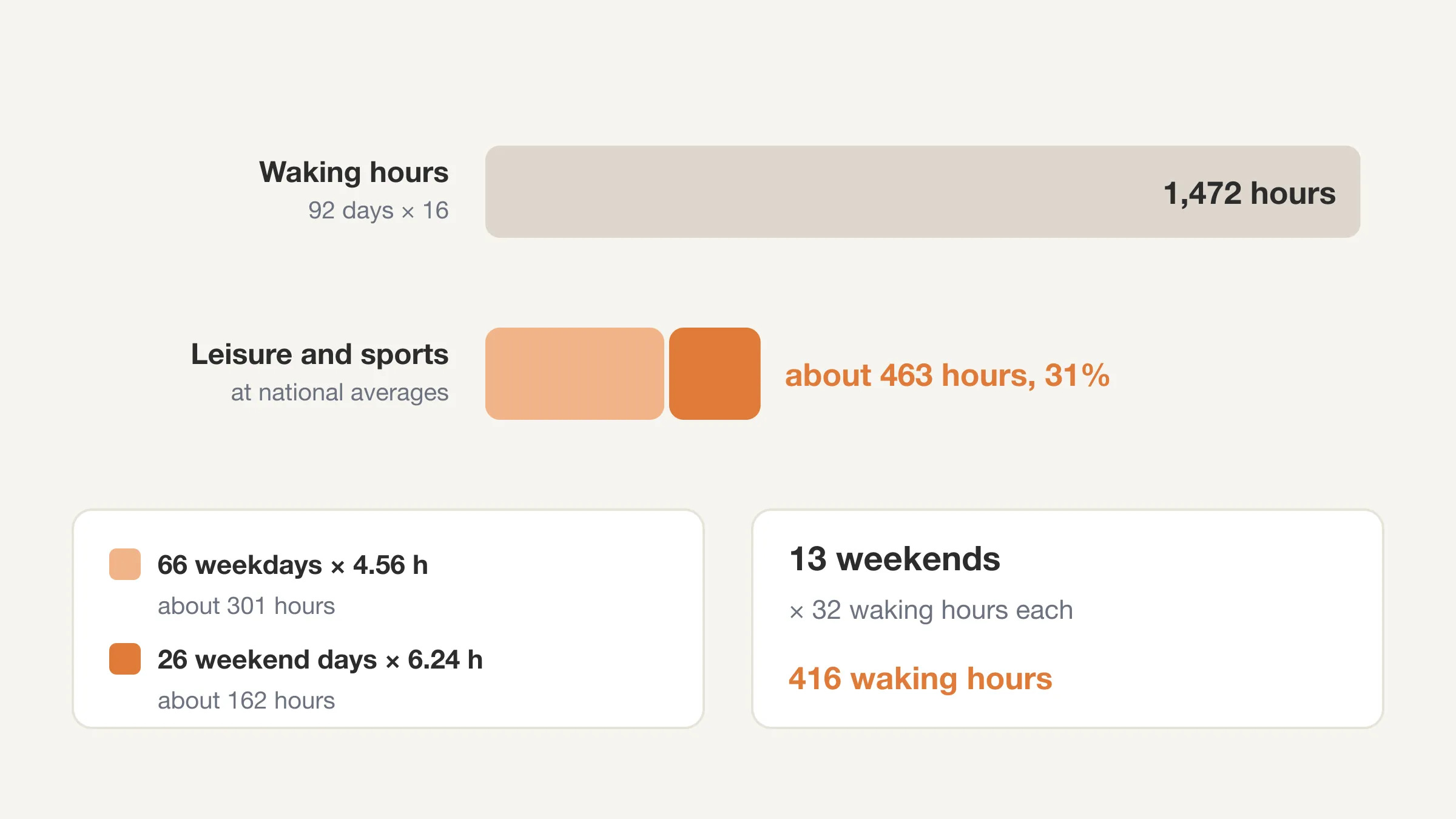
Meteorological summer has 13 weekends. That is 13 Saturdays and 13 Sundays, or 26 weekend days out of 92.
From today, there are also four weekends before 1 June: 9 and 10 May, 16 and 17 May, 23 and 24 May, and 30 and 31 May. Those are four chances to try a summer habit while the days are still lengthening.
Each weekend holds 32 waking hours. Thirteen weekends hold 416 waking hours. That sounds like plenty until you remember that sleeping in, errands and chores take a share of every one of them. If you want three big summer plans, that is about one per month, so pick them now.
How much of summer is actually free time?
Fewer hours than the count suggests. The US Bureau of Labor Statistics runs the American Time Use Survey, which asks a national sample to report a full day. In the 2024 results, released in June 2025, people age 15 and over averaged:
- 4.56 hours of leisure and sports on weekdays
- 6.24 hours on weekends and holidays
Apply those averages to meteorological summer. It has 66 weekdays and 26 weekend days. The estimate is about 66 × 4.56 + 26 × 6.24, which is roughly 463 hours of leisure and sports. That is about 31 percent of the 1,472 waking hours.
This is a rough national average, not a prediction for you. It ignores the holidays inside the summer, and it includes everyone from students to retirees. Still, it makes the point. Summer is not 1,472 hours of freedom. It is closer to 463 hours that you can shape, and the rest is work, chores, caring for others and everything in between.
How do you plan summer before it vanishes?
A short plan beats a long list. Try these steps this week.
- Pick three things. Choose three summer experiences that would make you say "that was a good summer". One should be small enough for an evening, one for a weekend and one for a week.
- Put them on dates. Match each one to a weekend or a long weekend in the table above. Things without dates tend to slip to September.
- Protect two empty weekends. Leaving some weekends unplanned keeps summer from turning into a second job.
- Check the plan weekly. On Sunday evening, look at the coming week and ask whether it makes room for one of your three.
This is the same idea as time blocking, applied to a season. If you want a shortcut, the free time blocking template gives you a weekly grid to fill in. Students with a long break ahead can go further with summer break goal setting.
How do you know where summer went?
Most people look back at September and feel the season disappeared. Memory compresses weeks that look alike. We cover why in why time goes by so fast: routine blurs, novelty stretches.
The remedy is a record. In Beyond Time, you open Start your day to note how you slept and pick one to three goals. Through the day you use Log time, where the day is 96 fifteen-minute blocks and you choose what each block was. Routines are grouped into Health, Life, Work and Sleep, and blocks you skipped show up as Not logged. At night, End your day takes about a minute: rate how health, life and work felt from 1 to 10.
After a week, See your week shows every hour split by category. The AI reflection then reads the logged days and tells you what went where you meant it to, where time leaked and one or two changes for tomorrow.
Two minutes in the morning and two at night is enough. If you would rather start on paper, the free weekly schedule template gives you a grid to fill in. For a full walk-through of the method, read the 15-minute time block method.
Plan summer, then see how it went
Start your day, log time in 15-minute blocks, end your day. Two weeks free, everything unlocked.
Try Beyond Time freeFrequently Asked Questions
How many days until summer 2026?
From 7 May 2026 there are 25 days until meteorological summer on 1 June and 45 days until astronomical summer on 21 June. To get your own count, subtract today's date from the start date you choose.
When does summer start in 2026?
Meteorological summer starts on Monday, 1 June 2026. Astronomical summer starts with the June solstice on Sunday, 21 June 2026 at about 08:24 UTC, which is still 21 June in every US time zone.
Why does summer start on two different dates?
Meteorological summer groups whole months for tidy climate records, while astronomical summer follows Earth's tilt toward the Sun. Both are used, and both are correct for their own purpose.
How many weeks of summer are there?
Meteorological summer has 13 weeks and 1 day, or 92 days. Astronomical summer has 13 weeks and 3 days, or about 94 days.
How many weekends are in summer?
There are 13 weekends from 1 June to 31 August 2026. There are also four weekends between 7 May and 1 June, if you want a head start.
How many hours are in summer?
Meteorological summer has 2,208 hours in total, from 92 days times 24, and 1,472 of them are waking hours at 16 a day. How many are truly free depends on work, chores and care, and the national average for leisure is roughly 463 hours.
Twenty-five days to meteorological summer
There are 25 days until summer by the meteorological count, 45 by the astronomical one, and 92 days once it begins. That is 13 weekends and about 1,472 waking hours to spend on purpose.
Your time is limited, so look at it before it is gone. Pick three things for the season, give them dates and keep a light log so you can see where the days went. If you want a place to start, begin with a week of 15-minute blocks, and read the 168-hour week framework for the bigger picture. You will have a clearer view by the solstice.
Put this into practice
Free tools that match this article.
Goal Setting Worksheet
Turn a vague goal into milestones, habits, blockers, and a weekly review plan.
Try Goal WorksheetTime ManagementWeekly Schedule Template
Plan your week with a free printable weekly schedule template for goals, routines, and focus blocks.
Try Schedule TemplateHabit BuildingHabit Tracker Template
Create a free printable habit tracker template — weekly or monthly. Customize your habits and download a clean PDF in seconds.
Try Habit TrackerTime ManagementTime Blocking Template
Map your day into focused time blocks with a free printable time blocking template.
Try Time BlockingRelated Articles
How Many Minutes in a Week? 10,080, and Where They Go
How many minutes in a week? 10,080, or 6,720 waking minutes at 8 hours of sleep. See the minutes in each activity for an average week and how many are left.

Bucket List Ideas: 100 Ideas Grouped by Theme and Lead Time
100 bucket list ideas grouped by theme and tagged by lead time: now, this year, or years ahead. Count the weeks you have, then pick ten. Start your list today.
How to Stop Doomscrolling: 9 Practical Fixes That Work
How to stop doomscrolling: add friction, swap in better habits and check your Screen Time against a real log of your day. Nine fixes, with sources. Try one.
Life Plan Template: A One-Page Plan With Weekly Costs
A free life plan template you can copy: eight areas of life, one outcome each, and a weekly time cost so your plan fits the 112 waking hours you really have.
How Many Work Weeks in a Year? 52 Minus Your Time Off
How many work weeks in a year? 52 on paper, usually 46 to 50 after holidays and leave. See the table by days off, 2026's count and the weeks left this year.
Second Brain Method Explained: CODE, PARA and Who It Suits
A second brain is a trusted place outside your head for notes and ideas. See how Tiago Forte's CODE and PARA work, who it suits, and what notes can't tell you.