
Four Thousand Weeks: Lessons and How to Use Them
Four Thousand Weeks by Oliver Burkeman, summarized in plain words, with the math of how many of your weeks are gone and what to do with the rest. Start here.
Four Thousand Weeks is a book by Oliver Burkeman about a simple, uncomfortable fact: if you live to about 80, you get roughly 4,000 weeks. Its argument is that no system will let you do everything, so the real skill is choosing what to leave undone. This post summarizes the main ideas in our own words, then turns them into something you can use this week.
The full title is Four Thousand Weeks: Time Management for Mortals, and the subtitle matters. It is less a productivity manual than a case against the idea that you can ever get on top of your to-do list. That idea is worth taking seriously, because most of us run our days as if the list could be finished.
Here is the practical part that most summaries skip. The book asks you to accept your limits. Accepting limits is much easier when you can see them, so we will count your weeks, count this week's hours and look at where a normal week actually goes.
Key takeaways
- A life of 80 years is about 4,160 weeks. The book rounds it to 4,000 to make the point.
- Getting faster does not empty your list. New demands arrive to fill any space you free.
- The useful move is choosing what to neglect on purpose, not doing everything better.
- Your week is 168 hours, about 112 of them awake. Seeing where those hours went beats planning them in the dark.
What is Four Thousand Weeks about?
The book was published in August 2021 by Farrar, Straus and Giroux (Wikipedia lists the publication details). Burkeman is a British writer who spent years writing about productivity and became skeptical of the whole project.
His central claim is that modern time management is built on a hidden promise: do the right tricks and you will eventually be on top of things. The book argues that this promise is false, and that believing it makes people more anxious, not less.
Instead of tricks, he offers a different stance. Treat time as the thing you are made of rather than a resource to be squeezed. Accept that every yes is a no to something else. Then spend your limited weeks on what you actually care about, and make peace with what you drop.
How many weeks do you actually get?
The title comes from simple arithmetic. Eighty years times 52 weeks is 4,160 weeks. The book rounds this to four thousand, as in its line about living to eighty. It is not a forecast. Some people get fewer weeks and many get more.
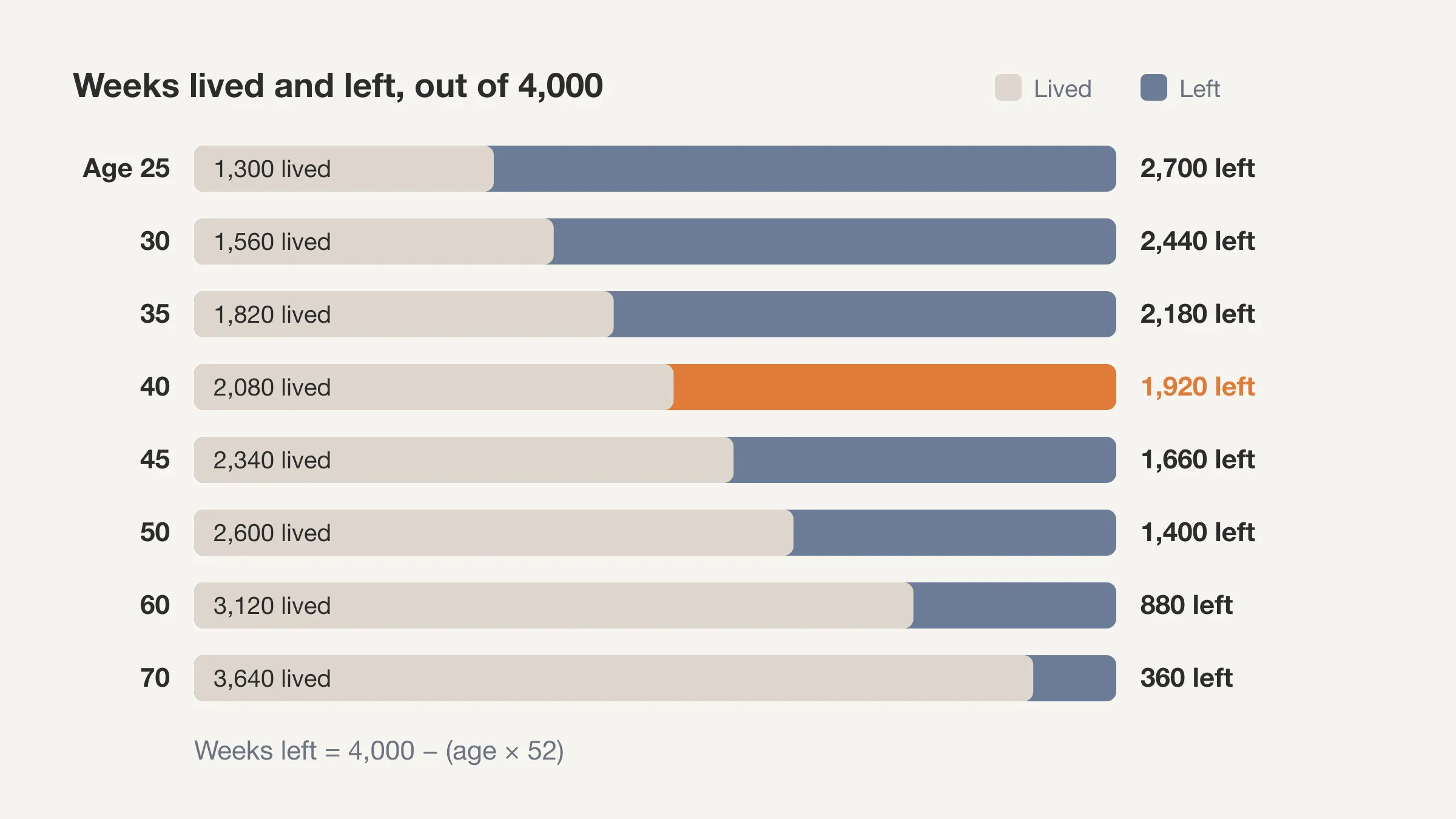
What matters is the order of magnitude. Your life is not tens of thousands of weeks. It is a few thousand, and you have already used some of them. Here is the same arithmetic at different ages, using 52 weeks a year.
| Your age | Weeks lived | Weeks left of 4,000 | Share of 4,000 used | Weeks left of 4,160 (age 80) |
|---|---|---|---|---|
| 25 | 1,300 | 2,700 | 33% | 2,860 |
| 30 | 1,560 | 2,440 | 39% | 2,600 |
| 35 | 1,820 | 2,180 | 46% | 2,340 |
| 40 | 2,080 | 1,920 | 52% | 2,080 |
| 45 | 2,340 | 1,660 | 59% | 1,820 |
| 50 | 2,600 | 1,400 | 65% | 1,560 |
| 60 | 3,120 | 880 | 78% | 1,040 |
| 70 | 3,640 | 360 | 91% | 520 |
To find your own number, multiply your age by 52 and subtract it from 4,000. That is the whole calculation. Use 4,160 if you would rather count to 80 exactly, or pick your own horizon.
Is this meant to be depressing?
No. If it reads as grim, you are reading it the wrong way round. Nobody gets a different answer by looking away from the number. What the number changes is how seriously you take a Tuesday.
The aim is a calm kind of seriousness. A week is a visible, countable thing, small enough to hold in your head and big enough to matter. If the idea makes you anxious in a way that is hard to shake, our guide to time anxiety covers the signs and calmer ways to cope, and a doctor or therapist is the right person to talk to if it affects your sleep or daily life.
What is the efficiency trap?
The efficiency trap is the book's most useful idea. It says that becoming more efficient does not give you spare time. It gives you more room for more work.
Reply to email faster and you get more email. Clear your backlog and new requests arrive. A faster washing machine, a quicker commute or a better app does not produce a free afternoon. It raises the level of what you expect from yourself and what others expect from you.
The deeper problem is that efficiency can only answer how to do a thing quickly. It cannot tell you whether the thing deserves your weeks. A day spent efficiently on the wrong list is still a day spent on the wrong list.
Why do we keep falling for it?
Because every individual improvement works. The email really is faster. The trouble is the total, and the total is invisible unless you look at the whole week. Most people have no running count of where their hours went, so they cannot see the trap closing around them.
This is where a plain record helps. If you want to know whether your efficiency gains became free time or just more commitments, you need to compare weeks. Our guide to planned versus actual time explains why days rarely match the plan and what the gap tells you.
Why does choosing what to neglect matter?
The book's most freeing claim is that you cannot do everything, so the question is which things you will fail at on purpose. Every life has things that go undone. The only choice is whether you pick them or they get picked for you by whatever shouted loudest.
Burkeman describes two ways to handle this. One is to keep all your options open and spread yourself thin. The other is to accept that choosing one thing excludes others, and to treat that exclusion as the price of a meaningful life. He calls the relief of the second approach the joy of missing out.
In practice, this shows up as a few habits that summaries of the book commonly list:
- Limit what is in progress. Keep a long list of things you might do and a very short list of things you are actively doing. Start something new only when something finishes.
- Work on one big thing at a time. Finish one project before starting the next, so effort is not scattered across ten half-done ones.
- Cap your hours. Work for a fixed number of hours and stop, rather than letting the work stretch to fill the day.
- Decide your don'ts. Choose in advance what will get the minimum from you, so the neglect is deliberate.
- Resist the middling priorities. Things that are fine but not important are the ones that quietly eat your weeks.
See where this week actually goes
Log your day in 15-minute blocks. Two minutes in the morning, two at night, and the gaps show up on their own.
Try Beyond Time freeWhat else does the book say about distraction, patience and rest?
Three more ideas are worth carrying away.
Distraction is often avoidance. Burkeman argues that we reach for our phones partly to escape the discomfort of limits: the feeling that the task in front of us is only one of a thousand we could be doing. Staying with the task, uncomfortable as it is, loosens the pull.
Do not live only for later. If every hour is a means to a future outcome, the present gets drained of meaning. The book pushes you to value some time for itself: a walk, a meal, a conversation that is not on a list.
Tasks take longer than you plan. Hofstadter's law says that things take longer than expected, even when you account for it. The book uses this to argue for patience: you cannot control how long things take, so building your sense of a good day around a perfectly predictable schedule is a recipe for frustration.
The book also closes with a short set of practical tools, including capping your hours, working on one project at a time and deliberately doing nothing for a while.
How do you use the 4,000-weeks idea in real life?
Reading about limits is easy. Living inside them takes a method. Here is a simple one, built around the single unit the book cares about: the week.
- Count your weeks. Use the table above. Write the number down. Do not obsess over it.
- Know your week's hours. A week has 168 hours. About 56 go to sleep, leaving roughly 112 awake. Our post on how many hours are in a week walks through that math in detail.
- Pick what you will neglect. Name two or three things you will do the minimum on this month. Say them out loud.
- Choose one or two things to protect. What deserves the best of your hours? Put those first.
- Look at the week afterward. Compare what you meant to protect with where the hours went.
Step five is the one almost everyone skips. It is also the only one that gives you real information.
Where does a week actually go?
Here is an illustrative example, not a statistic. Take a person who sleeps 8 hours a night and works 45 hours a week. That is 56 hours of sleep and 45 of work, which leaves 67 hours for everything else: commuting, meals, chores, exercise, family, friends, rest and screens. Spread over seven days, that is a little under ten hours a day to cover all of life outside sleep and work.
For a fuller picture of how large categories compare, the U.S. Bureau of Labor Statistics publishes the American Time Use Survey, which reports the average time Americans spend on sleep, work, leisure and household tasks. It is a good reality check on how big each category tends to be. It does not tell you about your own week. Only your own record does.
Why does seeing your week matter more than optimizing it?
Optimizing starts from the assumption that you know where your time goes and just need to rearrange it. Most of us do not know. When we try to remember a week, we get the highlights and a blur in between.
The book's logic points to a different order of operations. If time is what you are made of, and the aim is to spend it on things that matter, the first job is to see it. Optimization comes later, if at all.
A 15-minute log is a practical way to see it. A day has 96 fifteen-minute blocks, about 64 of them awake if you wake at 7 and sleep at 11. Each block gets a label. Blocks you cannot remember stay marked as not logged, and that gap is itself information. Our guide to the 15-minute time block method explains why this granularity works, and the daily time log template gives you a copyable table.
What do you do with the log?
After a few days, look for three things. First, where did the most hours go? Second, which of those hours went to something you would have chosen, and which just happened? Third, what did you protect and what did you neglect? The answers show whether your actual priorities match your stated ones.
If you want to go deeper on a full week, see our time audit guide. In Beyond Time, the AI reflection reads the logged day and tells you what went where you meant it to, where time leaked, and one or two changes to try tomorrow. The reading is quick. The decisions are still yours.
How does this connect to your 168 hours?
The book counts in weeks. The week is also the natural unit for looking at your life in hours. If you want to design a week around what matters, our guide to the 168-hour week framework lays out a way to do it, and how to find more time in 168 hours covers the common leaks.
A second angle is the slow pace of time itself. If your weeks blur together, the number will feel abstract. Our post on why time goes by so fast explains why identical days compress memory and what makes a week feel longer.
To turn a week into something you can plan, try the free weekly schedule template or the time blocking template. Both work on paper or screen.
What are common mistakes when applying the book?
A few traps appear when people try to turn a philosophy into a routine.
- Turning it into another optimization project. If you build an elaborate system to prioritize what to neglect, you have missed the point. Keep it small.
- Using the number as a weapon. Four thousand weeks is a reason to look at your time, not to feel behind. Guilt is a poor planner.
- Neglecting nothing. The hardest part is the explicit decision to do less of something good. If your neglect list is empty, it is not a list.
- Confusing rest with waste. Doing nothing on purpose is a tool in the book, not a failure of the system.
- Skipping the look back. Without a record of the week, you will keep guessing and the guesses will flatter you.
A note on the book itself
This post summarizes the ideas and adds our own math and method. It is not a substitute for the book. Burkeman's writing is warmer, funnier and more careful than any summary, and if the ideas here land, the book is worth reading in full.
Count the week, not just the weeks
Beyond Time shows every hour of your week split by category, so you can see what you protected and what leaked.
Start the free trialFrequently Asked Questions
How many weeks are in 4,000 weeks?
Four thousand weeks is about 76.9 years at 52 weeks a year. The book's title is a rounded version of 80 years, which comes to 4,160 weeks. The number is a way of making a lifetime feel countable, not a prediction of how long you will live.
How do I calculate how many weeks I have left?
Multiply your age by 52 and subtract the result from 4,000, or from 4,160 if you want to count to age 80. A 40-year-old has lived about 2,080 weeks and has roughly 1,920 left of 4,000. You can swap in any lifespan you like.
What is the main message of Four Thousand Weeks?
The main message is that you cannot do everything, so you should stop trying to and choose what to neglect on purpose. The book argues that productivity tricks often make things worse by raising expectations, and that accepting limits is what makes choices meaningful.
What is the efficiency trap?
The efficiency trap is the idea that getting faster at tasks does not free up time, because new demands expand to fill the gap. Answer email faster and more email arrives. The way out is deciding how much is enough, not working faster.
Is Four Thousand Weeks worth reading?
It is worth reading if you are tired of productivity systems that promise to get you on top of everything. It is a reflective book rather than a how-to manual, so if you want step-by-step methods it may feel light. This summary covers the main ideas but not the full argument.
Does the book say not to plan or track time?
No. The book argues against the fantasy of total control, not against looking at how you spend your time. Seeing your week honestly is consistent with its aims, since you cannot choose what to neglect without knowing where your hours currently go.
Four thousand weeks, one week at a time
The takeaway from Four Thousand Weeks is that your time is limited, and the sensible response is to choose rather than to cram. Count your weeks, accept that some good things will go undone, and decide which ones.
Then do the part the book leaves to you: look at an actual week. Log it in 15-minute blocks for a few days, see where the hours went, and compare that with what you meant to protect. That is how a number like 4,000 becomes a decision about next Tuesday. Your time is limited. See where it goes, then spend it on purpose.
Put this into practice
Free tools that match this article.
Weeks Left in the Year
How many weeks are left in the year? A live countdown of weeks, days, weekends and waking hours.
Try Weeks LeftTime ManagementTime Blocking Template
Map your day into focused time blocks with a free printable time blocking template.
Try Time BlockingPlanning90-Day Quarter Planner
Create a comprehensive 90-day plan with AI-powered goal setting and milestone tracking.
Try Quarter PlannerGoal SettingGoal Setting Worksheet
Turn a vague goal into milestones, habits, blockers, and a weekly review plan.
Try Goal WorksheetRelated Articles

Quality Time: What It Means and How to Make More of It
Quality time is undivided attention shared with someone. See what counts, 25 ideas by relationship, and how to check how much quality time you really had.

Digital Minimalism: A Gentle 30-Day Declutter That Sticks
Digital minimalism means using technology only where it serves what you value. Try a gentle 30-day declutter, then measure the hours that came back. Start here.

Slow Productivity: Cal Newport's Ideas and How to Use Them
Slow productivity means doing fewer things at a natural pace with high quality. Here is Cal Newport's idea in plain words, and how to check your hours.

Quarter Life Crisis: Signs, Causes and a Way Through It
A quarter life crisis is a stretch of doubt about career, relationships and direction in your 20s or early 30s. Learn the signs, causes and a way through it.

How to Romanticize Your Life: 15 Small Ways to Start Today
How to romanticize your life without spending money: 15 small rituals, a one-week experiment, and a way to see which hours were worth savoring. Start today.

Habits of Successful People: 6 That Have Real Evidence
The habits of successful people that research actually supports: sleep, movement, if-then plans, tracking, focus and self-testing. Sources included. Test one.