Slow Productivity: Cal Newport's Ideas and How to Use Them
Slow productivity means doing fewer things at a natural pace with high quality. Here is Cal Newport's idea in plain words, and how to check your hours.
Slow productivity is the idea that you get more of the work that matters by doing fewer things, at a more natural pace, and caring about the quality of what you finish. Cal Newport gave the idea its name in his 2024 book Slow Productivity: The Lost Art of Accomplishment Without Burnout. It is a response to a kind of work where being busy has become the proof that you are doing well.
The idea is easy to agree with and hard to practice. "Do fewer things" sounds wise until you open your calendar and every item looks necessary. The missing piece is usually a number: how many hours you really have, and how many of them are already spoken for. This post explains the three principles in our own words, then shows how to put numbers under them. Your time is limited, and that is the reason slow productivity works.
Key takeaways
- Slow productivity has three principles: do fewer things, work at a natural pace, obsess over quality.
- "Fewer" only becomes concrete when you know how many hours you have and where they go.
- A waking week is about 112 hours, or 448 fifteen-minute blocks. Most of them are committed before you plan anything.
- Log a normal week first. The list of things to drop usually writes itself.
What is slow productivity?
Slow productivity is a philosophy of work that measures progress over seasons and years instead of hours and days. Newport describes it as a reaction to what he calls pseudo-productivity: using visible activity, such as fast replies, full calendars and long hours, as a stand-in for useful output. When nobody can measure what you produce, looking busy becomes the safe choice.
The "slow" in the name does not mean lazy or unambitious. Newport's argument, in this summary, is that a lot of the work people are proudest of took a long time and was done by people who limited what they took on. The aim is a body of work you are glad of after five years, without wearing yourself out in year one.
Two things are worth keeping straight. First, the book is mainly about knowledge work: jobs where you decide how to spend much of your day. Second, it is a philosophy, not a schedule. It tells you what to aim at. It does not tell you how many hours a Tuesday holds. That second job is yours.
What are the three principles of slow productivity?
The book organizes the idea into three principles. Here they are in plain words.
- Do fewer things. Take on fewer projects and commitments at once, so each one gets real attention and finishes sooner.
- Work at a natural pace. Let big work take as long as it takes. Expect busy stretches and quiet ones, and don't hold every week to the same intensity.
- Obsess over quality. Put your best effort into the work itself. Quality is what builds your reputation, and it gives you leverage to say no.
The principles support each other. Fewer things leaves room for a natural pace. A natural pace gives you the time to raise quality. Quality earns you the standing to say no to more things. Pull one out and the others get shaky.
Principle 1: why does doing fewer things work?
Every commitment costs more than its hours. It costs the switching between it and everything else, plus the background worry of an open loop. Newport argues that a heavy load makes everything slower, so the work you are trying to push forward sits in a queue behind the work you agreed to last month.
Fewer things is not the same as less ambition. It means finishing one thing before starting the next, or at least keeping the number of live projects small enough that you can name them. If you can't list your current projects on one hand, that is a signal worth listening to.
Principle 2: what does a natural pace look like?
A natural pace accepts that good work moves in seasons. Some weeks are packed because a deadline is close. Others are slow, used for thinking, reading, or recovery. The book argues for building in that variation instead of holding a flat, constant sprint.
For your calendar, a natural pace means not treating every week like the heaviest one you have had. If every week is full, nothing is a peak, and nothing is a rest. Weeks that all look the same also blur together in memory, one reason time seems to go by so fast.
Principle 3: what does obsessing over quality mean?
It means choosing a few things worth doing well and giving them your best hours. Quality is the output that other people notice and remember. It is also the only part of your work that tends to hold its value over time, while the volume of messages and meetings gets forgotten.
Quality needs time that is protected, not squeezed between other things. A good test: when did you last give one piece of work a long, unbroken stretch? If you can't remember, the log in the next section will show you why.
See your week before you cut anything
Log the day in 15-minute blocks. Two minutes in the morning and two at night show you what is really taking your hours.
Try Beyond Time freeWhy is "do fewer things" so hard in practice?
Because the cost of a commitment is invisible when you say yes. A new project takes "a couple of hours a week" on paper. Nobody checks that against the hours you have, so the yes costs nothing at the moment you give it, and the bill arrives later as stress.
It is also hard because the choice is rarely between a good thing and a bad thing. It is between two good things. Without a budget, the default is to keep both and feel stretched. A budget turns the vague feeling of "too much" into a plain comparison: this needs 6 hours a week, and I have 4.
Finally, many people simply do not know how full they are. If you estimate your week in broad strokes, you will undercount the small things: the messages, the tidying up, the switching. Those are the commitments that never appeared on a list, so they never get cut.
How many hours do you actually have for slow work?
Start from the full week and subtract. A week has 168 hours. Sleep takes about 56 if you get eight hours a night, which leaves 112 waking hours. In 15-minute blocks, that is 448. Our guide to how many hours are in a week walks through the arithmetic and where an average week goes.
On the date of this post, 15 September 2026, there are about 15 weeks left in the calendar year. Fifteen weeks is a small number to hold up beside a list of projects you hope to finish.
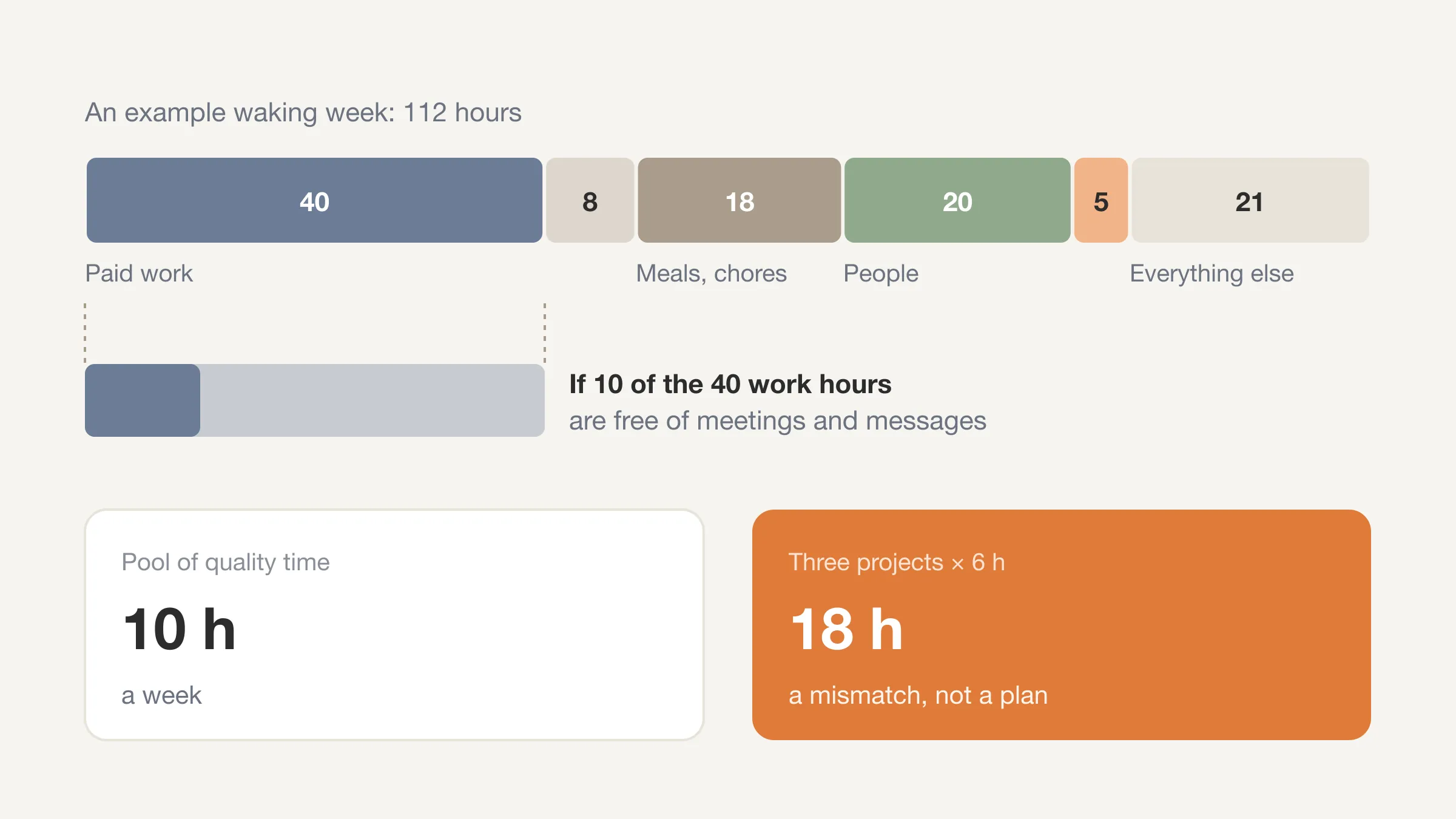
Here is an example budget for a typical working adult. It is an illustration with round numbers, not a statistic. Yours will differ.
| Where the waking hours go | Example hours per week |
|---|---|
| Paid work, including meetings | 40 |
| Commute and getting ready | 8 |
| Meals, chores and errands | 18 |
| Family, friends, and social time | 20 |
| Exercise and health | 5 |
| Everything else, including idle time | 21 |
| Total waking hours | 112 |
Now look at the part of the week where deep, high-quality work could happen. Inside the 40 work hours, how many are truly yours, free of meetings and messages? For many people it is a small fraction. If it is 10 hours, that is the pool every "important project" competes for. Seen that way, three active projects each needing 6 hours is not a plan. It is a mismatch with a number on it.
How does logging your time make "fewer things" possible?
A log replaces your estimate of the week with the week. Fifteen-minute blocks are small enough to catch the leaks and large enough to log in seconds. If you want the method itself, see the 15-minute time block method.
After a week, three things tend to surface.
- The real size of the pool. You find out how many hours of uninterrupted, quality-grade time you have. This is the number that decides how many projects you can carry.
- What has been quietly taking hours. Recurring things nobody decided on: a standing meeting, a daily scroll, a task that always takes twice as long.
- Which seasons you are in. A log across several weeks shows whether your pace is natural or flat. Heavy weeks and light weeks are visible as such.
None of this requires judging yourself. You are collecting facts that make a real decision possible. "I will do fewer things" turns into "I will drop X, because it takes 5 hours and gives me the least."
How do you apply slow productivity to your week?
Here is a practical sequence you can run over about two weeks. It uses the three principles in order.
Step 1: log one normal week
Keep the log simple. Pick a block, pick what you were doing. Group it into broad categories such as Health, Life, Work and Sleep, so you can add it up at the end. Don't tidy the week first. A normal week is the useful one. The daily time log template gives you a page to start from.
Step 2: count your live projects
Write down everything that currently needs your attention: work projects, goals, side projects, household projects. Next to each, write the hours it took last week according to your log. Anything with zero hours is either not live or being avoided. Both are useful to know.
Step 3: pick the few that get your best hours
Choose one to three things that deserve your protected time this season. Put the number of hours each needs next to it, and check the total against the pool you found in step 1. If the sum is bigger than the pool, something else must go, or wait. This is "do fewer things" in practice.
Step 4: set a natural pace
Look at the next four weeks. Mark which are likely to be heavy and which can be lighter. Plan one lighter week on purpose, so that the pace has a shape. If every week looks the same, you have not made a choice about pace yet.
Step 5: protect blocks for quality
Block time for the work you chose, in stretches long enough to do it well. Two or three blocks of an hour or more beat ten scattered fifteen-minute gaps. Our guide to deep work covers how to structure these stretches.
Step 6: review and adjust
At the end of the week, compare what you planned to what you logged. The gap is the useful number: where you meant your time to go, versus where it went. Move one thing and try again next week. Beyond Time's AI reflection reads your logged day and points out what went where you meant it to, where time leaked, and one or two changes worth making.
Find the hours that are really yours
Beyond Time splits every hour of your week by category, so you can see how much room there is for slow, high-quality work.
Start free on the webWhat are common objections to slow productivity?
"My job doesn't let me choose"
That is true for many roles, and the book is mostly about work where you have some control. Even then, you usually control something: the order you do things in, which optional commitments you accept, and how you use the gaps. Start with the part you do control, and let the log show how big it is. If the answer is "very small," that is information too, and a reason to raise the question with a manager using real numbers.
"I will fall behind if I slow down"
The principle is not to produce less of what matters. It is to stop spreading yourself over things that don't. A log often shows hours going to work that nobody would miss. Cutting that is not slowing down. It is moving your effort to a smaller number of things.
"I have no idea what to cut"
That is exactly what a week of logs is for. Sort your week into things that move your chosen work forward, things that keep life running, and things that fit neither. The third group is where you start.
"I like being busy"
Busy can be enjoyable, and slow productivity does not forbid it. The question is whether the busyness is going where you want. If the log says yes, you are done. If it says no, you now know where to look.
How is slow productivity different from other time methods?
It sits at a different level. Most time methods are tools for the day: time blocking, task lists, focus timers. Slow productivity is a view about how many things to carry and how fast to run. They fit together. Choose the few things with slow productivity, then use blocks to make room for them.
It also differs from methods that aim to fit more into the day. The point here is the opposite: with limited hours, the answer to "too much" is a smaller list, not a better squeeze.
If you struggle to decide what makes the cut, how to prioritize when everything feels important is a good companion, and the free goal prioritization matrix can help you rank what you listed in step 2.
Frequently Asked Questions
What is slow productivity in simple terms?
Slow productivity means doing fewer things at a time, working at a natural pace, and putting quality first. Cal Newport named it in his 2024 book and describes it as an alternative to measuring yourself by how busy you look.
What are the three principles of slow productivity?
They are do fewer things, work at a natural pace, and obsess over quality. Each supports the others: fewer commitments leave room for a natural pace, and that room is what lets quality improve.
Does slow productivity mean working less?
Not necessarily. It means being selective about what you take on and not forcing a constant sprint. Many people find they do the same number of hours on fewer, better-chosen things.
How many things should I work on at once?
There is no fixed number, but a useful test is whether you can name your active projects on one hand. Then check that the hours they need fit inside the hours you really have, which a week of logging will show.
Can slow productivity work with a demanding job?
It can work on the part of your week you control. Log a normal week to find out how big that part is, then decide which commitments to protect and which to drop or defer.
How do I know if I am doing too much?
Compare the hours your commitments need with the hours you have. If the total is higher than the available time, or if you cannot say where last Tuesday went, you are probably carrying more than you can do well.
Slow productivity, in numbers
Slow productivity asks you to do fewer things at a natural pace and care about quality. The practical way in is a number. You have about 112 waking hours a week and about 15 weeks left of 2026 as of this post. Log a normal week, count your live projects, and choose the few that get your best hours. See where the time goes, then decide what to carry.
See where your time goes
Start your day, log it in 15-minute blocks, end your day. Beyond Time shows the gap between what you planned and what happened.
Try Beyond Time freeSource for the book's ideas: Cal Newport, Slow Productivity: The Lost Art of Accomplishment Without Burnout (2024). The summary here is in our own words. Read the book for his full argument and examples.
Put this into practice
Free tools that match this article.
Productivity Score Calculator
Discover your productivity score and get personalized recommendations to improve.
Try Productivity ScoreTime ManagementWeekly Schedule Optimizer
Generate an optimized weekly schedule with AI-powered time blocking for maximum productivity.
Try Schedule OptimizerTime ManagementTime Blocking Template
Map your day into focused time blocks with a free printable time blocking template.
Try Time BlockingGoal SettingGoal Setting Worksheet
Turn a vague goal into milestones, habits, blockers, and a weekly review plan.
Try Goal WorksheetRelated Articles

Digital Minimalism: A Gentle 30-Day Declutter That Sticks
Digital minimalism means using technology only where it serves what you value. Try a gentle 30-day declutter, then measure the hours that came back. Start here.
Quality Time: What It Means and How to Make More of It
Quality time is undivided attention shared with someone. See what counts, 25 ideas by relationship, and how to check how much quality time you really had.
Quarter Life Crisis: Signs, Causes and a Way Through It
A quarter life crisis is a stretch of doubt about career, relationships and direction in your 20s or early 30s. Learn the signs, causes and a way through it.

How to Romanticize Your Life: 15 Small Ways to Start Today
How to romanticize your life without spending money: 15 small rituals, a one-week experiment, and a way to see which hours were worth savoring. Start today.

Four Thousand Weeks: Lessons and How to Use Them
Four Thousand Weeks by Oliver Burkeman, summarized in plain words, with the math of how many of your weeks are gone and what to do with the rest. Start here.

Habits of Successful People: 6 That Have Real Evidence
The habits of successful people that research actually supports: sleep, movement, if-then plans, tracking, focus and self-testing. Sources included. Test one.