
How to Romanticize Your Life: 15 Small Ways to Start Today
How to romanticize your life without spending money: 15 small rituals, a one-week experiment, and a way to see which hours were worth savoring. Start today.
To romanticize your life is to give ordinary hours your full attention and a little intention: make the coffee on purpose, walk the long way home, notice that the light is good right now. It costs almost nothing. It does not require a new apartment, a new personality or a new wardrobe.
The idea works because most of a life is made of ordinary hours. If you only feel alive during trips, milestones and big days, you are skipping most of what you will ever get. This guide shows you how to romanticize your life in small steps, how to tell which hours were worth savoring, and how to keep the habit going after the first week.
Key takeaways
- Romanticizing your life means paying attention on purpose to the hours you already have, not adding more things to do.
- Small, repeatable rituals beat big gestures. Pick two or three and attach them to things you already do each day.
- A day has 64 waking fifteen-minute blocks. Noticing even a handful of good ones changes how the day is remembered.
- Looking back at where the hours went shows you which ones were worth keeping.
What does it mean to romanticize your life?
The phrase came out of social media, where it usually means turning everyday moments into small scenes: a candle at dinner, a playlist for the commute, a journal by the window. Strip away the aesthetics and the idea underneath is simple. You treat your own life as something worth noticing.
That has three parts:
- Attention. You are actually there for the moment instead of half there while thinking about the next one.
- Intention. You make a small choice about how the moment goes. You pick the mug, the song, the route.
- Memory. You do something that helps the moment stick, such as saying it out loud, writing one line, or taking a photo.
It is not the same as spending money to make your life look nice. A lit candle and a cheap notebook are enough. It is also not the same as pretending everything is fine. You can romanticize a Tuesday and still admit that Tuesday had a bad meeting in it.
If the idea sounds soft, think of it as a practical response to a real problem. Many days blur together, and the blur is part of why the years feel short. We cover the mechanism in why time seems to go by so fast. Romanticizing is one of the ways to break the blur.
Why does romanticizing your life work?
There is no single study that proves "romanticizing" as a method, so be wary of anyone who claims there is. But three well-supported ideas explain why small acts of attention tend to help.
Attention changes what you experience. A coffee you drink while scrolling is a different event from a coffee you drink while looking out of the window. The coffee did not change. Your attention did. Psychologists who study this call the habit of paying deliberate attention to a pleasant experience savoring, and it is one of the simplest levers people have over how a day feels.
Distinct moments are easier to remember. Memory tends to hold on to what stood out. A week in which every evening looks the same leaves little to recall, while one in which you did a few distinct things leaves a trail. That is why a day with one small ritual in it is remembered better than a day with none.
A sense of limits makes the present richer. In a 2008 paper in Psychological Science, psychologist Jaime Kurtz found that college seniors who were told graduation was close took part in more college activities than students who saw it as far off, which she read as a "now or never" push to make the most of the time (summary of the study, ScienceDaily). It is one study, it counted activities rather than measuring well-being, and it was about a particular group of students, so treat it as a hint rather than a law. But it fits something many people notice: the last week of a trip is often the most vivid.
That last point is the one this site cares about. Your time is limited, and that is a reason to look at it, not a reason to panic. Looking is what romanticizing is.
How much time are we talking about?
Here is the arithmetic, because numbers make this feel real rather than vague.
A week has 168 hours. If you sleep about 8 hours a night, you are awake for about 112 of them (our guide to how many hours are in a week walks through the split). Divide a 16-hour waking day into fifteen-minute blocks and you get 64 blocks a day, or 448 a week.
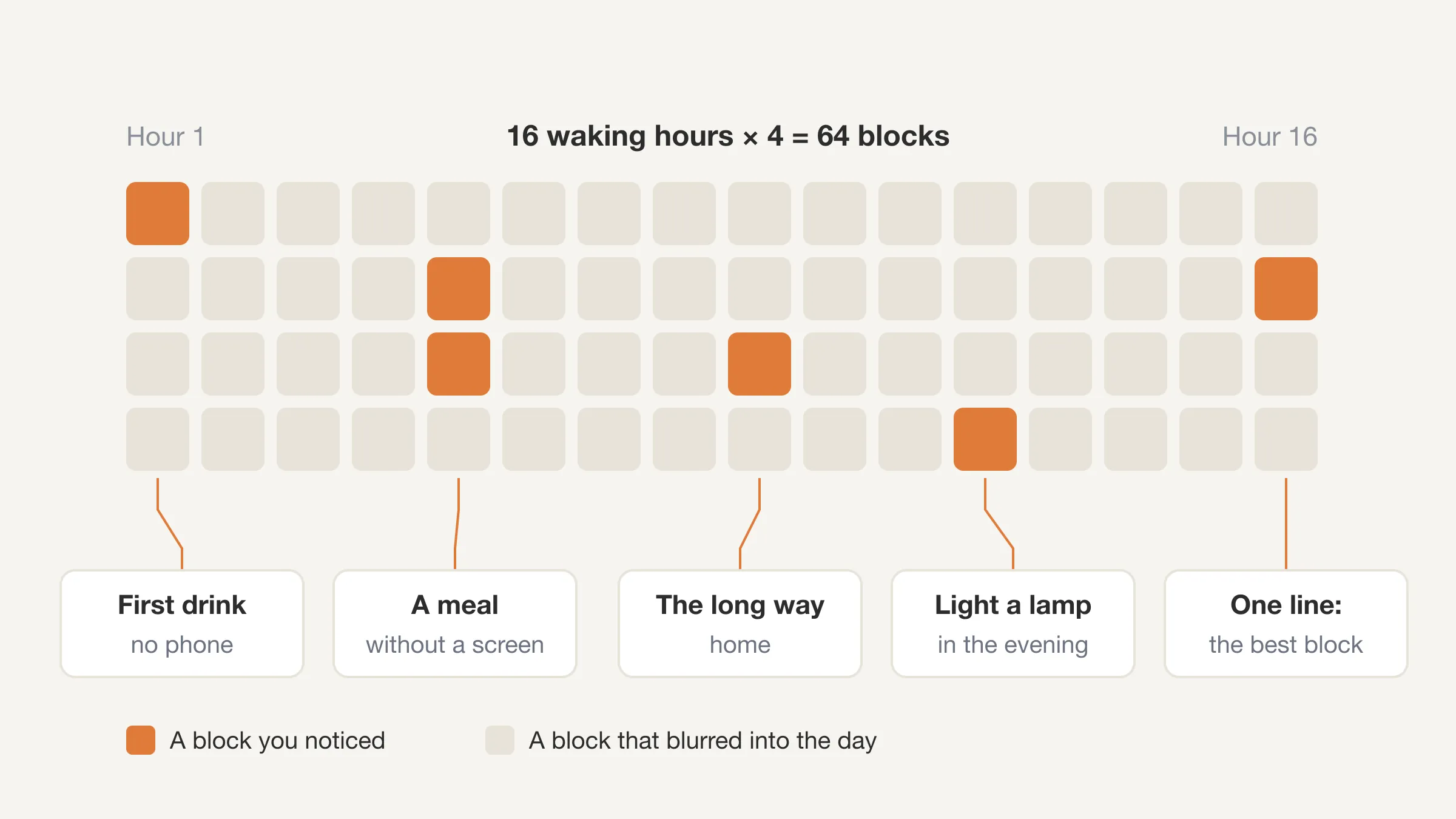
On Thursday 16 July 2026, there are 168 days left in the year, which is exactly 24 weeks. That is 24 more Saturdays and 24 more Sundays to live in.
Now compare that with how Americans say they spend the hours. According to the U.S. Bureau of Labor Statistics, the 2025 American Time Use Survey found that people spent 35 minutes a day socializing and communicating, down from 41 minutes in 2015, and that watching TV was the leisure activity that took the most time, at 2.6 hours a day (BLS, American Time Use Survey 2025 results). Those are averages across everyone, so your own numbers may look nothing like them. They are a prompt to check, not a verdict.
Romanticizing your life does not mean removing the TV. It means choosing where some of those blocks go and being present for them.
See where today goes
Log your day in 15-minute blocks. Two minutes in the morning, two at night. Then see which hours were worth keeping.
Try Beyond Time freeHow do you romanticize your life in practice?
Below are fifteen small ways to start, grouped by the part of the day they fit into. Do not try all of them. Pick two or three and attach each to something you already do, so you never need willpower to remember it.
In the morning
- Make the first drink on purpose. Use the good mug. Stand at the window for the first few sips with your phone in another room. That is about five minutes, or one block and a bit.
- Pick the song for the first hour. One album, no skipping. Music is a cheap way to give a stretch of time a mood.
- Choose one thing to look forward to. Not a goal, just a small thing: a lunch you like, a call with a friend, a walk. If you score your day's goals in the morning, put one pleasant thing next to the work.
- Dress for the day you are having. Wear the thing you save for "later". Later is made of ordinary Tuesdays.
During the day
- Take the long way once. Walk or drive a slightly different route and notice three things you have not seen before.
- Eat one meal without a screen. Taste the first three bites. It is the smallest daily ritual with the biggest return.
- Turn one errand into a small outing. The grocery run can include a coffee on a bench. Same errand, one more block of attention.
- Name the good moment. When something is pleasant, say to yourself, "This is a good block." It takes two seconds and works as a bookmark.
In the evening
- Light something. A lamp, a candle, a string of lights. Softer light makes an ordinary room feel different, and it marks the change from day to evening.
- Cook one thing slowly. Not a recipe project, just a dish you do not rush.
- Call or message one person. Not to catch up on everything, just to say one real thing. Our evening routine ideas include more ways to close the day.
- Write one line. What was the best block today? Write it down. A year of those lines is a record you will want.
Once a week
- Plan one outing with a name. "Saturday at the market" is more likely to happen than "do something fun".
- Do something you did as a kid. Bike, draw, build, swim. Adults rarely schedule play, so it has to be put in.
- Take a photo of an ordinary place. Your desk, your street, the table. In a year it will look like a different world.
If your list gets long, shrink it. Our guide to the minimum viable day is built on the same idea: on a hard day, the smallest version still counts.
Can you romanticize a boring or hard day?
Yes, within limits, and it is worth being honest about the limits.
On a boring day, the work is to find one thing that is slightly better than neutral and give it attention. A dull commute is still 40 minutes in which you can pick a podcast or a window seat. A dull afternoon can have a good cup of tea in it. You are not pretending the day was exciting. You are rescuing a block or two from the blur.
On a hard day, be careful. Romanticizing is not a way to talk yourself out of a real problem. If a job, a relationship or a living situation is making you unhappy, a candle will not fix it. Small rituals can make hard stretches easier to carry, but they do not replace changing what needs to change.
When to talk to someone
This article is general information about attention and habits, not medical or mental health advice. If your mood has been low most of the day, nearly every day, for two weeks or more, or if you have lost interest in things you usually enjoy, talk to a doctor or a mental health professional. If you are having thoughts of harming yourself, call or text 988 in the U.S. (the 988 Suicide & Crisis Lifeline) or contact local emergency services.
How do you notice which hours were worth savoring?
Here is the trick most guides skip. You cannot savor what you cannot remember, and most people cannot remember most of last week.
Ask yourself what you did on Wednesday afternoon. For many people the honest answer is a shrug. The hours happened, and they were not stored. That is not a character flaw. It is what happens when days look alike.
A simple fix is to look back. Not with a long journal, just with a short log. In a 15-minute time block log, you record what each block was, and the day becomes a thing you can see. Our daily time log template is a copyable version if you want to start on paper.
When you look at a logged week, two things usually show up:
- Good blocks are rarer than you thought. You may have had two hours you loved and thirty you do not remember. That is useful to know.
- Some good blocks were accidents. The walk that happened because a meeting ended early. The call that ran long. Once you see these, you can make them happen on purpose.
In Beyond Time, the end of the day is built for this. In the "End your day" step you rate how health, life and work felt from 1 to 10 and can add a line. Use that line for the best block of the day. It takes less than a minute. Over a week you will have seven small, specific memories instead of a blur, and the AI reflection will point out where the day went where you meant it to.
What is a one-week experiment to try?
Do not try to romanticize your whole life on Monday. Run a one-week experiment with a small budget.
| Day | One ritual | Time cost |
|---|---|---|
| Mon | First drink on purpose, no phone | 5 minutes |
| Tue | One meal without a screen | 20 minutes |
| Wed | Take the long way once | 10 minutes |
| Thu | Light something in the evening | 1 minute |
| Fri | Message one person with one real sentence | 5 minutes |
| Sat | One named outing | 1 to 2 hours |
| Sun | Look back: which blocks were the best? | 10 minutes |
That is under three hours in total, most of it on Saturday. At the end of the week, ask three questions:
- Which ritual did I enjoy most?
- Which one did I skip, and why?
- Which would I keep doing without thinking?
Keep one. Drop the rest. A habit you keep is worth more than ten you tried. If you want to build the habit into your morning, the morning routine generator helps you place it, and the night routine planner does the same for the evening.
What gets in the way of romanticizing your life?
Three things come up most often.
It feels fake. If lighting a candle feels like a performance, drop the candle and keep the attention. The point is not the object. Walk without headphones. Eat slowly. Look at a tree.
It turns into another thing to optimize. If you start grading yourself on how aesthetic your day was, stop. Romanticizing is meant to take pressure off, not add a checklist. If a ritual stops being enjoyable, drop it.
You are too busy. This is the common one, and it is partly a matter of seeing the day clearly. Most busy days have blocks in them that are not really spoken for: the ten minutes before a call, the wait for the kettle, the scroll before sleep. In a logged day these show up as small gaps. They are where small rituals fit. You do not need an hour. You need one block.
Our guide on the 4,000 weeks idea makes the case that the point of a limited life is to spend it on a few things you care about, not to do everything. Romanticizing is a way to care about the small things too.
If thinking about limited time makes you anxious rather than calm, read our guide to time anxiety. The goal is a gentler way of seeing the day, not more pressure.
Keep the good hours
Beyond Time shows where your week went, so you can spot the blocks worth repeating. Free for two weeks.
Start your free trialFrequently Asked Questions
What does it mean to romanticize your life?
It means giving ordinary moments deliberate attention and a small touch of intention, so that everyday life feels more worth noticing. In practice that is a lit lamp, a slow meal, a walk with no headphones. It is not about spending money or pretending that everything is perfect.
How do you romanticize your life on a budget?
Use what you already have: the good mug, a free playlist, a different walking route, a lamp instead of overhead light. The core of the idea is attention, which is free. Most of the 15 ideas above cost nothing and take under 20 minutes.
Is romanticizing your life a form of toxic positivity?
It can be if you use it to avoid real problems, but it does not have to be. The healthy version adds small pleasures without denying what is hard. If you notice you are using rituals to push away feelings or to stay in a situation that is hurting you, that is a good moment to talk to a friend, doctor or therapist.
How long does it take to feel the difference?
There is no reliable timeline, and it varies from person to person. Some people notice a difference within days, others need longer. The reason to run a one-week experiment is to find out what works for you rather than to follow a promise.
How do I make it a habit?
Attach it to something you already do: the first coffee, the walk to the car, brushing your teeth. Keep the ritual under five minutes and write one line at the end of the day about the best block. If you want to know how long habits take, our post on the 66-day rule explains the research.
Can romanticizing your life help with feeling like time is passing too fast?
It may help, because distinct, attended moments are easier to remember than blurred ones. It will not stop time, but it can make a week feel fuller when you look back. For a longer explanation, see our guide to why time goes by so fast.
Romanticize your life by noticing it
To romanticize your life, you do not need to change it. You need to notice it. Pick two or three small rituals, attach them to things you already do, and write one line each night about the best block of the day.
Your time is limited, and on 16 July 2026 there are 24 weeks of it left in the year. Seeing where it goes is how you decide which hours are worth keeping. If you want a quick way to look, Beyond Time lets you log the day in fifteen-minute blocks and shows you the week, so the good hours are easy to find.
Put this into practice
Free tools that match this article.
Life Audit Tool
Score your life in 6 key areas and get a personalized action plan to create balance and fulfillment.
Try Life AuditPersonal DevelopmentPersonal Development Plan Generator
Generate a personalized development plan with quarterly milestones, skill gaps, and daily habits tailored to your goals.
Try Development PlanLife Planning5-Year Plan Generator
Build your 5-year life vision with year-by-year milestones, domain goals, and a Q1 action plan — powered by AI.
Try 5-Year PlannerGoal SettingGoal Setting Worksheet
Turn a vague goal into milestones, habits, blockers, and a weekly review plan.
Try Goal WorksheetKeep exploring this topic
Life audit guide
Review the areas of life that need more attention and intention.
Personal development plan
Create a growth plan that connects identity, habits, and goals.
Strategy articles
Explore more strategy articles from the Beyond Time blog.
how to romanticize your life
Read more articles tagged how to romanticize your life.
Related Articles
Quality Time: What It Means and How to Make More of It
Quality time is undivided attention shared with someone. See what counts, 25 ideas by relationship, and how to check how much quality time you really had.

Digital Minimalism: A Gentle 30-Day Declutter That Sticks
Digital minimalism means using technology only where it serves what you value. Try a gentle 30-day declutter, then measure the hours that came back. Start here.

Slow Productivity: Cal Newport's Ideas and How to Use Them
Slow productivity means doing fewer things at a natural pace with high quality. Here is Cal Newport's idea in plain words, and how to check your hours.
Quarter Life Crisis: Signs, Causes and a Way Through It
A quarter life crisis is a stretch of doubt about career, relationships and direction in your 20s or early 30s. Learn the signs, causes and a way through it.

Four Thousand Weeks: Lessons and How to Use Them
Four Thousand Weeks by Oliver Burkeman, summarized in plain words, with the math of how many of your weeks are gone and what to do with the rest. Start here.

Habits of Successful People: 6 That Have Real Evidence
The habits of successful people that research actually supports: sleep, movement, if-then plans, tracking, focus and self-testing. Sources included. Test one.