
Quarter Life Crisis: Signs, Causes and a Way Through It
A quarter life crisis is a stretch of doubt about career, relationships and direction in your 20s or early 30s. Learn the signs, causes and a way through it.
A quarter life crisis is a period of doubt, restlessness or stuck feeling about career, relationships and identity, usually somewhere between the mid-20s and the mid-30s. It is not a medical diagnosis. It is a common name for a real experience: the sense that you are supposed to have figured things out by now, and you have not.
If you are in one, you are not broken, and you are not behind. This guide explains what a quarter life crisis is, the signs people describe, why it happens, and a practical way through that does not require you to quit your job or move countries. It is general information, not therapy, and we say clearly below when to talk to a professional.
Key takeaways
- A quarter life crisis is a common label for doubt about direction in your 20s or early 30s. It is not a diagnosis.
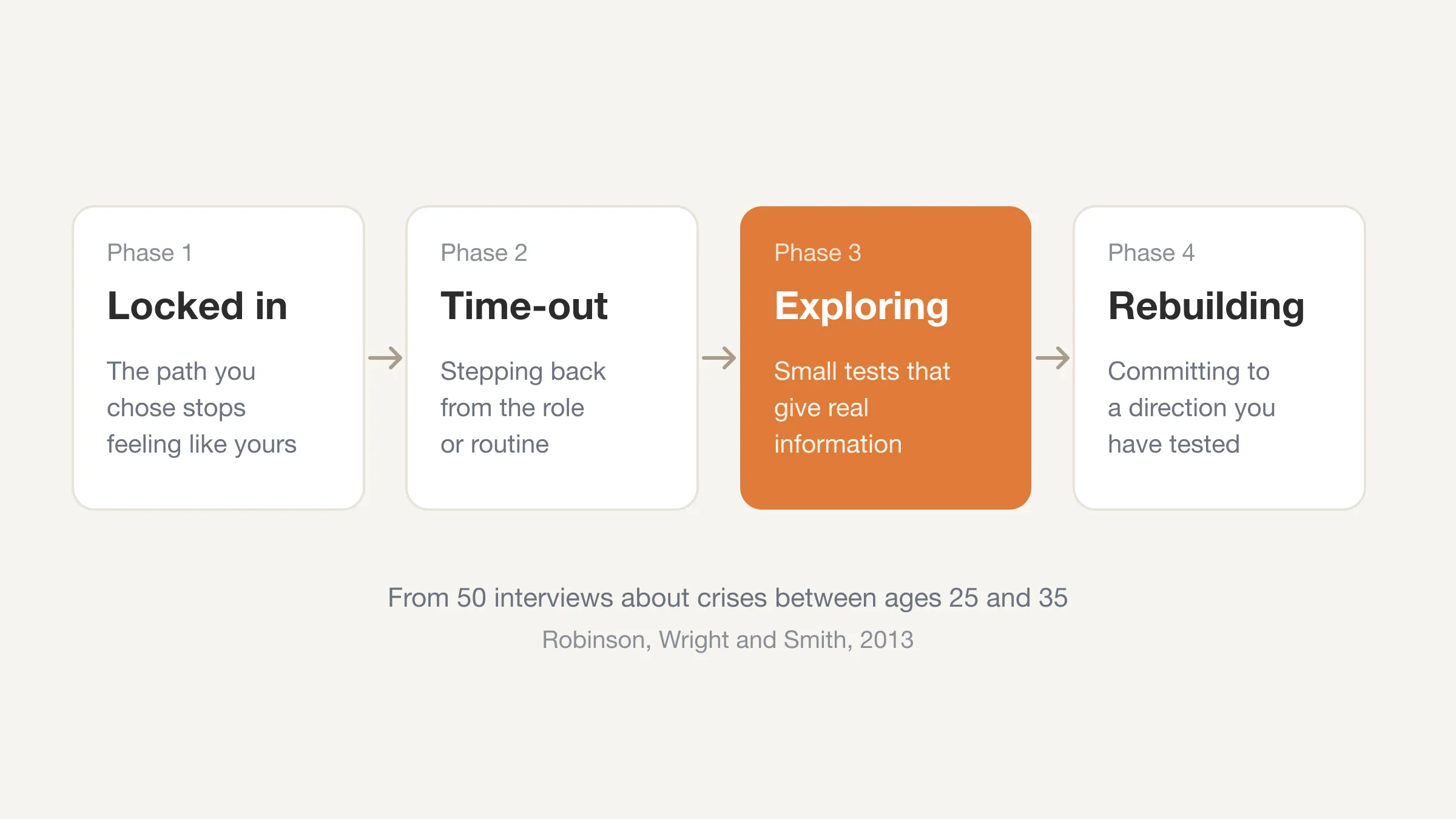
- Researchers who interviewed people about these episodes describe them as phases: feeling locked in, stepping back, exploring, then rebuilding.
- The way through is usually small and concrete: look at your actual life, name what you want more and less of, and run small experiments.
- If low mood lasts two weeks or more, or you have thoughts of harming yourself, talk to a professional. See the section below.
What is a quarter life crisis?
The term describes a stretch of uncertainty that tends to arrive after the structure of school or early career ends. Until then, the next step was usually obvious: finish the course, get the job, get the next promotion. Then the steps run out, and you are asked to choose a direction with no map.
Psychologist Jeffrey Arnett proposed in a widely cited 2000 paper in American Psychologist that the years from the late teens through the 20s are a distinct stage of life he called emerging adulthood, marked by identity exploration, instability, feeling in between, self-focus and a sense of possibilities (Arnett, 2000, American Psychologist). A quarter life crisis can be seen as the hard edge of that stage: the point where the exploring starts to feel like drifting.
Researchers have also studied the crisis itself. Oliver Robinson, Gordon Wright and Jonathan Smith analyzed 50 interviews with people about a crisis episode between the ages of 25 and 35 and proposed that these episodes tend to run through four phases: feeling locked in, a separation or time-out, exploration, and rebuilding (The Holistic Phase Model of Early Adult Crisis, Journal of Adult Development, 2013). That is one research group's model built from a relatively small interview sample, so treat it as a useful map rather than a rule. But it matches how many people describe it.
What are the signs of a quarter life crisis?
People describe it differently, but the same themes come up again and again. You may recognize some of these:
- A "stuck" feeling. You are doing the thing you chose, and it no longer feels like yours.
- Constant comparison. Other people seem further along in career, money, relationships or happiness.
- Doubt about big choices. Is this the right career? The right city? The right person?
- Restlessness or boredom. Days feel flat. You scroll, snack, wait for the weekend.
- Pressure about time. A sense that the window for something is closing.
- Low energy and motivation. You know what you should be doing and cannot start.
- Difficulty answering "what do you want?" Not because you are lazy, but because the question feels too big.
None of these means something is wrong with you. They are signals worth listening to. The next section covers when they point to something that needs more than self-help.
When should you talk to a professional?
A quarter life crisis is not a clinical condition, but the feelings that come with it can overlap with depression and anxiety, and those are treatable. It can be hard to tell the difference from the inside, which is why this section comes early.
Talk to a professional if
- Your mood has been low, or you have lost interest in things you usually enjoy, most of the day and nearly every day for two weeks or more.
- Your sleep, appetite or concentration have changed in a way that is hard to ignore.
- You feel hopeless, worthless or numb.
- You are using alcohol or other substances to get through the day.
- You have thoughts of harming yourself or ending your life. Call or text 988 in the U.S. (the 988 Suicide & Crisis Lifeline, free and open 24 hours a day) or contact your local emergency number. Outside the U.S., look up your country's crisis line.
The U.S. National Institute of Mental Health says that if symptoms are severe or last two weeks or more, you should seek professional help, and that a health care provider is the person to talk to if self-care is not enough (NIMH, "My Mental Health: Do I Need Help?").
Everything else in this article is for the ordinary, uncomfortable kind of doubt. It is not a replacement for care, and you do not need to wait until things are bad to ask for help.
What causes a quarter life crisis?
There is rarely one cause. These come up often:
The structure ends. School gives you a clear ladder with clear feedback. Work and adult life give you neither. Without a ladder, many people feel lost for the first time.
Too many options, too little information. You can choose almost any career, city or lifestyle, but you have little evidence about which would fit. Choosing without evidence feels risky, so people delay, then feel stuck.
Comparison at scale. You see other people's highlights daily. You do not see their doubt.
Big decisions arrive together. Career, partner, home, money and family can all feel urgent in the same few years.
A sense of time passing. Turning 25, 28 or 30 can make "later" start to feel like "now or never". That feeling is not irrational. It is also easy to exaggerate, as the math below shows.
Money and the economy. Rent, debt and a rough job market can make every choice feel higher-stakes. This is a real constraint, not a mindset problem, and it is fair to say so.
How long does a quarter life crisis last?
There is no reliable number, and anyone who gives you one is guessing. The phase model above suggests a pattern rather than a timeline: it often starts with feeling locked in, moves through a time-out, then exploration, then rebuilding. For some people that takes months. For others it takes years.
What tends to speed things up, according to how people describe their own experience, is moving from thinking to trying: small experiments that give you real information. What tends to slow things down is waiting for certainty before doing anything.
What does your time say about a quarter life crisis?
Here is a different way to look at it. A crisis feels like a loss of direction. A direction is mostly made of what you do with your hours.
Ten years is 520 weeks. If you sleep about 8 hours a night, you are awake for about 112 hours a week, so a decade holds about 58,240 waking hours. That is a lot of room. It is also something you can see.
On Thursday 30 July 2026, there are 154 days left in the year, which is exactly 22 weeks. Twenty-two weeks is enough to run a few real experiments and see what they teach you. It is not enough to rebuild a life, and it does not need to be.
The useful question is not "what should I do with my life?" It is "what did last week's 112 waking hours actually go to, and which of them felt like mine?"
Most people in a quarter life crisis cannot answer that, not because they are careless but because the days blur. A week of logging usually changes that. You see that two hours a day go somewhere you did not choose, that you have almost no blocks that are just yours, or that the thing you say you want gets 40 minutes a week. That is information a vague feeling cannot give you. Our guide to how to do a time audit shows the method in full.
See where your week really goes
Log your day in 15-minute blocks and see your week by category: health, life, work and sleep. Free for two weeks.
Try Beyond Time freeHow do you get through a quarter life crisis?
This is a practical sequence, not a cure. Take it slowly and skip steps that do not fit.
Step 1: Stabilize the basics
Doubt feels bigger when you are tired. Before you try to solve your life, look at sleep, food, movement and one person you can talk to. If any of those are in bad shape, fix them first. This is not a detour. A tired brain is a poor judge of whether its life is working.
Step 2: Look at what is actually there
Run a life audit. List the main areas of your life, such as work, relationships, health, money, learning, fun and home, and score each from 1 to 10 for how it feels, not how it looks. Our complete guide to the life audit walks through it, and the free life audit tool does the scoring for you.
Then add a second column: how many hours a week each area actually gets. This is the part most people skip. A low score next to very few hours often explains more than any amount of reflection.
Step 3: Name what you want more and less of
Not "what is my purpose". Just two short lists:
- Things that gave me energy in the last month.
- Things that drained it.
Look for patterns, not answers. If three of the five energizing moments involved teaching someone something, that is data. If every drained moment involved a particular kind of meeting, that is data too.
Step 4: Run small experiments
Instead of one big decision, try a series of small tests, each lasting two to four weeks:
- Take an evening class, a weekend workshop or a short course.
- Shadow someone in a job you are curious about, or ask for a 20-minute conversation.
- Start a side project for two hours a week.
- Change one fixed thing, such as a routine, a commute or where you work.
Each experiment should answer one question: do I want more of this or less? Our guide to setting goals when you feel stuck has a lightweight way to pick them.
Step 5: Talk to people, including people a few years ahead
Many people in this stage feel isolated because they assume everyone else is fine. Ask a friend how they are really doing. You will probably find they have the same doubts. Talk to someone five to ten years ahead of you and ask what they wish they had known. If you want more structure, a counselor or therapist is a good place to take all of it, and you do not need a crisis to go.
Step 6: Plan in short horizons
A five-year plan can help once you have more information, and our 5-year plan template is there when you are ready. But at this stage, plan in 90 days or less. The aim is to learn, not to commit for a decade.
What is a 30-day plan for a quarter life crisis?
If you want something concrete to start with, here is a gentle month.
| Week | Focus | What to do |
|---|---|---|
| 1 | See | Log your days in 15-minute blocks. Do the life audit once. |
| 2 | Name | Write your energy and drain lists. Pick the area that most needs attention. |
| 3 | Try | Start one small experiment, such as a class, a conversation or a project. |
| 4 | Review | Look at your logged hours. What did the experiment cost? What did it teach? Choose the next one. |
The plan is built to be small on purpose. Each week asks for a few hours at most, and the aim is to end the month with information you did not have at the start.
How do you see where your time goes during a quarter life crisis?
Seeing where your time goes helps with the thing the crisis takes away: a sense that your days belong to you.
Beyond Time is built for that. You log the day as 96 fifteen-minute blocks, with routines grouped into Health, Life, Work and Sleep, and the blocks you did not log show up as gaps. At the end of the day you rate how health, life and work felt from 1 to 10 and can add a line. Across a week you can see every hour split by category, and the AI reflection points out what went where you meant it to and where time leaked.
That is not a cure for doubt. It is a way to replace "I have no idea where my life is going" with "here is where it went, and here is one thing I want to change". For more on the planned-versus-actual idea, see our post on the gap between what you plan and what happens. If thinking about time passing makes you anxious, our guide to time anxiety may help, and the ideas in Four Thousand Weeks offer a calmer way to think about a limited life.
Make the vague feeling concrete
One week of logging shows you which hours felt like yours. Two minutes in the morning, two at night.
Start your free trialFrequently Asked Questions
What is a quarter life crisis?
A quarter life crisis is a period of doubt and uncertainty about career, relationships and identity, usually in the mid-20s to mid-30s. It is not a medical diagnosis. Researchers who studied people's accounts of these episodes describe them as moving through phases from feeling locked in to rebuilding.
What age is a quarter life crisis?
It is usually described as happening between about 25 and 35, though there is no strict age range. The 2013 phase-model study cited above focused on people aged 25 to 35. Some people feel it earlier, after college, and some later.
What are the signs of a quarter life crisis?
Common signs include feeling stuck, comparing yourself to others, doubting big choices, restlessness, pressure about time and low motivation. These feelings can also overlap with depression or anxiety, so talk to a professional if they last two weeks or more or feel severe.
How do you get out of a quarter life crisis?
Most people move forward by taking small, concrete steps: stabilize sleep and routines, look at what your life actually contains, name what gives and drains energy, and run small experiments. Talking to friends, mentors or a counselor helps, and seeing where your hours actually go makes the vague feeling specific.
Is a quarter life crisis a mental illness?
No, it is not a mental illness or a diagnosis. But the stress it brings can contribute to anxiety or depression, which are treatable. If your mood is low most days for two weeks or more, or you have thoughts of self-harm, contact a health professional or call or text 988 in the U.S.
Does everyone have a quarter life crisis?
No. Many people move through their 20s and 30s without a distinct crisis, and some have several smaller periods of doubt. We do not have a reliable number for how common it is, so be skeptical of any statistic that claims one. What matters is that it is common enough to be a normal thing to talk about.
A quarter life crisis is something you can work through
A quarter life crisis is a stretch of doubt in your 20s or early 30s, not a verdict on your life. The way through is small and practical: look after the basics, see where your hours actually go, name what you want more and less of, and run small experiments.
You do not need to solve the next ten years today. On 30 July 2026 you have 22 weeks left in the year, which is enough to learn something real. If you want a clear view of where those weeks are going, start by seeing where your time goes, and take anything heavier to a professional.
Put this into practice
Free tools that match this article.
Personal Development Plan Generator
Generate a personalized development plan with quarterly milestones, skill gaps, and daily habits tailored to your goals.
Try Development PlanCareerCareer Roadmap Planner
Plan your career progression with AI-powered roadmaps, skill gap analysis, and actionable milestones.
Try Career PlannerAssessmentLife Audit Tool
Score your life in 6 key areas and get a personalized action plan to create balance and fulfillment.
Try Life AuditGoal SettingGoal Setting Worksheet
Turn a vague goal into milestones, habits, blockers, and a weekly review plan.
Try Goal WorksheetKeep exploring this topic
Beyond Time for professionals
Plan career goals, weekly execution, and focused work in one system.
Life audit guide
Review the areas of life that need more attention and intention.
Career roadmap guide
Translate long-term professional growth into concrete milestones.
Personal development plan
Create a growth plan that connects identity, habits, and goals.
Related Articles

Quality Time: What It Means and How to Make More of It
Quality time is undivided attention shared with someone. See what counts, 25 ideas by relationship, and how to check how much quality time you really had.

Digital Minimalism: A Gentle 30-Day Declutter That Sticks
Digital minimalism means using technology only where it serves what you value. Try a gentle 30-day declutter, then measure the hours that came back. Start here.
Slow Productivity: Cal Newport's Ideas and How to Use Them
Slow productivity means doing fewer things at a natural pace with high quality. Here is Cal Newport's idea in plain words, and how to check your hours.

How to Romanticize Your Life: 15 Small Ways to Start Today
How to romanticize your life without spending money: 15 small rituals, a one-week experiment, and a way to see which hours were worth savoring. Start today.

Four Thousand Weeks: Lessons and How to Use Them
Four Thousand Weeks by Oliver Burkeman, summarized in plain words, with the math of how many of your weeks are gone and what to do with the rest. Start here.

Habits of Successful People: 6 That Have Real Evidence
The habits of successful people that research actually supports: sleep, movement, if-then plans, tracking, focus and self-testing. Sources included. Test one.