
Digital Minimalism: A Gentle 30-Day Declutter That Sticks
Digital minimalism means using technology only where it serves what you value. Try a gentle 30-day declutter, then measure the hours that came back. Start here.
Digital minimalism is a way of using technology in which you keep only the tools and apps that clearly support something you value, and let the rest go. Cal Newport made the term popular with his 2019 book Digital Minimalism: Choosing a Focused Life in a Noisy World. Its best-known tool is a 30-day digital declutter: a month away from optional technology, followed by a careful, deliberate return.
The idea is simple. The hard part is knowing whether it worked. "I feel calmer" is a fine result, but it is hard to hold onto. A better test is to count: how many hours did the declutter give back, and where did they go? This post explains the idea in our own words, lays out a gentle version of the 30 days, and shows how to measure what came back. Your time is limited, and attention is how you spend it.
Key takeaways
- Digital minimalism is a philosophy: keep a technology only if it clearly supports something you value.
- The 30-day declutter has three steps: define what is optional, take a break, then reintroduce tools on purpose.
- A month holds about 480 waking hours at 16 a day. Even small shifts add up to real hours.
- Log a normal week before you start and again after, so you can compare hours instead of impressions.
What is digital minimalism?
Digital minimalism is a philosophy of technology use, not a ban. You decide what you want from your life first, then keep the tools that serve it and drop the ones that do not. Newport's argument, as the book is summarized, is that many of us picked up apps one at a time, each for a small reason, and never asked whether the total made sense.
Two features make it different from a casual "phone detox." The first is that it starts with values, not with willpower. You are not trying to resist a feed. You are deciding whether the feed belongs. The second is that it is a reset followed by a rebuild. The declutter is temporary. What matters is what you let back in.
It is also not anti-technology. Plenty of digital tools are useful: maps, banking, messages from family, the app you use to do your job. The goal is that each one has a reason to be there that you can state.
What is the 30-day digital declutter?
The declutter is a structured experiment. Based on summaries of the book, it has three steps.
- Define your optional technologies. A technology is optional if taking it away for a month would not seriously harm your work or your life. Anything essential stays.
- Take a 30-day break from the optional list. Use the time to try other things, especially activities that you find more satisfying than scrolling.
- Reintroduce slowly and with rules. At the end, add tools back one at a time. For each, ask what value it provides and set a plain rule for how and when you will use it.
Step 3 is where the benefit lasts. Without it, people drift back to the old pattern within weeks. With it, the apps that return have a job.
Newport's book is more detailed than this outline, with further chapters on solitude and on high-quality leisure. We cover only the declutter here. Read the book for the full argument. His later book, Slow Productivity, applies the same do-fewer-things thinking to work.
Why would you want to declutter at all?
For most people the reason is not a rule. It is a feeling that time is going somewhere and they cannot say where. Phones are a common suspect, but suspicion is not evidence. Before changing anything, find out how big the problem is.
A month has about 480 waking hours at 16 a day. A week has 112. On 6 October 2026, there are about 12 weeks left in the year, or 86 days. If a tool takes even one hour a day without your deciding it should, that is 7 hours a week, and over the 86 days left it is 86 hours. Whether that is a good trade is your call. The point is to make the call knowingly.
How do you do a digital declutter gently?
A strict declutter works for some people. A gentler one works for more, because you are likelier to finish it. Here is a softer path that keeps the structure of the original.
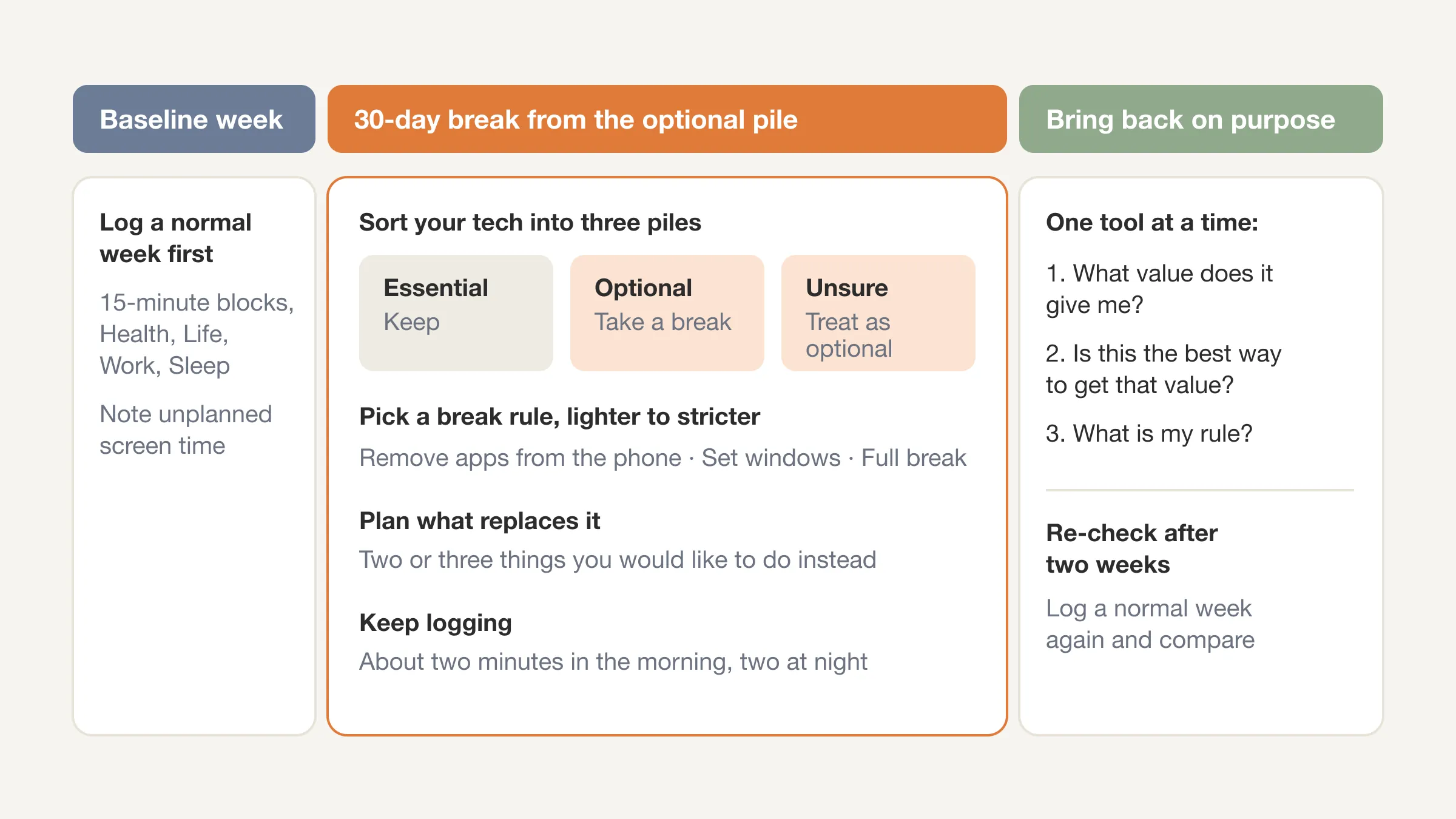
Step 1: measure a normal week first
Before you remove anything, log one ordinary week. Use 15-minute blocks and broad categories (Health, Life, Work, Sleep) so you can add it up. Write a note when a block went to a screen you did not plan to use. You are not judging. You are making a baseline you can compare with later. The daily time log template gives you a page to start with, and the 15-minute time block method explains why that size works.
Your phone's built-in screen time report is a useful second view. It shows what the device recorded, while a log shows what you did and how it felt. They answer different questions, and both are worth a look.
Step 2: sort your technology into three piles
List the apps, sites and devices you use. Then sort them.
- Essential. Your job, your bank, a call with your parents, navigation. These stay.
- Optional. Social feeds, news, video, games, shopping, endless messaging threads. These are candidates.
- Unsure. Tools you cannot place. Treat them as optional for the month, and see what you miss.
Keep the optional list short enough to follow. Ten items you will actually stop beats thirty you will not.
Step 3: choose your break rules
Pick rules you can keep. A few options, from lighter to stricter:
- Remove the apps from your phone but keep access on a computer, which adds a little friction.
- Set windows. For example, optional apps only between 6 and 7 pm.
- Full break from the optional list for 30 days.
Newport's version is the full break. If that feels like too much, a lighter version still gives you information, as long as you commit to it and write down the rule in advance.
Step 4: plan what replaces it
This step gets skipped, and it is why many declutters fail. If the time you free up has no plan, it goes back to the same place. Choose two or three things you would like to do with more time: a walk, a book, a project, calling a friend, cooking. Put them on the calendar as blocks, in the hours the old habit usually takes. Our guide to time blocking shows how to do that without over-scheduling.
Step 5: keep logging for the 30 days
Keep logging in the same 15-minute blocks. It takes about two minutes in the morning and two at night. If you slip, restart the next day. Do not rebuild a missing day from memory.
Get your baseline week
Log your day in 15-minute blocks and see how many hours go where. Two minutes in the morning, two at night.
Try Beyond Time freeWhat should you expect during the 30 days?
Most people report a mix. The first week can feel uncomfortable, with reflex checking of a phone that is no longer where you expect it. After that, many people say they notice more of their day. We have no study to cite for how common this is, so take it as a description of what the declutter is designed to do, not a guarantee.
A few practical notes to help you through.
- Boredom is a signal, not a failure. If a gap in the day feels odd, that is the space the old habit used to fill.
- Tell the people who rely on you. If you will be slower to reply, a short note avoids surprises.
- Expect exceptions. If you break a rule, write it down and keep going. A leaky 30 days still teaches you something.
- Note the moments you miss a tool. These are your best candidates for coming back in step 3.
How do you measure what came back?
This is where a log helps most. At the end of the 30 days, compare four things with your baseline week.
| Measure | How to check it | What it tells you |
|---|---|---|
| Hours by category | Add up Health, Life, Work and Sleep from your week view | Which areas gained hours |
| Not logged blocks | Count blocks you could not account for | Whether the day is more recallable |
| Blocks noted as unplanned screen time | Count the notes you made | How big the leak was |
| Sleep and day scores | Compare your sleep score and how health, life and work felt | Whether you feel different |
A worked example, with invented round numbers for illustration only: suppose your baseline week has 14 hours noted as unplanned screen time. After the declutter, it is 5. That is 9 hours back, or 36 fifteen-minute blocks a week. Over four weeks, it is 36 hours. The useful question is what those hours went to. If they went to the three things you chose in step 4, the declutter worked. If they went somewhere else, look at where, and decide whether that is fine.
In Beyond Time, your week view splits every hour by category and shows the share you logged, so the comparison takes a minute. The AI reflection reads the logged day and points out where time leaked, how often, and one or two changes for tomorrow.
How do you bring technology back on purpose?
At the end of the month, add things back one at a time. For each tool, ask three questions.
- What value does it give me? Be specific. "Staying in touch with my sister" is a value. "Keeping up" is not.
- Is this the best way to get that value? A call may do what a feed does, with less drift.
- What is my rule? Time of day, number of minutes, or which device. Write it down.
Some tools will not come back, and that is a fine outcome. Others will return with limits. A rule you can state in a sentence is more likely to survive a tired Thursday than a vague intention.
Check back after two weeks by logging a normal week again. Rules drift, and a second look catches it before the old pattern returns. For the broader habit of reviewing, see the complete guide to weekly reviews.
What if the declutter does not fit your life?
Not everyone can step away. If your job runs through messaging or you care for others, your optional list will be shorter, and that is fine. Digital minimalism works at any scale. A single rule, such as no phone in the first hour of the day, is a legitimate start.
If you cannot tell whether your screen use is a problem, do the measuring step first, without changing anything. Sometimes the log says the leak is small and your attention is better spent elsewhere. Sometimes the leak is somewhere you did not expect, such as a work tool. Both are useful results.
If the pull toward a device feels hard to control, or it is affecting your sleep, relationships or mood, talking to a doctor or a mental health professional is a sensible step. This post is general information, not medical advice.
For deeper, uninterrupted work once you have more room, see our guide to deep work, and the focus session planner can help you plan the blocks.
Measure what came back
Beyond Time splits your week by Health, Life, Work and Sleep, so you can compare before and after.
Start free on the webFrequently Asked Questions
What is digital minimalism in simple terms?
Digital minimalism is using only the technology that supports what you value and dropping the rest. It is a philosophy of choosing tools on purpose, popularized by Cal Newport's 2019 book.
What is a 30-day digital declutter?
It is a month-long break from optional technology, followed by reintroducing tools one at a time with clear rules. The break gives you distance, and the reintroduction keeps the benefit.
Do I have to quit social media completely?
No. Digital minimalism asks whether each tool earns its place. Some people keep a platform with strict limits, some drop it, and some replace it with something else. What matters is a reason you can state.
How do I know if the declutter worked?
Compare a normal week before and after. Look at hours by category, the number of blocks you cannot account for, and how your sleep and days felt. Counting is more reliable than a general impression.
What if I cannot give up my phone for 30 days?
Use a lighter version. Remove optional apps from the phone but keep them on a computer, or allow set windows. A partial break still shows you what you missed and what you did not.
How long does it take to see a difference?
It varies by person. Some notice a change in the first week or two, and others take longer. A log shows the change in hours whether or not you can feel it yet.
Is digital minimalism the same as a digital detox?
Not quite. A detox is usually a short break followed by a return to the old pattern. Digital minimalism uses a break as a reset, then rebuilds your use around your values, with rules for what comes back.
Digital minimalism, in short
Digital minimalism means keeping only the technology that serves what you value. A gentle 30-day declutter, run with a baseline week and a log, lets you see what you gain instead of guessing. Define what is optional, take a break you can keep, plan what replaces it, and bring tools back with rules. Your time is limited. See where it goes, and decide what earns a place.
See where your time goes
Start your day, log it in 15-minute blocks, end your day. See your week by category and the gaps in it.
Try Beyond Time freeSource for the book's ideas: Cal Newport, Digital Minimalism: Choosing a Focused Life in a Noisy World (Portfolio/Penguin, 2019), as described in summaries such as this one from RescueTime. The summary here is in our own words. Read the book for the full argument.
Put this into practice
Free tools that match this article.
Goal Setting Worksheet
Turn a vague goal into milestones, habits, blockers, and a weekly review plan.
Try Goal WorksheetTime ManagementWeekly Schedule Template
Plan your week with a free printable weekly schedule template for goals, routines, and focus blocks.
Try Schedule TemplateHabit BuildingHabit Tracker Template
Create a free printable habit tracker template — weekly or monthly. Customize your habits and download a clean PDF in seconds.
Try Habit TrackerTime ManagementTime Blocking Template
Map your day into focused time blocks with a free printable time blocking template.
Try Time BlockingRelated Articles
Slow Productivity: Cal Newport's Ideas and How to Use Them
Slow productivity means doing fewer things at a natural pace with high quality. Here is Cal Newport's idea in plain words, and how to check your hours.
Quality Time: What It Means and How to Make More of It
Quality time is undivided attention shared with someone. See what counts, 25 ideas by relationship, and how to check how much quality time you really had.
Quarter Life Crisis: Signs, Causes and a Way Through It
A quarter life crisis is a stretch of doubt about career, relationships and direction in your 20s or early 30s. Learn the signs, causes and a way through it.

How to Romanticize Your Life: 15 Small Ways to Start Today
How to romanticize your life without spending money: 15 small rituals, a one-week experiment, and a way to see which hours were worth savoring. Start today.

Four Thousand Weeks: Lessons and How to Use Them
Four Thousand Weeks by Oliver Burkeman, summarized in plain words, with the math of how many of your weeks are gone and what to do with the rest. Start here.

Habits of Successful People: 6 That Have Real Evidence
The habits of successful people that research actually supports: sleep, movement, if-then plans, tracking, focus and self-testing. Sources included. Test one.