How to Enjoy Time Off: Make Your Holiday Break Count
How to enjoy time off: decide what your holiday break is for, protect it, and see where the hours go so you don't come back asking where it went. Plan yours.
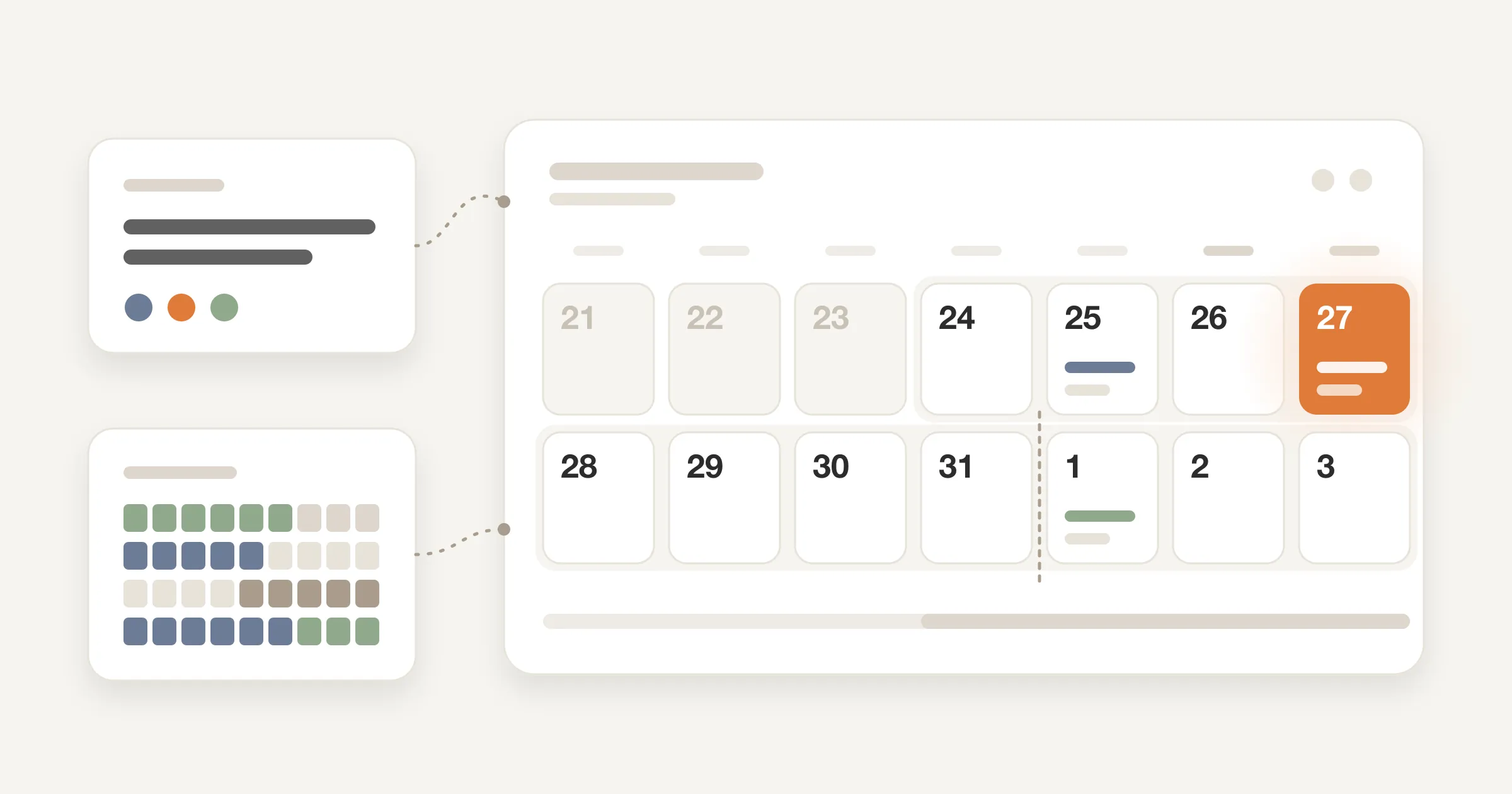
The way to enjoy time off is to decide, before it starts, what the break is for, and then notice where the hours go while it happens. A holiday break has no deadlines to shape it, so it takes the shape of whatever is nearest: the couch, the phone, the next errand. Without a purpose, the days blur and you come back asking where it went.
You have time to decide. On 27 November 2026 there are 34 days left in the year after today (35 counting today, exactly five weeks). A typical year-end break of ten days is 160 waking hours and 640 fifteen-minute blocks. That is a lot of time, and it is also finite. This post shows you how to spend it on purpose, without turning your rest into another project.
Key takeaways
- A ten-day break holds about 160 waking hours (16 a day, 7 am to 11 pm). Decide what it is for before day one.
- Research on vacations finds a small boost to well-being that fades soon after work resumes. Plan the return, not only the break.
- Pick one to three anchors for the whole break. Leave the rest open on purpose.
- Glance at where each day went in two minutes at night. You keep the feeling of a long break instead of a blur.
Why do holiday weeks disappear so fast?
Holiday weeks lose their edges. A normal week has a rhythm: alarm, commute, meetings, dinner. That rhythm is what lets you tell Tuesday from Thursday later. Take it away and days stop being distinct. When you look back, there is little to separate them, so the break feels short even if it was long.
Three other things pull hours out of a break:
- Obligations multiply. Travel, hosting, gifts, family visits and errands fill blocks you pictured as free.
- Open time gets absorbed by the easiest option. If nothing is planned, the default wins. For most people that is a screen.
- The break has no finish line. Work has outputs. Rest does not, so it is hard to tell whether it worked.
None of this means you should schedule every hour. It means the break needs a small amount of structure, placed where it matters. If you are curious why days that look alike feel shorter in memory, why time goes by so fast covers that effect in detail.
How many hours does a holiday break actually hold?
Do the arithmetic once and the break gets concrete. A day of 7 am to 11 pm is 16 waking hours, which is 64 fifteen-minute blocks. The rest is sleep. For more on that math, see how many waking hours you have.
| Break length | Waking hours | Fifteen-minute blocks |
|---|---|---|
| 4 days | 64 | 256 |
| 7 days | 112 | 448 |
| 10 days | 160 | 640 |
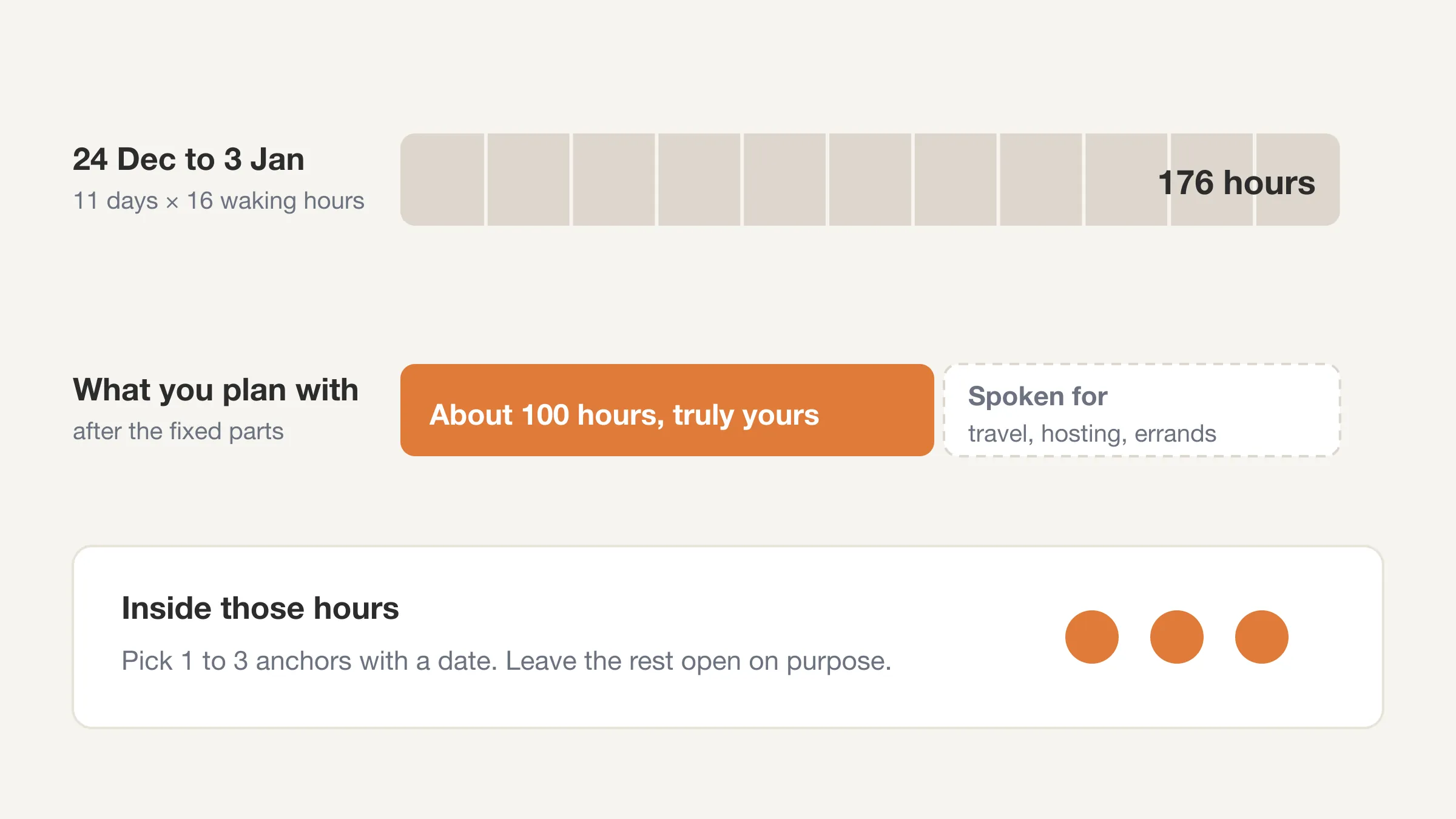
| 11 days (24 Dec to 3 Jan) | 176 | 704 |
The last row is an example you can check against your own calendar. In 2026, 24 December falls on a Thursday and 3 January 2027 on a Sunday, which makes 11 days. If you want the countdown itself, here is how many weeks are left until Christmas.
Now subtract what is already spoken for. Travel days, a family dinner, a long drive. A break that looks like 176 hours may have about 100 hours that are truly yours. That number, not the calendar, is what you are planning with. Run the same subtraction across a whole year and you get how many work weeks you really have.
See how many hours your week really holds
Beyond Time shows the waking time left today and this week, so a break stops being a vague block on the calendar.
Try Beyond Time freeWhat does research say about how time off helps?
The evidence is modest and useful. A 2009 meta-analysis in the Journal of Occupational Health by de Bloom and colleagues pooled seven studies of vacation effects. It found a small positive effect of vacation on health and well-being (an effect size of 0.43), and it found that the effect faded after work resumed (an effect size of negative 0.38). The authors also noted that what people actually do on vacation had barely been studied, so the research cannot tell you which activities protect the benefit.
Read that plainly. A break helps, and the help does not last by default. Two practical things follow:
- Rest has value while you are in it. Do not spend the whole break preparing for the return.
- The return deserves a plan. If the benefit fades after work resumes, the last day of the break and the first day back matter as much as the middle.
This is general information, not medical advice. If you cannot rest even when you have time, or you feel persistently low or anxious, talk to a doctor or another qualified professional.
What should your time off be for?
This is the question that changes the break. Pick the purpose in one sentence, before the first day. Most breaks serve one of these, and it is fine to choose more than one:
- Rest. Sleep, slow mornings, no alarm. The goal is to feel recovered.
- People. Time with family or friends. The goal is presence, not logistics.
- Play. Travel, a hobby, a game, a long walk. The goal is novelty and fun.
- Progress on one thing. A small project that never fits a work week. The goal is a finished thing.
- Reset. Cleaning out, planning the year, a review. The goal is to start January clear.
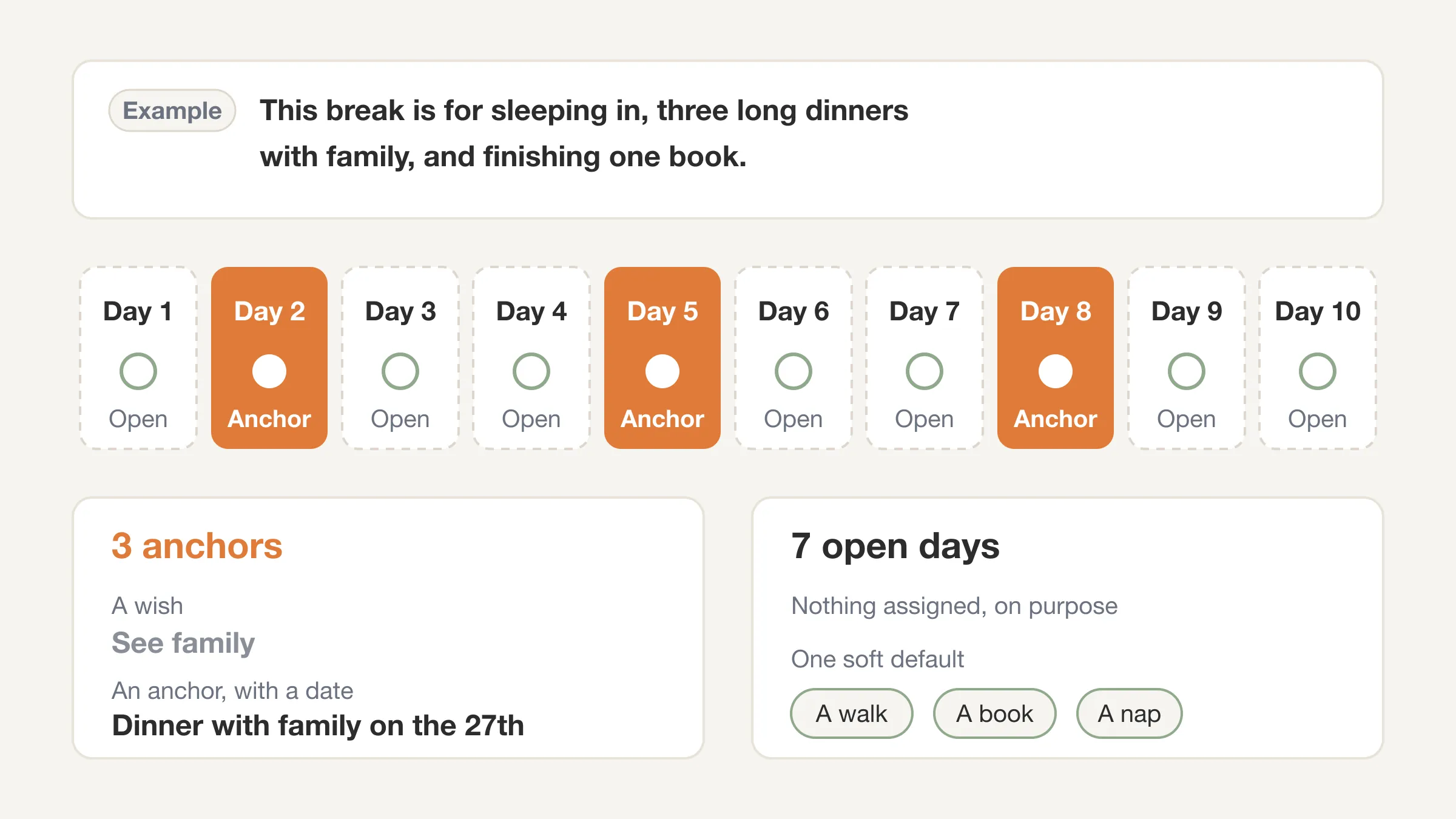
Write the sentence down. For example: "This break is for sleeping in, three long dinners with family, and finishing one book." That sentence is a filter. When an offer shows up on day four, you can check it against the sentence instead of against your mood.
How many anchors is the right number?
Choose one to three anchors. An anchor is something specific you want from the break, with a place in the calendar. "See family" is a wish. "Dinner with family on the 27th" is an anchor.
With three anchors in ten days, you have 7 days left with nothing assigned. That open time is the point of a break. It is also where the hours quietly go to whatever is nearest, so give it one soft default you would be happy with, such as a walk, a book or a nap.
How do you enjoy time off without work and chores creeping in?
Protection is mostly about decisions made in advance, because on the day you will be tired and agreeable.
- Set the boundary in writing. Tell the people who might reach you which days you are away and who covers what. A short message beats a vague hope.
- Decide your check-in rule. If you will look at messages, pick the time and the length: once a day, ten minutes, then done. A rule you choose is easier to keep than a temptation you resist all day.
- Cap the chores. Pick the two or three errands that matter and cap them. A chore with no cap expands, much like work does.
- Do the dread early. If something will nag you through the break, spend one block on it in the first two days, so it stops taking up room in your head.
- Keep one day empty. Leave it unplanned, with no travel and no guests.
If your job makes this hard, the aim is smaller: protect two or three full days rather than all ten. That is still a real break.
How can you see where your time off goes?
Seeing is the difference between a break that felt long and one that felt like it vanished. You do not need a spreadsheet. You need a light record, because memory flattens days that look alike.
This is the same practice as a normal day, relaxed for rest. In Beyond Time, a day is 96 fifteen-minute blocks. You pick a block, pick what you were doing, and anything left blank shows as not logged. On a break you can log in bigger strokes, such as "slept in," "family lunch" and "walk." The aim is not to measure your rest. It is to be able to say, at the end of the day, what the day was.
Try this minimal version:
- Morning, one minute. Name the one thing the day is for. It can be rest.
- Night, one minute. Fill what you can remember. Leave gaps if you are unsure.
- Rate it. One number from 1 to 10 for how the day felt.
After a few days, glance at the pattern. If most blocks are going to something you do not value, you can change course on day four, not after the break is over. If you want the long version of this practice, how to do a time audit walks through it step by step.
Rest is not wasted time
A break that is mostly sleep, naps and slow mornings is a break working as designed. The point of seeing where time goes is not to make rest productive. It is to check that the break matches what you said it was for.
How do you come back without the "where did it go" feeling?
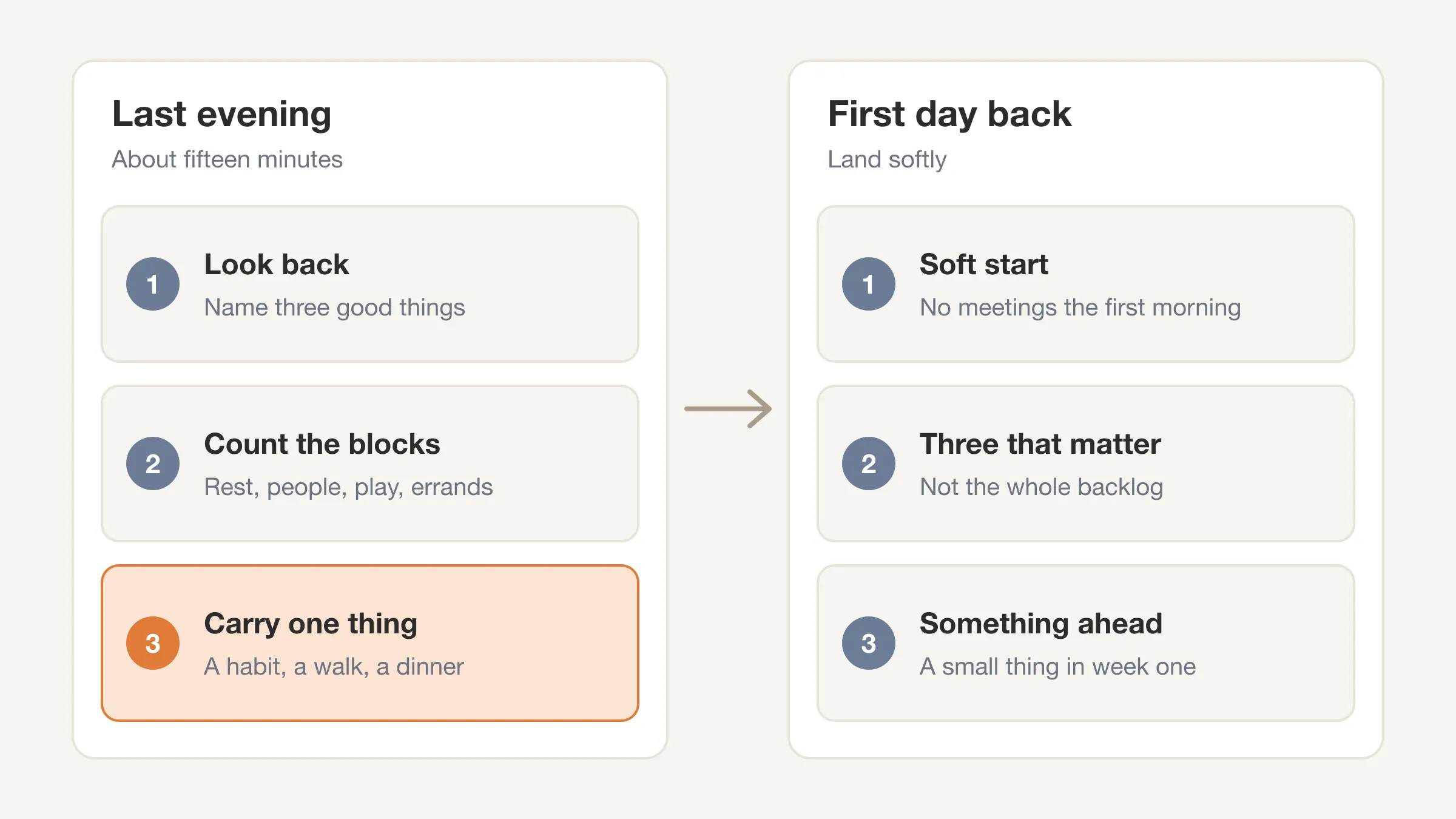
That feeling comes from two missing things: a record of the break, and a landing plan for the return. You can fix both in about fifteen minutes on the last evening.
What should you do on the last day of the break?
- Look back. Scan the days. Name three things that were good. They are what you will remember, so choose them on purpose.
- Count the blocks. If you logged, see how the break split: rest, people, play, errands. Does the split match your sentence?
- Pick one thing to carry forward. A habit, a walk, a Sunday dinner. One thing, not a list.
How do you plan the first day back?
- Schedule a soft start. If you can, keep the first morning free of meetings.
- List the three things that matter most. Not the whole backlog. The three that would make the day feel handled.
- Plan something to look forward to. A small thing in the first week, so the end of the break is not a cliff.
If you want a weekly version of that landing, a calm Sunday reset does the same job every week, and a short list of productivity tips that hold up helps the first week back stick.
If you want a quick way to close each day, an end of day routine takes about two minutes and works on a break as well as a workday.
See where today goes
Log your day in 15-minute blocks. Two minutes in the morning, two at night, and a break you can actually remember.
Try Beyond Time freeWhat if you are working through the holidays?
Many people are. Some jobs have no break, and some years do not allow one. The same idea works on a smaller scale.
- Find the pockets. A free evening, a Sunday, a morning. Name what each one is for.
- Protect one block a day. Fifteen minutes that is yours still counts. It is one of 64 waking blocks in the day.
- Keep the weeks in view. You can see how many weeks remain in the year with the free weeks left in the year counter, and plan your time off against the number you actually have.
If the year has been heavy, see how to recover from burnout. Rest that is planned small and kept is better than a long break that never comes.
How does a break fit into the end of the year?
A holiday break is not separate from the year. It is the last stretch of it. If you used the break to look back, you are halfway through your year-end review already. The last weeks of the year are a good time to pick one or two things worth finishing, and a break can hold both rest and one of those things.
It also helps to remember what is finite. 168 hours a week is the same number in December as in July. The break does not add hours. It changes what you choose to put in them.
Frequently Asked Questions
How do I enjoy time off when I feel guilty about not working?
Name the purpose of the break out loud, because guilt usually shows up when the time has no purpose. If the purpose is rest, then resting is the task, and doing it well is the work. If the guilt persists or feels heavy, it is worth talking to a doctor or another professional.
How long should a holiday break be to feel restful?
There is no single number. The 2009 de Bloom meta-analysis found a small positive effect of vacation that faded after work resumed, and it did not give a length that guarantees lasting benefit. A few fully protected days can beat a long break that is interrupted. Plan for the days you can truly protect.
How many hours of free time does a ten-day break give me?
A ten-day break holds 160 waking hours, or 640 fifteen-minute blocks, if you count a 7 am to 11 pm day. Subtract travel, hosting and errands, and the number that is truly yours is usually smaller. Do the subtraction before the break, not after.
Should I plan every day of my time off?
No. Plan one to three anchors and leave the rest open on purpose. Open time is part of what makes a break feel like a break. Give it a soft default, such as a walk or a book, so it does not default to whatever is nearest.
How can I stop checking work email on vacation?
Set a rule in advance and write it down, such as once a day for ten minutes. A rule you chose is easier to keep than a temptation you resist all day. Tell colleagues who covers what, so there is less reason to check.
How do I avoid feeling like the break went too fast?
Keep a light record of each day, even a line or a few blocks, and look back on the last evening. Days that look alike blur in memory, and a record gives each one an edge. Naming three good moments at the end also helps you remember the break.
Is it okay to spend my time off doing nothing?
Yes. Doing nothing on purpose is a valid use of a break, as long as it is a choice and not a drift. Decide how much of the break is for rest, and protect it the same way you would protect a trip.
Your time off is limited. Decide where it goes.
To enjoy time off, decide what the break is for, pick one to three anchors, protect them, and look at where the days go while you are in them. A ten-day break is 160 waking hours, and the aim is to be able to say afterward where they went. If you want to see the hours, try Beyond Time free for two weeks: your time left, your day in 15-minute blocks, and an AI reflection on the gap between what you meant and what happened.
Put this into practice
Free tools that match this article.
Weekly Schedule Template
Plan your week with a free printable weekly schedule template for goals, routines, and focus blocks.
Try Schedule TemplateTime ManagementTime Blocking Template
Map your day into focused time blocks with a free printable time blocking template.
Try Time BlockingTime ManagementWeekly Schedule Optimizer
Generate an optimized weekly schedule with AI-powered time blocking for maximum productivity.
Try Schedule OptimizerFocusFocus Session Planner
Create AI-optimized focus sessions with structured work blocks and refreshing breaks.
Try Focus PlannerKeep exploring this topic
Related Articles
How to Make the Most of the End of the Year (44 Days)
How to make the most of the end of the year: you have 44 days left on 18 November. Pick one or two things to finish, protect the holidays and see where it goes.
Quality Time: What It Means and How to Make More of It
Quality time is undivided attention shared with someone. See what counts, 25 ideas by relationship, and how to check how much quality time you really had.
Digital Minimalism: A Gentle 30-Day Declutter That Sticks
Digital minimalism means using technology only where it serves what you value. Try a gentle 30-day declutter, then measure the hours that came back. Start here.
Slow Productivity: Cal Newport's Ideas and How to Use Them
Slow productivity means doing fewer things at a natural pace with high quality. Here is Cal Newport's idea in plain words, and how to check your hours.
Quarter Life Crisis: Signs, Causes and a Way Through It
A quarter life crisis is a stretch of doubt about career, relationships and direction in your 20s or early 30s. Learn the signs, causes and a way through it.
How to Romanticize Your Life: 15 Small Ways to Start Today
How to romanticize your life without spending money: 15 small rituals, a one-week experiment, and a way to see which hours were worth savoring. Start today.