
How Many Work Weeks in a Year? 52 Minus Your Time Off
How many work weeks in a year? 52 on paper, usually 46 to 50 after holidays and leave. See the table by days off, 2026's count and the weeks left this year.
A year has 52 work weeks on paper, and most people work between 46 and 50 of them. The calendar gives you 52 weeks and one day. Holidays, vacation and sick days take away the rest. In 2026, with the 11 US federal holidays and no other time off, the count is 50 work weeks.
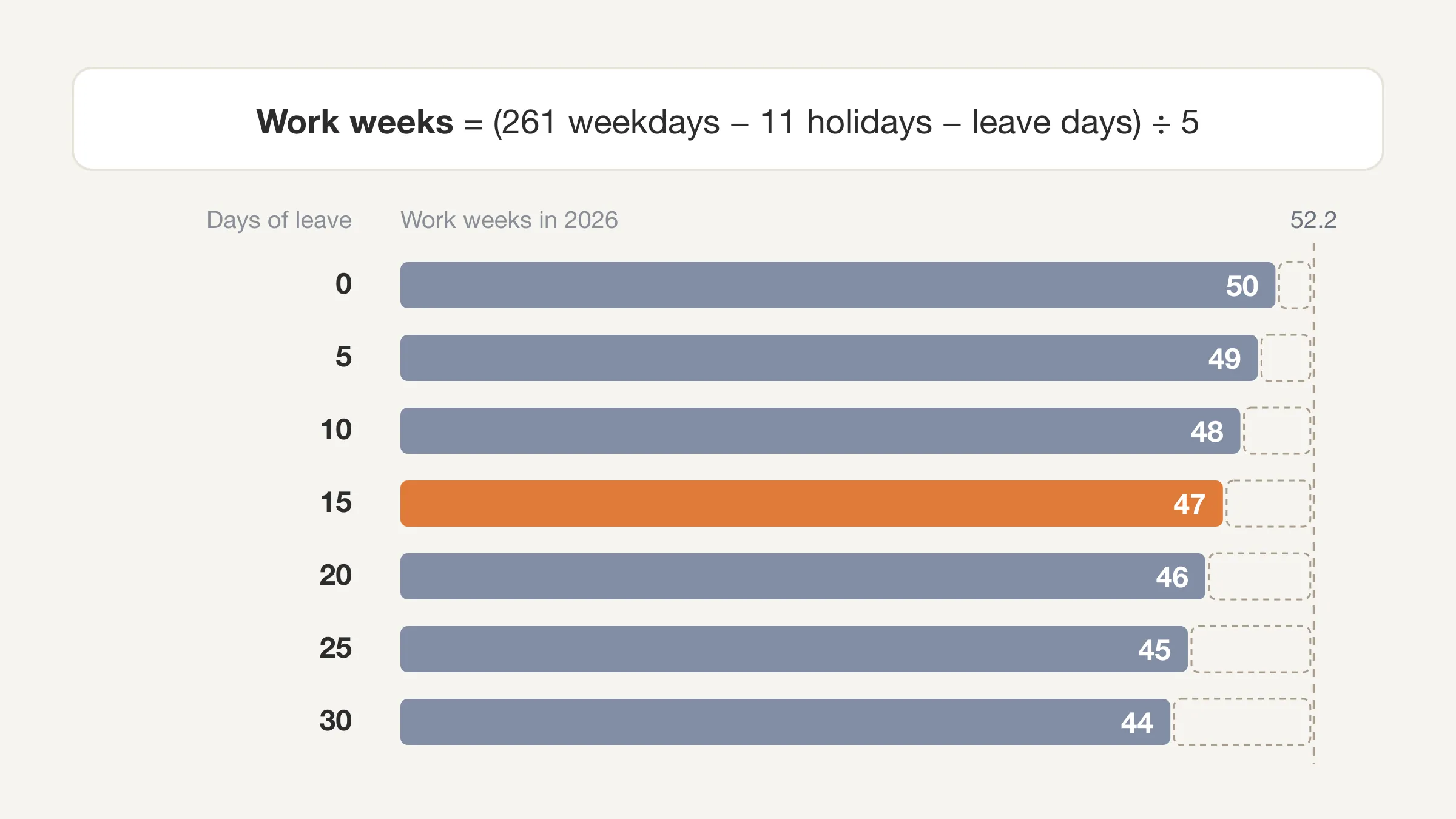
The number you should use depends on your time off. Each 5 days off is one work week gone. Someone with 15 vacation days works about 47 weeks in 2026, and someone with 25 works about 45.
This post gives you the table, the 2026 math, how many work weeks are left in the year as of 20 October, and how to think about a work week as a unit of your time rather than just a unit of pay.
Key takeaways
- A year is 52 weeks plus 1 day (2 days in a leap year). Work weeks are fewer, because holidays and leave remove days.
- In 2026 there are 261 weekdays. Take off 11 federal holidays and you have 250 workdays, or 50.0 work weeks.
- With 10, 15 or 20 vacation days on top, the count is 48, 47 or 46 work weeks.
- On 20 October 2026, 50 workdays (10.0 work weeks) are left in the year.
How many work weeks are in a year?
The standard answer is 52, and it is a calendar count. A 365-day year has exactly 52 weeks and 1 day left over. A leap year has 52 weeks and 2 days. So the exact number is about 52.14.
Work weeks are fewer than calendar weeks for one reason: you are not at work every weekday. A work week here means five workdays, so every five days off removes one.
The number also varies by how you define a "week". Some payroll calendars use 52 weeks, some use 26 two-week pay periods, and some years have 27 pay periods. ISO week numbering gives 52 or 53 week numbers a year, and 2026 has 53 of them, because the year starts on a Thursday. That count is for numbering weeks. It does not mean you work 53 weeks.
How many work weeks are in 2026?
Start with the weekdays. 2026 has 365 days and starts on a Thursday, so it has 52 weeks of five weekdays plus one extra Thursday: 261 weekdays, or 52.2 work weeks.
Then take off the days that are not work. The US Office of Personnel Management lists 11 federal holidays in 2026: New Year's Day (Jan 1), Martin Luther King Jr. Day (Jan 19), Washington's Birthday (Feb 16), Memorial Day (May 25), Juneteenth (Jun 19), Independence Day observed (Fri, Jul 3), Labor Day (Sep 7), Columbus Day (Oct 12), Veterans Day (Nov 11), Thanksgiving (Nov 26) and Christmas (Dec 25). All fall on weekdays.
261 weekdays minus 11 holidays is 250 workdays, which is 50.0 work weeks. Private employers often give fewer holidays, so your count may be higher.
See how your weeks are spent
Beyond Time splits every hour of your week into Health, Life, Work and Sleep, so each week is one picture.
Try Beyond Time freeHow many work weeks are there after vacation and sick days?
Here is the table for 2026. It assumes the 11 federal holidays are all days off and counts time off in workdays. Divide by five to get weeks.
| Vacation and other leave (days) | Workdays in 2026 | Work weeks | Work hours (8-hour days) |
|---|---|---|---|
| 0 | 250 | 50.0 | 2,000 |
| 5 | 245 | 49.0 | 1,960 |
| 10 | 240 | 48.0 | 1,920 |
| 15 | 235 | 47.0 | 1,880 |
| 20 | 230 | 46.0 | 1,840 |
| 25 | 225 | 45.0 | 1,800 |
| 30 | 220 | 44.0 | 1,760 |
Count sick days and personal days as leave. Someone with 15 vacation days and 5 sick days has 20 days of leave, and works about 46 weeks.
The rule for any year is simple: work weeks = (weekdays in the year − days off) ÷ 5. A typical year has 260 or 261 weekdays.
If you want the pay side, see how many work hours are in a year, which turns these weeks into hours and hourly wage conversions.
How much time off do workers get?
It varies a great deal, and in the United States it is not set by federal law. The Bureau of Labor Statistics' Employee Benefits release for March 2026 says 80% of private industry workers had access to paid vacation and 81% had access to paid holidays.
For the number of days, the BLS March 2024 release reports averages by employer size. At employers with 1 to 99 workers, paid vacation averaged 10 days after one year and 14 days after five. At employers with 500 or more workers, it averaged 14 days after one year and 18 after five.
That is why the realistic range is wide. A new worker at a small company may have 10 vacation days, so about 48 work weeks. A worker with five years at a large company may have 18, so about 46 to 47. These are averages for workers with the benefit. Those without paid leave may work more weeks, and may not be paid for the holidays.
How many weeks are in a quarter and a month of work?
A quarter is 13 calendar weeks. After holidays and leave you may work 11 to 12 of them, which makes it a useful planning unit. Students plan in a similar block, since a semester runs 15 or 16 weeks. A month is about 4.3 weeks (see how many weeks are in a month), and a month of work is about 4 work weeks once you take off a holiday or two.
Planning by work weeks is a practical habit. If a project needs six weeks of full-time work, and your quarter has 11 work weeks, you can see at a glance that it takes more than half of the quarter. It is easy to say "three months" without noticing that it is 12 or 13 weeks of which one or two are holiday weeks.
How many work weeks are left in 2026?
Today is 20 October 2026, a Tuesday. There are 73 days left in the year, counting today, which is 10.4 calendar weeks. The work weeks are fewer:
| From 20 October to 31 December 2026 | Count |
|---|---|
| Calendar days | 73 |
| Weekdays | 53 |
| Federal holidays on a weekday (11 Nov, 26 Nov, 25 Dec) | 3 |
| Workdays left | 50 |
| Work weeks left | 10.0 |
That is 10 work weeks, which is 400 hours at 8-hour days. If you plan to take vacation before the year ends, subtract it. One week of vacation before the year ends leaves you about 9 work weeks.
Ten weeks is not much. It is also a clear number you can plan with. If you have three things you want to finish this year, you can put each one against its share of the ten.
How many work weeks are in a career?
This is the bigger number, and it is the one people rarely write down. As an example, take a working life from age 22 to 67. That is 45 years.
| Assumption | Calculation | Weeks |
|---|---|---|
| Calendar weeks, age 22 to 67 | 45 × 52 | 2,340 |
| Work weeks at 48 a year | 45 × 48 | 2,160 |
| Work hours at 40 a week | 2,160 × 40 | 86,400 |
This is an illustration, not a forecast. Your career may start later, end earlier or have gaps. But it gives you a scale. About 2,160 work weeks is a lifetime of working, and about half the weeks of an 80-year life. If a number that size lands hard in your twenties, the quarter-life crisis guide covers that feeling and a way through it.
Oliver Burkeman's book Four Thousand Weeks starts from the idea that a long life is only about 4,000 weeks. We summarize it in four thousand weeks lessons. The practical point here is that a work week is one of your limited weeks, and it is worth knowing where its hours go.
What does a work week leave you?
A standard work week is 40 hours. In the 168 hours of a week, that is 23.8%, and 35.7% of the 112 hours you are awake at 8 hours of sleep. How many hours are in a work week has the table.
A work week takes more than 40 hours of your life when you add the commute and getting ready. What is left is often around 34 hours of free time, and that is where the rest of your life happens: exercise, family, friends and the goals you care about. See how to find more time in your 168 hours if that number is smaller than you expected.
To see yours, log one work week:
- Use 15-minute blocks. A day is 96 of them.
- Mark each block as Work, Health, Life or Sleep.
- Fill it in twice a day. Two minutes in the morning for yesterday's gaps, and two at night.
- Add it up. The week view in Beyond Time splits every hour by category and shows how much of the week you logged.
Beyond Time asks you to start your day by scoring your sleep and picking one to three goals, log time through the day, and end the day by rating how health, life and work felt from 1 to 10. The AI reflection tells you what went where you meant it to, where time leaked and one or two changes for tomorrow. For a paper start, the daily time log template works, and time tracking for beginners covers how to keep it going.
Frequently Asked Questions
How many work weeks are in a year?
There are 52 weeks in a year, but most people work between 46 and 50 of them after holidays and leave. In 2026, with 11 federal holidays and no other time off, it is 50 work weeks.
How many work weeks are in a year with 2 weeks of vacation?
About 48. With 11 federal holidays and 10 vacation days in 2026, there are 240 workdays, which is 48 work weeks.
How many work weeks are in a year with 4 weeks of vacation?
About 46. Twenty vacation days plus 11 holidays leaves 230 workdays in 2026, which is 46 work weeks.
How many weeks are in a year?
A year has 52 weeks and 1 day, or 52 weeks and 2 days in a leap year. ISO week numbering gives either 52 or 53 week numbers, and 2026 has 53.
How many working days are in a year?
There are 260 or 261 weekdays in a year, depending on the year. 2026 has 261. After 11 federal holidays it has 250 working days.
How many work weeks are left in 2026?
On 20 October 2026 there are 50 workdays left, or 10 work weeks, after the three weekday federal holidays still to come. Subtract any vacation you plan to take.
How many work weeks are in a quarter?
A quarter has 13 calendar weeks, and about 11 to 12 work weeks once holidays and leave are removed. The exact number depends on the quarter and your time off.
So, how many work weeks are in a year?
The answer to how many work weeks in a year is 52 on paper and about 46 to 50 in practice. In 2026 it is 50 weeks with only the federal holidays, and fewer with vacation. With 10 weeks of work left this year, the useful question is where they go.
Your time is limited, so see where it goes. Log one week in 15-minute blocks and see how much of it work really takes. Start with Beyond Time, or read how many work hours are in a year for the hours behind the weeks.
Sources: OPM, 2026 federal holidays. BLS, Employee Benefits in the United States, March 2026 and March 2024. Weekday and week counts for 2026 are computed from the calendar. The career figures are an illustration.
Put this into practice
Free tools that match this article.
Weekly Schedule Template
Plan your week with a free printable weekly schedule template for goals, routines, and focus blocks.
Try Schedule TemplateTime ManagementTime Blocking Template
Map your day into focused time blocks with a free printable time blocking template.
Try Time BlockingTime ManagementWeekly Schedule Optimizer
Generate an optimized weekly schedule with AI-powered time blocking for maximum productivity.
Try Schedule OptimizerFocusFocus Session Planner
Create AI-optimized focus sessions with structured work blocks and refreshing breaks.
Try Focus PlannerKeep exploring this topic
Related Articles

How Many Minutes in a Week? 10,080, and Where They Go
How many minutes in a week? 10,080, or 6,720 waking minutes at 8 hours of sleep. See the minutes in each activity for an average week and how many are left.

Bucket List Ideas: 100 Ideas Grouped by Theme and Lead Time
100 bucket list ideas grouped by theme and tagged by lead time: now, this year, or years ahead. Count the weeks you have, then pick ten. Start your list today.

How to Stop Doomscrolling: 9 Practical Fixes That Work
How to stop doomscrolling: add friction, swap in better habits and check your Screen Time against a real log of your day. Nine fixes, with sources. Try one.

Life Plan Template: A One-Page Plan With Weekly Costs
A free life plan template you can copy: eight areas of life, one outcome each, and a weekly time cost so your plan fits the 112 waking hours you really have.

Second Brain Method Explained: CODE, PARA and Who It Suits
A second brain is a trusted place outside your head for notes and ideas. See how Tiago Forte's CODE and PARA work, who it suits, and what notes can't tell you.

How to Journal: Start in 5 Minutes With Any Format
Learn how to journal in five minutes a day: pick a format, a time and a first line. Includes seven formats, starter prompts and ways to make the habit stick.