How Many Weeks in a Semester? 15, 16 and What Counts
How many weeks in a semester? Most run 15 or 16 weeks of classes, plus finals. See the math for quarters, credit hours and the hours a term really gives you.
A semester is usually 15 or 16 weeks long, and most schools add an exam week on top. That is the typical answer, not a rule. Every school publishes its own academic calendar, so the number that matters for you is on your registrar's page.
The number is smaller than it feels. Take away the first week while schedules settle, a break or two and finals, and you have roughly 13 to 15 weeks in which the actual teaching and studying happen. That is your whole semester budget. This guide gives you the standard lengths, the credit-hour math behind them, and a way to see how many hours a semester really holds.
Key takeaways
- Semester: typically 15 to 16 weeks of classes, plus a finals period. Check your school's calendar for the exact dates.
- Quarter: the federal credit-hour rule describes a quarter as 10 to 12 weeks. Trimesters split the year into three terms.
- The standard rule of thumb: each credit hour is about 1 hour in class and at least 2 hours of work outside it, every week.
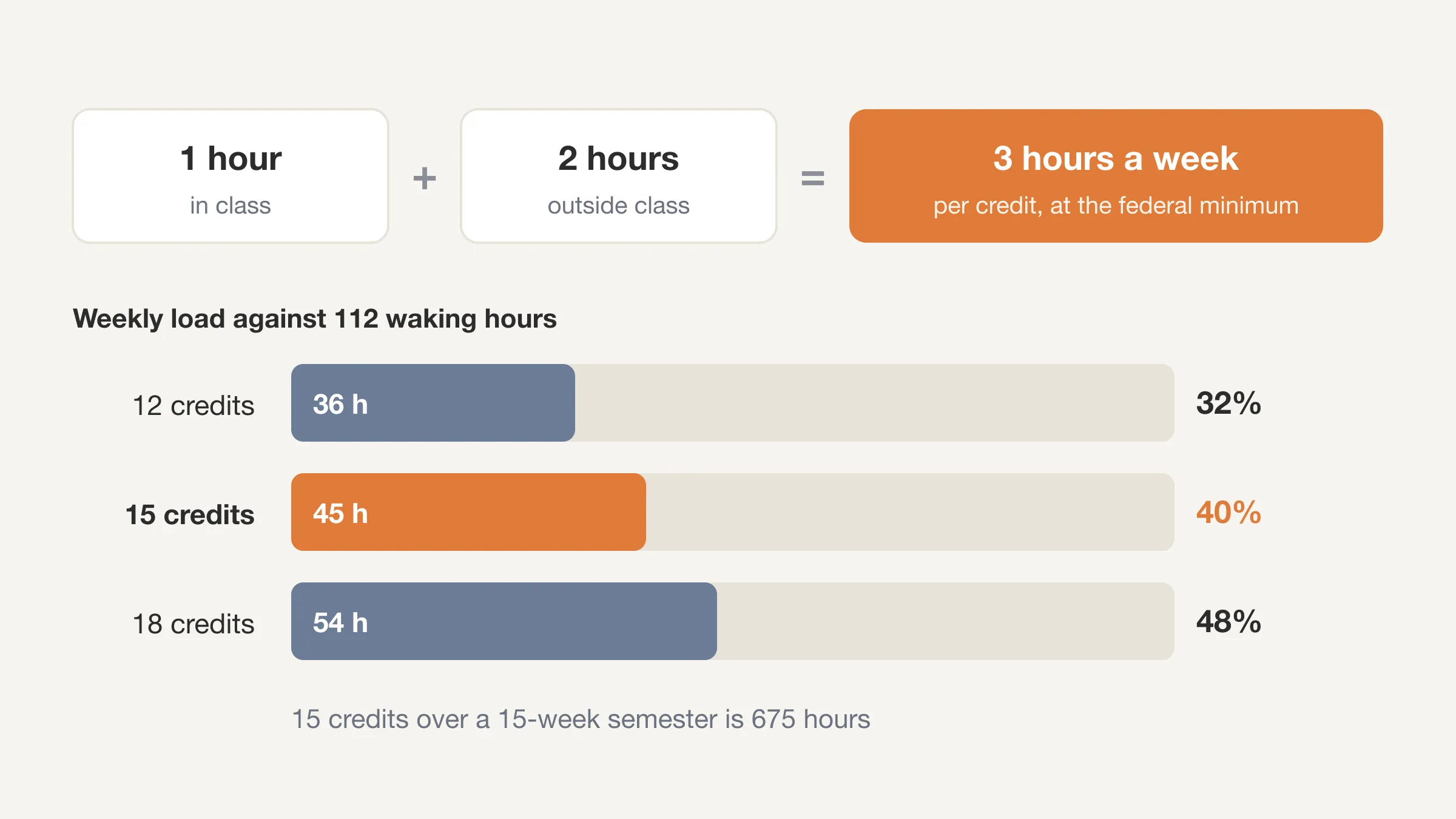
- 15 credits is about 45 hours a week. That is 40 percent of the 112 hours you are awake in a week.
How many weeks are in a semester?
Most U.S. colleges run two semesters a year, fall and spring, and each one is around 15 to 16 weeks of instruction. The federal definition of a credit hour uses "approximately fifteen weeks" as the length of a semester, which is why 15 shows up so often.
Real calendars add and subtract around that figure:
- Exam week. Many schools put finals in a separate week after the last class, so the full term can span 16 or 17 calendar weeks.
- Breaks. A fall break, a Thanksgiving break or a spring break removes a week of class from the middle without shortening the calendar.
- Late starts. Some courses start in week 2 or end before finals.
So "how many weeks in a semester" has two honest answers. The calendar answer is about 15 to 17 weeks from the first day to the last exam. The working answer is the number of weeks you will actually be learning and producing, which is often 13 to 15.
What does a sample semester look like?
Here is an example, not any particular school's calendar. Say a fall term starts on Monday 24 August 2026 and runs 15 weeks of classes, with finals the week after.
| Part of the term | Weeks | Dates in this example |
|---|---|---|
| Classes | 15 | 24 Aug to 4 Dec 2026 |
| Finals | 1 | 7 to 11 Dec 2026 |
| Calendar total | 16 | 24 Aug to 11 Dec 2026 |
If that example school also took one week off in the middle, you would have 14 teaching weeks. The difference between 16 on the calendar and 14 in the classroom is two weeks of a very full term.
How long is a quarter, trimester or summer term?
Terms differ by system. The federal credit-hour rule is a neutral reference, but schools set their own calendars.
| Term system | Terms per year | Typical length | Notes |
|---|---|---|---|
| Semester | 2 (fall, spring) | About 15 to 16 weeks | Plus finals; summer is often optional |
| Quarter | 3 (plus summer) | 10 to 12 weeks in the federal definition | Many schools run about 10 weeks plus finals |
| Trimester | 3 | Usually shorter than a semester | Three terms across the academic year; the federal rule counts a trimester hour like a semester hour (about 15 weeks) |
| Summer session | Varies | Usually shorter than a semester | Often the same credit in fewer weeks |
The summer row is the one to plan around. A course that earns the same credit in 6 weeks instead of 15 needs more than double the weekly hours. The work does not shrink, the calendar does. If you are using the summer for something other than classes, summer break goal setting covers how to plan it.
A common conversion is that one semester credit equals 1.5 quarter credits. Schools set their own conversions, so confirm it before you transfer credits.
See where your study hours really go
Log the day in 15-minute blocks. Two minutes in the morning, two at night. After a week, you can see classes, study, work and sleep as they actually happened.
Try Beyond Time freeWhat is a credit hour, in hours per week?
A credit hour is the unit that turns "weeks in a semester" into hours. The U.S. Department of Education's definition (34 CFR 600.2) says a credit hour reasonably approximates at least one hour of classroom or direct faculty instruction and a minimum of two hours of out-of-class student work each week, for approximately fifteen weeks for one semester or trimester hour, or ten to twelve weeks for one quarter hour.
That is a floor. Institutions can ask for more, and some courses (labs, writing-heavy seminars, languages) routinely do. But it gives you a defensible baseline:
1 credit = 3 hours a week = 45 hours over a 15-week semester.
A 3-credit course is therefore about 9 hours a week, or 135 hours over the term. In 15-minute blocks, that is 36 blocks a week and 540 blocks per course.
How many hours does a semester take?
Multiply credits by 3 to get the weekly minimum, then by the weeks in the term.
| Credits | Hours a week (1 in class + 2 outside, per credit) | Hours in a 15-week semester | Share of 112 waking hours |
|---|---|---|---|
| 12 | 36 | 540 | 32% |
| 15 | 45 | 675 | 40% |
| 18 | 54 | 810 | 48% |
The waking-hours column assumes about 8 hours of sleep a night, which leaves 112 waking hours a week. If you want to see how that number is built, how many hours are in a week walks through it.
A full-time load of 15 credits is a 45-hour week before you add a job, a commute, meals, laundry, friends or exercise. Add a 12-hour part-time job and you are at 57 hours of obligations against 112 waking hours, which leaves 55. Those 55 hours must cover everything else, including rest.
That is not a reason to panic. It is a reason to count once, early, so the semester stops feeling bigger than it is.
How many hours are in a whole semester?
Time left is easier to feel at the scale of a term. A 15-week semester holds:
- 2,520 hours in total (15 weeks × 168).
- 1,680 waking hours (15 weeks × 112).
- 6,720 fifteen-minute blocks while you are awake (15 weeks × 448).
Of those 6,720 blocks, a 15-credit load claims 2,700 at the minimum (675 hours × 4). That leaves about 4,020 for everything else.
The point is not to optimize every block. It is to know the size of the container before you fill it. Most students plan a semester by courses and assignments, which never add up to a number of hours. Counting weeks and hours first means the plan has to fit something real.
Why does a semester feel shorter than it is?
Because the first four weeks feel like setup, and the last four feel like panic. The middle is where the work either happens or does not.
Three patterns show up in most terms:
- The slow start. Week 1 and 2 have light assignments, so the term feels long. By the time work ramps up, a fifth of the semester is gone.
- The midterm cluster. Exams and papers often land in the same 2 or 3 weeks, so the hours you planned to spread out arrive at once.
- The finals squeeze. Everything due in the last week was assigned weeks earlier.
Knowing the week count lets you work backwards. If a paper is due in week 12 and you have 14 teaching weeks, you have 12 weeks to place one piece of it each. A paper that needs 24 hours is two hours a week, not a weekend of dread.
For a longer version of this planning, semester goals to daily tasks breaks a term into weekly and daily steps. If the last term went badly, a reset framework for a bad semester helps you start this one cleanly.
How do you plan a semester in weeks?
Planning in weeks sits between a vague semester and an overloaded to-do list. Here is a five-step version that takes about 30 minutes.
- Count your real weeks. Take the first day of class and the last exam from your school's calendar. Subtract breaks. Write the number at the top of a page.
- List the fixed weekly hours. Classes, labs, work shifts, commute. Multiply by the weeks to see the total.
- Add the credit-hour minimum. For each course, add 2 hours a week of out-of-class work as a starting point. Adjust after the first graded assignment.
- Mark the heavy weeks. Midterms, project deadlines and finals. Plan lighter study in the weeks around them.
- Leave slack. Keep a few hours each week unassigned. Illness, travel and slow days will use them.
If you want a structure for the study half, the study plan generator builds a weekly schedule from your subjects, and the weekly schedule template gives you a blank grid. For the science of what to do inside those hours, spaced repetition and active recall is worth reading.
Why log the semester, not only plan it?
A plan says where the hours should go. A log says where they went. The gap is the useful number.
Take a typical weekday as an example. A student plans 3 hours of study after class. The log shows a 40-minute break that ran to 90, a lunch that became a long conversation, and 75 minutes of study. Nothing is wrong with any of those blocks. But the plan said 3 hours, and the day delivered 75 minutes.
Over a 15-week semester, a 90-minute daily shortfall on 5 days a week is about 112 hours. That is the cost of an unseen gap, and it only shows up if you write the day down. Closing it is often the first step in raising your GPA.
The cheapest version is a 15-minute time block log: after each stretch, note what you did. After one week you can compare the plan to the log. For a fuller walk-through, how to do a time audit covers a week-long version.
Plan the term, then see how it went
Beyond Time shows the week as 15-minute blocks. Start your day with one to three goals, log what happened, and end the day with a quick rating.
Try Beyond Time freeWhat if your semester is shorter or longer?
Adjust the same math with your weeks.
- A 10-week quarter: 1 credit is still about 3 hours a week under the federal rule, so a 4-credit course is roughly 12 hours a week for 10 weeks. That is 120 hours, close to a semester course's total in fewer weeks.
- A 6-week summer course: a 3-credit course that would be 9 hours a week over 15 weeks needs about 22 hours a week to hold the same total (135 hours over 6 weeks). Compressed courses are not lighter. They are denser.
- A 4-week intensive: the same 135 hours is about 34 hours a week, which is a job on its own.
The takeaway is the same in each case: total hours are fixed by the course; weeks only change how hard they press. When you count weeks first, you know whether the term has room for the work.
Frequently Asked Questions
How many weeks are in a semester?
Most semesters are about 15 to 16 weeks of classes, with an exam week on top. The federal credit-hour definition uses approximately fifteen weeks as its basis. Your school's academic calendar gives the exact dates.
How many weeks are in a quarter?
The federal credit-hour definition uses ten to twelve weeks for a quarter hour of credit. Many quarter-system schools run about 10 weeks of classes plus finals. Check your registrar for your own term.
How many weeks are in a trimester?
A trimester system splits the academic year into three terms, so each term is shorter than a typical semester. The exact length varies by school, so use your school's calendar instead of a general figure.
How many hours should I study per credit hour?
A common guideline, built into the federal definition of a credit hour, is at least two hours of work outside class for every hour in class each week. A 3-credit course is therefore about 9 hours a week in total. Some courses need more.
How many weeks of a semester are actually teaching weeks?
Often 13 to 15. Subtract the first week while schedules settle, any breaks, and a finals period. The exact figure depends on your calendar.
How many weeks are in a school year?
A two-semester year is about 30 to 32 weeks of classes, plus exams and breaks. Many schools also offer a shorter summer session on top.
How many hours are in a 15-week semester?
A 15-week semester holds 2,520 hours in total and about 1,680 waking hours if you sleep 8 hours a night. In 15-minute blocks, that is 6,720 waking blocks.
So how many weeks in a semester?
Plan on 15 to 16 weeks of classes plus finals, and treat 13 to 15 as the number you can actually work with. Then do the multiplication for your own load. For a 15-credit semester, that is 45 hours a week at the federal minimum.
Your time is limited. A semester is a small, countable stretch of it. Count the weeks, see where the hours go for one week, and you can plan the rest from facts instead of hope. If you want to see your time as numbers every day, Beyond Time shows the day in 15-minute blocks and reflects on where it went.
Sources
- U.S. Department of Education, definition of "credit hour," 34 CFR 600.2: law.cornell.edu/cfr/text/34/600.2
Put this into practice
Free tools that match this article.
AI Study Plan Generator
Generate a personalized study plan with proven learning techniques for exam success.
Try Study PlannerTime ManagementWeekly Schedule Template
Plan your week with a free printable weekly schedule template for goals, routines, and focus blocks.
Try Schedule TemplateFocusFocus Session Planner
Create AI-optimized focus sessions with structured work blocks and refreshing breaks.
Try Focus PlannerGoal SettingGoal Setting Worksheet
Turn a vague goal into milestones, habits, blockers, and a weekly review plan.
Try Goal WorksheetKeep exploring this topic
Beyond Time for students
See how students connect semester goals, study blocks, and routines.
Student success guide
Use Beyond Time to plan study sessions, habits, and academic goals.
Guide articles
Explore more guide articles from the Beyond Time blog.
weeks in a semester
Read more articles tagged weeks in a semester.
Related Articles

How Many Minutes in a Week? 10,080, and Where They Go
How many minutes in a week? 10,080, or 6,720 waking minutes at 8 hours of sleep. See the minutes in each activity for an average week and how many are left.

Bucket List Ideas: 100 Ideas Grouped by Theme and Lead Time
100 bucket list ideas grouped by theme and tagged by lead time: now, this year, or years ahead. Count the weeks you have, then pick ten. Start your list today.

How to Stop Doomscrolling: 9 Practical Fixes That Work
How to stop doomscrolling: add friction, swap in better habits and check your Screen Time against a real log of your day. Nine fixes, with sources. Try one.

Life Plan Template: A One-Page Plan With Weekly Costs
A free life plan template you can copy: eight areas of life, one outcome each, and a weekly time cost so your plan fits the 112 waking hours you really have.

How Many Work Weeks in a Year? 52 Minus Your Time Off
How many work weeks in a year? 52 on paper, usually 46 to 50 after holidays and leave. See the table by days off, 2026's count and the weeks left this year.

Second Brain Method Explained: CODE, PARA and Who It Suits
A second brain is a trusted place outside your head for notes and ideas. See how Tiago Forte's CODE and PARA work, who it suits, and what notes can't tell you.